Quorum sensing

I’m sure someone somewhere made an argument for group selection based upon bacteria working together like this. That model has always clearly been wrong, but now we have yet another reason why.

Butchering science

This is just a mess.

I have written in the past about Jack Hudson’s tendency to butcher science. There are a lot of examples of him doing this, but one of the most egregious was when he concluded that because fruit fly populations under laboratory conditions come to allelic fixation at a different rate and/or way than asexual populations, that must mean there is some flaw in evolutionary theory. (In re-reading his post, I’m also seeing that he concluded something else equally egregious: He said that mutations which affect mRNA structure as opposed to protein sequence is evidence that random mutations cannot lead to new traits.) In short, it is highly evident that Jack read a popularized article about a recent study, glommed a few lines from the original research, and then went about drawing inept conclusions.

And now he’s back at it.

Let me give an actual summary of this most recent study first:

Stickleback fish are found all around the world. They exist in a number of streams, rivers, lakes, and oceans due to their great ability to adapt quite quickly to their environment. This opens up a great opportunity to take a look at their genes to see just what regions are evolving.

Now, what often happens in these sort of studies is that researchers will choose selected areas or candidate genes and compare them. It’s a tried and true method, but it probably isn’t the whole picture. While researchers can grow various species (usually of bacteria), objectively know how they’ve diverged and evolved under laboratory conditions, and then compare what they know to phenotypic changes brought on by alterations in protein-coding genes, there has been a push for a long time to sequence more and more full genomes. One result has been information overload (even when the full genome of something has not been sequenced; the technology that allows full genome sequencing also inherently allows easier partial sequencing), but that’s not a bad problem to have. So for this study, the biologists sequenced 21 three-spined stickleback genomes. Their goal was to determine the underlying molecular basis for adaptive evolution in the fish: Do they evolve by way of regulatory or coding changes?

What the team found was that 147 regions vary in freshwater versus marine stickleback populations. Of these 147 regions, 17% were linked to coding genes, 41% to regulatory regions, and 42% could not be classified cleanly (though, as the neat little graph under “Proportion of regulatory and coding change” in the paper says, they are probably regulatory).

So the big conclusion is this. Stickleback evolution is dominated by regulatory changes – changes involving areas which control genes. (Coding changes are still important, but this study indicates a possible shift in focus as it becomes cheaper and easier to sequence whole genomes.) The regions prevalent in stickleback evolution are relatively few; we keep seeing the same areas get tweaked over and over, leading to independent (and often convergent) solutions for the same sort of environments.

Now let’s look at Jack’s butchery:

But these findings are actually quite contrary to the sort of evolution often advocated by Darwinian evolutionists. Instead of incidental mutations coding sequences leading to the production of new proteins (and conceivably, novel structures and systems) the researchers found that the changes were primarily to the same sets of regulatory sequences in separate populations of sticklebacks…

While the researchers continue to use the term ‘evolutionary change’, the reality is this is nothing like the sort of change described by the modern evolutionary synthesis, a theory which relies on natural selection acting on genetic mutation.

To summarize this inanity: Jack is saying that evolution predicts that changes in species should occur almost exclusively by way of natural selection working on random mutation. He’s wrong. What evolution says is that change will occur by a number of mechanisms – random drift, hitchhiking via linkage, bottlenecking, horizontal gene transfer, and others. Random mutations culled by non-random selection will result in changes, certainly. And that’s what we see quite frequently in the laboratory and nearly 1/5 of the time in this stickleback study. However, the presence of other mechanisms is not somehow counter to evolutionary theory. Indeed, I think embryologists would be rather upset to learn that their field undermines evolution since the regulation of development – not necessarily or even usually by coding regions – has a huge impact on the way species change over time.

Yet I haven’t even gotten to the kicker:

The very fact that the researcher describes these as “key genes that control evolutionary change” contradicts the ordinary notion of evolution itself, which is purportedly an unguided process.

This reminds me Mary Midgley’s complete misunderstanding of Richard Dawkins’ The Selfish Gene. Midgley complained, chiefly, that Dawkins’ use of “selfish” was wrong because genes don’t have emotions. It was risible and I don’t know as Dawkins should have bothered responding. Naturally, I have to wonder if I should bother with the likes of Jack Hudson.

The language being employed by the scientists behind the stickleback study does not indicate that there is any guiding mechanism to evolution. They obviously are not claiming that regulatory genes direct evolution in a predetermined way. All they are saying is that these genes are a major factor in evolutionary change. It would be as if I said that my gene for lactase controls my tolerance for lactose (dairy products, more or less). That does not mean there is a little man sitting on a section of my DNA, tinkering away because he desires that I ingest milk.

Sorry to keep this going, but there are a lot of kickers in this one:

If natural selection acting on incidental mutations were actually capable of producing the radically different body plans, structures and systems we find throughout the plant and animal kingdoms, then we wouldn’t expect to see the consistent similarity of genetic modifications that we do with regard to the various populations of sticklebacks.

It would be generous to say this is a strain on logic. It absolutely does not follow that the predominance of regulatory genes excludes the importance of random mutation. Moreover, this study is not looking at millions of years, so extrapolation out that far should be constrained.

The changes wouldn’t be a matter of merely regulating extant genes, but the origination of new genetic capabilities.

Jack is, in essence, claiming that regulatory changes do not count as evolution. Unfortunately for him, we have thousands of different species of sticklebacks that attest to significant change over time – and now we know they’ve been doing it with a lot of help from their regulatory genes. So even if there was something to Jack’s claim on its own, it wholly crumbles when we hold it up to all the different stickleback populations around the globe.

Genetic sequencing continues to demonstrate that there are limits to biological variation.

This is in reference to specific creationist-proposed limitations, something not supported by an iota of this study. That is, this claim boils down to Jack saying that because sticklebacks evolve in a large number of ways by virtue of relatively few regulatory regions, species are constrained to microevolutionary changes. Again, this is a logic fail. The presence of changes by way of natural selection operating on regulatory genes does not exclude changes by way of natural selection operating on random mutation. Anyone who bothered to honestly look at this study would know that. (17% and perhaps more of the regions map to actual genes, for Christ’s sake.)

As I’ve said a few times before, what takes a creationist 30 seconds to say takes an educated person hours to untangle. And just as with my last post about butchered science, this didn’t take quite that long, but the sentiment remains true.

This is why no one respects the South

You’d think Tennessee, of all places, would know better:

Tennessee, where the nation’s first big legal battle over evolution was fought nearly 90 years ago, is close to enacting a law that critics deride as the “monkey bill” for once again attacking the scientific theory.

The measure passed by the Tennessee General Assembly would protect teachers who allow students to criticize evolution and other scientific theories, such as global warming. Republican Gov. Bill Haslam said this week he would likely sign it into law.

Interestingly, the governor is claiming that the law will basically do absolutely nothing while changing approximately zilch. The truth is different:

The bill says it would encourage critical thinking by protecting teachers from discipline if they help students critique “scientific weaknesses.”

In other words, teachers won’t be punished for telling students lies.

I think a great test of this horseshit bill would be for a teacher to go into a dead-pan routine where he questions the validity of the theory of gravity. Talk about its weaknesses, cast doubt on its validity, and maybe even propose some alternatives. Of course, those “alternatives” would need to be couched in science-y language, but I’m sure there are plenty of creationist groups out there willing to lend their expertise to those who wish to abuse science.

One fact to refute creationism

Sometimes I pity the religious for not having a person as intelligent as Richard Dawkins on their side:

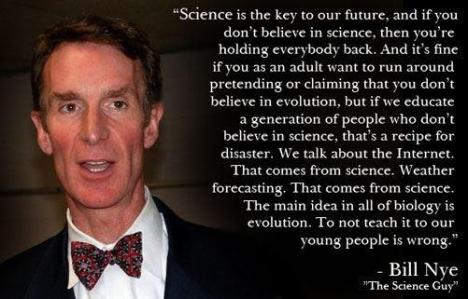
Bill Nye knows what’s going on

Happy Darwin Day

Today marks the 203rd anniversary of one of the most important scientists to have ever lived. I pity those who can’t recognize his greatness.

Anti-evolution legislation in New Hampshire

New Hampshire has been disappointing as of late. Here and there I’ve been hearing rumblings of Republicans gearing up to destroy the lives of Granite State gays. Then they put money in the pockets of naturopaths at the expense of the health of their citizens. And now a number of schmucks are getting ready to put forth some anti-science bills:

House Bill 1148, introduced by Jerry Bergevin (R-District 17), would charge the state board of education to “[r]equire evolution to be taught in the public schools of this state as a theory, including the theorists’ political and ideological viewpoints and their position on the concept of atheism.” House Bill 1457, introduced by Gary Hopper (R-District 7) and John Burt (R-District 7), would charge the state board of education to “[r]equire science teachers to instruct pupils that proper scientific inquire [sic] results from not committing to any one theory or hypothesis, no matter how firmly it appears to be established, and that scientific and technological innovations based on new evidence can challenge accepted scientific theories or modes.”

Bergevin pulls out what has got to be the most basic creationist canard by implying that a theory is somehow not scientifically sound or established. He’s wrong. See Theory of Gravity for further reference. But as if blatant ignorance wasn’t enough, he then goes and commits a logical fallacy by demanding, in poorly veiled code, that teachers make ad hominem attacks on scientists. It would be risible if it wasn’t so pitiable and contemptible and insensible all at the same time.

Hopper and Burt don’t fair much better. They use the broad concept that accepted science changes with the evidence, but they do so in an obviously sneaky, if superficially acceptable, way. Fortunately they slipped up and showed their hand early:

Although HB 1457 as drafted is silent about “intelligent design,” Hopper’s initial request was to have a bill drafted that would require “instruction in intelligent design in the public schools.”

Surprise, surprise. I guess they must have read Kitzmiller v. Dover after their first draft.

I remember Maine had a very brief flair up a few years ago when some administrator out in East Bumfuck made similar suggestions concerning the teaching of evolution. He quickly learned the value of shutting up in the face of overwhelming evidence he just didn’t understand, but it was still disappointing that the moment wasn’t captured more fruitfully by journalists; no one in the media took the time to pen a short article on why evolution is true and why the administrator was wrong. It wouldn’t have needed to be some in-depth piece, but just something that explained some of the basics (starting with what a theory is since that was at the heart of the issue here). Hell, I’m sure any paper could have gotten an actual biologist to write something for them in under an hour.

I just hope New Hampshire does at least a little bit better than Maine did.

A hugely pathetic understanding of evolution

One of the creationists favorite pieces of bullshit rhetoric is to say to anyone who accepts the facts of evolution, “You are beholden to your evolutionary past! Why would you do anything good if the point of life is to merely survive? Checkmate, atheists.” It’s an awful line that just won’t go away, but I figure if I make a post like this, at least I will have an easy stock response on hand. So here’s why it’s so awful.

First, it is a conflation of descriptive and normative claims. (I am thoroughly convinced most Christians do not understand the difference.) Evolution deals with the facts of biology as discovered via the powerful methodology of science. It’s a description of observation; it does not have a say on how one ought to act. Morality, on the other hand, is nothing but normative claims. It is the way in which we say what is right and wrong. It is the precise opposite of descriptive claims like those made by science.

Second, it reflects a fundamental misunderstanding of evolution. Simply because the history of all life is marked with ruthless struggle does not mean that we must display such ruthlessness at all times. Or any times. In fact, I think we would want to do just the opposite at most times. But none of that is really pertinent. The facts of our evolution do not mean we must act in this way or that way. It would be like saying all Americans must love the French now and forever because we got so buddy-buddy with them during the Revolutionary War. Could you imagine how upset FOX Noise would be if that were true?

This line of argumentation from creationists is really just an excuse to disengage. Rather than openly debate the merits of this or that moral position, they just appeal to a red herring of an argument. And it isn’t merely creationists. The same tactic is often used by theistic evolutionists. It does a disservice to logical, philosophical debate, but perhaps worse, it undercuts the science at the heart of it all. Ultimately, it is a misunderstanding of the issues: Evolution is a descriptive fact; morality is normative. No matter what moral conclusions one draws, evolution still remains true. Even if one draws conclusions about morality (i.e., not moral positions, but ideas concerning the concept of morality) which conflict with the descriptive fact of evolution, Mr. Darwin’s great idea, with all its modern day modifications, still remains true. And should someone think that evolution leads to particular consequences such as ruthlessness and mayhem (which, incidentally, is an invalid reason to reject acceptance of evolution), even that is immaterial. In addition to those people being wrong on the facts, evolution, once again, still remains true.

So, no, logically inept creationists and friends, you haven’t added anything of value here. As usual. Evolution is descriptive and so has no say on morality. Moreover, even if it did dictate how we ought to live, we would not therefore be beholden to our past anyway. Even if you were right, you’re still wrong. Or as I really need to say more often, you’re wrong in your wrongness.

Too many journalists do not understand evolution

The primary reason so many Americans reject the theory and fact of evolution is religion. I think that’s pretty undisputed. However, there is a lot of incorrect information out there promulgated by journalists who get in way over their heads, and that is also a contributing factor. For the most recent example, let’s turn to the obituary of Lynn Margulis:

The [endosymbiotic] hypothesis was a direct challenge to the prevailing neo-Darwinist belief that the primary evolutionary mechanism was random mutation.

Rather, Dr. Margulis argued that a more important mechanism was symbiosis; that is, evolution is a function of organisms that are mutually beneficial growing together to become one and reproducing. The theory undermined significant precepts of the study of evolution, underscoring the idea that evolution began at the level of micro-organisms long before it would be visible at the level of species.

This is just awful. Just awful.

Margulis’ theory showed that some organelles – primarily mitochondria and chloroplasts – were once bacteria before being taken up into eukaryotic cells. This did not overturn any major precepts, nor did it shake the biological world. It was a big idea, one that turned out to be correct, and it marked a major turning point in our understanding. But that turning point was more complementary than it was subtracting. That is, it added a good deal of knowledge, it explained some mysteries, and it opened up a lot of avenues of research (as correct ideas often do) while fitting into the broad model of evolution, but it did not diminish the importance of random mutation, natural selection, genetic drift, or any other aspect of the theory.

Moreover, Margulis’ theory did not show that “evolution is a function of organisms that are mutually beneficial growing together to become one and reproducing”. It showed that sometimes endosymbiosis happens. And when it does, it sometimes has huge contingent importance. For instance, without the mitochondria in our cells, the history of life on Earth is not even remotely the same. But there are other hugely important events which, while ultimately reliant upon historic events like moments of endosymbiosis, can be explained without the need to appeal to Margulis’ theory. For example, the rise of mammals. Of course we are eukaryotes and so we depend upon the endosymbiosis event that happened billions of years ago, but that would be like appealing to the formation of Earth to describe the construction of a skyscraper. It just isn’t necessary and, besides, planetary accretion doesn’t happen every time a worker pours some concrete.

Stuff like this is why I say science is so undermined by so many science journalists.