Attack of the DNA robots

Whereas bombing raids in the early and mid part of the 20th century involved hardly any direction, any bombing that we do today is going to be highly precise. This so-called smart bombing has constituted one of the great military advances over the past several decades. It’s efficient, cost-effective, and saves civilian lives. Now keep that in mind as I move into the non-military world of fighting cancer.

In one form or another researchers have been working to create DNA carrying/laden devices for years now. The application potential is huge, but the area that has received some of the greatest focus has been cancer research. The drugs and treatments we have now are inexact and not always effective. Aside from often killing healthy cells, thus leading to weight and hair loss, general illness, and other negative side-effects, they don’t always kill every cancer cell. Even surgery can be a bad thing at times. Consider for a moment what tumors need. More than perhaps anything is a blood supply. (The same goes for your regular cells; your skin cells are too far from a blood source, hence why they are little more than dead keratin.) In order to get their supply of blood, tumors must induce angiogenesis, the growth of new blood vessels. They do this by releasing certain stimulators. They also release inhibitors, but not enough to overwhelm the stimulators. However, these inhibitors have no problem traveling through the blood stream. The result is often the suppression of secondary tumors, especially if they are nearby. So when a surgeon removes a primary tumor, those other, previously restricted secondary tumors will have a chance to grow. And that is no good, of course. In short, the more exact we can get in destroying cancerous cells, the better off we will be.

Enter DNA nanobots.
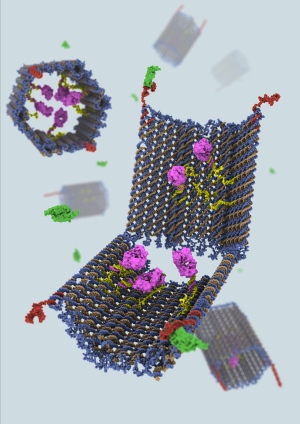
I like to think of these as smart bombs of cancer cells. They are bits and pieces of DNA naturally self-assembled into a particular shape (the barrel in the background) that is prepared to deliver a payload. That payload (the purple/pink stuff) is attached to specific strands (the yellow/green stuff) inside the DNA barrel structure. This is all held together by strands of DNA which are programmed to recognize specific molecules on the target cells (in this case, cancer cells). When the DNA attaches to these molecules, it changes shape and opens up the barrel. The payload is then free to enter into the target cell, inducing apoptosis (cellular suicide). Experiments have shown that these DNA robots are able to avoid healthy cells during this process.

There are, of course, limitations to this technology. Take malaria, for instance. It would be difficult to target most strains (such as P. vivax and P. falciparum) because they get inside hemoglobin rather than attach to the outside of anything. That makes them effectively invisible to both our immune system and these nanobots. Strategies for fighting that disease will tend towards the sort of medications we’re using now combined with bed nets and efforts to destroy mosquito habitats.

Still, this is exciting. I say that about most cancer-related advances, but I don’t feel I’m ever overdoing it. Every little bit of progress is crucial, even the bits that don’t pan out. I have hopes for this one, though. Even if it doesn’t end up being pragmatic in application, it still has the potential to 1) increase our understanding of cancer and 2) be used in so many other ways. Three cheers for science.

Sources: Here and here.

Lynn Margulis, 73, dead

Lynn Margulis was one of those scientists that biology needed. She forged the now universally accepted endosymbiotic theory only about 44 years ago, bringing it to the mainstream 30 years ago. I have heard her work compared to that of Watson & Crick insofar as it marked a significant turning point within the field. She really did have some great ideas and it’s a shame that she died so young.

Compassion is more than just human

This story about an elephant and her friend is incredible:

In 2009, CBS News correspondent Steve Hartman introduced you to a couple of very unlikely friends who couldn’t have been more different. But from the moment Tarra the elephant met Bella the dog, they were inseparable.

The Elephant Sanctuary south of Nashville is more than 2,000 acres of freedom for elephants. But for a resident named Tarra, there’s not enough room in Tennessee to escape the bad news she got last week.

“Certainly her whole demeanor changed,” said Rob Atkinson, the sanctuary’s CEO. “She became more reserved, quieter, she was depressed.”…

Last week, sanctuary workers found Bella’s body. By all indications she’d been attacked by coyotes. Whether Tarra witnessed it, tried to intervene or was too late – no one knows. All they do know is that where they found Bella is not where she was attacked.

Tarra carried Bella’s body close to a mile, laying it down near a building on the sanctuary. It is the same building where Tarra stayed for three straight weeks when Bella previously became injured.

This is a tremendously fascinating story. It goes to demonstrate some amazing characteristics present in the animal world, especially amongst elephants. The article seems to sum things up quite nicely, but do go to the link to watch the video.

3.4 billion year old fossils recently discovered

Martin Brasier of Oxford and his team have just described some very ancient fossils discovered in rocks dated to 3.4 billion years of age. The article is unfortunately behind a paywall, so I am unable to review it, but Jerry Coyne lays out the evidence neatly:

As the authors note, “determining the biogenicity [biological origin] of putative Archaean microfossils is notoriously difficult.” How do we know that these things are real remnants of bacteria and not just inclusions or artifacts? There are several independent lines of evidence, none conclusive but together building a very solid case:

  • They look like cells, being cell-shaped, cell-sized, and forming chains of spheroids that look like chains of both well-established fossil bacteria and modern bacteria. Some can even be seen “dividing” or expelling their contents after cell damage (see figure above).
  • The variation in size of the bodies is small—smaller than you’d expect if they were abiological inclusions. A uniformity of size, however, is expected if they’re all members of one living species.
  • The cell “walls” of the microfossils, too, are of uniform thickness, unlike that of artifacts like silica grains coated with carbon.
  • The geochemistry of the bacteria and surrounding rock supports the idea that these are true organisms. This involves not only the isotopic nature of the carbon, but the presence of nitrogen, a crucial biomarker, within the cell walls.

This reminds me very much of Margulis’ endosymbiotic theory and its multiple lines of evidence. Of course, that idea was a cornerstone achievement of 20th century biology whereas this recent discovery pushes the known origins of life back about 200 million years, but that does not mean it isn’t important. Braiser’s find goes to demonstrate the nature of early bacteria. Many of the features in these fossils show that ancient bacteria operated in ways similar to certain bacteria today – if you find something that works, keep it up. The find also demonstrates that life can come to be quite quickly. Earth is only 4.54 billion years old and probably was not hospitably cool enough for life for its first half billion years. Given this 3.4 billion year date plus the fact that these fossils are fairly complex, it is not a stretch to say life dates back even further, probably quite soon after it was possible for it to do so on Earth.

Finally, I have to reflect Coyne’s curiosity that this was not published in Nature or Science, but rather Nature Geoscience. It’s still in a prestigious enough journal, but the paper is important enough where it deserves publication that comes with a higher profile. I’m sure the authors attempted to reach the best level possible, so who knows what the deal is.

How the future of cancer research is shaping up

There are two foundational concepts a person must understand before he can say he understands biology. First, all life has evolved from a common ancestor via natural selection. Miss this concept and one has no reference frame for anything within the entire field. It would be like trying to grasp physics without understanding gravity. Second, it’s all about shape. This can apply to many other fields, but it is an essential concept within biology. The molecules within living organisms are like pieces of a puzzle, or like keys and key holes. However one wishes to think about, biology really is about shape. Now with that in mind, I turn to some really awesome cancer research.

[Bruce] Levine and his colleagues designed a new gene that can be inserted into T cells to trick them into attacking cancerous B cells, the cause of chronic lymphocytic leukemia (CLL). The new gene encodes a receptor that, on one end, can bind to a molecule that’s unique to cancerous B cells. The other end of the receptor sets off a chain reaction when such a B cell is bound, eventually leading the T cell to destroy the cancerous cell. “Essentially, we’re converting T cells that would normally recognize other types of cells to be tumor specific,” Levine says.

In many ways, this is very much a basic immune response. The difference here is that gene transfer techniques have been used to modify the shape of the T cells to recognize particular cancerous cells, something which does not normally happen. As the article states, one patient went from having 170 out of 200 cells containing a cancer-causing mutation to having all signs of his leukemia vanish. The paper itself goes further and says tests showed 198 out of 200 cells to be negative for that mutation, which is within the normal range for such tests.

The insertion of these modified cells was not without complications. The cells themselves are without toxicity, but within two weeks the patient was experiencing a low-grade fever and chills, both of which intensified and required a short hospitalization. He also had tumor lysis syndrome, which could be expected – and is ultimately a good thing. It’s a common condition after certain types of cancer treatment (though it had not previously been reported in cellular immunotherapy). Basically, cell lysis is when a cell is destroyed and its contents spill out. Often, this constitutes a significant release of chemicals which cause a reaction. It can be quite dangerous, but then, so is cancer.

While this research is cause for a lot of excitement, I think, there also must be much reservation. The test subjects number a whopping three patients. Furthermore, they’ve only been tracked for approximately a year since treatment. It is fortunate that they still contain within them cells with the inserted gene – it’s self-propagating since it gets passed on with somatic division just like any other gene – but more time needs to pass before too much more can be said (not to mention the dramatic need for a much larger sample). There is also concern that there could be long-term deficiency of B cells in patients since the genetically modified cells do attack normal B cells as well as the cancerous ones. These are all things that can be clarified with continued research – and I’m confident “with continued research” is a phrase that is more than traditional lip service, in this case.

Why quacks should be more cautious

One of the hallmarks of quacks is that they’re willing to latch on to any bit of science that shows even the most remote, most distant promise. One familiar quack did this for a preliminary study not too long ago. And other quacks do it all the time. They hear about some result which indicates some positive benefit from something – usually a berry or herb – and they go nuts. Forget that they reject just about everything else science has to tell us. If it fits into their paradigm, it must be true.

But of course they’re jumping the gun. Again and again a study will come out which shows promise for some substance that will help in the fight against this or that disease, but once a few more groups start taking a look, things fizzle out. Often studies will even get to the clinical stage, only to turn out to be failures. (“Failures” in the sense of not working, not in terms of science.) Companies usually are decent at protecting themselves from getting that deep if there is no benefit to be had, but they aren’t perfect.

I go on about this because I am currently reading a review article about the protein p53. It is a protein which is involved in tumor suppression. When it mutates, usually by missense mutation, it becomes involved in tumor growth by virtue of loss of function, though evidence strongly suggests that it also confers a gain of function in terms of cancer growth. I’ve written about other tumor suppressing proteins here.

I had to stop when I got to a section about post-translational modifications of the protein:

Post-translational modifications of p53 such as phosphorylation, acetylation or sumoylation have been shown to be essential in determining and regulating p53 activity in vitro. However, their effects in vivo remain difficult to assess. Sabapathy (S1) generated a ‘knock-in’ mouse strain replacing the serine 312 residue, equivalent to the human serine 315, by alanine (S312A) to abolish phosphorylation. This residue has been proposed to have a role in the regulation of p53 protein stability. p53S312A/S312A knock-in mice are viable, fertile and not –pre-disposed to spontaneous tumor formation. In addition, the p53S312A protein was found to be activated as efficiently as wild-type p53 and its turnover rate was not affected, suggesting that despite in vitro evidence this phosphorylation event may not be critical for in vivo suppressive functions.

Let’s get some of the terms out of the way. “Phosphorylation”, “acetylation”, and “sumoylation” all refer to the addition of certain chemical groups (such as phosphates) to the protein – it’s basically attaching stuff to p53. “In vitro” pretty much refers to the testing of cells in a test tube (or Petri dish, or whathaveyou) whereas “in vivo” refers to testing done on whole organisms. “Sabapathy” is a person, not a biological term. “Knock-in” refers to a type of genetic engineering. “Wild type” means the default protein, or the protein as it “normally” would appear, unmutated. (I’ve always found the term counter-intuitive.)

Now, presuming anyone is still with me here, the important aspect of the above excerpt is where it says, “In addition, the p53S312A protein was found to be activated as efficiently as wild-type p53 and its turnover rate was not affected, suggesting that despite in vitro evidence this phosphorylation event may not be critical for in vivo suppressive functions.” In other words, the genetically altered ‘test tube’ results showed that the addition of a chemical group was important, but further evidence showed otherwise. One thing this means, as all scientists know, is that we ought not jump the gun.

Another way to think of these results is to compare red hots dogs and apples. Each one is known to contain nitrites, which is a chemical compound linked to cancer. However, whereas red hot dogs have a small connection to tumor development, apples have no connection. Why? There is a complex interaction between meat and nitrites which results in the production of the actual carcinogenic compound. Apples, on the other hand, even if they did interact with other chemicals (probably ones within the body), have components which would help the immune system and thus help prevent cancer, at least to some degree. Or to use another comparison, tobacco cigarettes and marijuana contain a ton of carcinogens, but only one (cigarettes) has a causative link to cancer. Presumably some other chemical(s) in marijuana counteracts the carcinogens. But however the cancer is prevented, it happens through a complex interaction that needs to be studied. Lab results are wonderful and they’re a major reason why we live so healthy and so long today, but they aren’t the final word. In fact, we ought not think of anything within biology as being the final word. We have large scale statistical results that will be true in virtually all cases, but there are no hard and fast rules for how organisms will interact with their environments. We need to test and test and test – and science will always do that – but the real solution here is that we need to be sure we aren’t jumping the gun. After all, no one wants to be a quack.