NOVA tonight

Nova will be airing a 2 hour special titled What Darwin Never Knew. It’s all about evo-devo, the science behind how embryological development is so important to evolution as a whole.

It’s on at 8pm ET/7pm CT on PBS.*

*It saddens me that it’s likely necessary I need to point out what station NOVA is on.

Dirty mud-sucker!

Fossilized cetaceans provide for one of the more robust evolutionary records. Especially with whales, it is abundantly clear that it takes the fundamental underlying theme of all of biology – evolution – to explain all that pesky empirical evidence we have. Now some light has been shed on the origin of baleen.

The fossil whale, thought to be between 25 and 28 million years old, hints that mud sucking might have been a precursor to the filter feeding used by today’s baleen whales.

Many modern whale species use hair-like structures called baleen to filter tiny prey such as krill from seawater. Baleen species include the humpback, the minke, and the largest animal ever to have lived on Earth, the blue whale.

The newfound fossil whale, which measures just nine feet (three meters) long, shares the same distinct jaw and skull structures as today’s baleens.

But the tiny whale also had teeth, said study author Erich Fitzgerald, a paleontologist at Museum Victoria in Melbourne, Australia.

Article on Dawkins

I’m swamped in Marine Biology, Human Nutrition, Genetics, some philosophy and other areas of study this weekend, so cheapo-posts will have to do. Here is an article about Richard Dawkins I found enlightening.

So he is genuinely puzzled by people calling him aggressive. “Well, I’m nothing like as aggressive as I’m portrayed. And I’m always being labelled ‘strident’. In the bestseller lists it always has a little one-line summary of the book, and for my new one it says ‘strident academic Richard Dawkins’. I’m forever saddled with this wretched adjective. I think I’m one of the most unstrident people in the world. I’d like to think my books are humorous at points,” he adds, pensively. “I’d like to think people laugh when they read them.”

And when asked about who may read them,

So finally I have to ask him, does he honestly think any creationists will read it?

“Hardline, mind-made-up creationists, no. But there are lots of people, people who think they are creationists but who haven’t thought about it very hard, people who grew up in some religion or other, who are just beginning to question what they were taught. And all of a sudden they are reading about evolution and saying, wait a minute, this makes sense. I get a lot of letters from people thanking me, saying, ‘You’ve changed my life.’ That is very, very gratifying.” So you have actually converted people? “Well, for example, I was at one point teaching in Oxford, and we had an animal-behaviour student who was a creationist from some out-of-the-way Bible college in America. He came dutifully to all my lectures, every week, and after the last lecture, he came down to the desk where I was packing up my notes and he said, ‘Gee, this evolution, it really makes sense!’ So yes, yes, I do believe that people can change their minds, be convinced by the truth. And I thought, yes, that’s what I’m here for.”

Ardi

There are a bunch of great new fossil discoveries. I’m pretty busy making some Italian herb chicken (is it weird that the recipe calls for “2.5 lbs chicken parts”?), so I’ll have to write more later, but here’s a snippet from the article.

The scientists say 1.2m-high (4ft) Ardi was good at climbing trees but also walked on two feet. However she did not have arched feet like us, indicating that she could not walk or run for long distances.

“She has opposable great toes and she has a pelvis that allows her to negotiate tree branches rather well,” explained team-member Professor Owen Lovejoy, from Kent State University, Ohio.

“So half of her life is spent in the trees; she would have nested in trees and occasionally fed in trees, but when she was on the ground she walked upright pretty close to how you and I walk,” he told BBC News.

_46476758_ardi-composite

The actual peer-reviewed articles can be found here for free.

The Greatest Show on Earth

Dawkins gives an intro to his new book (which I have already pre-ordered).

Awesome sight

Over at Why Evolution Is True, Jerry Coyne has posted one hell of a great image.

a-young-fan1

This fan of evolution is 4 years old. His mother or father writes in to say:

He can’t seem to get enough of all the pictures and diagrams in the book. He is particularly fond of the diagram near the beginning of the book that shows the evolutionary change from reptiles to dinosaurs to birds. Since I have explained the diagram to him he now goes around telling everyone that birds came from dinosaurs. You can never start teaching them science and critical thinking too early!

Old eggs, daphnia, and evolution

When predation is high, crustaceans and other water loving egg lay-ers are not hatched much. What often happens is that they will remain dormant until later in the year when the predators are much less active. This offers a great research opportunity into evolution.

By hatching these eggs, Hairston and others can compare time-suspended hatchlings with their more contemporary counterparts to better understand how a species may have evolved…

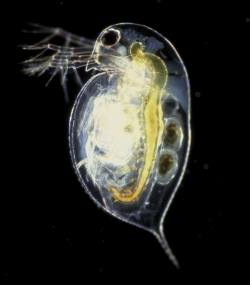
What happens is that some of these eggs can remain unhatched for years and years, not just seasons. This is the case with daphnia. These are normally seasonal crustaceans, but researchers have specimens which are upwards of 40 years old. They use these to compare the change which has happened to this species over time. Daphnia_DGC

In the 1960’s, the lake from which these daphnia were taken had non-toxic levels of algae. But in the 1970’s, pollution had caused the algae to raise to a deadly imbalance. Currently, daphnia still reside in the lake, but researchers have found they are markedly different from the eggs they hatched. The older version of the species was unable to survive in the lake, poisoned by the overwhelming cyanobacteria. Clearly, the newer species had adapted to their new environment throughout the 70’s and subsequent decades.

Oh, Jesus

There’s a story floating around the interwebbings that says “Study shows evolution guided by ‘invisible hand'” or some variation of that. Most of the actual articles take this idea too far.

A study in the University’s School of Psychology sought to explain how turn-taking has evolved across a range of species. The conclusion is that there is an “invisible hand” that guides our actions in this respect.

That isn’t really the conclusion. The researchers did use the phrase “invisible hand”, but they didn’t come to a scientific understanding that, “OO! Magic!” is what’s going on here. Here’s some actual meat.

The researchers state: “Turn-taking is initiated only after a species has evolved at least two genetically different types that behave differently in initial, uncoordinated interactions with others. Then as soon as a pair coordinates by chance, they instinctively begin to play ‘tit for tat’. This locks them into mutually beneficial coordinated turn-taking indefinitely. Without genetic diversity, turn-taking cannot evolve in this simple way.”

Tit-for-tat is a model of behavior that results in a form of altruism. It’s pretty much what it sounds like: you scratch my back, I’ll scratch yours. A lot of organisms have it, and it’s especially strong among kin or even likely kin. The basis is that closely related organisms tend to have highly similar genes. While helping out (in one form or another) one’s brother may seem detrimental, it actually isn’t. That brother has 50% of the genes, on average, that the helper has. He’s really helping a lot of his own genes. On top of that, the brother is likely to help back at some point in the future (afterall, genes for altruism, if in one brother, are likely to be in the other brother).

What happened in the aforementioned study is that tit-for-tat is already assumed in the model. That is, it has already evolved within groups. What needs to be explained is specific turn-taking. And that’s exactly what the researchers did. They showed that it takes a random throw of the dice to find the right gene combination, so to speak. Once that point is reached, the non-randomness of natural selection can subject those genes to adaptations.

Professor Colman added: “In our simulations, the individuals were computer programs that were not only dumb and robotic but also purely selfish. Nevertheless, they ended up taking turns in perfect coordination. We published indirect evidence for this in 2004; we have now shown it directly and found a simple explanation for it. Our findings confirm that cooperation does not always require benevolence or deliberate planning. This form of cooperation, at least, is guided by an ‘invisible hand’, as happens so often in Darwin’s theory of natural selection.”

Let’s be fair to Professor Colman. There’s no way of telling from this if he too is trying to sneak a vague concept of a god into all this. I doubt he is. Unfortunately, it doesn’t matter because he’s a scientist and his languages suggests religious connotations. That is why the media especially latched onto this story. It isn’t like turn-taking grabs the attention of the average layman.

New information

I’ve posted about “new information” in the past, but I recently wrote this for some friends and figured it may as well go up here, too.

~~~~~
This is from a YouTube video by some dishonest creationists who poorly edited a video to make it look like Richard Dawkins couldn’t answer a question. It doesn’t deserve to be linked.

“[Is there] an example of a genetic mutation or an evolutionary process which can be seen to increase the information in the genome?”

The answer is yes. But I won’t get to the heart of the question right away. It needs explaining.

A definition of “information” is drastically needed here. It’s a term that doesn’t really mean anything in the given context. However, we can ascribe it some definition which is useful. My best proposition is that it can mean DNA itself (nucleic acids), amino acids, or genes. I’ll tackle DNA first.

Our genetic code consists of four ‘letters’, A, C, T, and G (or adenine, cytosine, thymine, and guanine). These four letters are mixed in a huge number of ways in order to form amino acids. It is amino acids which compose our genes. But let’s slow down.

An amino acid is composed of 3 letters. Let’s say we have CGU. That makes arginine. If we replace that final letter with, say, another “C”, we have CGC. As it happens, that still gives us arginine. Different letter combinations can make the same amino acid. When a mutation occurs which does this, it’s called a silent mutation. It’s neutral and natural selection is blind to it.

Now let’s say we change that middle “G” to an “A”.That gives us CAC, or histidine. This is a completely different amino acid. It’s presence in a given gene in place of arginine can have potentially huge consequences. This single letter substitution is called a missense mutation. (It is also called a point mutation because just one letter was changed; the same applies to the arginine example.)

So as should be clear, single letters of DNA can be considered information because they can have profound effects on genes, which in turn affect how proteins are made. However, we have another avenue.

An amino acid can be considered information because it is more directly responsible for the changes to how a protein operates than a simple letter. Personally, I prefer this option the least, but I digress.

Genes are composed of chains of amino acids. Some can be quite short while others range into the hundreds, even thousands. Recall how an amino acid is composed of a series of 3 letters of DNA. That means those letters go back to back to back to back to etc…, each set of 3 making an amino acid. After one triplet, there’s another. And another. Each “another” is an amino acid. (Eventually, a gene can be defined, at least one way, by identifying where the stop codons are – triplets which tell the gene that it is at its end, thus releasing the amino acid chain.)

But if we’re going to call amino acids information, we may as well go a step further and just say genes. And this gets more to the heart of the question. Genes essentially determine what protein will be made (epigenetic or environmental factors are important, but there’s no need for those here). A mutated gene is mutated information, at least in a sense. So how can an evolutionary process be seen to increase the information in a given genome?

It’s actually pretty simple. DNA is far from perfect. It has incredibly high fidelity, meaning it makes few copying errors, but it isn’t perfect. That’s one way we get mutations. Another thing we can get is extra copies of genes. There are a myriad of ways this can occur which I will not discuss here. But it does occur all the time. In one recent text, I read of 12 copies of a gene for seeing green in relation to eyesight.

So what does it mean to have too many copies of a gene? Sometimes it can mean a lot. A lot of the time, though, it doesn’t have to mean too much, such as with the aforementioned case. But what happens to all those extra copies in the next generation, especially if they have no real world (phenotypic) results? They are not subject to the pressures of natural selection. They are free to mutate in whatever way they ‘please’. This gives these genes a huge range to become useful in other ways. In this case, they may affect vision acuity or color sharpness and that may be an advantage.

This is, for all intents and purposes, new information.

A gene gets duplicated. It mutates. It becomes useful, by chance, in some other way. It is subject to the pressures of natural selection. For that reason, it is maintained in the gene pool. Those with this gene have increased the size of the ‘information’ in their genomes.

Why it's so easy

The more and more I think about it, the more and more I recognize just how easy it is to understand evolution.

Evolution is the change within populations over time. This change is continuous. Take birds, for instance. They are descended from dinosaurs. Depending on who you ask, you might even hear them referred to as dinosaurs. However, for the sake of argument, let’s draw a line in the sand. Let’s say birds are birds and dinosaurs are dinosaurs. There is no single point to which we can point that says “Ah-ha! This is the generation in which birds originated!” Evolution doesn’t work that way.

Life is gradual in the big picture. The lines are blurry as to where one species begins and where another ends. It is simply a matter of convenience that we are able to make the distinctions we make. Ancient birds weren’t great at flying. Less ancient birds were better. Even less ancient birds were even better. And then, sometimes, extant birds are back to being terrible at flying. It just so happens that we’ll never know what every year of every species was like. If we ever do, we won’t be able to say “Such-and-such is Species X and this other example is Species Y”. We’ll be looking at Species X.1, X.11, X.111, X.112, etc.

To be this all another way, mother birds (or bats or monkeys or humans or bears or prarie dogs) only give birth to daughter birds (or bats or monkeys or…etc). But over time, small changes accumulate. Think of how much you probably resemble your father in some way. Now think of how much you resemble your grandfather. Odds are, you resemble him less than you resemble your father. Go back further and you’ll see more changes. And that’s just on a phenotypic (for purposes here, “physical”) level. Go to a genotypic (genetic) level and there’s no questioning the facts. You are more similar to your close relatives than to your distant ones.

Now we have to extend this concept over time. We have plenty of it. Evolution has been playing out for nearly 4 billion years. Think about that for a moment. You’ll live around 80 years. If you’re lucky, you might hit 100. A tremendously long human lifespan would be another 20 years on top of that. It’s all a blip on the timescale of Life on Earth.

So here’s what you should be thinking. Every generation is similar to the previous generation. It doesn’t matter what species we want to specify. It’s always true. But the further back we go, the fewer similarities we see. But importantly, we still see similarities.

Take the bones in the wing of a bat. They are easily matched with the bones in the hand of a human or the paw of a cat. They are the same bones but shaped vastly differently. It isn’t simply a huge (convenient) coincidence that this is so. Bats share a common ancestor with other mammals. This common ancestor, being that it is found deeply in time, would hold notable similarities with all extant mammals, but it obviously wouldn’t visually match with every single organism (or even a majority).

But the visual match isn’t all with which we need to concern ourselves. That common ancestor wouldn’t be able to breed with anything alive today. The changes have been far, far too considerable since its time.

I’m breaking stride for a moment because I want to note something. The changes which occur over time in a species are what cause it to be considered a new species. In other words, when two populations cease to be able to breed and produce fertile offspring, we have a two separate species (which one we want to call the “new” one is somewhat subjective, but usually it’s the one least resembling the common ancestor). As I said, there is no single point where speciation happens, but imagine for a moment approximately the time where two populations cease to be able to breed. It won’t be one defined generation where it occurs, but there will be some generation somewhere where some members of a population cannot successfully produce fertile offspring with members of another population.

On the face of it, this sounds like I’m contradicting what I’ve been saying all along about not being able to pinpoint one generation. I’m not.

Remember I talked about the lines being blurry. While some members of one population probably won’t be able to breed with some members of another population, that won’t be true for all members of both groups. Much breeding will still be possible. With time, those possibilities dwindle. Eventually, the line begins to come into focus. That is how evolution works: It’s gradual.

So again, the more and more I contemplate evolution, the more and more it makes so much sense. Of course, the evidence is crystal clear and I don’t need this contemplation to confirm the theory. However, it is through this focus that I’m forced to wonder why we had to wait until Charles Darwin and Alfred Wallace to really recognize how new species come into existence. The truth is that changes occur in populations over vast expanses of time. Then most of the world’s populations either continue to evolve or, more likely, go extinct. In hindsight, we observe definitive periods of stasis, almost leading one to believe in static, unchanging species. Almost.

Forelimb morphology