Blogging protip:

If you aren’t willing to stick around to defend an argument you’ve made, then you probably shouldn’t be making any arguments. You just look like a coward.

I’m looking at you Ichthyic, Roxeanne, and Michael.

Thought of the day

Braveheart is overrated.

VE Day

Blogging protip:

Don’t make a post with more than a handful of pictures. Chances are people don’t care about them anyway, and if they do, they won’t when they get to the 15th one you’ve uploaded.

Thought of the day

I’m just finishing up a paper for my Global Health/Haiti course and I thought I would think outside the box a little for the final. We have to propose some sort of health initiative and, in part, relate it to one of the Millennium Development Goals. Since the biggest issue underlying any problem in any developing nation not in a religious war (see Nigeria) is poverty (also a problem in Nigeria), I decided to address things from that angle: Build a highway system. I have some very good examples of countries which have done this to great success: The Roman Empire, Germany, the United States, and, currently, China.

These burgers are getting out of control

I already take back the title of this post. I’m a big fan of a good, homemade cheeseburger and mine are only getting better.

Thought of the day

One of the downsides of letting people know where I am in my career has been that it opens me up to illogical attacks. Namely, I have often had people point to my status as a student in order to discredit my positions. For instance, I have been told that my position that the process of development is not the same as the subjective concept of humanity comes from my unfinished education. If only I was a graduate, I would know better. (Ironically, one of the people making this claim had no degree in biology.) But now I am in a position where all I have is a single outstanding math course (to be taken not too far down the road). I have completed every core biology course plus a swath of biology electives. I’ve looked at development from an anatomical perspective. I’ve looked at it from a cellular perspective. I’ve looked at it from a genetic perspective. Yet, my position is exactly the same. Not a bit different.

It’s almost like demanding one be an authority in a subject in order to have a valid opinion on a particular point is a logical fallacy.

Finals

One more test, one more paper, one more class…

Thought of the day

I hate finals week. Hate it.

On the plus side, my degrees are done bar a single course (which is ever-so-conveniently offered two semesters from now).

Fun fact of the day

I think most people know where this is:
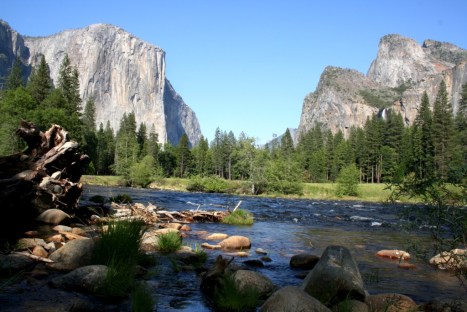
For those who don’t know where it is, I bet most have still at least seen this image. It’s of Yosemite Valley in Yosemite National Park in California. Notice the square shape of the valley. This is unusual because valleys tend to be formed by two things: rivers and/or glaciers. Rivers result in a V-shape due to their cutting action and glaciers result in a U-shape due to weight and grinding. So why is Yosemite Valley square?

The answer actually does lie in the geological activity of glaciers. When a glacier moves, it has a lot of mass and power behind it. That means it can easily bring tons and tons of rocks and debris along for the ride. Go on a hike anywhere reasonably far from the equator and glacial erratics will not be uncommon.
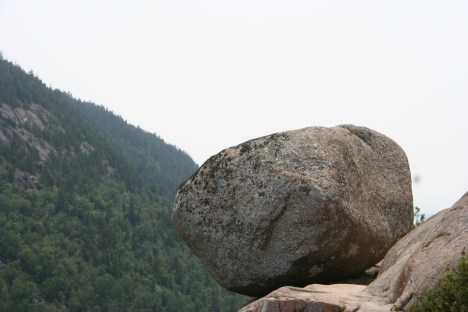
In the case of Yosemite Valley, a glacier moving through it brought more than a few erratics. In fact, it was more than just one glacier. Over millions of years many glaciers have run through the park, creating a massive lake where we see sheer cliffs in the first picture. On one end of this lake was a moraine, a collection of rocks pushed forward by the weight of all that ice. They built up on each other and formed what was essentially a damn. This allowed the lake to also form, filling in what was then a U-shape. Of course, that shape was still underneath all that water.

So the question that may be popping up from all this is, What is it that lakes do that is important here? The answer is that they create sediment. And with enough time, all that sediment adds up. In the case of Yosemite Valley, it added up to the point where it filled in that U-shape, creating the square we know today.