The fruits of faith

As I’ve noted many times, faith is an effectively random way of believing. That is, faith is precisely belief without evidence, so it offers absolutely no logical path towards one idea or another. This is an obvious problem in the world; there are far more ways to get things wrong than to get them right, so we should expect theists and other random-belief persons to cause a lot of havoc and offense on a daily basis. The religious, dogmatic United Arab Emirates offers one of the most egregious examples as of late:

A Norwegian woman who was sentenced to prison in Dubai after reporting that she was raped has been given a pardon and will be heading home soon, she said Monday.

Speaking to reporters in Dubai, Marte Deborah Dalelv seemed relieved and happy as she confirmed the news — if still slightly bewildered by the swift turn of events.

“They told me that I would be pardoned and that they were going to give me my passport back, so I got it immediately,” she said.

Asked what happens next, Dalelv paused a moment before replying: “I get to go home.”

She added, “We want to make it as soon as possible.”…

Dalelv, a Qatar-based interior designer, was on a work trip to Dubai when she reported to police that she had been raped by a colleague at the hotel where she was staying.

She was herself then detained and charged with having unlawful sex, making a false statement and illegal consumption of alcohol. A court last week sentenced her to 16 months in prison, prompting outrage in Norway.

Dalelv’s lawyer, Mahmoud Azab Abu Gareda, said the sheikh’s pardon is “effectively a royal decree,” which wipes the slate clean, leaving no record of her conviction.

This means the alleged perpetrator, who was charged with public intoxication and having sex outside of marriage, also walks free, he said.

Notice the stark difference in the involved nations. The United Arab Emirates is a majority Muslim nation where Islam is the official state religion. Norway, on the other hand, has a high cultural Christian population, but relatively little religious participation. According to Wiki, only 32% of Norwegians said they believe in a personal god. Moreover, an overwhelming majority, 73%, are not theists: Of the total population, 44% are effectively deists, whereas 29% are atheists.

Of course, it isn’t that atheism or deism have led the charge in Norway’s basic moral authority in this situation. They couldn’t. They’re both 100% descriptive positions. No, it’s that the people of Norway have opted for a secular guidance in their moral and ethical thinking. This is just the opposite of faith, so it isn’t surprising when we see it working so well in so many instances.

On the National Day of Prayer

What an odious day:

When a religion is good, I conceive it will support itself; and when it does not support itself, and God does not take care to support it so that its professors are obliged to call for help of the civil power, ‘tis a sign, I apprehend, of its being a bad one.

~Benjamin Franklin

I’d go a step further and say they’re all bad. We shouldn’t expect a single positive thing as a direct result of the random basis for belief that is faith.

Terrorists motivated by religion

This isn’t a shocker:

The hospitalized Boston Marathon bombing suspect charged Monday with using a weapon of mass destruction has told investigators that he and his brother were motivated by religion but were not in contact with overseas terrorists or groups, officials said.

Several officials familiar with the initial interrogation of Dzhokhar Tsarnaev described his behavior during questioning as cooperative.

A senior government official said Tsarnaev has told investigators — by writing some answers down, and by nodding yes or shaking his head no to others — that he and his brother were not in touch with any overseas terrorists or groups.

Tsarnaev, who has injuries to his tongue preventing him from speaking properly, also indicated that he and his brother conceived the bombing attack on their own, and were motivated by religious fervor.

And what is the key underlying factor in religion? Everyone say it with me: faith. It doesn’t take some overseas organization to motivate a person to effectively random violence on a massive scale. With faith, anything is possible. I mean. It’s fucking random. It isn’t a way of thinking or knowing at all.

Don’t expect to hear too much about religion’s role in this (much less faith’s). The left-wing media is going to bury this key factor and the right-wing media will speak of the motivations here only in terms of “radical Islam”. (Why “radical Christianity” doesn’t appear to be a thing, I don’t know. That religion has more than its fair share of brutes, past and present.)

To digress, I’ve been perplexed by another issue surrounding the surviving terrorist fuck. Apparently people would like to deem him an enemy combatant and strip him of the rights afforded to citizens under the Constitution. It is absolutely beyond me that the nature and magnitude of a crime should make a difference. Once we start walking down that road, we start calling accused murderers “enemy combatants” – guilty or not. And why stop there? Stealing gum from that store undermines the U.S. economy, you economic terrorist. Enemy combatant! Like we need to tip the balance of power any further into the hands of the government.

People become Republicans because of religion

At least for the vast majority, that is. See here:

With no debate, Republicans at the party’s spring meeting here on Friday unanimously approved a number of resolutions, including one that reaffirmed the party’s opposition to same-sex marriage.

“The Republican National Committee affirms its support for marriage as the union of one man and one woman, and as the optimum environment in which to raise healthy children for the future of America,” the resolution read. The 157 RNC members present approved it in a voice vote.

I’ve made the claim in the past that the reason people turn to the GOP is out of their conservative Christianity. To me, this is a very tiny, very obvious claim. Basically dishonest people who aren’t interested in critical thinking (or doing any research, but I digress), such as the odious Michael Hartwell, have tried to spin my statement in a way where in order to prove it I would have to explicitly know the minds of every single Republican. Under his requirements, we could never surmise why anyone becomes anything if the group we’re discussing is sufficiently large. (This is interesting, too, since he has gone the racist route of claiming that blacks vote for Democrats because they benefit from and like handouts.)

At any rate, I think this is all quite obvious: Most people who become Republican are first fundamentally religious, soon recognizing that there is a political party which reflects their religiosity. The re-affirmation of the GOP’s opposite to marriage equality is a perfect example of this because there are no good (or even honest) secular arguments against allowing same-sex couples their constitutionally guaranteed right to marriage. That is, it is the base Christianity that underlies the Republican party that has caused this vote and view; we don’t live in some backwards world where people became bigoted Republicans all on their own, later noticing that a particular cultural religion happens to exactly reflect their positions.

Jesus Christ

Jesus Christ

Christian Mormons are hardly any different from mainstream Christians

I know mainstream Christians, in a rare display of an ability to recognize inanity, like to pretend like Mormons aren’t also Christians, but let’s illuminate the differences between these sects with a conversation:

Mainstream Christians: It’s just silly that Mormons believe Joseph Smith received gold tablets from an angel on a hill.

Atheists: Agreed.

Mainstream Christians: Everyone knows Moses received stone tablets from a burning bush on a mountain, though.

Atheists: I do believe we have parted ways, my friend. My crazy, crazy friend.

I can’t say I see any importance distinctions.

The non-basis of faith

It’s worth saying this as many times as possible: Faith is nothing more than precisely belief without evidence; it is an entirely random basis for beliefs, actions, and behaviors. If you don’t believe me, just look at the results of a recent study on faith-based programs and religious belief amongst the overwhelmingly Christian prison population in America:

Serious criminals co-opt religious doctrine to permit, and even encourage, their illicit activity, a Georgia State University study shows.

Titled “With God on my side: The paradoxical relationship between religious belief and criminality among hardcore street offenders,” the research was co-authored by Georgia State criminologists Volkan Topalli, Timothy Brezina and graduate student Mindy Bernhardt. It was published in the journal Theoretical Criminology. Their findings have policy implications for correctional faith-based reforms.

“Offenders in our study overwhelmingly professed a belief in God and identified themselves with a particular religion, but they also regularly engaged in serious crimes,” said Topalli, an associate professor in Georgia State’s Andrew Young School of Policy Studies. “Our data suggest that religious belief may even produce or tend to produce crime or criminality among our sample of hardcore street offenders who actively reference religious doctrine to justify past and future offenses.”

The criminals who were studied were not in prison at the time of the study and the sample size was small (48 individuals), but the findings were compelling. These men had been through the system, been preached to through faith-based programs and other religious inmates, and they had come out none the better. I’m not sure I necessarily find it convincing that prisoners with these experiences would become worse than those without such experiences (again, the sample size is small), but I highly suspect that prisoners who went through philosophy- and reason-based programs (if such things actually existed) would come out far, far better people.

The authors note their results do not indicate these effects accrue from the content of religious doctrine. However, it is important to consider their policy implications.

“The growing correctional reform of faith-based programs encourages inmates’ participation in prayer, Bible studies and religious services,” Topalli said. “To the extent that some offenders misinterpret or distort religious teachings to justify and excuse crime, program facilitators may benefit from this knowledge and work to challenge or correct these errors.”

One must wonder how this could possibly be fixed. Sure, we could drill dogma and traditional doctrine into these prisoners, arbitrarily declaring that their current interpretations are wrong, but that’s hardly objective. Indeed, whereas modern day religion is, partially, just a reflection of secular morality, there is no good justification within the context of Christianity, Islam, Judaism, or any other religion for such declarations. This inability to offer a basis of reason is most clearly the mark of faith; nothing in any religion stops these prisoners (or any other person of faith) from believing in absolutely anything.

Faith just isn’t a valid basis for belief.

Christian emptiness

I hear over and over how Christians have doubts all the time. They question their beliefs, the story goes, on a daily basis. This doesn’t always show through in the certainty of their often logically flawed arguments, but I suspect they do sincerely have doubts. How couldn’t they? Their religion is asking them to use the vacuity of faith to believe something that is totally preposterous. And this leads me to wonder: How intense must their feelings of emptiness be?

It’s a common position for Christians to look down their noses at others for not having what they’ve deluded themselves into believing they have, but let’s just ask ourselves about the sort of people who tend to turn to Christianity. There are, of course, all the wealthy white people who are paranoid of minorities (and thus, generally, become Republicans), but most of these people didn’t “turn” to Christianity. They were simply indoctrinated by their parents. (What a happy coincidence that they were born into a particular family in a particular culture that got the right particular religion!) The people who tend to find themselves moving towards the Christian religion as adults are quite frequently those who have hit rock bottom: drug addicts, prisoners, divorcees, and those whose lives have otherwise taken a turn for the worse. For adolescents, it’s frequently enough those who have had a rough time with bullies and the pressures of being a teenager. It should be clear to anyone that this is nothing more than comfort-seeking.

So, again, I’m left to wonder just how intense the feelings of emptiness must be for those who need to escape the trials of life with religion. I had a tremendously difficult time transitioning between junior high and high school because all my good friends went to different districts (plus, hey, I was a teenager), but I never turned to God. Indeed, my junior high (and grammar school) was a Catholic institution; I actually slowly lost my faith through high school, though not in the difficult transition year I had. And so knowing just how hard that was for me and that I never even came close to feeling as though I needed God, I actually find myself feeling genuinely bad for people who feel they need to turn to Christianity, just as I feel bad for those who feel they need to escape through drugs.

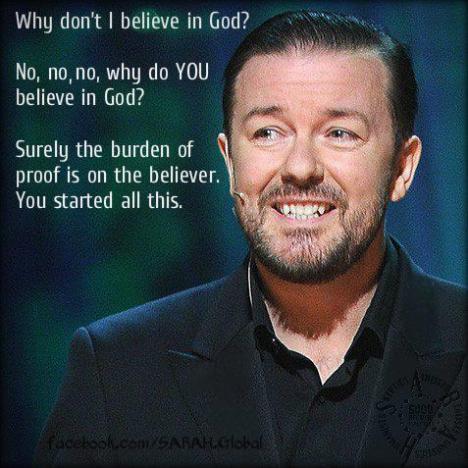
Here’s one believers often miss

RickyGervais

Next up on the list of what believers miss: Why noting that no atheists spends as much time debunking unicorns as they do debunking gods is asinine.

Yes, religion is given undue respect and special rights

One of the basic arguments of Gnu Atheism is that religion is given undue respect. Indeed, this argument is aired out in the opening pages of The God Delusion; it’s necessary to establish this obvious fact before going any further with other issues. To do otherwise would be to handcuff one’s self to fighting on the the theist’s sheltered turf. It isn’t usually a fair match when one side needs to tiptoe around the facts for fear of being dismissed purely on the grounds of being mildly offensive.

Of course, there are plenty of examples of this undue respect all around us. TGD gives a number, and there are new ones literally every single day. I’ll stick to just one:

A devout member of the Church of the Flying Spaghetti Monster had the cops called on him by employees at a Dayton, New Jersey, Motor Vehicle Commission facility after he demanded to be allowed to wear a pasta strainer on his head for his driver’s license photo.

25-year-old Aaron Williams, a practitioner of the mostly satirical anti-creationism “religion” of Pastafarianism, says he was told that motor vehicle policy prohibited the wearing of head coverings in license photos excepting those worn for religious reasons.

“I take it as seriously as anybody else when it comes to religious beliefs,” he later told NJ.com.

There really was no reason to call the police it seems, but that isn’t what’s important here. What’s important is that New Jersey allows individuals to wear headgear for religious (among a few other) reasons. Aaron Williams should have been allowed to have his photo taken with a strainer on his head. To say otherwise is tantamount to saying that the government is allowed to pick and choose what religious beliefs are protected under the First Amendment.

The first objection, I think, that many people will have (besides outrage at having the very idea of religion mocked – the horror!) is that Pastafarianism is not a religion, so there’s nothing to discuss here. That isn’t entirely true. While it isn’t a sincere religion, it does reflect a sincere religious position. That is, Pastafarianism specifically addresses the silliness of certain religious dogma, doctrine, and teaching. It isn’t necessarily related to atheism, but it does deserve the same protection atheism is given under the First Amendment. (Though atheism is also not a religion, the First Amendment provides for freedom for and, as a natural and necessary extension, from religion.)

Williams will be taking his request to state officials higher up the ladder, so it remains to be seen what happens, but I think it’s worth taking a look at the laws of other states. Let’s take a gander at Maine:

An individual may be photographed wearing a turban or the customary wear of a nun. Headgear is also allowed for medical reasons. No other exceptions are provided. “No one will be allowed to wear a hat or other headdress when their photo is taken, except for a Nun who may wear the headdress as part of their ‘habit,’ or a turban may be worn in conjunction with religious beliefs. A person undergoing chemotherapy and requests to wear a kerchief, hat, etc., is allowed to do so.”

This is one of the most absurd special rights granted to religious driver’s. Not only is it saying that special laws apply to people based upon their religious beliefs, but it’s going one step further and specifying two specific groups who don’t have to follow the same laws as the rest of us. So you got that, Jews? You listening, Mennonites? No hats for you.

I only pray to his Noodley Goodness that these laws may one day change.