Never mind, Cedric

Turns out that, in addition to updates on this being surprisingly frequent, Cedric the Tasmanian devil is not immune to the cancer afflicting his population.

Two coin-sized tumours were cut out of his face and, although it is hoped he will make a full recovery, it casts doubt on much of the research work conducted over the past two years, the BBC’s Nick Bryant reports from Sydney.

Double update update: Actually, I was getting articles from a recent blog post which had out-of-date references. Cedric proved to be a dead-end close to a year ago.

Devil cancer update

The devastating cancer spreading through the Tasmanian devil population has so far met resistance in at least one devil (Cedric), and possibly in his brother (Clinky).

Both were injected with dead tumours by scientists. Clinky produced no antibodies, but Cedric did and appears to have built-in defences against the mystery illness.

The experiments have now moved up a gear.

Researcher Alex Kriess says the pair have had live cancer cells inserted into their faces.

“They haven’t developed a tumour so far,” he said. “We injected very few cells so it might take a while until they develop anything that we can see.”

The next step is to see why Cedric may be resistant to the disease, which Jerry Coyne has deemed “can be regarded as a separate organism, genetically free to undergo independent evolution.” (The syntax is correct, but for clarity, it’s the disease that can be regarded as a separate organism.)

The most interesting aspect of all this is that Cedric comes from the side of the island not yet especially devastated by the disease. As more research is done, it will be interesting to find out if there is any sort of special history with cancer, even this specific cancer, that Cedric’s part of the island has had. That could be one driving cause behind the genetic difference to consider in addition to simple drift or geographical barriers.

Image via Jerry Coyne

Gene therapy for color blindness

How’s this for weird? This past semester I did a paper on color blindness, citing the different types, where the mutations occur, and the newest research. I was just about to post about one specific breakthrough when I got distracted by a list of the top scientific breakthroughs of 2009. As it turns out, number one has to do with gene therapy.

Two boys with X-linked adrenoleukodystrophy, a disease that ravages the brain, are doing well after French doctors gave them a gene that helps to maintain the delicate myelin coating on their nerve cells. A woman with Pachyonychia Congenita, a painful skin condition, watched one of her sores fade after doctors switched off the offending protein with a newer kind of gene therapy called RNA interference. Twelve patients who were blinded by Leber’s congenital amaurosis showed signs of recovery after getting a genetic treatment in one of their eyes. Italian researchers announced that most of the 10 patients who received gene therapy for severe combined immunodeficiency, or “bubble boy disease,” are doing very well eight years after the procedure that repaired their defenses against infection.

I especially love the implementation of RNAi. I strongly suspect its use will only increase in the coming years, especially in the fight against cancer.

Also this year, researchers at the University of Washington cured two adult monkeys of colorblindness by giving them injections of a gene that produces pigments necessary for color vision. After the treatment, the animals scored higher on a computerized color blindness test.

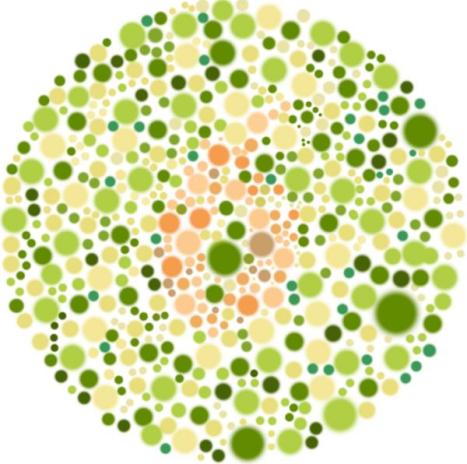
This one hits especially close to home. I also ‘suffer’ from color blindness, so I find it incredibly uplifting that I may not feel like I’m missing out on the things everyone else is seeing for the rest of my life. It isn’t that I can’t see color – I can – but colors become far less vibrant to me in lesser lighting. This happens to all humans, but it happens to those with color blindness sooner. I also cannot make fine distinctions, like the ones you see (literally) in the Cambridge Colour Test for color blindness. Take this for instance.

Most people will see a “6” there. I can make out some discoloration and the vague shape of a 6, but I wouldn’t be able to guess it without already knowing what to expect. I am likely deuteranomalous. It’s a pretty common type of color deficiency and it doesn’t especially affect daily life – I didn’t know I had it until 3 or 4 years ago during a routine eye exam (which I no longer need thanks to LASIK).

(And blah blah blah your monitor may suck or you may suck at coming up with a balanced coloring, so that test may not show up correctly in the first place.)

Devil Facial Tumour Disease

Devil Facial Tumour Disease (DFTD) is a particularly nasty tumor currently afflicting Tasmanian devils. It is responsible for the destruction of around 70% of the island population. One step, fortunately, has been made through the discovery of its specific cause.

The research collaboration, led by Australian scientists, has found that DFTD originates from cells called Schwann cells, which protect peripheral nerve fibres.

The results have been published in the journal Science.

Through the discovery, the team has now identified a genetic marker that could be used to accurately diagnose the perplexing cancer, which has seen the devil listed as endangered and facing extinction.

What happens is that these devils – so appropriately named – tear into each others’ faces because, well, that’s what they do. They’re about as nasty as the tumor itself. This then transmits the disease from one animal to the next. The research, in fact, has shown that the tumors all share the same characteristics, thus showing that it’s essentially the same faulty genes that are getting passed around, not new, individual tumors. Once the disease is passed, a massive tumor grows on the face of the unfortunate devil. If it doesn’t die directly from the cancer first, it starves from its inability to eat with a massive growth all over its face.

Associate Professor Greg Woods from the University of Tasmania’s Menzies Research Institute said the Schwann cell find was an important step in the process to further understand the disease.

“Devils develop tumours of all different types and the genetic markers we have identified are useful for telling apart the tumours that occur in DFTD from other kinds of tumours,” Associate Professor Woods said.

The propensity for devils to develop cancer so easily is distressing. They’re like the anti-naked mole rats. I would specifically be interested in learning about the quality of contact inhibition of the devils. My suspicion is that it simply sucks.

Another letter

The Kennebec Journal (KJ) has done what has become rare and published something which is full of sense and science: a letter by me.

Naturopathic medicine is pure bull.

Let’s not beat around the bush on this one. Those who practice naturopathy are quacks. They may be sincere quacks, but sincerity does not translate to evidence — or your health.

The Ontario legislature is considering giving naturopathic “doctors” prescription rights. This presents a serious danger to the health of any Canadian ignorant enough to be duped into the “care” of these charlatans.

But it hits closer to home than that. Maine is just one of several states that give these vastly underqualified “doctors” such rights. This presents a serious risk. They have no relevant medical training for offering prescriptions; this makes them highly susceptible to blindly doling out contra-indicated drugs, among other dangerous possibilities.

I cannot overstate this fact: Naturopaths are not doctors and they are not qualified.

They cherry-pick evidence, often lie and misrepresent facts.

Recently, a local naturopathic “doctor,” Christopher Maloney, wrote a letter in which he committed himself to that third possibility. He implied H1N1 vaccination properties for black elderberry. The only relevant studies on black elderberry are for the regular flu, do not show vaccination properties, and far larger studies are needed (as noted by the original researchers).

I implore anyone considering naturopathic “medicine” to not do it and/or cross-check Maloney’s “facts.” Naturopathy is not a science in any sense of the word; it is not to be trusted.

A long laundry list countering false naturopathic claims can be found at the qualified page Terra Sig on http://scienceblogs.com/terrasig/2009/11/more_naturopathic_nonsense_in.php

If everyone began to demand evidence, we could do away with this naturopathic “medicine” malarkey. We’d be all the safer for it.

Michael Hawkins

Augusta

withoutapologyinmaine@gmail.com

I’m glad I was able to sneak that email address in there. Without Apology is my publication and the sister site to FTSOS. That little advertisement is probably the best I can do there since I’m sure the KJ won’t let me link back to myself.

Anyway.

I don’t know if it was because I recently laid out a short summary of the sort of antics this paper has been playing (and then subsequently emailed the link the head honcho), but it took me some time to get this letter published. I originally wanted a much more comprehensive letter published, but Jim Evans lied to me and wouldn’t admit that libel was his concern, so I settled for a pro-atheism letter. Seeing through Evans’ lies, I rewrote my letter so that I could call Maloney a charlatan without directly saying it and submitted that. And then resubmitted it. And again. It looks like persistence won the day. (And that’s fortunate for Evans because once finals were over I planned on paying him a personal visit to get him to just tell me the truth. I mean, goodness. Just say what you mean.)

In the comment section of this letter, “homesteps” of Chelsea speaks of his/her experience being treated by Maloney. S/he says this.

Chris is very good at looking at factors that may impact mysterious conditions. He helps patients with food diaries and elimination diets. He encourages them to embrace an all-around healthier lifestyle. On top of these qualities, he is focused on finding the true underlying problems and treating the whole patient. He often recommends that people see their regular medical doctors, as he recognizes the limitations of any one-size-fits-all approach. He is one of the most caring doctors we have been to.

Maloney is NOT a doctor by any reasonable measures – and Maine’s measures are not reasonable! He has NO qualifications which earn him that title beyond the state’s bogus measurements!** It’s all fine and dandy if someone wants to waste money on someone telling them to not eat crappy foods* (should I be charging you readers for that nugget of advice?), but let’s not pretend that these people are actually qualified to be doling out medical advice. As I note in my letter, people run the risk of taking contra-indicated drugs if we start treating naturopaths as real doctors.

*I’m not disparaging true nutritionists or implying that their advice is a waste. My comment is more specific; think of going up to some random schlub on the street and asking him for dietary advice. He may rightly tell you that eating a lot of trans fat is bad for you, but that doesn’t mean that he has done anything to earn payment from you.

**Maloney whined to WordPress to make me change this. I originally said he was not a doctor at all. Under the technicality of Maine law, he is a doctor. But he’s a dangerous one because he lies about the efficacy of treatments to suit his purposes. And, again, he is not allowed to practice naturopathy in two states.

Intelligence trick

How dare this person use the trick of intelligence! It’s a conspiracy of the competent!

Greatest Discovery Since Natural Selection Possibly Made

Not since Charles Darwin discovered the process by which life diversifies has a more important discovery been made (and I include relativity). In fact, part of me almost wants to say this is the most important discovery ever. Almost.

Nasa scientists have produced the most compelling evidence yet that bacterial life exists on Mars.

It showed that microscopic worm-like structures found in a Martian meteorite that hit the Earth 13,000 years ago are almost certainly fossilised bacteria. The so-called bio-morphs are embedded beneath the surface layers of the rock, suggesting that they were already present when the meteorite arrived, rather than being the result of subsequent contamination by Earthly bacteria.

No, no, no. Stop. You didn’t let it sink in. Even if you’re amazed, you still haven’t let it sink in properly. It’s good evidence for life on another planet. LIFE ON ANOTHER PLANET.

This meteorite has actually been known for some time on Earth (1984), but it wasn’t until recently that better technology (thank you, science) made it possible to carry out far more detailed tests. The likely conclusion appears to be that this is, in fact, evidence for life.

As always, scientific excitement needs to be tempered with an eye toward always needing greater evidence (and there is some in the form of two separate meteorites). But that doesn’t make this any less exciting for me. It is crashingly obvious that life is wholly tenacious, so its existence elsewhere – in a Universe with more stars than grain of sands on all the beaches of Earth – is practically expected. Its close proximity and initial discovery is where the excitement really rests.

Only in the Light of Evolution

The following also appears at For the Sake of Science. Presented here is that version rather than the version for the physical copy of Without Apology.

By Michael Hawkins

We should see fossils in a certain order if evolution is correct. They should go from simple to more complex overall, and the fossils we see in the most recent strata should resemble extant life much more than the fossils we see in old strata.

We should also see changes within lineages. We should be able to observe instances of gradual change in species that eventually leads up to either current species or at least to the time of extinction for these species.

Here’s a simple timeline of life’s history. Click it.

What the evidence shows is gradual change. First we find simple bacteria which survived off energy from the Sun, then we see more complicated cells known as eukaryotes arise. (You are a eukaryote.) Next we see a slew of multi-cellular animals arise. They’re still simple, but much more complex than the original bacteria. A few million years later more complicated life arrives. Early (and simple) plants begin to take hold. Soon the fossil record begins to show more plant complexity with low-lying shrub such as ferns, then conifers, then deciduous trees, and finally flowering plants. Gradual changes occur in the oceans and fresh waters which lead to fish and then tetrapods (Tiktaalik comes to mind).

One of my favorite fossils is trilobites. They’re extremely common due to their hard bodies. In fact, even their eyes are well-preserved because of their hard mineral make-up. I personally recall entering touristy-stores seeing countless fossils of these guys in the mid-west to the west (which, unsurprisingly, was once a shallow sea). This image shows the different lineages of this organism. Studies show that the ‘rib’ count has changed over time in each individual species, often without regard to how the other species changed. Going back further, there is less and less divergence in each species. Eventually, as evolution predicts, they all meet at a common ancestor.

So naturally the next step is to find fossils which show more significant changes. Let’s take birds and reptiles. They hold similarities between each other, both morphologically (certain shapes and structures) and phylogenetically (genetic sequence). A good hypothesis is that they came from one common ancestor. If this is true, the links between birds and its ancestors and reptiles and its ancestors should lead to the same point. They do. Dinosaurs are the ancestors of both. The links between birds and dinosaurs are so incredibly well established that I’d prefer to not go over them in detail. But for starters, some dinosaurs sported feathers and claws and had the same proteins for the feather-making process as extant birds. The links between reptiles and dinosaurs is easier just on intuition, so I’ll leave it at that for now.

Other transitional fossils include the already mentioned Tiktaalik. A view of the history of life can be see here. This shows the change in head and neck structure. Recent research on long-ago discovered Tiktaalik fossils has shown the importance in the gradual bone changes in the neck. These changes – a hallmark of evolution – were important to the ability to turn its head. This is a hallmark because natural selection only modifies what already exists. This is precisely what happened.

Going further with this example, evolution makes predictions as to how early fish evolved to survive on land. If there were lobe-finned fish 390 million years ago and obviously terrestrial organisms 360 million years ago (which is what the fossil record shows), then if scientists are to find transitional fossils, they should date in between that time frame. There should be an animal that shows both features of lobe-finned fish and terrestrial animals. Tiktaalik is that animal. It has fins, scales, and gills, but it also has a flat, salamander-like head with nostrils on top of its nose. This is a good indication that it could breathe air. Its eyes were also placed there, indicating that it swam in shallow waters. Furthermore, it was lobe-finned, but shows bones (which eventually evolved into the arm bones you used to get out of bed today) that were able to support its weight to prop itself up. And of course, it dates to 375 million years ago.

Next, evolution says the fossil record should show recent fossils being more closely related to extant species than are early fossils. This is precisely what happens. Sixty million years ago there were no whales. Fossils resembling modern whales only show up 30 million years ago. So, again, evolution makes a predication: if transitional fossils are to be found, they will be within this gap. And so it is.

We begin with Indohyus. It was an artiodactyl. This is important because extant whales have vestigial bones which indicate that they came from this order: scientists expected to find this because, again, evolution predicted it. It should be of no surprise that this fossil dates to about 48 million years ago, right in the predicted gap. From here there is a gradual evolution shown in the fossil record which leads up to modern whales.

The lac Operon

This article has appeared separately at For the Sake of Science.

By Michael Hawkins

The lac operon of E. coli is the classic example for describing inducible prokaryotic gene expression. One excellent video description of it can be found here.

The jist is this. Not all genes are turned on all the time. There are ones which are needed constantly, others which are only needed in specific types of cells, and then others which are ‘turned on’ in specific situations. It is on this last point which I will focus.

In order for a gene to be ‘turned on’, it must be ‘off’ in the first place. All this means is that an organism’s (relevant) DNA is not being transcribed, thus preventing translation and the manifestation of proteins. The way this occurs in E. coli by means of the lac operon is that the lac repressor is bound to a DNA sequence.

A repressor is itself a protein. It binds to an organism’s DNA, thus preventing RNA polymerase from transcribing anything. This is a physical blockade; the repressor prevents the RNA polymerase from physically attaching and running along a specific sequence of DNA. This is the default position for an inducible repressor.

The way the repressor is removed is simple to understand. It has a specific shape to it which enables it to bind to the DNA sequence. However, this shape can be changed if lactose is present. The lactose will bind to the repressor, thus causing an allosteric change in shape. This means the repressor is no longer the specific shape needed to attach to the DNA, so it releases its ‘grip’.

This release allows the RNA polymerase to continue with transcription. This, eventually, turns to translation. In this stage, enzymes are created, two of which are ß-galactoside permease and ß-galactosidase (there is a third which can be ignored here). The former of the two is membrane-bound. This means it becomes embedded in the cell membrane. This quickens the transport of lactose from outside to inside the cell. Think of it like a tunnel through which only specific shapes can fit.

Once these specific shapes (lactose molecules) pass into the cell, ß-galactosidase breaks them into their constituents, one of which is glucose. This is used as a key source of energy in many organisms, including E. coli.

Once concentration falls, lactose molecules are no longer bound to the repressor, making it free to resume its normal duties attached to DNA.

RNAi: Watching Your Back

The following has appeared on For the Sake of Science. The article in the physical copy of Without Apology has slightly different wording for the sake of print.

By Michael Hawkins

RNAi is an arrestingly interesting little mechanism for protecting the health of cells. The “i” stands for interference, and with good reason. RNAi is made up of a series of molecules which work to detect and destroy possible viruses and RNA which could be viruses.

It was first detected in 1986 when an attempt was made to make a really, really purple flower. The reason was purely for aesthetics, but it would prove to be far more important.

Knowing the gene which coded for purple pigmentation in petunias, geneticists made the logical conclusion and figured adding a bunch of those genes to the flowers would increase the depth of purple coloring in them. But as it turned out, they were wrong. In fact, they were remarkably wrong. Instead of deep purple flowers, they produced white flowers. Not a hint of purple anywhere.

No one had an answer to why would be. It took 12 years until researchers came up with the answer (and another 8 until they were awarded a Nobel Prize).

When viruses invade a cell, they ‘seek’ to make copies of themselves by utilizing the available DNA source. Post-transcription, this comes out with a funny shape due to the RNA making a mirror image of itself. The RNAi then recognizes this strange shape and destroys it with dicers. But it doesn’t stop there. Any sequence which comes out of the nucleus thereafter is also destroyed. This prevents any of the viruses (hopefully) from being translated and replicating (thus exploding out of the cell and infecting other cells).

Something similar happened when the geneticists tried making the super purple flowers. There wasn’t a mirror-image RNA sequence, but there was a funny sort of shape created by all the extra purple pigmentation genes. The RNAi recognized this as a potential virus and began destroying it. All of it. This meant there were no genes for purple getting translated into proteins.

Example petunia plants in which genes for pigmentation are silenced by RNAi. (http://en.wikipedia.org/wiki/Rnai)

Example petunia plants in which genes for pigmentation are silenced by RNAi. (http://en.wikipedia.org/wiki/Rnai)

So far this is pretty exciting stuff. It’s a post-transcriptional defense mechanism against viruses no one ever knew existed. But it has so much more potential than just as a passing curiosity.

Think about it. If RNAi can essentially turn off genes by destroying them through a sort of sequence-detection, then what stops it from curing diseases? This discovery has the serious potential to cure all the major ailments facing the world today: AIDS, cancer, Alzheimer’s. There has already been success in treating macular degeneration. This is a disease where too many blood vessels are growing in the eye. It damages the retina over time and makes vision majorly cloudy and blurry. There are simply too many genes for blood vessels being produced. But one way to stop this disease is to stop that blood vessel growth. To achieve this, a patient is given an injection which contains a copy of the gene with its mirror image (two mirror strands of DNA). The RNAi detects this misshape and destroys it. It then destroys all other likewise sequences. The same principle could be applied to any number of diseases.

There is an excellent NOVA video on RNAi which can be viewed here. It’s certainly worth watching (and only 15 minutes long).