I accepted the invitation to see Expelled. It was about what I expected.
I didn’t subject myself to that horrid movie since I’ve already seen it, but I did make sure to show up toward the end. I caught the last bit with the interview with Richard Dawkins. It’s hilarious. Ben Stein, horrid economist, understander of science, and vaguely entertaining actor in the 80s, asks Dawkins to put a specific number on the probability that God does not exist. Dawkins says he doesn’t feel comfortable doing this, but Stein persists. To the creationist audience that’s going to interpret absolutely everything as supporting their inane ideas, this comes across as gold. Dawkins seems to be stumbling. The truth is the question is absurd. It would be like asking a creationist to scientifically put a number on the likelihood God does exist. The more stupid breed of creationist will say “100%”, ignoring my qualifer “scientifically” – words, meanings, definitions, and honesty are irrelevant to these mooks – but the rare creationist will see the absurdity of this. More aptly, however, this would be like asking the likelihood that an elephant, shark, or wolf would evolve. No scientist is going to give a straight-up percentage. It doesn’t make sense to that, and even if it did, there are far too many variables to be in the least bit accurate. This, contrary to what the creationist mind thinks (if we are to follow its ‘logic’ to its end), does not mean elephants, sharks, or wolves could not or did not evolve. But even more aptly, it’d be like asking the likelihood that fairies do not exist. The whole thing ignores the point of the argument.
Anyway, there was a “discussion” after the movie ended. By this I mean one guy who claims to have a degree from Oxford and I had a back and forth. The details are becoming fuzzy, but to give you an idea of the sort of thing he was saying, take this. I brought up that no papers supporting intelligent design have ever been peer reviewed and published. He countered by pointing out that Michael Behe and William Dembski both have books out that have been reviewed. For the dumber of you out there (i.e., creationists who think he delivered me a knock-out punch), that is not peer review. The criteria for getting published in, say, Nature is just a tad more difficult than the criteria for seeing your book on the shelves of Barnes & Noble. Mainly, the bookstore criteria is that it will make some money. I had difficulty making this point because the leader of this whole shindig kept trying to interrupt our discussion, but I did get to mention that those books have been peer reviewed in the sense that The God Delusion has been peer reviewed. At that point, this guy (a pastor) completely misunderstood the point and not only asserted that Dawkins’ book had been panned but that it was very poorly written. Again, I was cut off before being able to counter, but c’mon. I can understand someone being so driven by a fear of evidence that they outright reject Dawkins’ arguments, but the man is a fantastic writer. Saying otherwise is just being petty.
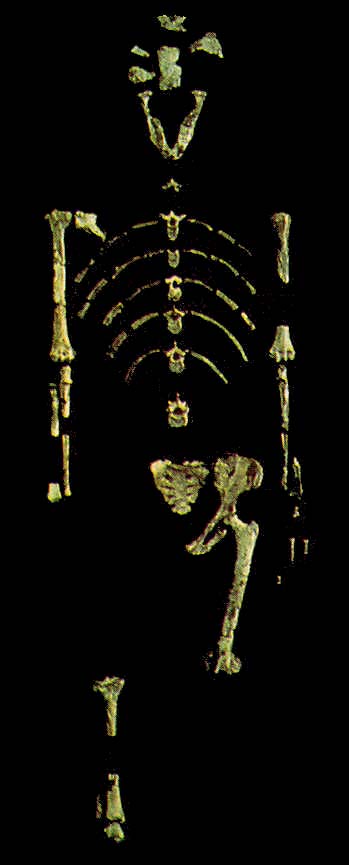
After the discussion was mysteriously cut short by 30 minutes, I continued speaking with this pastor. He claimed that the Lucy fossil had been found over an area of 300 feet and only 1% was discovered. I told him he was wrong. This is common; creationists will get these untruths flowing at their churches (usually pushed by the leaders) and entirely believe them. Research? Confirmation? Nah. It’s a convenient thing to believe. You can do your own 30 second Yahoo! or Google search if you’d like, but if you don’t already know the answers, they are: Lucy was discovered all in one location with no duplicate bones nearby (in other words, it was certainly one animal); her body is surprisingly complete, not at 1%, but 40%. From my memory of her images, I would have guessed something a little higher, but I refrained, opting instead to get his email. I gave him this information, plus some other things debunking some wrong ideas he had about black holes (time does not “become irrelevant” at the event horizon). No response has shown up in my inbox.
Overall, it was about what I thought it’d be. A lot of quiet people who would nod their heads to the one or two more vocal creationists in the group who would invariably give me the same old tired arguments coupled with a few random numbers they think are impressive but are really just wrong. Standard.
Filed under: Creationism | Tagged: Ben Stein, Creationism, Evolution, expelled, Lucy, Richard Dawkins, University of Maine at Augusta | 1 Comment »





 For the Sake of Science