Religion and the fear of death

One of the motivators for religious belief is the comfort it provides. For many people it provides an immediate comfort because it allows one to be a part of a bigger group, and people like to belong. For others, it provides a comfort of ‘knowing’. For instance, we all want to know the answer to a lot of basic questions like “How old is the Earth” and “How did humanity begin”. Religion – while it has either always been wrong or been forced to defer to science in order to be correct (and even then it usually mangles things) – makes strong claims that it has the answers. But for so many others, religion provides comfort against the fear of death. Many of us want to believe we keep on existing, that all we’ve done in our lives has some unending meaning, and maybe ultimately, that we are never alone. It is this final sort of comfort that indirectly forms the basis of some new research:

Researchers at the University of British Columbia and Union College (Schenectady, N.Y.) have found that people’s ‘death anxiety’ can influence them to support theories of intelligent design and reject evolutionary theory…

The researchers carried out five studies with 1,674 U.S. and Canadian participants of different ages and a broad range of educational, socioeconomic and religious backgrounds.

In each study, participants were asked to imagine their own death and write about their subsequent thoughts and feelings, or they were assigned to a control condition: imagining dental pain and writing about that.

The participants were then asked to read two similarly styled, 174-word excerpts from the writings of Behe and Dawkins, which make no mention of religion or belief, but describe the scientific and empirical support for their respective positions.

After going through these steps, participants who imagined their own death showed greater support for intelligent design and greater liking for [Michael] Behe, or a rejection of evolution theory coupled with disliking for [Richard] Dawkins, compared to participants in the control condition.

However, the research team saw reversed effects during the fourth study which had a new condition. Along with writings by Behe and Dawkins, there was an additional passage by Carl Sagan. A cosmologist and science writer, Sagan argues that naturalism — the scientific approach that underlies evolution, but not intelligent design — can also provide a sense of meaning. In response, these participants showed reduced belief in intelligent design after being reminded of their own mortality.

While it was creationism intelligent design that was chosen for this experiment, I see this study as representative of religion at large. When shown two different arguments, a sizable portion of the participants clearly chose to reject evolution on the basis that it provided them with no sense of meaning. It isn’t particularly relevant that the alternative was specifically creationism intelligent design since there is no science to be found within any religious idea anyway – nor is there any science supporting any religious claim of significance. Any relatively mainstream religious idea could have been presented in science-y terms – just as creationism intelligent design is – and then used as a tool for comparison.

This isn’t all to say that the primary motivator for religious belief is the fear of death. I suspect it’s actually culture and upbringing – the biggest indicator of what one’s religion will be is what his or her parent’s religion is. But the fear of death – the fear of the unknown – frightens people and makes them uncomfortable. Religion helps to ease that discomfort with its made-up stories and fairy tales, and so it acts as a tightly woven net that catches people before they can fall into reason or even momentary consideration of their beliefs.

While the results of this study are obvious (and while they will be distorted by believers), I think there is another interesting point here, albeit an obvious one. There are a lot of accomodationists (Collins, Giberson, Miller, etc) out there who will argue that religion and science are compatible. While their position is one that is in some ways a small improvement over the current situation, there is comfort in the fact that they aren’t winning over too many adherents. People still recognize that evolution does largely eliminate their particular, cultural god. The fact that we know humans were not inevitable (or any other animal, for that matter) means that most of the gods in which people believe are untenable. That is, the sort of gods people praise are almost always the ones that deemed the inevitably of humanity. That inevitably takes away the random components of life and gives credence to why a god would care about us at all. I think the recognition that evolution takes this all away is ultimately good because it shows that while these people do not understand evolution in its details, they do understand its implications. That is a good thing – even if they falsely associate those implications with a lack of meaning in life.

Source

It bears repeating

Happy birthday, Richard Dawkins

The good doctor is 70 years old today. Here’s to many more fruitful years of destroying all the weak* arguments Christians have for their evil little god.

*There aren’t any strong arguments.

Revelation TV interview of Richard Dawkins

My two favorite parts happen between 36 and 40 minutes. First,

Conder: Am I just deluded?

Dawkins: Probably, yes.

Second, shortly thereafter Conder cites the fulfillment of prophecies, especially those that come from Micah, as one of his big reasons for initially being attracted to the Bible. It’s hilarious. As I’m sure all good Christians know, the gospels were often poor attempts to fulfill those prophecies. That’s the case with the birth of Jesus.

Anyway. The interviewer is pretty awful, but Dawkins’ parts are good.

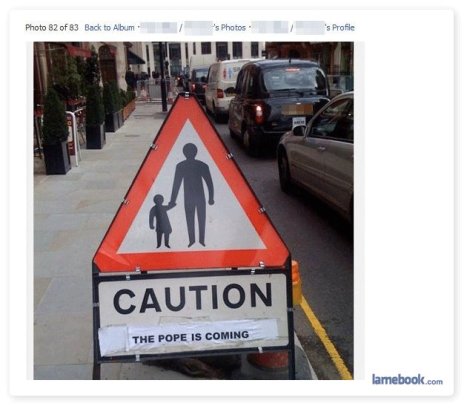
Caution: The pope is coming

But there’s more!

Hugh Dallas, head of referee development for the Scottish Football Association has been sacked because he passed on, by eMail, a joke about the pope. His dismissal was called for by a spokesman for the Roman Catholic Church in Scotland. This nasty little weasel is called Peter Kearney, Director of the Scottish Catholic Media Office. His details, in case you feel like sending him a message, are as follows:

Peter Kearney, Director, Scottish Catholic Media Office, St George’s Buildings, 5 St Vincent Place, Glasgow G1 2DH
eMail: mail@scmo.org

Similarly, the Chief Executive of the Scottish Football Association, responsible for this craven giving-in to Catholic censorship is Stewart Regan. The address of this coward is Scottish Football Association, Hampden Park, Glasgow G42 9AY
eMail info@scottishfa.co.uk

It would seem, from the YouTube video posted here, that the joke concerned is the one that heads this page, warning children of the approach of the pope. The caption was censored, but it isn’t difficult to find the original. It is at http://www.hollow-hill.com/sabina/images/caution-pope.jpg

My suggestion is that we should do our best to make this joke go viral, beginning by sending hundreds of copies of it to these two addresses:
mail@scmo.org
info@scottishfa.co.uk

But there are probably funnier jokes along the same lines, and I would encourage you to send as many as you can find.

Richard

Hitchens-Blair debate

There is a YouTube channel devoted specifically to the recent debate between Christopher Hitchens and Tony Blair. I’ve yet to watch it, but I find both men to be quite intelligent. (Update: I have watched it.) Hitchens’ intelligence is crashingly obvious; I’ve never seen him lose a debate point. And I absolutely love how he will routinely bend over backwards to grant as much as possible to his opponent just so he can point out that he still has the point won. Anyone who saw that awful creationist movie with Ben Stein should be familiar with this tactic: In the Richard Dawkins interview, Dawkins granted that it’s possible that we could have been designed by aliens, but even if that were so, we would still need to appeal to evolution in order to explain their existence. Stein, unsurprisingly, takes the dishonest route of claiming that Richard Dawkins is only against intelligent design when it involves a god. This was rather expected since the creators of the movie lied to every biologist involved, not to mention the fundamental dishonesty behind creationism intelligent design. But I digress. Blair’s intelligence is clear enough, but I think perhaps some of my perception of it comes from the contrast of it with Dubya’s lack of smarts.

Anyway. Watch the debate. (Skip the first video if you just want to get to the meat of the debate.)

Agnostic? Then you shouldn’t have children.

An Indiana judge has issued a ruling stripping a father of joint custody of his three children. One of the reasons cited by the judge was the lack of religion of the father.

[Judge] Pancol’s order says [Craig] Scarberry “did not participate in the same religious training that the (mother) exercised and that (Scarberry) was agnostic.” Scarberry has until Dec. 1 to appeal the ruling, which has reduced his custody to visitation with his children four hours per week and on alternating weekends.

Watch this short news report.

Of course, there’s certainly more to the story, but all that’s out there right now is that Scarberry’s lack of Christianity is a contributing factor in why he is not allowed to retain joint custody of his children. There is no evidence of neglect or abuse, nor any accusations of any sort of thing.

The main issue for the ruling (and then affirming) judge is this:

The order severing joint custody was issued by Pancol on Nov. 1 and affirmed by Newman on Nov. 8. It said that when Scarberry had been a Christian, “the parties were able to communicate relatively effectively.”

So why give benefit to the mother? Both parents were given joint custody; that communication is difficult due to religious differences does not mean the Christian therefore wins the legal battle. There is no reason to presume the Christian is better – in any way – than the agnostic. Besides, the ruling is blatantly unconstitutional.

A secondary issue in all this is the right of the father to have a fair hearing in these cases. In the past, the father was considered the bread winner and there were financial and practical reasons for granting more rights to the mother. Except we aren’t living in a dysfunctional episode of The Dick Van Dyke Show anymore. For that reason, Scarberry has this planned:

A Navy veteran and health-care worker, Scarberry has obtained a permit for a demonstration in support of fathers’ rights for Dec. 16 at the Madison County Courthouse.

Scarberry, of course, will also be addressing his (non)religious liberty, or lack thereof. His case is a good one and his fight is for all the right reasons. I’m just worried about all the inherent and undeserved respect religion is getting in all this.

“I wasn’t interfering in their right to be brought up in a Christian environment,” [Scarberry] said, noting that the children still attend Christian school and church services as they have done in the four years that he has had joint custody.

It’s bad enough that both the ruling and affirming judges are letting their personal and cultural biases seep into the court room, but Scarberry doesn’t need to do it too. Or maybe he does. After all, the man is fighting for his children; what it takes, it takes. But ideally, he should not need to let undue respect squeeze its way in: children don’t have a “right” to be brought up in a particular religious environment. That sort of right goes to the parent. There is no such thing as a Christian (or Muslim or Jewish or…) child, much less one that wants to exercise its right to be brought up in a particular religion. Saying otherwise is like saying there are Democratic and Republican children. There aren’t. And to compound the whole mess, Scarberry cites the attendance of a Christian school and church services by his children. Again, the man is fighting for the children, so he has no higher concern, but the indoctrination of his children should not be looked upon as a good thing.

Maybe if the judges just read the first and final chapter of The God Delusion, they would get it.

If only I had so much hate mail

The time when I know this blog will be successful is when I begin to regularly receive hate mail.

He doesn’t get atheism either

It’s annoying enough when Christopher Maloney wades in over his head and pretends to know something about medicine beyond what a pre-med student might know. But it’s even more annoying when he goes after atheists. (And, I mean, does he really want to go down that road, what with yet offering a viable defense for his quackery?)

I’m constantly amazed that the spokespeople for religious points of view aren’t better at getting their points across. The atheists are the one group who could have picked their spokespeople logically and by open election, but they let the most grumpy of their brethren carry the flag. Here’s a comparison of Dawkins vs. Gervais. If Gervais were the spokesperson for atheism, there would be a lot more converts. He makes his point, and you can’t help liking him for it. Dawkins makes a clever (rehearsed- he gives the same mocking answer to others as well) response without engaging the speaker.

Here’s Richard Dawkins not answering a question. Or answering it, if answering with the same question is an answer.

He then links to this video of Dawkins where an audience member asks what happens if he’s wrong about the Christian god. Dawkins replies by asking the audience member what if she’s wrong about all the other gods. To Maloney, this isn’t answering the question.

Is Dawkins’ point really that hard to get? He’s saying that the only reason that question seems reasonable to the audience member is that she has been brought up in a Christian culture. His question about what it means if she’s wrong about Zeus or Thor or whoever is to show that it doesn’t matter about what god we want to ask the question. It’s a trivial issue that assumes a lot of culture with it. So what if he’s wrong about the Christian god? Then he goes to hell, to the glee of a so-called benevolent creator. And if the audience member is wrong about Allah, she can kiss heaven goodbye. Who cares? The whole question is just a rudimentary way of posing Pascal’s Wager, that piece of philosophical trash.

Oh, and I love how Maloney links back to religion and atheism, as if we need his help in defining the terms. (Well, maybe he needs some help in defining “atheism”.) And linking to the IMDb page for Dawkins? Gold. I love when the elderly use the Internet.

On fundamentalism

Richard Dawkins on fundamentalism:

I’m not fundamentalist. A fundamentalist is someone who knows they’re right because they’ve read a holy book. Nothing is going to shift them from it, whereas a scientist is going to shift if the evidence changes. What a scientist does is say the evidence at present points me in one direction. If the evidence changes, I’ll change with great pleasure. That’s the opposite of a fundamentalist.