


The more and more I think about it, the more and more I recognize just how easy it is to understand evolution.
Evolution is the change within populations over time. This change is continuous. Take birds, for instance. They are descended from dinosaurs. Depending on who you ask, you might even hear them referred to as dinosaurs. However, for the sake of argument, let’s draw a line in the sand. Let’s say birds are birds and dinosaurs are dinosaurs. There is no single point to which we can point that says “Ah-ha! This is the generation in which birds originated!” Evolution doesn’t work that way.
Life is gradual in the big picture. The lines are blurry as to where one species begins and where another ends. It is simply a matter of convenience that we are able to make the distinctions we make. Ancient birds weren’t great at flying. Less ancient birds were better. Even less ancient birds were even better. And then, sometimes, extant birds are back to being terrible at flying. It just so happens that we’ll never know what every year of every species was like. If we ever do, we won’t be able to say “Such-and-such is Species X and this other example is Species Y”. We’ll be looking at Species X.1, X.11, X.111, X.112, etc.
To be this all another way, mother birds (or bats or monkeys or humans or bears or prarie dogs) only give birth to daughter birds (or bats or monkeys or…etc). But over time, small changes accumulate. Think of how much you probably resemble your father in some way. Now think of how much you resemble your grandfather. Odds are, you resemble him less than you resemble your father. Go back further and you’ll see more changes. And that’s just on a phenotypic (for purposes here, “physical”) level. Go to a genotypic (genetic) level and there’s no questioning the facts. You are more similar to your close relatives than to your distant ones.
Now we have to extend this concept over time. We have plenty of it. Evolution has been playing out for nearly 4 billion years. Think about that for a moment. You’ll live around 80 years. If you’re lucky, you might hit 100. A tremendously long human lifespan would be another 20 years on top of that. It’s all a blip on the timescale of Life on Earth.
So here’s what you should be thinking. Every generation is similar to the previous generation. It doesn’t matter what species we want to specify. It’s always true. But the further back we go, the fewer similarities we see. But importantly, we still see similarities.
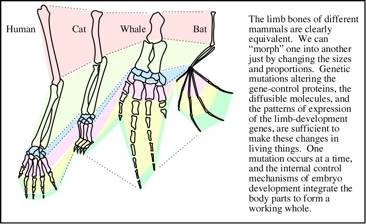
Take the bones in the wing of a bat. They are easily matched with the bones in the hand of a human or the paw of a cat. They are the same bones but shaped vastly differently. It isn’t simply a huge (convenient) coincidence that this is so. Bats share a common ancestor with other mammals. This common ancestor, being that it is found deeply in time, would hold notable similarities with all extant mammals, but it obviously wouldn’t visually match with every single organism (or even a majority).
But the visual match isn’t all with which we need to concern ourselves. That common ancestor wouldn’t be able to breed with anything alive today. The changes have been far, far too considerable since its time.
I’m breaking stride for a moment because I want to note something. The changes which occur over time in a species are what cause it to be considered a new species. In other words, when two populations cease to be able to breed and produce fertile offspring, we have a two separate species (which one we want to call the “new” one is somewhat subjective, but usually it’s the one least resembling the common ancestor). As I said, there is no single point where speciation happens, but imagine for a moment approximately the time where two populations cease to be able to breed. It won’t be one defined generation where it occurs, but there will be some generation somewhere where some members of a population cannot successfully produce fertile offspring with members of another population.
On the face of it, this sounds like I’m contradicting what I’ve been saying all along about not being able to pinpoint one generation. I’m not.
Remember I talked about the lines being blurry. While some members of one population probably won’t be able to breed with some members of another population, that won’t be true for all members of both groups. Much breeding will still be possible. With time, those possibilities dwindle. Eventually, the line begins to come into focus. That is how evolution works: It’s gradual.
So again, the more and more I contemplate evolution, the more and more it makes so much sense. Of course, the evidence is crystal clear and I don’t need this contemplation to confirm the theory. However, it is through this focus that I’m forced to wonder why we had to wait until Charles Darwin and Alfred Wallace to really recognize how new species come into existence. The truth is that changes occur in populations over vast expanses of time. Then most of the world’s populations either continue to evolve or, more likely, go extinct. In hindsight, we observe definitive periods of stasis, almost leading one to believe in static, unchanging species. Almost.

Filed under: Evolution | Tagged: Birds, darwin, Dinosaurs, Evolution, Gradual, Species, Wallace | 19 Comments »
 For the Sake of Science