

Well, of the Universe. But as seen through the eye of Hubble.

I know I’ve posted this in the past, but it’s just such a great photograph.
Filed under: Astronomy/Cosmology/Physics | Tagged: Galaxies, Galaxy, hubble | Leave a comment »

 | septrose14 on Reddit layoffs |
 | shelldigger on Thought of the day |
 | The Sauciest Duck on Chauvin and Rittenhouse |
 | Michael on Chauvin and Rittenhouse |
| Stephen Moreton on Chauvin and Rittenhouse | |
 | Mele Kalikimaka | Fo… on Merry Christmas |
| Mele Kalikimaka | Fo… on Mele Kalikimaka |
 | somdeblahiriyahoocoi… on Thought of the day |
| Michael on Wuhan virus and one last… |
| Quick correction | F… on The A-Unicornist, Bernie Bro… |
Well, of the Universe. But as seen through the eye of Hubble.
I know I’ve posted this in the past, but it’s just such a great photograph.
Filed under: Astronomy/Cosmology/Physics | Tagged: Galaxies, Galaxy, hubble | Leave a comment »
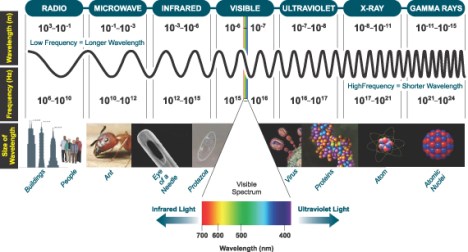
I’m just sticking this up here for the sake of easy reference since today is the day I get to continue with conveying science.
Filed under: Astronomy/Cosmology/Physics | Tagged: Electromagnetic spectrum | 4 Comments »
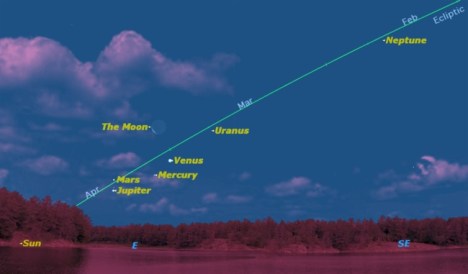
For the last two months, almost all the planets have been hiding behind the sun, but this week they all emerge and are arrayed in a grand line above the rising sun. Mercury, Venus, Mars, and Jupiter are visible, and you can add Uranus and Neptune to your count if you have binoculars or a small telescope.
This sky map of the six planets shows how they should appear at dawn to observers with clear weather and an unobstructed view.
Counting this morning, the moon will also be lined up for four mornings (sorry my fellow EST people for the post-dawn post).
Filed under: Astronomy/Cosmology/Physics | Tagged: Aligned planets | Leave a comment »
I’ve been placed in the fortunate position of working with teens who need help. They’ve all dealt with drug issues and are trying to rehab while maturing and learning. I help in both areas, but I especially enjoy helping in the second realm.
Many of these kids have been out of school for years, so as a result they’ve missed quite a bit in life and formal education. In fact, even if they were in school, they probably have missed out on a lot of what I want to tell them. For instance, while in front of a world map, I told one kid a few basic geography facts while conveying the historic and biological significance of the Galapagos Islands. He really enjoyed it, learning it for the first time. He even enthusiastically told his peers what I told him, emphasizing how big the tortoises are on the island. But what really struck me was how interested another kid was in some basic facts about the Universe. I started by showing him this picture I’ve posted before:

This is an image taken near Saturn. The little blurry dot outside the rings on the right is Earth. A zoom of Earth is seen in the top left. It’s a great picture that really puts things into perspective quite simply. Showing it to this other person, I was genuinely impressed with the fact that he was blown away by the obvious insignificance of Earth and human life. I didn’t need to lead him to my world view.
I followed up on the image by telling him about light waves and the fact that when he sees starlight, he is actually looking into the past. Soon another “client” (I hate that word) joined us before “lights out” (aka., bed time) and I told them both about some scale-related facts, i.e., big numbers about the Universe. Not only did they love it, but I felt fantastic about it all. I love conveying science. In fact, they and I are both pretty excited about continuing the talk next week. Here’s the video I plan on showing them:
I think this is all great, from the video and beyond. These are basic facts about the Universe – everything is 13.7 billion years old, Earth is 4.6 billion years old, life has been around for 3.9 billion years, Earth is relatively insignificant, especially when compared to stars. It is extremely important that people have this frame of reference; I was so glad that, without any input from me, one client said he couldn’t imagine that there wasn’t other intelligent life in the Universe. I was more than happy to add my two cents. I mean, of course there is other life. There are too many stars, too many planets, too many opportunities. Other life is there. And his mind is already there – which makes sense. Anyone who has any degree of honesty and is fortunate enough to come to any degree of understanding necessarily recognizes how insignificant this pale blue dot is in the wide scheme of things.
I plan on more science talk, but I think the best thing I can do for these kids is bring them outside at night. If it happens to be a clear enough night, staring at the stars and contemplating the very basics of the Universe might be more than any drug rehab program can ever do.
Filed under: Astronomy/Cosmology/Physics, Science | Tagged: Drug rehab, Electromagnetic spectrum, Hubble Ultra Deep Field, Starlight, Stars | 4 Comments »
I should have posted this for Earth Day. It’s a spectacular photo taken by Cassini from next to Saturn. The little dot outside the main rings on the right is Earth, and the top left is a zoom-in of the planet.
Filed under: Astronomy/Cosmology/Physics | Tagged: Cassini, Earth, Earth Day, Photographs, Saturn, space | 1 Comment »
I was reading The A-Unicornist’s blog by that swell chap otherwise known as Mike when I just had to stop. Mike had earlier pointed out to me some silly comment from the king of silly comments, Jack. But as hilarious as that comment was, Jack topped himself:
Actually, [William] Craig speaks primarily from a position of reason and logic; he doesn’t simply assert God, he considers certain premises that are logically valid – that causes are necessary for things to begin to exist
This is a common error that Christians make. The idea that we can apply the idea of cause and effect to the time prior to the Big Bang makes no sense. Cause is another way of describing force. Forces are products of the Universe that we know, of the Universe that we can understand. The whole reason why we say every force has an equal and opposite force is because we can deduce as much within our framework of laws. Once we go beyond that framework (that is, beyond the Universe), all the laws we know go out the window. We absolutely cannot say the Big Bang was caused by something on the basis of our knowledge of cause and effect – we are throwing out that very basis the moment we begin to talk about anything ‘prior’ to time.
Some people just aren’t smart enough for this stuff. Mike, fortunately, is. To put what I just said in his words:
Even if the universe had a beginning, Craig has no basis for assuming that a physical process such as causality exists outside of the universe – just because things within the observable universe require a cause does not mean the universe itself does.
Even if I’m wrong and all our laws remain intact ‘prior’ to the Big Bang, there still is no valid scientific basis for asserting so. Try again, theists.
Filed under: Astronomy/Cosmology/Physics | Tagged: Cause and effect, Forces, Jack Hudson, The A-Unicornist, William Craig | 1 Comment »
Nobel prize winner John Mather has a small series on YouTube where he answers various questions people have about physics. It’s all quite fascinating and eloquent. I recommend watching it all.
Here is a link to the playlist.
Filed under: Astronomy/Cosmology/Physics | 2 Comments »

Filed under: Astronomy/Cosmology/Physics | Tagged: Fotos, hubble, Images, Photographs, Photos, space, Tarantula Nebula | 1 Comment »
The answer is 50 billion. But I find the number in the Goldilocks zone far more interesting.
At least 500 million of those planets are in the not-too-hot, not-too-cold zone where life could exist. The numbers were extrapolated from the early results of NASA’s planet-hunting Kepler telescope.
Hey look, every Facebook user could have one Goldilocks planet all his or her own.
These numbers could change drastically, but don’t expect to ever see any minuscule estimate by any measure. We have billions of stars in the Milky Way alone; we can predict the number of planets should reasonably be in the billions just by that fact. And if we venture our minds outside our little corner of the Universe, we realize there are more stars than grains of sand on Earth. The total number of planets in the Universe is undoubtedly in the trillions. And I’m probably being conservative. Earth is likely to be mind-blowingly mundane.
Filed under: Astronomy/Cosmology/Physics | Tagged: 50 billion, 500 Million, Galaxy, Grains of sand, Life, Milky Way, Planets | 2 Comments »
I wish I could be more specific, but the media is sucking on this one. The sun recently had a big solar flare. When those hit Earth’s magnetic field, they tend to look awesome. The further North or South you are, provided the flare is at the correct angle, the cooler it is. Maybe you can see one tonight. Maybe.
I’ve found articles that say the U.S. would have been seeing it a few days ago and Northern Europe is going to get a show. Others say it was last night or tonight. Still others take pains to note all the mayhem and destruction that could happen because FEAR FEAR FEAR! The best I can figure, go outside tonight and look up. It can’t hurt. Maybe you’ll see some pretty colors.
Also, as a note of interest, solar flares often get cited by global warming denialists as one reason for some of Earth’s more recent temperature fluctuation. This perplexes me. The Sun has 11 year cycles where it goes from kicking some ass to just being a cute little puppy. To put it scientifically. The past decade has seen it be unusually quiet. As a result, we might expect temperatures to be, um, well, this is crazy, so brace yourself…lower. But we don’t see that. We just keep breaking records. Besides that, the biggest convey of change in Earth’s temperature is water. We have these things called oceans, you see, and because water has a high specific heat capacity, it takes some time to warm it up or cool it down. Solar flares wouldn’t have a significant impact. The denialists need to find a new way to abuse science, methinks.
Anyway. Go outside tonight. Look up. It might be prettier than usual.
Filed under: Astronomy/Cosmology/Physics, News | Tagged: 11 year cycle, Aurora borealis, Solar flares, Sun | Leave a comment »
 For the Sake of Science