It has recently occurred to me that I’ve been neglecting the Hubble eye candy posts. Well, I’m technically still doing that because this image (“Ring Nebula”) was taken with NASA’s Spitzer Space Telescope. But it’s still eye candy.
There’s an amazing interactive application I just came across which shows the scale of the Universe. It ranges from strings up to the entirety of the Cosmos (i.e., beyond merely what we can observe). Give it some time to look through all the graphics; it’s pretty mind boggling.
The most massive conglomeration of galaxies ever spotted in the early universe has been found, astronomers say.
This behemoth galaxy cluster contains about 800 trillion suns packed inside hundreds of galaxies. And it’s not even finished growing.
The newfound cluster, called SPT-CL J0546-5345, is about 7 billion light-years from Earth, meaning that its light has taken that long to reach us. Thus, astronomers are seeing this clump as it was 7 billion years ago.
By now, it likely will have quadrupled in size, researchers said.
How one can imagine there is no life dancing amongst those 800 trillion (and by now, 3200 trillion) stars is beyond me.
Starts With A Bang is yet another great offering from Scienceblogs.com. Its author’s posts are always excellent and easily worth my time. (That author being Ethan Siegel, by the way.) I added the link to my blogroll last week and that turned out to be a very good decision. I’ve been going to his site more frequently as a result and learning quite a bit in a short period of time. Definitely check it out.
I just got my copy of Stephen Hawking’s “The Grand Design”. I’ve only looked at it briefly, so a full report is not possible at this time. However, I think it’s worth quoting a section he has on miracles.
It is Laplace who is usually credited with first clearly postulating scientific determinism: Given the state of the universe at one time, a complete set of laws fully determines both the future and the past. This would exclude the possibility or miracles or an active role for God. The scientific determinism that Laplace formulated is the modern scientists’s answer to question two (‘Are there any exceptions to the laws, i.e., miracles?’). It is, in fact, the basis of all modern science, and a principle that is important throughout this book. A scientific law is not a scientific law if it holds only when some supernatural being decides not to intervene. (Page 30)
Emphasis mine.
This is a concise account of why the belief in miracles is so anti-science: science tells us ‘These are laws which are true at all points and all times within the observable Universe’ whereas a believer in miracles inherently says, ‘No, no. These aren’t laws at all. They can be made untrue at any point and any time, and in fact some of them have not been valid in certain places and at certain times.’ Of course, the believer doesn’t actually say that. But his belief in miracles means that.
Just like with Einstein, theists love to usurp the words Stephen Hawking to pretend as though he’s a believer. It’s long been obvious that that is not the case. Recent statements now make this more clear.
In “The Grand Design,” co-authored with U.S. physicist Leonard Mlodinow, Hawking says a new series of theories made a creator of the universe redundant, according to the Times newspaper which published extracts on Thursday.
“Because there is a law such as gravity, the universe can and will create itself from nothing. Spontaneous creation is the reason there is something rather than nothing, why the universe exists, why we exist,” Hawking writes.
“It is not necessary to invoke God to light the blue touch paper and set the universe going.”
This ought to be clear.
It’s unfortunate that literary devices are often abused. Recall when Hawking ended “A Brief History of the Universe” by referencing “the mind of God”. We have dozens of other statements from the man, including these most recent ones, which show that he rejects religion and silly superstition. But does this stop all the lying and/or ignorant theists? Of course not. Really, it’s sad that they think by having a prominent scientist on their side of belief that they’ve actually bolstered the case for God, but I’m more offended by the utter willingness to misrepresent a person’s views.
Again, this all should be clear – and it should have been clear almost 20 years ago.
Here’s my attempt to be topical while really writing this post many weeks in advance. I’m actually in either Nevada or Utah right now.
The Perseid meteor shower should be near its peak today. The rate of visible meteors will probably be around 60 per hour, so if the sky is even remotely clear, go take a look. The best viewing time, as always, is in the pre-dawn hours, but don’t think that means going out at 9:30pm won’t yield a spectacular sky.
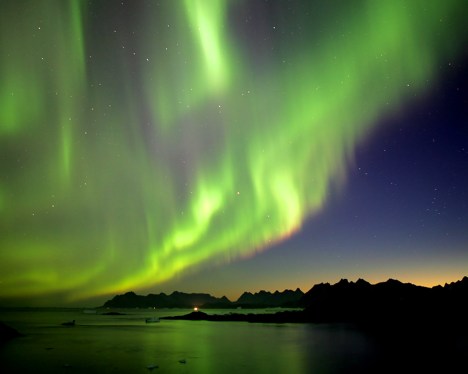
It’s still possible to see the northern lights tonight, so I hear. I just took a look with somewhat clear skies, but I couldn’t see anything. Of course, something so spectacular is worth a second shot in a couple of hours.
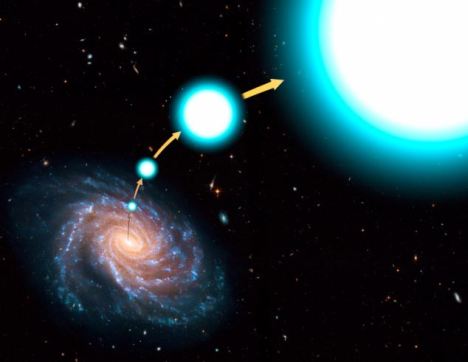
One of the fastest moving stars ever discovered is on its way out of the Milky Way, but Hubble can still see it.
Nasa’s Hubble Space Telescope has detected a rare hypervelocity star that was spat out of the centre of our galaxy and is travelling three times as fast as the Sun.
Scientists believe that it was created when three stars travelling together passed too close to the black hole at the centre of the Milky Way around a hundred million years ago.
One of the stars was captured while the other two were flung out of the galaxy and merged to form a super-hot blue star travelling at around 1.6 million miles per hour.
Creationist interpretation: a deceitful designer placed the star at a high velocity in just such a way that we would be tricked into thinking something plausible had happened instead.
Anyway.
Here are a couple images. The first is a NASA graphic while the second is the actual image.



 For the Sake of Science