


Filed under: Astronomy/Cosmology/Physics | Tagged: Carl Sagan, Cosmic Calendar | Leave a comment »
Hubble captures fireworks
Posted on July 11, 2010 by Michael
How a theist can look at all the fantastic images Hubble has offered humanity and somehow not feel insignificant in the Universe is one of the greatest feats of arrogance there is.

This gorgeous star cluster doesn’t need a holiday to set off fireworks. Officially called NGC 3603, the small community of young stars is located about 20,000 light-years away in the constellation Carina.
Ultraviolet radiation and violent stellar winds from the cluster’s stars shoved away the cloud of gas and dust in which the stars formed, giving the Hubble Space Telescope’s new Wide Field Camera 3 a clear view. Hubble captured this image in August 2009 and December 2009, just a few months after the new camera was installed, in both visible and infrared light. The image shows a sharper view of the stars than an earlier image taken with Hubble’s NICMOS infrared camera in 2007, and traces sources of sulfur, hydrogen and iron.
Most of the stars in the cluster were born around the same time, but age differently depending on their masses. Clusters like NGC 3603 give astronomers a lab to study stars’ life cycles in detail, as well as a window into the origin of massive star formation in the distant universe. NGC 3603’s stars are among the most massive known. After they burn through their fuel, these stars will end their lives in spectacular supernova explosions.
Via Wired.
Filed under: Astronomy/Cosmology/Physics | Tagged: Carina, hubble, Images, NGC 3603, NICMOS, Photos, Pictures, Wide Field Camera 3 | 1 Comment »
Hubble images offer better benchmark for stellar evolution
Posted on June 8, 2010 by Michael
Hubble images have helped to detect minute movements in relatively new stars previously expected to have settled down by now.
The discovery, reported in June 2 in Astrophysical Journal Letters, may cause astronomers to rethink how clusters form and evolve. The new measurements will help astronomers to develop benchmarks of cluster evolution and better estimate the masses of other star clusters. Many such measurements are based on the stars having reached a more settled state known as virial equilibrium. If the stars haven’t reached this state, the mass of the cluster will be overestimated.

Filed under: Astronomy/Cosmology/Physics | Tagged: hubble, NGC3603, Stellar Evolution | Leave a comment »
Arrogant religion takes another blow
Posted on June 5, 2010 by Michael
To the chagrin of religious egos, scientists have found Titan has conditions possibly suitable for life.
The first paper, in the journal Icarus, shows that hydrogen gas flowing throughout the planet’s atmosphere disappeared at the surface. This suggested that alien forms could in fact breathe.
The second paper, in the Journal of Geophysical Research, concluded that there was lack of the chemical on the surface.
Scientists were then led to believe it had been possibly consumed by life.
Researchers had expected sunlight interacting with chemicals in the atmosphere to produce acetylene gas. But the Cassini probe did not detect any such gas.
Chris McKay, an astrobiologist at Nasa Ames Research Centre, at Moffett Field, California who led the research, said: “We suggested hydrogen consumption because it’s the obvious gas for life to consume on Titan, similar to the way we consume oxygen on Earth.
It feels good that I don’t need to intentionally misinterpret scientific studies because they contradict long-held, traditionally based beliefs. The fact that there may be other life in our solar system isn’t all that surprising, especially since exceedingly strong evidence for ancient life on Mars has already been confirmed.
Filed under: Astronomy/Cosmology/Physics | Tagged: astrobiology, Cassini, Chris McKay, exolife, Extraterrestrial life, NASA Ames Research Centre, Titan | 1 Comment »
More Symphony of Science
Posted on June 4, 2010 by Michael
My least favorite so far, but here it is.
Filed under: Astronomy/Cosmology/Physics, Misc | Tagged: Symphony of Science, The Case for Mars | Leave a comment »
Crab Nebula
Posted on June 1, 2010 by Michael
When I choose Hubble images to put on FTSOS, I specifically try to avoid the Crab Nebula image. It’s just so common, so frequent. It’s almost a stereotype in a way, at least to me. In fact, it wouldn’t surprise me if I’ve slipped up actually posted it in the past. But I was just rethinking it. Stereotype, cliche, overused, too common, too frequent: none of that matter. It’s a frickin’ cool image. That’s all the justification I need.

Filed under: Astronomy/Cosmology/Physics | Tagged: Crab Nebula, hubble, Hubble images, NASA, space | 2 Comments »
Yeah, that’s probably empty
Posted on May 30, 2010 by Michael
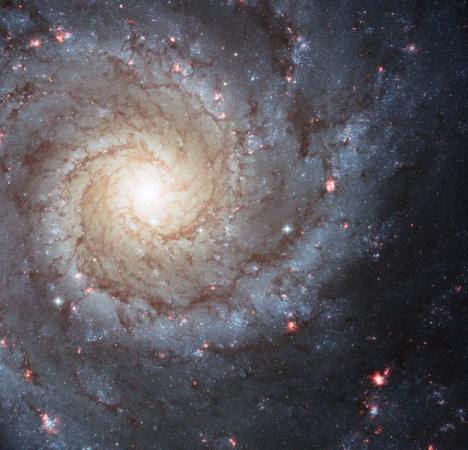
I mean, there are only billions and billions of these. I can see how it might be reasonable to presume each one is empty.
If you’re arrogant, that is.
Filed under: Astronomy/Cosmology/Physics | Tagged: Galaxy, hubble, Hubble image, Spiral galaxy | Leave a comment »
Hubble, WISE, and VISTA
Posted on May 21, 2010 by Michael
Hubble is great and all, but it’s better in a bundle.
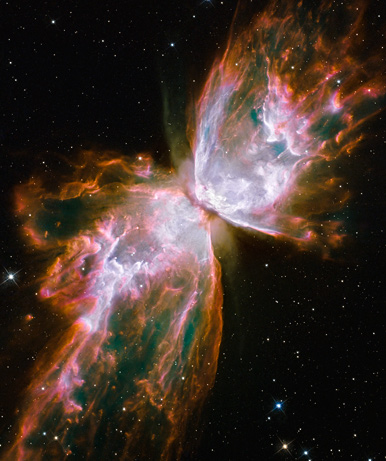


In order: Hubble, WISE, VISTA. And no, not the OS.
Filed under: Astronomy/Cosmology/Physics | Tagged: Astronomy, hubble, Photos, VISTA, WISE | 3 Comments »
My favorite Hubble image
Posted on May 18, 2010 by Michael

Filed under: Astronomy/Cosmology/Physics | Tagged: hubble, Ultra Deep Field | 2 Comments »
20 year Hubble anniversary
Posted on April 23, 2010 by Michael
My favorite thing about showing up 3rd for searches of “Hubble” in Google image is that whenever Hubble is in the news, I know it pretty quickly thanks to the sharp increase in hits. (Right now the third result is some website that has swiped my Hubble image, but it still links back to FTSOS.) For instance, tomorrow is the 20th anniversary of the launch of Hubble.
The universe was a different-looking place 20 years ago. The most powerful optical telescopes on Earth could see only halfway across the cosmos. Estimates for the age of the universe disagreed by a big margin. Supermassive black holes were only suspected to be the powerhouses behind a rare zoo of energetic phenomena seen at great distances. Einstein’s cosmological constant, a hypothesized repulsive property of space, was merely a skeleton in the astrophysics closet.
But astronomy was kicked-started into fast-forward on April 24th, 1990 when NASA’s Hubble Space Telescope left the blurry skies of Earth for the stars. Tucked away inside the space shuttle Discovery’s cargo bay, the telescope was set free into low earth orbit on April 25th.
Of course, this naturally means eye candy on FTSOS.


Filed under: Astronomy/Cosmology/Physics | Tagged: 20th Anniversary, Astronomy, hubble, Launch of Hubble, Photos, Space images | 3 Comments »
 For the Sake of Science
