First image from WISE

WISE is a survey telescope recently launched by NASA. Here’s what Phil Plait had to say over at Bad Astronomy.

Nice. It may not look as pretty as a Hubble or Spitzer shot at first glance, but to an astronomer it’s the Mona Lisa. The images are sharp (it’s in focus), the stars are not overexposed, diffuse sources are detected, and the diffraction spikes (the crosshairs centered on stars) are clean.

I would have just called it sexy, but maybe that’s why I’m not an astronomer.

Hubble, giver of blog hits

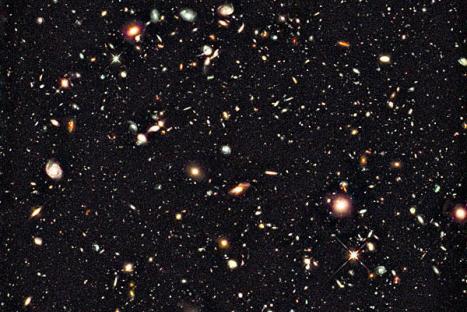
Thanks to a spike in hits today on Hubble posts, I’ve gone and found that NASA released more Hubble images taken since the telescope’s recent upgrade. The first is one of the most recent images (and may as well just be a close-up of a past release). The second is older, but not blurry and generally ugly.

Update: I’m not sure if this one has just been released, but it’s the best I’ve seen so far.

Forget Jesus

Hubble and monkeys

Well, Hubble and an ape, but “monkeys” made for a funnier title.

Hubble gazes deeper than ever

Since being recently serviced, Hubble has taken one of the most stunning and deep images yet.

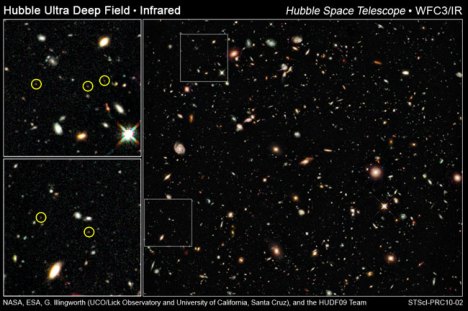
NASA’s Hubble Space Telescope has made the deepest image of the universe ever taken in near-infrared light. The faintest and reddest objects in the image are galaxies that formed 600 million years after the Big Bang. No galaxies have been seen before at such early times. The new deep view also provides insights into how galaxies grew in their formative years early in the universe’s history.

Sorry for the graphics. I wanted to post the largest version I could find and this was it. An even larger image is available here.

Greatest Discovery Since Natural Selection Possibly Made

Not since Charles Darwin discovered the process by which life diversifies has a more important discovery been made (and I include relativity). In fact, part of me almost wants to say this is the most important discovery ever. Almost.

Nasa scientists have produced the most compelling evidence yet that bacterial life exists on Mars.

It showed that microscopic worm-like structures found in a Martian meteorite that hit the Earth 13,000 years ago are almost certainly fossilised bacteria. The so-called bio-morphs are embedded beneath the surface layers of the rock, suggesting that they were already present when the meteorite arrived, rather than being the result of subsequent contamination by Earthly bacteria.

No, no, no. Stop. You didn’t let it sink in. Even if you’re amazed, you still haven’t let it sink in properly. It’s good evidence for life on another planet. LIFE ON ANOTHER PLANET.

This meteorite has actually been known for some time on Earth (1984), but it wasn’t until recently that better technology (thank you, science) made it possible to carry out far more detailed tests. The likely conclusion appears to be that this is, in fact, evidence for life.

As always, scientific excitement needs to be tempered with an eye toward always needing greater evidence (and there is some in the form of two separate meteorites). But that doesn’t make this any less exciting for me. It is crashingly obvious that life is wholly tenacious, so its existence elsewhere – in a Universe with more stars than grain of sands on all the beaches of Earth – is practically expected. Its close proximity and initial discovery is where the excitement really rests.

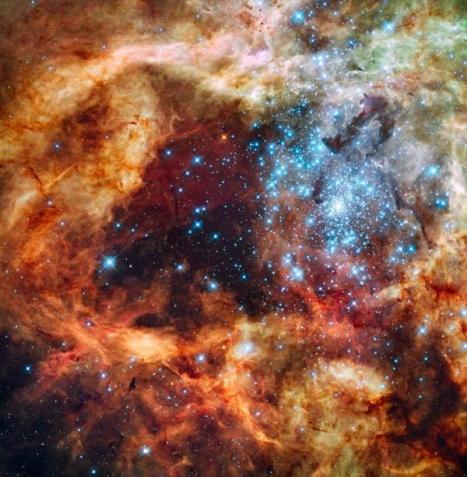
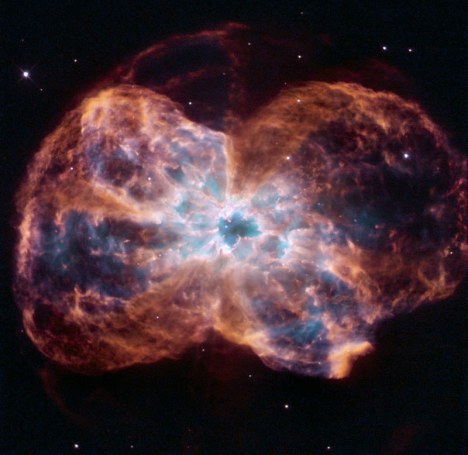
Hubble Images

SN 1987A

NGC 2440

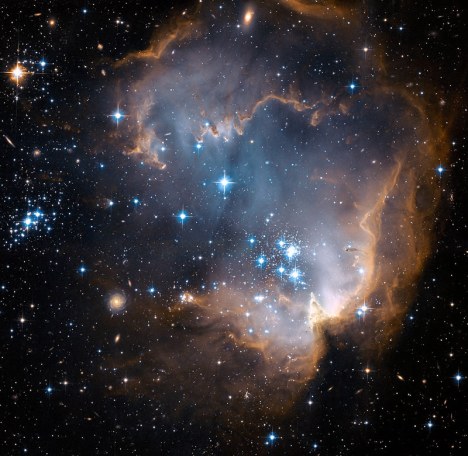
Small Magellanic Cloud

Leonid Meteor Shower

There is a meteor shower tonight. Most any location should offer decent views, but it will be necessary to stay up a bit late. The best viewing hours are between 1 a.m. and about until the sun comes up on the east coast.

Water on the Moon

NASA discovered there is plenty of water on the moon.

Experts have long suspected there was water on the moon. So the thrilling discovery announced Friday sent a ripple of hope for a future astronaut outpost in a place that has always seemed barren and inhospitable.

“We found water. And we didn’t find just a little bit. We found a significant amount,” Anthony Colaprete, lead scientist for the mission, told reporters as he held up a white water bucket for emphasis.

He said the 25 gallons of water the lunar crash kicked up was only what scientists could see from the plumes of the impact.

This is equivalent to roughly a bathtub’s worth of water from this double-impact.

One part of me wants to endlessly speculate at the possibility of microbial life. But all reason and rationality tell me to be cautious. Water does not automatically mean life (especially when its frozen).

…but what if it does mean life, at least in this case? Would the world realize the utter significance of this discovery? Not since Darwin described evolution by natural selection has there been such an important find.

Religions would squirm

Recent evidence suggests Europa has enough oxygen for life.

The global ocean on Jupiter’s moon Europa contains about twice the liquid water of all the Earth’s oceans combined. New research suggests that there may be plenty of oxygen available in that ocean to support life, a hundred times more oxygen than previously estimated.

The research says various openings in the top of Europa’s massive oceans could provide a pathway for oxidizers to deliver an oxygen content which could quickly exceed that of Earth’s oceans.

All this makes me wonder. What would the religions of the world do? What would they do if life was found elsewhere? I know many would adapt their teachings pretty quickly; they would ignore that a central part of their beliefs is that humans are special (the arrogance!). It may take a period of adjustment, but none of them would let go of what they’ve always believed. They’d just pretend like their holy book was ballparking its claims and move on (just like they do when they claim “days” really means “millions of years”). But what about the other guys? The creationists and likewise country bumpkins? While they tend to be some of the most dishonest people around, I do think they would maintain their point of view. Whereas most of religion would shift uncomfortably for a period, the more literal-minded mooks would squirm. They’d deny facts, twist evidence, make false associations and accusations. I guess I’m basically saying they’d continue exactly what they do now.