More lies and plagiarism? You don’t say.

I stopped reading Jack Hudson’s shitty blog some time ago for the most part. He’s just a bag of dishonest rubbish that churns out annoying pieces of repetitive rhetoric over and over. Really, it’s just the same thing every time: “Christians are great, atheists suck, lol. Christians invented everything good and science is premised on the Bible. lol. Also, I start every single one of my responses with ‘Well’ because I think that’s good writing. lol.”

Yet despite my aversion to bad logic (and probably more so, his horrible writing), I hopped over to his site to see what filth he had to say about Christopher Hitchens. It was about what I expected – Christianity leads to great things, atheism doesn’t, lol, well, lol, etc. Here I tear apart (for the nth time) the shitball logic of Fatty Hudson:

Upon learning that he was sick and in all likelihood dying, many skeptics expected the caustic atheist would be reviled by Christians, when in fact the opposite happened.

I have to give chubs credit here. He actually managed to hold off on the lying until his second paragraph. Rather unusual, indeed. But a lie is a lie; nobody expected Christians would shit all over Hitchens in death. We expected they would concoct phony stories of a deathbed conversion like they always do. Fortunately, Hitchens put forth a great effort to ensure that there could be no reasonable doubt that he remained an atheist and anti-theist until the very end. When Richard Dawkins’ time comes, he will do just the same for the exact same reason.

In part this might be explained by the fact that Christians are commanded to ‘love their enemies’…

Nope. False. Hitchens was a respectable man who had something special about him. His intelligence was never approached in debate (especially by Christians and Muslims), and he was the exact opposite of an intellectual coward – something I can’t say for Chunky Hudson.

Besides, let’s just apply a bit of logic here: Atheists routinely show respect when Christians of note die, provided those Christians did something worthwhile while living. And we do it for good reasons, not because we were commanded by a Sky Daddy to do it. (Indeed, how genuine can a show of respect be if it is forced from up high?)

He wasn’t petty like Dawkins, or prissy like Sam Harris…

This line, along with a second post to which I will get, is what motivated me to write. What happened to that command to ‘love thy enemy’, Jack? I guess I’m not surprised a Christian would apply parts of the Bible selectively, but I thought the normal course of action was to pick and choose several different pieces to apply selectively – not pick one piece and apply it in exactly opposing ways. (See this post on Jack Kevorkian for an example of Hudson ‘loving his enemy’.)

The affection many believers had for Hitchens undermines the New Atheist caricature of Christians.

Don’t worry, the disdain you’ve shown for two atheist friends of Hitchens has already reinforced the view.

In the modern atheist mythos, Christians are invariably dumb, deluded and dangerous.

I think I know who’s creating the caricature here.

And yet Hitchens, who himself often spoke this way about believers was often warmly received on by them.

Huh. Jack is able to write (poorly) so he must be able to read. Strange then that he apparently has never read what believers had to say of Hitchens.

Unlike atheists, Christians merely see their opponents as wrong, not fundamentally stupid or insane.

If I say I see that as a wrong, stupid, and insane generalization, does that mean all atheists see it that way?

We understand that despite his best efforts, Hitchens was no more a sinner than anyone else and no less deserving of the grace than any believer.

What condescending assholery.

If Hitchens was right about the universe, then he has passed into nothingness and will be soon forgotten – atheists have little love for history except where it serves their purposes…

Says the guy who thinks Christianity has always been the driving force behind science.

If a face and voice isn’t ever-present on the screen it soon fades from public memory. So the increasingly secular world quickly forgets its ownchampions (sic); everyone is equally unimportant and inevitably lost in a dying universe.

I like the quick change between “atheists” and “the secular world”. Clever. But no matter, it’s all premised on the continued lies of Chunk-face Hudson. Some of the greatest figures remembered now are the ones which, atheists or not, contributed to the views of many of today’s atheists: scientists. (Fatty Jack, having zero interest or educational background in science beyond a Bio 101 course 30 years ago, is unlikely to be aware of most of this.)

The ultimate irony of his life is that believers, who saw in him the Godly virtues of courage and honesty and perseverance, may have valued his life more than he did himself.

I don’t see how people who place value on magical, evidence-free thinking – thinking which culminates in the belief that there is a realm that somehow matters more than now, more than today – can even begin to understand how to value life. Their entire belief structure is premised on the devaluing of actual life in favor of pretend future life. Just take Jack. My jabs about his struggle with all the excessive weight he carries do point to something more than just my own desire to insult an obvious feature of an obvious idiot: If he really valued life, he would do something to live it. As it stands, he is more willing to stuff his face than exercise; he is willing to risk sacrificing years of life for petty pleasures. The likely result? He will die, joining Hitchens in nothingness, never having seen his children reach important milestones like graduations, marriages, or having their own children. And even if he is fortunate enough to see these important marks, he will still miss years and years of time with family and friends, not to mention the simple joys of life otherwise had. This certainly is not a problem exclusive to the religious, but it is extremely convivial to religious valuing of a pretend afterlife over real life.

This post has become longer than I intended, so I will make this last bit quick. Jack has a history of stealing material from me. He has stolen it from both here as well as the FTSOS Facebook page. Here he does it again:

Though [New Atheists] purport to derive their atheism as a result of scientific knowledge which they consider to be the ‘best way of knowing’, in practice…

The fact that their main use of what they consider the “best way of knowing” is to…

Emphasis mine.

Take a look at my About tab. “Best way of knowing” is a phrase I have used time and time again. I have used it in posts, on Facebook (where available to Jack), and even on Jack’s own blog. He has been called out on his plagiarism in the past, including his theft of this exact phrase. I would link to where that has happened, but it was on his blog and he, of course, deleted the post. In fact, the post demonstrated more than a stray phrase. At the time, I matched no fewer than 5 posts I made here with posts he made the following day or so. He used my phrasing, my ideas, and/or my arguments as premises each time. And I had only looked back at six weeks worth of material. He is a wildly dishonest thief and I would expect an apology from a better man.

Christopher Hitchens has died

A sad day indeed:

Christopher Hitchens—the incomparable critic, masterful rhetorician, fiery wit, and fearless bon vivant—died today at the age of 62. Hitchens was diagnosed with esophageal cancer in the spring of 2010, just after the publication of his memoir, Hitch-22, and began chemotherapy soon after. His matchless prose has appeared in Vanity Fair since 1992, when he was named contributing editor.

“Cancer victimhood contains a permanent temptation to be self-centered and even solipsistic,” Hitchens wrote nearly a year ago in Vanity Fair, but his own final labors were anything but: in the last 12 months, he produced for this magazine a piece on U.S.-Pakistani relations in the wake of Osama bin Laden’s death, a portrait of Joan Didion, an essay on the Private Eye retrospective at the Victoria and Albert Museum, a prediction about the future of democracy in Egypt, a meditation on the legacy of progressivism in Wisconsin, and a series of frank, graceful, and exquisitely written essays in which he chronicled the physical and spiritual effects of his disease. At the end, Hitchens was more engaged, relentless, hilarious, observant, and intelligent than just about everyone else—just as he had been for the last four decades.

“My chief consolation in this year of living dyingly has been the presence of friends,” he wrote in the June 2011 issue. He died in their presence, too, at the MD Anderson Cancer Center in Houston, Texas. May his 62 years of living, well, so livingly console the many of us who will miss him dearly.

No report yet of any deathbed conversions. I don’t expect any, either.

Set it free

It isn’t so much atheism that will set one’s mind free (how would it?), but the rejection of religion certainly will.

Study: Atheists are only as trustworthy as rapists

Well, this is disconcerting:

Religious believers distrust atheists more than members of other religious groups, gays and feminists, according to a new study by University of B.C. researchers.

The only group the study’s participants distrusted as much as atheists was rapists, said doctoral student Will Gervais, lead author of the study published online in the Journal of Personality and Social Psychology.

That prejudice had a significant impact on what kinds of jobs people said they would hire atheists to do.

“People are willing to hire an atheist for a job that is perceived as low-trust, for instance as a waitress,” said Gervais. “But when hiring for a high-trust job like daycare worker, they were like, nope, not going to hire an atheist for that job.”

Of course, this is pretty much a one-way street. Atheists, not having in-group thinking ingrained in them since birth (or at least having been able to shed much of that type of bad thinking), don’t particularly judge others based on religious beliefs. It just isn’t a great judge of individual character. (Group character, on the other hand, is an entirely different story.)

I think my favorite part of this is how believers give away their dumb reason in this study:

Gervais was surprised that people harbour such strong feelings about a group that is hard to see or identify. He opines that religious believers are just more comfortable with other people who believe a deity with the power to reward and punish is watching them.

“If you believe your behaviour is being watched [by God] you are going to be on your best behaviour,” said Gervais. “But that wouldn’t apply for an atheist. That would allow people to use religious belief as a signal for how trustworthy a person is.”

This issue has been brought up again and again in moral discussions. Atheists will rightfully acknowledge that morality is a subjective concept unique to humans (at least on a deep level) whereas theists will incorrectly claim there needs to be an all-knowing, all-powerful lawgiver in order for morality to even exist (which, incidentally, is known as begging the question). They will say, “If there is no God, then there is nothing that makes murder wrong”, to which the atheist replies, “So if there is no God, you would do exactly whatever you please with no remorse? What a monster.” It’s like a little kid with no control over himself. He’ll behave when mom is around, but the moment she leaves the room, he’s into everything. It’s preposterous.

Now excuse me while I go praise Stalin and murder puppies.

A hugely pathetic understanding of evolution

One of the creationists favorite pieces of bullshit rhetoric is to say to anyone who accepts the facts of evolution, “You are beholden to your evolutionary past! Why would you do anything good if the point of life is to merely survive? Checkmate, atheists.” It’s an awful line that just won’t go away, but I figure if I make a post like this, at least I will have an easy stock response on hand. So here’s why it’s so awful.

First, it is a conflation of descriptive and normative claims. (I am thoroughly convinced most Christians do not understand the difference.) Evolution deals with the facts of biology as discovered via the powerful methodology of science. It’s a description of observation; it does not have a say on how one ought to act. Morality, on the other hand, is nothing but normative claims. It is the way in which we say what is right and wrong. It is the precise opposite of descriptive claims like those made by science.

Second, it reflects a fundamental misunderstanding of evolution. Simply because the history of all life is marked with ruthless struggle does not mean that we must display such ruthlessness at all times. Or any times. In fact, I think we would want to do just the opposite at most times. But none of that is really pertinent. The facts of our evolution do not mean we must act in this way or that way. It would be like saying all Americans must love the French now and forever because we got so buddy-buddy with them during the Revolutionary War. Could you imagine how upset FOX Noise would be if that were true?

This line of argumentation from creationists is really just an excuse to disengage. Rather than openly debate the merits of this or that moral position, they just appeal to a red herring of an argument. And it isn’t merely creationists. The same tactic is often used by theistic evolutionists. It does a disservice to logical, philosophical debate, but perhaps worse, it undercuts the science at the heart of it all. Ultimately, it is a misunderstanding of the issues: Evolution is a descriptive fact; morality is normative. No matter what moral conclusions one draws, evolution still remains true. Even if one draws conclusions about morality (i.e., not moral positions, but ideas concerning the concept of morality) which conflict with the descriptive fact of evolution, Mr. Darwin’s great idea, with all its modern day modifications, still remains true. And should someone think that evolution leads to particular consequences such as ruthlessness and mayhem (which, incidentally, is an invalid reason to reject acceptance of evolution), even that is immaterial. In addition to those people being wrong on the facts, evolution, once again, still remains true.

So, no, logically inept creationists and friends, you haven’t added anything of value here. As usual. Evolution is descriptive and so has no say on morality. Moreover, even if it did dictate how we ought to live, we would not therefore be beholden to our past anyway. Even if you were right, you’re still wrong. Or as I really need to say more often, you’re wrong in your wrongness.

I accept your apology, GelatoGuy

Apparently some guy running an ice cream shop in Missouri put up a sign saying people attending a nearby “skeptics” conference were not welcome at his Christian business. Naturally, this caused a big stink. It is illegal and stupid to refuse the business of people because of what they do or do not believe in terms of religion. The owner, now known as “GelatoGuy”, didn’t take long to backtrack. He issued an apology, even taking the time to explain his actions:

Once the store slowed down, I decided to walk down the street to learn more about the convention, fully thinking it was something involving UFOs (“skeptics”). What I saw instead was a man conducting a mock sermon, reading the bible and cursing it. Instead of saying “Amen”, the phrase was “god damn”. Being a Christian, and expecting flying saucers, I was not only totally surprised but totally offended. I took it very personally and quickly decided in the heat of the moment that I had to take matters into my own hands and let people know how I felt at that moment in time.

So, I went quickly back to my business, grabbed the first piece of paper I could find, wrote the note and taped it in my front window. This was an impulsive response, which I fully acknowledge was completely wrong and unacceptable. The sign was posted for about 10 minutes or so before I calmed down, came to my senses, and took it down. For what it’s worth, nobody was turned away. I strongly believe that everybody is entitled to their beliefs. I’m not apologizing for my beliefs, but rather for my inexcusable actions. I was wrong.

This is probably one of the better apologies I’ve ever seen. Even if he’s just looking out for his business interests, it sounds entirely genuine. And, anyway, there is zero evidence that he isn’t 100% sincere. I see no reason to reject a bit of what he said.

But in addition to the above letter, GelatoGuy went ahead and reached out to some of his most well-known critics, including PZ. This was the response he got:

Apology not accepted. What I see in you is a person who hates me for not believing in the nonsense of your religion; while you may now be in a panic because your actions were unethical and illegal, and you were caught out, and face economic consequences for them, I don’t see any sign that your attitudes have changed in the slightest.

You’ll just have to live with the fact that I won’t be buying your ice cream on the rare occasions I visit your town, while I have to live with the fact that I live in a country where my rejection of your religion makes me a pariah. There’s absolutely nothing you can do to make up for that.

And here I thought PZ was all about understanding the perspectives of others.

This isn’t that hard. GelatoGuy got emotional about an issue close to his heart. As a result of that emotion he made a mistake that lasted for about 10 minutes. What he did wrong has been fully rectified; it isn’t like he defiantly left a sign up for days on end, refusing people based upon religious reasons. I suspect if the tables were turned, PZ wouldn’t be all that hesitant to forgive an atheist shop owner.

But I also want to address another issue that is part of all this: “skepticism”. First, if you’re American and you spell it with a “C”, you’re a pretentious douchebag. I prefer British grammar and some British spelling, but only where it makes sense. Quit being a douche, you douche. Second, and much more importantly, the word “skeptic” is almost devoid of meaning. I really hate the term and I understand why GelatoGuy first associated it with UFO’s. People of all stripes use it to suit their given purposes. Atheist? Nah, bro, I’m a skeptic. Humanist? No way, guy, I’m a skeptic. Global warming denialist? Think again, dude, I’m a skeptic! What people really mean is, “I have come to a conclusion about [issue] and I would like people to hear my point of view, so I have couched my opinion in anti-dogmatic terms.”

Let’s be honest. The “skeptics” conference, Skepticon, was an atheist convention. And that’s great. If one ever comes to my area, I will be likely to attend. And yes, of course most of the people there were open-minded. They have drawn many general conclusions, but they are a group which highly values science – that is, they value changing their beliefs based upon evidence. But that doesn’t make them “skeptics”. Fuck, I have no idea what makes someone a skeptic besides a self-declaration.

PZ raises a good point, though, even if he intends it in a way entirely different from what it really means:

But oh, no, a real skeptic conference is supposed to limit itself to UFOs, and chupacabras, and bigfoot, and ESP. As if we have a gigantic problem with a Republican government diverting vast resources into the search for cryptids and mind-reading, as if our educational system is overwhelmed with demand to teach the controversy about little green men, as if religion is somehow on a completely different plane from beliefs about alternative medicine or quantum vibrations.

This isn’t about “real” skeptic conferences. It simply comes down to connotations. The term is generally associated with the things PZ listed. Any other time it is used, it’s just empty rhetoric.

I fully agree that if someone thinks UFO’s, chupacabras, Bigfoot, ESP and other BS constitute fair game for a “skeptics” convention, then so does religion. It isn’t like there ought to be something special about how we treat religious beliefs versus any other beliefs. But that’s as far as PZ’s point should go. The rest is effectively an acknowledgement that the word “skeptic” is associated with certain things that have nothing to do with the conference – he ought to understand why GelatoGuy was surprised, not to mention why the word should be abandoned: it doesn’t mean a damn thing. Besides that, the whole point here is to be unafraid to be outspoken regarding the fact that we are atheists. Let’s use that fucking word, huh? It would be clear, direct, get more attention, and most of all, be honest.

‘Flagged for review’

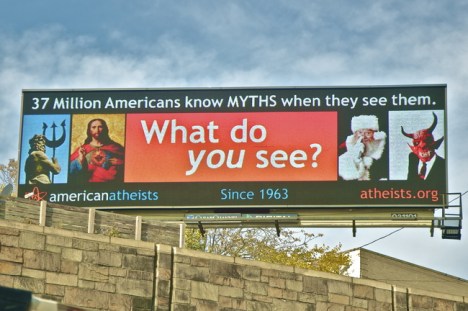
The American Atheists have billboards posted again. Here is this year’s:

This is better than last year’s design, but it still isn’t that great. The devil guy on the right makes the whole thing ugly, plus he is featured very close to the word “atheists”, which is printed in a similar red font. All it does is serve to associate atheism with the magic evil that Christians and other religidiots think exist. If they changed the font color and inserted an alternative myth in the final panel, I would say this is an excellent ad.

What I think is hilarious about this whole thing, though, is the CNN article I used as my source. This is what I get when I go to the page:

Under review

The following contains content that has been flagged as inappropriate, and is currently under review. Do you want to continue?

It’s actually a straight forward report. It does only cite those who support the message, but I can’t say that’s all that upsetting. After all, when Christians have some message to put out there, I don’t see the media running out to talk to any atheist organizations.

Of course, we all know why this was flagged. A handful of Christians can’t deal with the fact that some other group would dare not show them the utmost respect – “respect” being code for “shut the hell up, atheists”. It’s sad and pathetic, if anything. But who knows. Given the actions of these people, I guess I could see Jesus being an Internet troll if he was still kickin’ today. At least then a lot of his followers would be consistent with who he is for a change.

Update: The article has apparently been reviewed. And gasp! it’s appropriate.

Bow! Bow before my particular god!

That’s what the military told one of its soldiers. He said no:

The 20-year old private first class, a proclaimed atheist, is graduating from Advanced Individual Training at Fort Jackson in South Carolina on Thursday.

The soldier, who requested that CNN not give a name and gender for fear of repercussions, called the Military Religious Freedom Foundation on Wednesday after taking part in a rehearsal for the graduation.

The soldier told the watchdog group that during the rehearsal, officials ordered the soldiers to bow their heads and clasp their hands during the chaplain’s benediction. As an atheist, the soldier refused to do so.

The military then threatened to prevent the soldier from graduating. They backed down when they found out he had contacted an outside group for protection of his rights, but who knows how far things would have gone otherwise.

This isn’t a big story because it appears to have been resolved relatively quickly (plus the solider is remaining anonymous), but I wonder how Christians in general would react to this. I imagine a good number would support the solider in principle, but I think a significant portion would be against his actions.

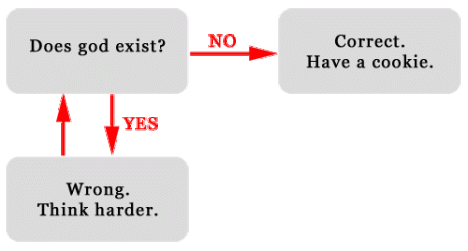
I get a cookie

It’s all I ever really wanted anyway:

via PZ

Ricky Gervais in New Humanist

I’m a big Ricky Gervais fan. He’s a funny guy, especially in his interviews on The Daily Show, and he has produced a lot of good television, too. Now he has an interview with New Humanist:

I never actively try to offend though. That’s churlish, pointless and frankly too easy. But I believe you should say what you mean. Be honest. No one should ever be offended by truth. That way you’ll never have to apologise. I hate it when a comedian says, “Sorry for what I said.” You shouldn’t have said it. You shouldn’t say it if you didn’t mean it and you should never regret anything you meant to do.

I like this quote. Offending others merely for the sake of offending them is a useless endeavor. It doesn’t get anyone anywhere. But causing offense when there is a wider point to be had is useful. In Gervais’ case, he is doing it for the sake of comedy. For others such as Gnu Atheists (of which Gervais is one), the point is often to raise consciousness/awareness. It’s like Kant says about using others as a means. (He is commonly summed up as saying that it’s a bad thing, but that misses a very key part of his philosophy.) What he says is that it is bad to use others merely as a means. Of course we’re using others as a means all the time. It’s when the point is to only use others that we’ve gone awry. The very same goes for causing offense.

But all this aside, I think Gervais may have an even better quote:

I used to believe in God. The Christian one, that is. (There are a few thousand to choose from. But I was born in a country where the dominant religion was Christianity so I believed in that one. Isn’t it weird how that always happens?)

Weird, indeed.