Art in a Petri dish

Former microbiologist Zachary Copfer was mesmerized by what he was learning every day as an undergraduate seeking a degree in biology. However, shortly after graduation he found himself in a commercial lab setting and his romance with science began to wane. That’s when he turned to photograph:

Photography developed into my new method of inquiry. Everything that I had missed about science I rediscovered in photography. For me, the two seemingly disparate fields of study served the same purpose, a way to explore my connection to everything else around me. As a former microbiologist recently turned visual artist, I seek to create work that is less of an intersection of art and science and more of a genuine fusion of the two.

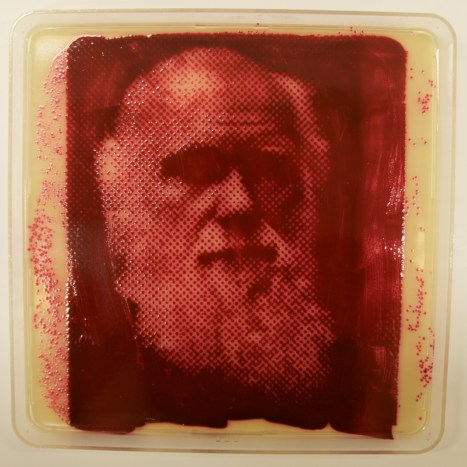
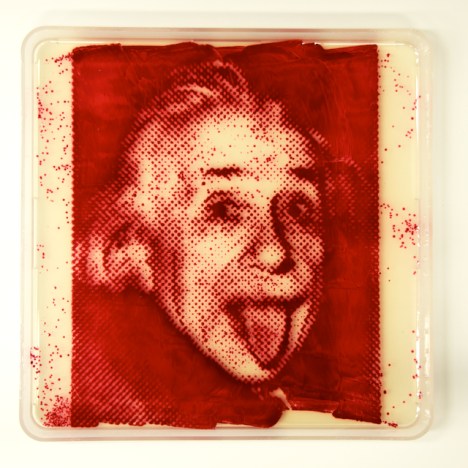
Here is some of what he has created:

Copfer explains the process:

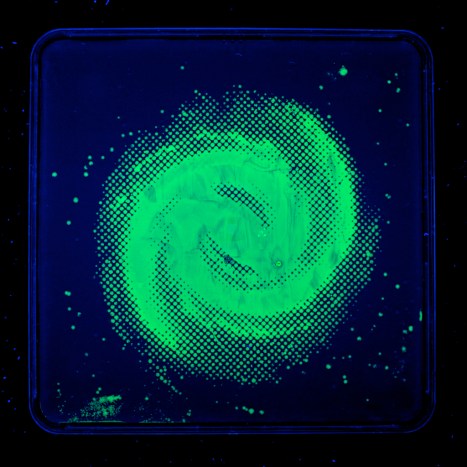
The process is very similar to darkroom photography only the enlarger has been replaced by a radiation source and instead of photographic paper this process uses a petri dish coated with a living bacterial emulsion. I believe that great beauty and poetry reside within the theories woven by scientists. And that it is through the unification of art and science that these treasures can be fully explored and made accessible to the world at large.

He has a number of pieces of science-art on his website, including ones of a galactic nature. They are, of course, very nice, but I don’t think they are necessarily his best. However, I do really like the idea of them. He takes something like E. coli, part of a group of the smallest living things on Earth, and he uses them to emulate the grandest of scales:

It looks like most of the trivia of what Copfer is doing can be found by poking around his site, but for anyone wondering, Einstein is made from S. marcescens grown on nutrient agar. The other scientist plates look to be the same, but I don’t know what sort of media he used to grow the other pieces of art.

Quorum sensing

I’m sure someone somewhere made an argument for group selection based upon bacteria working together like this. That model has always clearly been wrong, but now we have yet another reason why.

WHO issues warning about tanning beds

This is from 2009 (though it should be from 1995), but I just came across it:

In July, the International Agency for Research on Cancer (IARC), a working group of the World Health Organization, added ultraviolet (UV) radiation-emitting tanning devices – tanning beds and lamps – to the list of the most dangerous forms of cancer-causing radiation. It joins an assembly of hazardous substances including plutonium and certain types of radium, as well as radiation from the sun.

The IARC report cited research showing that tanning is especially hazardous to young people; those who use sunbeds before age 30 increase their lifetime risk of melanoma, the deadliest form of skin cancer, by 75 percent. The authors also pointed to studies showing a link between UV radiation from indoor tanning devices and melanomas of the skin and eyes. Melanoma will kill an estimated 8,650 people in the US this year alone. And melanoma isn’t the only problem: people who use tanning beds are 2.5 times more likely to develop squamous cell carcinoma and 1.5 times more likely to develop basal cell carcinoma. Squamous cell carcinoma kills an estimated 2,500 Americans a year.

I am absolutely convinced that people do not appreciate the tenacity and seriousness of cancer. There seems to be a it-won’t-happen-to-me attitude that pervades society. Or maybe quacks have lulled people into a false sense of security. Just take some garlic, laxatives, and a little black elderberry and you’ll be fine! For Christ’s sake. I recently developed a small splotch on my nose. It wasn’t a blackhead and it didn’t go away after a couple of weeks, so I made an appointment to get it checked out (alongside a physical). I figured it was nothing given its color and shape, but why take risks? It matters how quickly these things are identified. It turned out, as I figured, to be nothing more than a new freckle (probably a result of my time in Haiti or some of the nicer days we had not too long ago). I’m fine this time, but who knows about next time? I’m not somehow magically exempt from how biology works. Neither is anyone else. I am, however, exempt from a 75% increase in getting melanoma. Also, think about this:

This is the logic of anti-abortionists

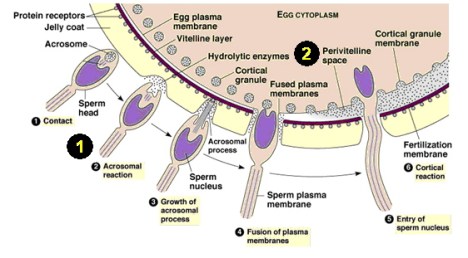
According to anti-abortionists, the first four parts of this process is just sperm doing what sperm does. The fifth part, however, shows a human being:

http://www.bio.davidson.edu/courses/molbio/molstudents/spring2005/dresser/review%20paper.htm

Let’s break it down:

  1. Not a person.
  2. Not a person.
  3. Not a person.
  4. Not a person.
  5. Person.

I would normally like to add a bit more to a post on a big topic like this, but I think it speaks for itself.

Thanks for being wrong

I am finishing up the final portion of a paper concerning HIV and circumcision. Normally this would be a pretty big endeavor since it involves reading a lot of papers, but I have an advantage. Commenters like Ichthyic and Roxeanne have forced me to correct so many stupid things they’ve said on the issue that I’m already fairly familiar with the material. So I would like to thank those two: I really appreciate the utter wrongness with which you have each approached science. Your ideological commitments have really made this project of mine a breeze. Thanks.

Richard Owen and Gideon Mantell

Richard Owen was one of the great jerks of history. He also happened to coin Dinosauria, from which we get “dinosaur”, he made a number of important scientific discoveries, and he did a great deal in making museums what they are today by way of organizing the Natural History Museum in London. Taken together, we still look back on him with fair acknowledgement for his accomplishments. But, boy, was he ever a jerk.

The man’s heyday was the middle of the 19th century alongside greats like Charles Darwin and Charles Lyell. People tended to recognize Owen’s quality of mind, but they couldn’t help but notice how petty and vindictive he could be. Cross the man and he would make your life as awful as he possibly could. Just ask Gideon Mantell.

Gideon Mantell made his splash in the sciences long before Owen came on the scene. He discovered the first bits of Iguanodon, a major genus of dinosaur, and is credited with kick starting the study of the ancient monsters before the 19th century had even reached its 25th anniversary.

At first Owen and Mantell were friends. For reasons now lost to time, though, they parted ways, becoming bitter enemies – Owens the more bitter of the two. They both were quite remarkable in their discoveries and descriptions of dinosaurs, giving title to many of the dinosaurs commonly recognized by the layman today. Unfortunately for Mantell, little could keep him from poverty.

As time wore on, Mantell’s health and focus waned. He was a doctor by training – and an excellent one, at that – and he had once run an incredibly successful practice, but his geological and paleontological research got the better of his time. Soon his wife left him, then he found himself suffering from spinal damage after being dragged by a carriage. He was forced to turn his home and all its fossils into a museum to pay his bills, but fearing his status as a gentlemen was in danger he would tend to wave the entrance fee. He eventually sold off most of his collection to the Natural History Museum.

Throughout all this, though, Mantell still wrote and published a number of papers. Unfortunately, he was unable to publish as many as he would have liked because the head of the Royal Society was none other than Richard Owen. Owen did all he could to have Mantell’s papers cast aside. It wouldn’t be long until Mantell could no longer bear the pain of his spine and the burden of Owen’s hatred.

Gideon Mantell took his own life in 1852. His obituary soon followed in the papers and although there was no byline, no one doubted its uncharitable nature was due to Richard Owen. In fact, Owen even transferred claim of a number of discoveries from Mantell to himself. Then, as a final act of indignity, Owen had Mantell’s spine placed in a jar and put on display at the Royal College of Surgeons of England where Owen taught.

Of course, no man could come to be known as one of the most hated and reviled men in scientific history without finding some black mark on his career. For Owen this mark came when it was found that he had failed to credit another scientist with a discovery – a discovery for which Owen had already accepted a prestigious award from the Royal Society. Moreover, he had an ongoing dispute with Thomas Henry Huxley, Darwin’s bulldog. Huxley tended to win the specifics of their dispute, often showing Owen as deceptive in many of his claims. This lowered Owen’s standing as a gentlemen and, in 1862, Huxley managed to have him voted off the Royal Society Council. Few members of the scientific community were saddened.

It was at this point, Mantell long dead, that Owen turned his full attention to the Natural History Museum in London. He continued with his plans to make the museum appealing to the general public rather than simply the scientific community and its followers. It was perhaps some of his greatest work, despite not being the most prominent of his career. He remained at his post in the museum, controversy diminished in his life, until his retirement late in the century.

As for Gideon Mantell’s spine, it was destroyed by the Royal College of Surgeons in 1969 due to the distressingly fitting reason that more space was needed.

Welcome to the Anthropocene

Globaia.org has put together a great video of the impact humanity has had on the world over the past several hundred years. I think the worst part has to be the fact that CO2 levels in the atmosphere today are higher than they’ve been in the past million years or so. But hey. Maybe it’s just coincidence, amirite?

Butchering science

This is just a mess.

I have written in the past about Jack Hudson’s tendency to butcher science. There are a lot of examples of him doing this, but one of the most egregious was when he concluded that because fruit fly populations under laboratory conditions come to allelic fixation at a different rate and/or way than asexual populations, that must mean there is some flaw in evolutionary theory. (In re-reading his post, I’m also seeing that he concluded something else equally egregious: He said that mutations which affect mRNA structure as opposed to protein sequence is evidence that random mutations cannot lead to new traits.) In short, it is highly evident that Jack read a popularized article about a recent study, glommed a few lines from the original research, and then went about drawing inept conclusions.

And now he’s back at it.

Let me give an actual summary of this most recent study first:

Stickleback fish are found all around the world. They exist in a number of streams, rivers, lakes, and oceans due to their great ability to adapt quite quickly to their environment. This opens up a great opportunity to take a look at their genes to see just what regions are evolving.

Now, what often happens in these sort of studies is that researchers will choose selected areas or candidate genes and compare them. It’s a tried and true method, but it probably isn’t the whole picture. While researchers can grow various species (usually of bacteria), objectively know how they’ve diverged and evolved under laboratory conditions, and then compare what they know to phenotypic changes brought on by alterations in protein-coding genes, there has been a push for a long time to sequence more and more full genomes. One result has been information overload (even when the full genome of something has not been sequenced; the technology that allows full genome sequencing also inherently allows easier partial sequencing), but that’s not a bad problem to have. So for this study, the biologists sequenced 21 three-spined stickleback genomes. Their goal was to determine the underlying molecular basis for adaptive evolution in the fish: Do they evolve by way of regulatory or coding changes?

What the team found was that 147 regions vary in freshwater versus marine stickleback populations. Of these 147 regions, 17% were linked to coding genes, 41% to regulatory regions, and 42% could not be classified cleanly (though, as the neat little graph under “Proportion of regulatory and coding change” in the paper says, they are probably regulatory).

So the big conclusion is this. Stickleback evolution is dominated by regulatory changes – changes involving areas which control genes. (Coding changes are still important, but this study indicates a possible shift in focus as it becomes cheaper and easier to sequence whole genomes.) The regions prevalent in stickleback evolution are relatively few; we keep seeing the same areas get tweaked over and over, leading to independent (and often convergent) solutions for the same sort of environments.

Now let’s look at Jack’s butchery:

But these findings are actually quite contrary to the sort of evolution often advocated by Darwinian evolutionists. Instead of incidental mutations coding sequences leading to the production of new proteins (and conceivably, novel structures and systems) the researchers found that the changes were primarily to the same sets of regulatory sequences in separate populations of sticklebacks…

While the researchers continue to use the term ‘evolutionary change’, the reality is this is nothing like the sort of change described by the modern evolutionary synthesis, a theory which relies on natural selection acting on genetic mutation.

To summarize this inanity: Jack is saying that evolution predicts that changes in species should occur almost exclusively by way of natural selection working on random mutation. He’s wrong. What evolution says is that change will occur by a number of mechanisms – random drift, hitchhiking via linkage, bottlenecking, horizontal gene transfer, and others. Random mutations culled by non-random selection will result in changes, certainly. And that’s what we see quite frequently in the laboratory and nearly 1/5 of the time in this stickleback study. However, the presence of other mechanisms is not somehow counter to evolutionary theory. Indeed, I think embryologists would be rather upset to learn that their field undermines evolution since the regulation of development – not necessarily or even usually by coding regions – has a huge impact on the way species change over time.

Yet I haven’t even gotten to the kicker:

The very fact that the researcher describes these as “key genes that control evolutionary change” contradicts the ordinary notion of evolution itself, which is purportedly an unguided process.

This reminds me Mary Midgley’s complete misunderstanding of Richard Dawkins’ The Selfish Gene. Midgley complained, chiefly, that Dawkins’ use of “selfish” was wrong because genes don’t have emotions. It was risible and I don’t know as Dawkins should have bothered responding. Naturally, I have to wonder if I should bother with the likes of Jack Hudson.

The language being employed by the scientists behind the stickleback study does not indicate that there is any guiding mechanism to evolution. They obviously are not claiming that regulatory genes direct evolution in a predetermined way. All they are saying is that these genes are a major factor in evolutionary change. It would be as if I said that my gene for lactase controls my tolerance for lactose (dairy products, more or less). That does not mean there is a little man sitting on a section of my DNA, tinkering away because he desires that I ingest milk.

Sorry to keep this going, but there are a lot of kickers in this one:

If natural selection acting on incidental mutations were actually capable of producing the radically different body plans, structures and systems we find throughout the plant and animal kingdoms, then we wouldn’t expect to see the consistent similarity of genetic modifications that we do with regard to the various populations of sticklebacks.

It would be generous to say this is a strain on logic. It absolutely does not follow that the predominance of regulatory genes excludes the importance of random mutation. Moreover, this study is not looking at millions of years, so extrapolation out that far should be constrained.

The changes wouldn’t be a matter of merely regulating extant genes, but the origination of new genetic capabilities.

Jack is, in essence, claiming that regulatory changes do not count as evolution. Unfortunately for him, we have thousands of different species of sticklebacks that attest to significant change over time – and now we know they’ve been doing it with a lot of help from their regulatory genes. So even if there was something to Jack’s claim on its own, it wholly crumbles when we hold it up to all the different stickleback populations around the globe.

Genetic sequencing continues to demonstrate that there are limits to biological variation.

This is in reference to specific creationist-proposed limitations, something not supported by an iota of this study. That is, this claim boils down to Jack saying that because sticklebacks evolve in a large number of ways by virtue of relatively few regulatory regions, species are constrained to microevolutionary changes. Again, this is a logic fail. The presence of changes by way of natural selection operating on regulatory genes does not exclude changes by way of natural selection operating on random mutation. Anyone who bothered to honestly look at this study would know that. (17% and perhaps more of the regions map to actual genes, for Christ’s sake.)

As I’ve said a few times before, what takes a creationist 30 seconds to say takes an educated person hours to untangle. And just as with my last post about butchered science, this didn’t take quite that long, but the sentiment remains true.

High fructose corn syrup

I just finished up a biochemistry paper on fructose metabolism. As often happens when I write these sort of things, I found myself drifting to related topics. Namely, I looked into the research on high fructose corn syrup metabolism versus sucrose metabolism. What I found was interesting, but first I need to note something else.

About a year and a half ago I wrote about a bad opinion piece from the Chicago Tribune. I stand by most of what I said, but I want to distance myself from something contained in this paragraph:

Imagine, for those unfortunate to have it in their grocery stores, if SmartOption foods didn’t have nutrition facts. They look and sound so appealing. But a quick look at the nutrition facts and ingredients reveals that it’s a load of garbage. Or, more nationally, imagine if there was enough ignorance for those pro-high fructose corp syrup commercials to slide by uncriticized.

What I found in my research was that much of the criticism directed towards HFCS is bunk. There is evidence of short-term metabolic differences between HFCS and sucrose, but it is not without its problems. Namely, many of the studies (done with rats) look at artificially high concentrations of fructose in subject diets. No one in the real world eats just fructose. In fact, HFCS is usually listed as something like HFCS-55. That refers to the concentration of fructose (55%) in the product. Most of the rest will be glucose. There are other ratios (as high as 90% fructose, 10% glucose), but what will be found in most soft drinks is around 55% fructose, 45% glucose. Sucrose, in contrast, is about 50/50. (Those high ratio products are either used for specialty purposes or dilution.)

There is some legitimate ground for the anti-HFCS crowd. Upwards of 30% of people have difficulty absorbing fructose through their small intestine and so will face cramps, gas, and general physical discomfort and pain as a result. It’s much like lactose intolerance, though to a lesser degree. The solution for these people is to avoid too much fructose. However, manufacturers are allowed to list “corn syrup” in their ingredients instead of high fructose corn syrup. This presents an obvious problem. Those will fructose malabsorption can safely bet that any soft drink will have HFCS, but they can’t do that for a number of other products. Thus, those who oppose HFCS are right when they demand proper labeling on food products. (In contrast, I don’t share the same sympathies with those who want genetically modified labels on products.)

The scale of the Universe versus the complexity of life

I have often found myself contemplating which is more amazing, the sheer scale of the Universe or the complexity of life? It isn’t easy to find an answer, but I’ll do my best to very briefly explain my thinking on this.

Despite my field being biology, and despite finding nothing more amazing on Earth than the evolution and subsequent complexity of life, I have to fall on the side of the size of the Universe. I think I’m going to be in the minority on this one, but I’ve given it some thought. Here is why I think what I do.

It isn’t possible for an individual to know everything about a single field. I’ve had incredible biology professors who have told me that they are lucky to understand 1/3 of what they read in scientific journal articles concerning biology. This is because in order to become an expert on anything, it requires one to focus on a relatively small subset of facts within a field. Just look at how biology breaks down: microbiology, biochemistry, genetics, cell biology, zoology, botany, anatomy, physiology, embryology, evolutionary biology, molecular biology, and so on. This sort of division is going to be true of just about any field. (I can’t think of any exceptions.) How can we expect anyone to understand it all? We simply cannot. But that isn’t to say we can’t understand it all as a species. In principle, we can understand everything that has to do with biology. We can break it down and analyze each bit, no matter how esoteric and specific. That doesn’t mean we necessarily ever will, but there is nothing preventing us from doing so. We have the ability, when we pool all our resources and minds, to understand everything there is to understand about life and its evolution.

I don’t think we can say that same thing about the sheer scale of the Universe. For the sake of argument, I will limit myself to the observable Universe. But right there. Look at what I just did. Without fear of losing any ground in my argument, I limited my scope. Yet my whole point is scope. That’s just how huge the Universe is. And how can anyone truly appreciate that? No human is going to travel any distance from Earth that is notable on the scale of the Universe. Even our space probes that are now on their way to interstellar space have done so little; being impressed by that distance would be like being impressed that an atom moved a tiny fraction of a fraction of a fraction of its radius to the right. I would say to now imagine that analogy increased trillions upon trillions upon trillions upon…of times, but of course you can’t. No one can. We don’t have any way, in our small lives, to really comprehend something like that. The Universe is enormous. Just enormous.

We can pool our minds together as a species and come to a great understanding of all that surrounds us. All our physicists and astronomers and cosmologists can give us a tremendous understanding, via science, of how it all works. They can even describe, with numbers on paper, how large the observable Universe is. They can show us incredible pictures of thousands of galaxies (in just a small sliver of the sky), each with billions of stars and billions of planets. And it really all is wonderful. But no matter how many brilliant minds we put to the task, we can never appreciate the sheer scale of what is. It is, in every meaning of the word, beyond us.