Natural selection is a serious problem for theism

Natural selection is the process by which different traits and, ultimately, alleles spread or shrink throughout a population over time. It is a key mechanism in evolution and an understanding of it is necessary to knowing anything important about life itself. It demonstrates how we can have such a long history with so many seemingly lucky ancestors, culminating in such a massive variety across the planet. But perhaps most importantly, it sheds light on some of our most fundamental questions about existence.

I’ve spoken in the past about Richard Lenksi’s E. coli experiment. He has been tracking a dozen different lineages of the bacteria for the past 25 years, carefully cataloging the genetic changes that take place and when they happen. What he has found is that mutations are often contingent, meaning that for Mutation #2 to happen, Mutation #1 is first needed. However, in his most interesting finding, it turns out that neither of these mutations will necessarily be useful at first. That is, they are neither advantageous nor deleterious, instead merely being neutral, as is so often the case. Yet they persist. It is only by chance, so it is a lucky persistence, but it happens. And, with time, Mutation #3 (or 4 or 5, etc) happens, and it is that mutation which is advantageous. Here natural selection goes to work, causing the new allele to near or reach fixation. But this does not happen in every lineage. Indeed, when Lenski re-runs his experiment using generations he had frozen earlier, he has found that sometimes the mutations all happen again, but more often they fail to occur. The reason is clear: there is nothing but chance that can maintain a neutral mutation. (This is why microsatellites are great for studying short-term generational changes, but not deep evolutionary time.)

I bring this up because Lenksi’s work crystallizes in experiment the words of Stephen Jay Gould:

Replay the tape a million times from a Burgess beginning, and I doubt that anything like Homo sapiens would ever evolve again.

Gould went further, however, than us. No single trait, and certainly no entire species, is inevitable in evolution, he rightly said. Perhaps some features are more likely than others – the eye is said to have evolved independently 40 different times – but no specific feature (such as wings or bipedalism) can be firmly predicted. Indeed, Gould spent much of his time arguing that evolution drives not towards complexity or specificity, but rather diversity; life finds itself at many forks, but it never ‘knows’ which road it will take.

This presents a significant problem for theists. For the young Earth variety, the issues are glaring. That group of people is nothing but woefully ignorant, denying even the most obvious and established science. They don’t deserve any more of my time here. For the older Earth variety that opts for theistic evolution, however, the problems they face are merely buried just far enough away from mild, easy thinking to be ignorable for most. That is, they’ve admitted to the fact of evolution, but they are necessarily ignoring that if humans evolved just like everything else, there was a point where our ancestors weren’t human; we were no different from any other mammal in the distant past. (It is only time and space which allows us to define a species.) That destroys any argument that says, in the eyes of some deity, we might be more special than, say, a giraffe.

The counter to this, as per the Catholic Church and others, is to simply declare that we were infused with souls at some unknown point in our evolutionary history. This isn’t much of an answer: No member of a species gives birth to a different species; evolution is continuous. So to believe the theist’s argument, we must conclude that at some point in our ancestry, a mother with no soul gave birth to offspring that did have a soul. That is, one was not essentially human while, magically, the other was.

The one version of theism that gets around some of this is where it is declared that all of life is equally special, so it doesn’t matter that no particular species or even traits are inevitable. This, however, has its own problem. Namely, it makes the given deity (or deities) entirely superfluous. It’s no more a viable position than seeing a door blown inward from the wind and declaring that there was also a ghost pushing from the outside.

For me, I find it far easier to simply accept natural selection and its clear implications. I have no need to make seemingly comfortable lies comport with contradictory facts.

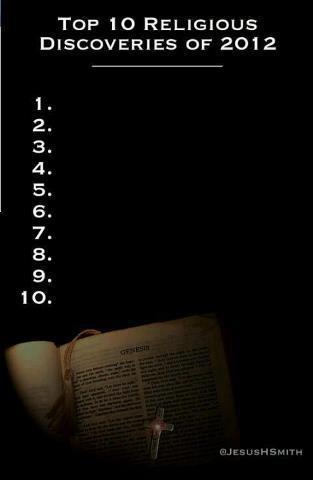
Religious discoveries

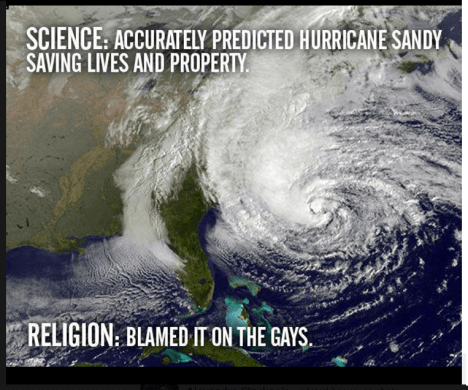
Religious discoveries

It’s almost as if religion is not a way of knowing anything.

Misunderstandings

Continuing my new series about misunderstandings, I want to address an issue that has popped up in an on-going debate I’m having on Facebook. Unlike in my last post, I won’t be linking to anything because it’s all happening on a personal page of a friend (which is probably private anyway), nor will I give out any names.

So, the debate I’m having is wide-ranging and there’s a lot to address in it, but I want to focus on one specific area: whether religion is a force for good or evil. I had a twopart post back in November where I argued that people do good things because of their human nature, but what allows for evil acts is the scourge that is faith, otherwise known as belief without evidence:

If a large premise of religion (and belief in God) is that one doesn’t need to use reason and rationality to come to bold conclusions, then what stops a person from going a step further and saying that God wants his followers to take x’s land, or oppress y’s people, or kill people of belief z? Indeed, arguments leading to these conclusions have all been made using religion – Christian and Muslim invasions, Christian-based slavery, 9/11. It may be argued that these are incorrect conclusions, but 1) there’s no objective way to determine that and 2) if the religion says faith is a virtue, then there is no need to enter something as wacky as reasons into the debate, is there?

Faith is simply not a valid basis for believing anything by virtue of its very nature. This is what underpins religion and, thus, undermines our good nature.

The misunderstanding of this came when I was accused of implying that human nature does not lead people to do bad things. Of course, I never argued such a thing. Just as our evolutionary history helps to explain why we might be motivated to do good acts, it also helps to explain why we’re sometimes outright bastards. After all, sometimes being greedy can pay off. Theft occasionally pans out, whether it happened 100,000 years ago on the African plains or 10 minutes ago at the local gas station. Some people manage to commit murder, not get caught, and actually improve their lot in life (again, whether tens of thousands of years ago or yesterday). However, none of this undermines my argument that religion is an influencing factor for bad deeds. People still believe crazy things on the basis of the nothingness of faith, thus allowing and sometimes even encouraging them to do heinous things.

We told you so

Atheists and secularists alike have long pointed out that Christians would quickly object if their rights were ever trampled upon in the same way they frequently trample upon the rights of others. From marriage equality to other basic rights to the building of holy centers, the Christian majority would freak if they were prevented from all these things. But does that stop them from doing it to others? Does that stop them from introducing creationist intelligent design bills? Have they ever ceased in their desire to weasel prayer into public schools? Or to keep it, a la irrational Communist fears, on our money? Of course not. But now that yoga is being taught to kids…well. Now we have a real problem:

Mary Eady, the parent of a first grader, said the classes were rooted in the deeply religious practice of Ashtanga yoga, in which physical actions are inextricable from the spiritual beliefs underlying them.

“They’re not just teaching physical poses, they’re teaching children how to think and how to make decisions,” Ms. Eady said. “They’re teaching children how to meditate and how to look within for peace and for comfort. They’re using this as a tool for many things beyond just stretching.”

Ms. Eady and a few dozen other parents say a public school system should not be leading students down any particular religious path. Teaching children how to engage in spiritual exercises like meditation familiarizes young minds with certain religious viewpoints and practices, they say, and a public classroom is no place for that.

This all, of course, came out of discussions at Evangelical churches. The hint of even the remotest of threats has spurred Christian parents into action.

As it so happens, these parents aren’t entirely wrong. It does appear that Hindu practices are being promoted, especially given the religious source of funding for the program. However, that doesn’t mean the practice needs to stop all together. I’ve never done yoga and I don’t know much about it, but it appears to me that there are plenty of yoga classes and techniques out there that are basically secular in nature. I don’t see why the school couldn’t simply amend the class to reflect the fact that they’re a public institution.

All that said, it really doesn’t surprise me that we have Christians up in arms over something like this. If there was some sort of way they could not-so-slyly promote a uniquely Christian praying style, I’m sure we would hear every excuse in the book about how harmless it was. Then, when the practice was banned, we wouldn’t hear the end of how persecuted Christians are in America.

I just wish the Encinitas Muslim community would express their disapproval of this practice. I’d be curious to see the Christian reaction then.

That Christian love

From AoM:

We’re having our third Atheists of Maine meeting this Saturday in the Auburn Public Library from 11am-1pm and it looks like we’re going to have a decent turnout. Bolstering us at least a little will be the presence of a few of our members’ kids (who, sometimes, are also active members themselves). One person, however, wanted to be sure it would be fine if he brought his 14 year old son. Of course, we’re always delighted to give anyone and everyone an honest introduction into what atheism is (something Christians seem to routinely fail miserably at doing), so we let him know that. Unfortunately, one of this person’s distant in-laws saw that he had posted on our page and…well, see for yourselves:

AoM

And, lo, the Lord did say, “He who hath doubted me is not only a fool, but too is he retarded.” And, hail, Jesus did that thing kids do with their hands against their chests to indicate retardation. Later, some bears attacked a bald guy for some reason, but the Lord doth digress.

~KJV, somewhere in the back

Religion is not a motivator for good, part 2

In the first part to this post, I defined religion as an influencing factor in terms of people doing good. This is opposed to the idea of a motivating force. I compared them as such:

There is a key difference between a motivating force and an influencing factor. The former is the direct cause for something that happens (or said, thought, etc) and the latter is an indirect cause. To put it into other terms, my hunger is a motivating force for why I might buy a sandwich. An influencing factor, however, would be a commercial I saw for Subway. My procurement of food is directly motivated by my hunger, but my specific purchase is influenced by another factor – that is, my motivation exists independently of a given influence.

The reason, I’ve argued, that people do good deeds is that it’s in human nature to have empathy, sympathy, concern, and interests in the well-being of others due to our evolutionary history and status as a social animal. That isn’t to say we don’t have good reasons for those good deeds, but I am saying our tendencies as humans should not be viewed as fundamentally different on a biological level than the tendencies of any other animal.

As it happens, religion has had a long history of getting people to do good things. I would hazard that most charities are religious in their nature, and if not, then they at least make up a sizable portion of the total. We see church and mosque and synagogue groups traveling to help out developing nations and other places and people in need every day. It isn’t uncommon for someone to help out a neighbor while citing God’s will. The fact is, religion has influenced a lot of people to do good things.

Unfortunately, as it also so happens, religion has had a long history of bringing people to do bad things. We have The Inquisition, the Crusades, yet another war brewing in the Middle East, the current situation in Nigeria, Northern Ireland for quite some time, the Church’s devastating restriction of science for so many centuries, and on and on and on. The fact is, religion has influenced a lot of people to do bad things.

But here’s the kicker: There isn’t anything to stop a person from being influenced by religion to do bad things. The two primary reasons for this are 1) the subjective interpretations that are demanded by holy texts and 2) faith. Let me quickly break these down.

Subjectivity in Holy Texts

Unlike science or history or a number of other legitimate fields, theology and religious studies have no objective methods for determining what any piece of holy writ is meant to convey. Sure, there are textual critics, such as Bart D. Ehrman, who do perfectly valid work that has perfectly valid conclusions, but that’s because they have a real methodology and objective argumentation. The biggest advocates of what this or that piece of holy text means are little more than literary critics. That isn’t to say literary criticism is necessarily vapid, but there is a lot of empty air in the field. I mean, there’s a reason why two people can write two conflicting theories on a Shakespeare play and yet each have acceptable arguments. Or fifty different people with fifty conflicting theories. It all comes down to personal, subjective interpretation. Really, that’s art. And there isn’t anything inherently wrong with that, but problems do arise when people begin to pretend they’re using objective means to come to their conclusions – which is exactly what we see with theologians and priests and others of the like.

Faith

I still haven’t heard a better definition of faith than “belief without evidence”. Because that’s exactly what it is. Stories in the Bible (and presumably other holy books) support this (but maybe arguments can be made against this claim and I can’t really say boo, what with the subjectivity of it all), and the words and sermons of believers are overwhelmingly in favor of believing x could be true, even when there is no good reason to suppose it actually is. So given this fact, it isn’t surprising that we see religious people influenced by their religion to do bad things every day. Because, why not? If a large premise of religion (and belief in God) is that one doesn’t need to use reason and rationality to come to bold conclusions, then what stops a person from going a step further and saying that God wants his followers to take x’s land, or oppress y’s people, or kill people of belief z? Indeed, arguments leading to these conclusions have all been made using religion – Christian and Muslim invasions, Christian-based slavery, 9/11. It may be argued that these are incorrect conclusions, but 1) there’s no objective way to determine that and 2) if the religion says faith is a virtue, then there is no need to enter something as wacky as reasons into the debate, is there?

So to conclude, it is our humanity – our very nature – that leads us to the tendency to do good things. Everything else is sauce for the meat – though, to be clear, not all sauces are equal. Some will tend to bring us to do more good than bad, to even be restricted from doing bad because of those crazy things called reasons. Others, however, are not so positive. Enter religion. This influencing factor is subject to the interpretations of countless people who have come to countless conclusions. (Just imagine if science worked that way, where two scientists working independently with the same information rarely came to the same conclusion. It would be mayhem.) Moreover, religious belief has this awful tendency to be underpinned with faith. Faith, as described earlier, is nothing more than belief without evidence. And if a person is willing to believe something for no reason other than hope or wishful thinking or fear or whathaveyou, then what sort of basis is that for doing good? More importantly, what sort of basis is that for not doing bad? The fact is, it isn’t a good basis for either – but anyone can (and has) made it a basis for any number of acts, good or bad. That’s what faith inherently allows.

Religion is not a motivator for good, part 1

This image caused a kerfuffle over at the Atheists of Maine Facebook page last week:

The point of the image is simple: Science has a practical utility whereas religion often has a petty focus. Unfortunately, there are a lot of people out there who don’t want to understand that. Some were Christian trolls (who had to be banned), others were atheist/agnostic trolls (one of whom was almost banned), and still another was an accomodationist (that is, a person who does everything in his power to promote the effects of religion without actually believing in its core ideas). This last person responded with this link:

As hundreds of thousands of East Coast residents evacuated to seek shelter from Hurricane Sandy, the Christian humanitarian relief organization World Vision scaled up its emergency response to provide immediate relief supplies to families and children impacted by the storm.

Three rapid assessment teams will deploy in New York, Washington, D.C., and West Virginia this week while additional staff will remain on standby to begin distributing emergency supplies to the hardest-hit areas.

“Why, there you are!”, the argument goes. “Religion does have an important role to play. Just look at how much good it has motivated!”

I think it’s a patronizing and lazy argument.

It’s patronizing if only because it was made with the posting of a link, as if it isn’t common knowledge that people do good things all the time under the banner of religion. It’s lazy, if not because it was nothing more than the posting of a link, then because it doesn’t take into account human nature, evolutionary history, different forms of selection, and overwhelming evidence from other animals around us. Let me clarify.

People do good deeds in the name of religion all the time. That isn’t a secret, with or without the above link. But that does not therefore mean religion is a motivating force for that good. That argument was never made, and whereas that’s the point being argued, it’s the height of intellectual laziness to engage in this arena of discussion without even considering anything about motivation. Let me clarify further.

There is a key difference between a motivating force and an influencing factor. The former is the direct cause for something that happens (or said, thought, etc) and the latter is an indirect cause. To put it into other terms, my hunger is a motivating force for why I might buy a sandwich. An influencing factor, however, would be a commercial I saw for Subway. My procurement of food is directly motivated by my hunger, but my specific purchase is influenced by another factor – that is, my motivation exists independently of a given influence. So now let me connect this to the point I want to make.

The motivation to do good in the world is an inherent human characteristic. We have ample evidence for why this is so, ranging from the extrapolation of kin selection into an environment with large, non-tribal populations to the way other animals exhibit moral behavior to studies which compare how different cultures respond to the same moral problems. For example on this last point, the Trolley Problem was posed to remote tribes that had never been exposed to Western, Christian, or most other modern ideas. The specifics of the thought experiment were tailored to make sense to these isolated groups, but the results were stunningly in line with what we see all over the world. A sense of right and wrong would appear to not only be inherent in humans, but it can often result in similar outcomes in disparate groups.

The position I am putting forward then is that religion is an influencing factor that often operates on this inherent motivation to do good. A more robust argument can be made for this, but the rough outline is here (and it’s an outline I don’t think accomodationists and many others have even considered). Religion itself, however, is not a motivator to do good. Just ask yourself, Who honestly believes that good deeds would cease without religion? And for those that do believe that, how do they explain people who are good and do good without it? One might say that religion is just one of many motivators for good, but that’s basically saying that there exists some other basis for doing good. That basis, I am arguing, must be the reason people do good things. I happen to believe we have a lot of quality reasons for looking to our evolutionary past and status as social animals to figure out the nature of this basis, but even if I’m wrong, it still follows that religion is an influencing factor in doing good, not a motivating force.

In part 2 to this post I am going to address how religion’s status as an influencing factor and one of its prime characteristics (the promotion of faith) opens the door for it to cause harm in the world.

David Marshall, The A-Unicornist, and a review of reviews

Mike over at The A-Unicornist has spent quite a few weeks working through the Christian apologist book True Reason, chapter by chapter. (Links to all his reviews can be found here.) The book is more or less a response to the relatively recent uptick in atheist writings and whatnot; it contends that Christianity and reason go hand-in-hand while atheism lacks in justification. Most of the chapters are written by different people, the most well known of whom is William Lane Craig. (Craig, popular on YouTube and the debating circuit, is the sort of guy who fancies himself knowledgeable about physics. This is despite the fact that he does not understand anything about the First Cause argument.) Unfortunately, Mike has yet to get a response from Craig. However, he has had several authors respond in his comment sections. A few even made their own blog posts. One of those bloggers is David Marshall.

I have not read True Reason, so I can’t respond to anything specific from Marshall’s chapter unless it has been quoted. However, I can respond to a few of the bad arguments he makes in his response post. Let’s start with this gem:

[Alister] McGrath is Dawkins’ colleague, and his expertise lies in historical Christian theology, so he ought to (and does) know what it teaches.

Richard Dawkins has studied biology and evolution for over 50 years. He has a PhD from Oxford. He has taught at Berkley and Oxford. He wrote one of the most influential books on evolutionary theory in the 20th century. Alister McGrath is not his colleague.

This sort of thing represents the general quality of Marshall’s opening. For instance, he goes on to link to books he has written, bash more atheists, and call Dawkins ignorant while saying John Loftus is basically a liar. But the part that takes the cake is where he attempts to poison the well by, as he admits, biasing us against Mike:

Whether you call [the name of Mike’s website, The A-Unicornist) whimsy or logic, let me begin by asking the obvious question. Is it intellectually humble, or wise, to define oneself as denying the existence of unicorns? If you are a Christian, how can you know God didn’t create any unicorns, and put them in one of the worlds C. S. Lewis locates at the bottom of pools in the Wood Between the Worlds in his children’s book The Magician’s Nephew? (A Christian multiverse already, in 1955!) And if you are an atheist, the Anthropic Principle probably requires you to posit an infinite number of worlds, or so enormously large a number of worlds that the word “astronomical” is rendered quaint. Then on what grounds, having visiting almost none of those worlds (I am not talking to New Agers), that there are no unicorns on a single one of them?

This is an issue that has been covered so many times by so many people, including Mike during his process of reviewing this book. Atheism (and a-unicornism, for that matter) does not mean denying the existence of deities. It refers to a lack of belief in them. That is, atheists are not making the positive claim that there are no gods. We don’t know that. What we’re saying is that no compelling evidence has been presented to convince us of the Christian’s positive claim that there is a god, so we reject his proposition. (The same goes for positive claims made by Jews, Muslims, Hindus, and virtually all other religions.) Hell, Richard Dawkins even has a 7 point scale of belief in The God Delusion where he contends that he is an agnostic because, though no good evidence exists to make a reasonable case for any god, he does not have definitive proof that we live in a godless Universe. Just the same, there is no proof that we live in a unicornless Universe, but there is absolutely no reason to assume that they exist.

At this point Marshall is starting to get into Mike’s actual arguments, but continues with the bad form:

The question is how fairly or incisively Mike has thought through what he claims are the book’s better arguments, or if he knows enough for his opinion to be worth anything.

So Jesus-like.

Let his attempt to “think through” my argument be a test of that. If he fails to accurately grasp the argument I make in this chapter, let’s assume that he flubbed the other chapters, as well, until he proves otherwise.

This is interesting because the post to which Marshall is responding is about chapter 10. One would imagine he might look to the 9 previous reviews (one of which was about a chapter which Marshall also wrote). Or even more significant, since his post went up on October 21 and Mike finished chapter 16 on October 16, one would not be unreasonable in imagining he could have read those other chapters rather than assume they were flubbed. But, no, by all means. Let’s go down that totally logical road and assume that if someone gets one argument wrong, he must have them all wrong. SPOILER ALERT: This ‘logic’ does not work out in Marshall’s favor.

David Marshall, whose previous chapter left me unimpressed . . .

Since I know quite a bit about the subjects of that previous chapter, world religions and the history of Christianity, and Mike evidently does not (read my response in the comments section), let’s just say, that his “thumbs down” critique does not quite break my heart.

(The italicized portion is a quote from Mike whereas the rest is Marshall’s response.)

Oh, well. If you’re an authority in your field, then I guess we’re done here. Unless…wait a minute. That’s right. It turns out logical fallacies are not valid responses. So…I guess we can just assume that Marshall has flubbed the rest of arguments, right?

If Gnus were really open to learning something gnu, shouldn’t the fact that Christians keep denying the definition of faith New Atheism projects on us Christians, tell them something right there?

First, this is an argument from popularity. That makes three logical fallacies (though credence has been lent to Marshall’s argument that we might rightly assume a person who flubs one argument has flubbed them all). Second, atheists have been arguing for who-knows-how-long that atheism is not a positive claim, yet that hasn’t stopped Marshall from ignoring us. Third, the definition Gnu Atheists have had for the sort of faith displayed by those who believe in God (‘belief without evidence’) is correct. If it wasn’t, then we would expect to have all sorts of Christians who came to their beliefs independently of the Bible. That is, the Bible is not a source of evidence anymore than the Lord of the Rings is a source of evidence that Mt. Doom exists. So since that is true and since Christianity requires the Bible, we do not have independent Christians as we would expect if faith was not belief without evidence. On the other hand, scientists come to the same conclusions independently all the time.

Indeed it doesn’t! Here’s Blatant Flub II: Mike quaffs his first quote! (And what he calls an “old canard,” at that!)

He glosses me as saying “faith is just another way of knowing.” But then what he quotes me as actually saying, is rather that faith (as Christians understand it) is the ONLY way of knowing anything!

Here is what Marshall said, emphasis mine: In fact, faith is simply one of two faculties (along with its close cousin, reason) by which we know all that we know.

At least that one wasn’t a logical fallacy.

Also, the sub-text, Mike is admitting that he has often heard Christians say faith is reasonable. This he calls an “old canard,” because he has heard it so often. Why, then (third and most important error so far) doesn’t he allow Christians to explain what we believe for ourselves?

He read your book, didn’t he?

If Christian after Christian says, “Faith is, by our understanding of the word, a function of reason,” shouldn’t our understanding of the word be normative for how we use it? The question is, after all, what Christians think about faith, not what gnus or unicorns or hippogriffs think.

The problem is that Marshall says religious faith is like the ‘faith’ we have in our senses. That premise is what allows Mike to pick apart the argument: There already exists a description of what our belief in the reliability (or lack thereof) of our senses is. It’s called assumption. The things we assume are distinctly different from what Marshall says we must do in order to believe in God; Marshall describes two things as faith, but he is plainly wrong about one of those things. Take this from his post, for example:

When I cross a bridge, I assume it will not fall down. If it does fall down, my assumption will have proven to be in error. But the act of crossing the bridge is an act of faith, in the sense I am using the word, as is the act of praying to God.

See the problem? It lies in the phrase “in the sense I am using the word”. That would be fine if his argument was narrowly construed, but it isn’t. He is attempting to apply his sense of the word to situations in which a different definition already exists. Again, this is what allows Mike and everyone else to tear his argument apart.

How can Christians be “abusing” language for using the word “faith” consistently as we have used that word for thousands of years, and its ancestors, before the modern English language even evolved into being?

This isn’t a logical fallacy, but it is a bit of hipster theology, and that’s just as bad, if not worse.

Again, Mike is completely missing the point of this chapter. It is not to prove that the Bible is accurate — I wrote two books arguing that the gospels are essentially historical, but their arguments are completely irrelevent to what I am saying here.

What elicited this response was a claim by Mike that one will not be convinced of a particular portion of Marshall’s arguments unless one assumes the Bible to be true. Marshall understood that to mean Mike was saying a full defense of the Bible needed to be given in the chapter. Again, perhaps that first logical fallacy wasn’t so far off the mark, what with how many times Marshall has flubbed his responses.

I’ve actually skipped quite a bit of what Marshall had to say because it was largely just a series of insults directed at Mike. He calls him thick, ignorant, numbskull, and says he is acting dumb. Taken with his earlier poisoning of the well, it isn’t a big leap to conclude that this guy isn’t entirely secure with his arguments. He commits a number of logical fallacies (maybe 5, counting the ad homs? I think I forgot to include the poisoned well, but who knows at this point) and all he has to rely on is pulling rank and insisting that everyone needs to buy into his definition of faith. Then, just to compound it all, he says this in his comment section:

Mike: “His whole post was like that. Bragging about how he’s an expert and I’m not, saying that I’m “arrogant” and a “numbskull”, that Sean Carroll “worships science”, that I have a “thick skull”…. the dude’s certifiable. And a pretty major (novel obscenity — DM). If his arguments had a leg to stand on, he wouldn’t be steeped in that kind of vitriol.”

This seems a bit peculiar, because just a few posts earlier, Mike had been calling William Lane Craig a “hypocrit,” “dishonest,” and an “f-ing theologian.” And in this post he uses stronger language than “numbskull” about me. So is this a concession that his own arguments have no leg to stand on?

This is a common mistake people make about ad homs. It is not a logical fallacy to insult the hell out of one’s opponent when the point of the insult isn’t meant to undermine the arguments being made. It is only when an ad hom is used in place of actual rebuttal that it becomes a logical fallacy. I think it is clear that, while Marshall does respond to Mike’s arguments with actual arguments of his own, he is also attempting to undermine Mike’s credibility throughout the entire post. As for the language Mike used about Marshall, he called the guy a major dickhole well outside the purview of any attempt to present further argumentation; he was just stating his opinion of the guy, not trying to undermine anything.

At any rate, this post has gone on for far too long, so let me sum things up: There are a lot of good reasons to reject the arguments David Marshall presents. Also, he is a bit of a dickhole.

Doctor arrested for child pornography; no extensive organization comes to his defense

A doctor in Boston has been arrested for receiving child pornography:

A search of Richard Keller’s home turned up more than 500 photographs and as many as 100 DVDs full of pornography, the U.S. Attorney’s Office in Boston said in a statement. An associated complaint described the content of some of the DVDs, which mostly featured young boys in a variety of situations.

The complaint noted that on multiple occasions, orders for pornographic DVDs were delivered directly to the Isham Health Center on Phillips’ grounds.

Keller, 56, was medical director of Phillips for 19 years, ending in 2011. A prestigious boarding school that dates to the 1780s, it counts both former presidents Bush among its graduates.

Interestingly, and in contrast to the Catholic priests, no extensive or prominent organization has come to the defense of Keller. No one is getting up and standing in front of this man, defiant to the charges against him. The only people who will be defending Keller are those he hires and, perhaps, close family and friends.

Weird how things work in the normal world, huh?

How to get public holiday displays banned

Many towns and cities will allow displays on public property around the December holidays. They do this mostly for Christians, but other groups have been taking advantage of things lately. In Olympia this led to a banning of all displays after atheists began adding their signs. Now the same is happening in Palisades Park in Santa Monica:

Nativity scenes and other private winter displays will no longer be allowed in Santa Monica’s Palisades Park after the City Council voted unanimously Tuesday to bar them.

For nearly six decades, private, life-size scenes celebrating Jesus Christ’s birth have been a fixture each December in the park that runs along the coastal bluffs. In recent years, displays have also celebrated the winter solstice and Hanukkah and have promoted atheism.

Last year, after requests for display space exceeded the space allotted, the city held a lottery to allocate slots fairly and legally. Atheists won 18 of the 21 plots. A Jewish group that sets up a menorah won another. The Nativity story that once took 14 displays to tell had to be crammed into two plots.

The reason this happened is because the Christian groups that usually win most of the lottery spots (by virtue of being the most numerical to throw their hat in the ring) had petitioned the city to forever deed them 14 of the spots. The City Council members recognized this was a lawsuit waiting to happen because, as it turns out, Christians aren’t to be given some special privileges under the law. (I hate that word, but I had no choice but to use it here.)

So all it takes to get rid of a set of displays on public property is to allow atheists to play. Do that and everyone is going to pick up their ball and go home. How tolerant.