It’s okay to kill abortion doctors

Or at least that’s the idea some Republicans in South Dakota want to pass into law.

The bill, believed to be the first of its kind in the nation, was introduced in late January by Phil Jensen, a Republican legislator from Rapid City.

If passed, it would provide protection to a family member who kills “in the lawful defense of … his or her husband, wife, parent, child, master, mistress, or servant, or the unborn child of any such enumerated person” by defining the killing as a justifiable homicide.

Emphasis mine.

I hope this bill is destined to be aborted itself, but South Dakota is pretty fanatical about the whole issue. Fortunately, the wording makes it a moot issue since federal law trumps state in these matters and, well, it isn’t exactly legal to allow murder.

Of course, the whole purpose of this part of the bill is being spun a different way.

Jensen insisted the bill “has nothing to do with abortion” and would merely bar prosecutors from pressing charges against a family member who kills an assailant attacking a pregnant relative.

“Let’s say an ex-boyfriend finds out his ex-girlfriend is pregnant with his baby and decides to beat on her abdomen to kill the unborn child,” Jensen said. “This is an illegal act and the purpose of this bill is to bring continuity to South Dakota code as it relates to the unborn child.”

Too bad that isn’t what the bill actually says, huh?

The way Jensen is trying to frame the bill wouldn’t make it unique. Other states have given or sought to give protections to the fetuses of pregnant women. And to an extent I agree with them. We give police, federal agents, and elected politicians more protection under the law in many cases. The reason is because they hold a special place in society. I don’t think it’s a stretch to say expectant mothers hold a special place as well. Of course, the motivation for those bills is always to protect the “unborn child”, not the actual human being, but the result is a good one, I think; I accept it on pragmatic grounds.

It’s just unfortunate that the results of Jensen’s crappy bill would be the legalization of murder in South Dakota. That isn’t very pragmatic.

On abortion

Let’s get one thing out the way first. People who view abortion as being the murder of human beings are not inherently anti-women’s rights. Just the same, people who view the issue as being a fundamental choice that ought to be left up to women are not inherently pro-abortion, much less pro-murder. Both arguments are just dishonest rhetoric.

The question of the morality of abortion can be viewed from a number of perspectives, but I want to focus on the most common issue: When does life begin? I don’t think the answer is so clear.

My big motivation for this post comes from a number of red herring theists, none of whom were able to argue in a coherent fashion. Since they insisted on avoiding the topic at hand (the support for their position), instead demanding I answer their questions (about my position), they are welcome over here in order to appropriately address where I stand on abortion.

Perhaps the most tempting way to define the beginning of humanity is the point of conception. And there’s some good reason. It marks the point where the genetic material for a person all comes together. Usually. In some instances of twinning the embyo can split in two up to four days after it was conceived. As a result, we have two groups of cells that, provided everything goes to plan, will end up as two living, breathing newborns. The problem that this raises is that we can no longer call the point of conception the absolute beginning of humanity. In these instances, conception results in one set of cells. It was only after conception that a new set of cells emerged. Unless we’re ready to call that ‘second’ twin non-human, we have to abandon this imaginary line in the sand.

But let’s go with the most logical counter-argument: Okay, it isn’t that conception marks the beginning of humanity; it’s something about conception that makes that mark. In that case, what? I think the best answer is that it is the emergence of cells which can result in the birth of a newborn which defines the beginning of humanity. That covers twinning. (The fact that the aforementioned red herring theists could not articulate something so simple and obvious makes me regret the time I wasted giving them any sort of respect.) But this answer isn’t without its problems.

What is it about this emergence of cells that is special? What makes this moment so important? The most logical answer is that it marks the beginning of development. (The red herring theists confused development for humanity.) It is the point where cells can start to form a full organism. But what more is this than the arbitrary declaration that a certain level of potential development is important? When gametes come together, yes, that marks the start of development, but so what? It isn’t development itself. It isn’t a full organism. It’s just a baseless valuing of potential. I could just as easily point to the emergence of a fully formed gamete and say that that marks a key point in development. “Why, a sperm has the potential to become a human!” And I would be right. The counter-argument would be, “A sperm can’t become human on its own” and the easy response is that neither can two gametes just because they’re combined. The whole process depends on a massive number of factors. That’s why it’s a process.

I like to compare the arbitrary line-drawing to the mark of American adulthood: the age of 18. It isn’t like a 17 year old is appreciably less mature the day before his next birthday compared to the day after. The line is ultimately an arbitrary one. That doesn’t mean it doesn’t have value. The fact is, if we want to have a coherent system of law, we must declare some age as especially important in distinguishing between childhood and adulthood. Eighteen is a reasonable number. Just the same, we need to do the same with how we want to define what it means to be human.

Now I need to clarify even further (or at least re-emphasize). The starting point of development is a technical concept; it isn’t a difficult one, but it is technical. That is when we can say the road to humanity has begun. If we want to go further and say that that is the marker of humanity itself, then we need to explain why. That is, “humanity” isn’t some technical, scientific term we can apply to conception. (We can apply it when we’re talking about species, presuming we’re using it interchangeably with “Homo sapien“, but we can’t go beyond that; we can only say “That is a human egg/that is a human sperm/that is a human zygote.” When we start using “human” as a noun rather than an adjective, we’ve lost all embryological meaning.)

So that brings us to my position. As I said, the line in the sand isn’t clear, no more than it’s clear that an 18 year old is or is not really an adult. I do believe that if an embryo is a human being, then we must protect it. There are persuasive arguments, especially from Judith Jarvis Thompson, which say we don’t have that responsibility even if humanity begins at conception, but I don’t buy into them. I value human life highly and as a result I feel it necessary to protect whenever possible. But I reject the idea that conception is some magical point where some cells go from non-human to human. I still see cells.

I hope it is clear that it is the process of development where I see real value. It is patently absurd to say a human life begins at conception, as if development is unimportant to how a person turns out. Take another look at twinning. There is a point where everything is exactly the same between each set of cells. At that instance, there is no difference between the twins. So how can anyone say we are looking at two different humans? If there is no difference, there is no difference. And if that’s true (and it is), then there must be something else which goes into defining a human. We call that development. And that isn’t without its problems.

Just as the assertion that humanity begins at conception suffers much like the assertion that an 18 year old is an adult, the process of development suffers from a lack of clear lines. But it does offer reasonable lines. We can figure out viability, ability to feel, development of consciousness, and even employ caution. This often brings us to approximately six months. But I’m open to moving that mark. Maybe there are key factors in development which take place by five months, even four. Maybe those factors matter in how we define the important aspects of what it means to be human. A persuasive argument might get me to adjust my position. And in all likelihood, that position will only move down in number of months, if it moves at all. It seems there is too much doubt in moving up beyond seven months. Certainly at the eight or nine month mark that line in the sand has almost completely vanished; it wouldn’t be reasonable to claim a fetus is not a human at 9 months, 1 week, and 6 days, but when it’s born at 9 months, 2 weeks, why, we have ourselves a full-fledged human. That’s just as arbitrary as declaring conception the beginning of humanity.

So discuss the issue. But keep this in mind: while I don’t normally moderate comments except for obvious spam (such as ads), I will be moderating them here for blatantly dishonest (and bad) rhetoric. In other words, don’t call someone pro-abortion or anti-women’s rights merely for holding an opposing view.

The red herring theist returns

I wrote a couple of months ago about the notorious red herring theist. That’s the person who will move the discussion from whatever the topic at hand is in order to attack atheists. It’s the same thing every time: “What? You think something is wrong? You have no basis for saying that because you don’t believe what I believe! Morality must be objective in order to say anything is true!” It’s tiresome if only because it’s pathetic. What’s more, there isn’t a person on the planet who somehow adheres to any sort of objective morality. People will claim they do, but they are necessarily interpreting ideas subjectively. When a believer says “God tells us what is moral”, they are coming to their conclusion through a subjective interpretation of (what they think is) the evidence. Furthermore, even if I grant that morality can be objective, theists undermine their case all the time.

What brings this on is my recent participation at the site of a religious nutbag. My first comment was to his bad post about Planned Parenthood. The important part of his post claimed that humanity begins at conception (whereas the rest of his post was the use of anecdotes to draw broad conclusions). When pressed on why conception is the best marker of humanity, he just kept repeating his position, sometimes citing anti-abortion websites which said the same thing. Great. But that doesn’t tell me anything. I eventually got one user to answer the question when she cited the coming together of chromosomes, but I was unable to get her to go further before the administrator nearly banned me. And I was the most respectful person the whole time. I know. It’s crazy.

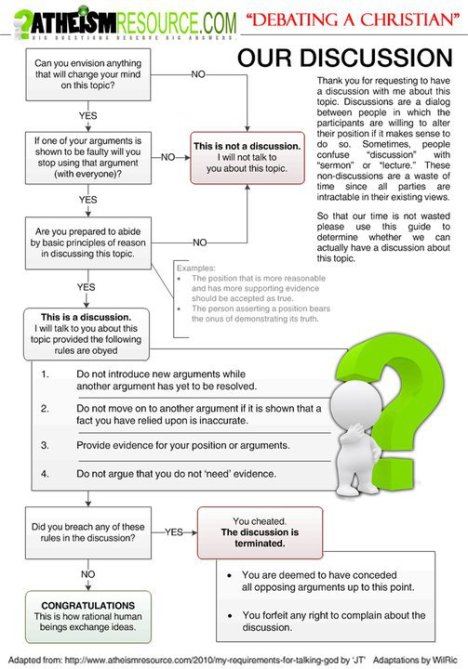
I plan on making a separate post about abortion, so I will address their dogma arguments there. Of course, that would be the appropriate thing to do, right? Not according to Roxeanne. She insisted that I tell her my personal views in response to the questions I was posing. That is logically inappropriate. The issue at hand needs to be resolved; it is only a red herring to go after my views as a means of defending her views. To help clarify:

And she isn’t even a Christian.

She violated number 1 in the list over and over again. That apparently makes me dishonest. Oh, and a “jerk” and “stupid” and somehow sexist. Okay, okay. The sexist part doesn’t come from that, I admit it. I actually accused her of grabbing the mantle of science. We all know how sexist that is, amirite? (Oh, and for the record, she said I called her anti-scientific; her point in claiming that was to brag about her undergraduate degree in engineering (because that constitutes authority in biology?), but she was wrong. She may very well be as anti-scientific as a creationist theist (just like the blog owner), but I was calling her position an attempt to misuse science. I said very little of her.)

Then there comes the Comments tab. The blog owner goes on and on about some random Internet guy and his supposedly bad arguments, but he only quotes one supposed comment. Who knows what the real context was. But since the author had some obvious flaws in what he said, I quickly pointed them out: 1) In addressing the charge of being censorious, he cited that awful creationist movie Expelled; 2) he said Darwinists insist that evolution explains the origins of the Universe; 3) he said reason and logic are “clearly” immaterial. The issues are obvious: 1) the false charge that anyone from Expelled was censored doesn’t even begin to address whether or not he was right to censor others; 2) it is creationists who often conflate evolution with the Big Bang – I have never once witnessed a Darwinist (he means atheist) do that; 3) reason and logic are products of the electrical impulses in our brains. So are our thoughts, our feelings, our perception of reality.

Of course, he hardly responded to any of that. Of what he did say, he had two revealing replies. First, I pointed out that when he says “morality”, he really means objective morality. This is a common error of assumption theists make. It’s annoying. If we’re going to compare objective and subjective morality, we need to use our qualifiers. Aside from creating a lack of clarity in discourse, it’s begging the question: if we’re trying to determine what is moral and one side is asserting that objectivity is the key factor, then they don’t get to assume “objective” in front of morality. It would be like saying, “What makes objective morality objective is objectivity.” This shows an unwillingness to approach the topic in a way resembling any sort of fairness (or logic). Second, he claimed that he embraces science. Let’s take a peek.

I don’t reject science, I embrace it as discovering how God put his universe together.

That sure doesn’t sound like an “embrace” of science to me. It sounds like he will only accept science which reaches the conclusion he already has. Need more proof? No problem.

My evidence comes before science. I see the evidence for God and the supernatural and I see evidence in the natural and how science sometimes gets it right.

That is an outright rejection of what science is, of what it stands for. By only accepting what reaches his pre-held conclusion, he shows an unwillingness to look at any evidence objectively; every idea he will ever have on science must be distrusted. He’s a walking stereotype.

The primary reason for this post was that I was apparently banned (despite being the only respectful person there – and you all know how dirty that makes me feel). I have no idea where the administrator said I would no longer be allowed to post, but I thank Dan Trabue for letting me know before I made some big reply. As it turns out, my comments are ‘only’ being held in moderation. As a result, I won’t be making any further posts over there; someone who feels the need to moderate perfectly rational discourse for no more reason than because he disagrees with it is not someone I can trust.

Santorum loses chance at presidency

Ex-Senator Rick Santorum recently said as a black man, President Obama ought to be more sensitive to the defining of a fetus as a non-person.

“The question is — and this is what Barack Obama didn’t want to answer: Is that human life a person under the Constitution? And Barack Obama says no,” Santorum says in the interview, which was first picked up by CBN’s David Brody. “Well if that person, human life is not a person, then, I find it almost remarkable for a black man to say, ‘We are going to decide who are people and who are not people.'”

There are a number of things wrong with that statement. First, on what basis is Santorum claiming President Obama didn’t want to answer that question? He went to the 2008 televised interview with Rick Warren. That tells me he was more than willing to answer that sort of question. Second, black people are living, breathing, conscious, aware, have advanced nervous systems, etc, etc. They are not comparable to fetuses.

But then the article had to go and give this quote from Obama in 2008.

Santorum was referring to Obama’s comments at a 2008 forum with Pastor Rick Warren in which he said the question of whether a baby should have human rights was “above my pay grade.” Obama later said his remark was too flip, but “I don’t presume to be able to answer these kinds of theological questions.”

It isn’t a theological question. Theology has nothing to logically say about abortion. Of course, that doesn’t stop religious leaders and adherents from doing so, but that doesn’t mean they have any real basis.

But was I to be left disappointed with this article? Was I to be left with a dumb quote from a very intelligent man? Fear not:

“Just about everything else in the world he’s willing to do – have the government do – but he can’t answer that basic question which is not a debatable issue at all,” Santorum told Jeffrey. “I don’t think you’ll find a biologist in the world who will say that is not a human life.”

Two things. One, really? What constitutes life is not debatable? Come on. Santorum should be required to shut the fuck up at this point for that one. Two, really, really? No biologist is going to say a fetus is not a person? Has Santorum ever talked to any biologists? Has he ever looked at a mass of cells? I’ve never looked at a human embryo in person, but I’m confident that it isn’t any more a human being than any of those zebrafish embryos I decapitated dechorionated were living zebrafish. I’ll let you know if I change my mind at any point in my career. Just don’t count on it.

Oh, and the post title? It’s probably wrong. If anything, I see this as increasing Santorum’s odds with the Republican anti-science base.

Remember when LePage was against special interests?

Yeah, that was Friday. But come Saturday he must have had a change of heart.

The activists rallied Saturday at Augusta’s St. Michael School and later marched to the State House to trumpet the anti-abortion cause. Gov. Paul LePage, an abortion opponent, joined them for part of the rally, which was organized by the Maine Right to Life Committee.

St Michael’s School is where the last Maine governor, Baldacci, sent his children. As it happens, back when it was known as St. Mary’s School, I also received a big hunk of my education there. I never saw Baldacci. But then, he wasn’t the sort of governor to say he believed one thing one day and another thing another day. At least not this blatantly.

And LePage’s handlers in all this? Not very good so far.

Asked Saturday whether the Maine Right to Life Committee represented a special interest, [Dan] Demeritt said special interests inevitably would end up on LePage’s schedule.

“This isn’t about politics,” he said of Saturday’s rally. “This is about supporting a group that’s worked very hard to make sure that life is a choice that everybody can make.”

What about supporting groups that have worked very hard to make sure a chance at equality is possible for people who are actually alive? Or maybe giving black people as a group the time of day in Maine isn’t something political advantageous enough for LePage.

Catholic Church: Double Effect is wrong

Well, they didn’t really say that. But they effectively stated as much when they stripped an Arizona hospital of its affiliation with the church.

The Roman Catholic Diocese of Phoenix stripped a major hospital of its affiliation with the church Tuesday because of a surgery that ended a woman’s pregnancy to save her life.

Bishop Thomas Olmsted called the 2009 procedure an abortion and said St. Joseph’s Hospital and Medical Center — recognized internationally for its neurology and neurosurgery practices — violated ethical and religious directives of the national Conference of Catholic Bishops.

In fact, the woman was virtually guaranteed to die if she continued to carry the 11 week old fetus much longer. Now keep that in mind:

Double effect is the ethical principle which says something is ethical so long as it conforms to these four conditions:

1. The nature-of-the-act condition. The action must be either morally good or indifferent.
2. The means-end condition. The bad effect must not be the means by which one achieves the good effect.
3. The right-intention condition. The intention must be the achieving of only the good effect, with the bad effect being only an unintended side effect.
4. The proportionality condition. The good effect must be at least equivalent in importance to the bad effect.

This case in Arizona is textbook. The first condition is satisfied because the act was to save the mother’s life. The second condition is satisfied because the means is the removal of a physical condition, not the explicit murder of another person. The third condition is satisfied because the doctors only want to save the mother’s life, not destroy the fetus. The fourth condition is satisfied because even if the fetus is a human, the mother’s life must be equally considered.

In fact, double effect isn’t really important here because the fetus is not a human being, but I digress.

The church stripped the hospital of its status (and, really, that’s a good thing anyway) because it thinks the woman should have risked certain death (which isn’t really a risk, now is it?). We know the end result would be the death of her and her fetus. How that is considered good is a mystery.

And that raises another point, doesn’t it? What methodology, what guidelines, what anything does the Bible (or any holy book) offer in this situation? One person unfamiliar with basic, classic philosophical examples couldn’t come up with an answer. (In fact, he might say the problem here was just logistics.) It doesn’t look like the Catholic Church has an answer either.

It’s unfortunate that the hospital says it will still follow Catholic Church guidelines (not Biblical guidelines…since they do not exist), but this is an overall good incident. While I hate to see the sort of irrational arguments that say the saving of one life is really just abortion of another, it’s fantastic that the Church has severed its formal ties with an institution committed to actually helping people. I hope that whenever necessary the hospital will not hesitate to continue saving living humans.

A response to the pope

Thought experiments

It has come to my attention as of late that a surprising number of people have little grasp on how thought experiments work. They’ve all been theists, but I’m rather unwilling to extrapolate my anecdotal experience to that entire group. I suspect there are a number of underlying personal factors at work here, so I will forego the speculation as to the motive/reason behind the poor grasping and instead focusing on simply explaining a few key points about thought experiments. (I will focus on the areas where these people have had trouble.)

A thought experiment is not meant to be inherently realistic. It very well may reflect a real scenario, but often it’s a contrived situation that could never happen. Take for example Judith Jarvis Thompson’s violinist. She created a scenario where we might be tempted to agree that abortion is permissible.

You wake up in the morning and find yourself back to back in bed with an unconscious violinist. A famous unconscious violinist. He has been found to have a fatal kidney ailment, and the Society of Music Lovers has canvassed all the available medical records and found that you alone have the right blood type to help. They have therefore kidnapped you, and last night the violinist’s circulatory system was plugged into yours, so that your kidneys can be used to extract poisons from his blood as well as your own. [If he is unplugged from you now, he will die; but] in nine months he will have recovered from his ailment, and can safely be unplugged from you.

Using libertarian principles, she argues that we have no responsibility to that violinist and are therefore justified in disconnecting ourselves from his circulatory system. Her argument isn’t without its problems, but it is powerful. And why? Because a lot of people are going to agree that we lack responsibility in this situation and people are going to see the situation as analogous to the abortion debate.

Rather than focus on the merits of Thompson’s argument, I want to focus on the form of her argument. That situation is unlikely to ever happen; it presumes there are no alternatives when there probably are, it assumes the violinist wouldn’t simply detach himself or die beforehand anyway, absolving us of the responsibility of carrying on with the full nine months, etc, etc. But that isn’t the point. Thought experiments are often very restricted. When we enter in variables we offer people too much wiggle room. The whole point is to find a principle and see if we hold it consistently. To do that, it is necessary to limit the conditions.

The other point on which I’ve found people have confusion is – and this one is, frankly, bizarre – when someone uses a point in which that person does not actually believe. In the above explanation, I used a different example than the one that caused someone confusion. For this explanation, I will be using the experiment that is being confused.

First, let us go over another way thought experiments are used. Rather than being a contrived analogy created with purposeful restrictions, thought experiments can take the form of an if/then scenario. Generally this isn’t referred to as a thought experiment, but the relation is close enough where I feel comfortable including it in this post. Take for example an example provided by Peter Singer. (I’m at a loss for the book where this is included, so I will be paraphrasing.) In making an argument for the rights of animals, he begins by pointing out that we’ve long held assumptions that are easily abused when used in arguments. Specifically, he references an argument made in the 1800’s where a politically strong man argues that giving women the vote would be like giving gorillas the vote. He assumes that everyone else has the assumption that giving gorillas any sort of human rights is ridiculous; he doesn’t offer an argument as to why it would be ridiculous to give them the vote (or any other right). With this assumption he is able to allow his reader to follow the consequences: if it’s ridiculous to give gorillas the right to vote, then it is ridiculous to give women the right to vote for the same (unmentioned) reason(s).

Now on to my specific example. The Problem of Evil is something theists have been unable to resolve without violating certain principles. To refresh everyone’s memory, here is the Problem:

1. If God exists, then God is omnipotent, omniscient, and morally perfect.
2. If God is omnipotent, then God has the power to eliminate all evil.
3. If God is omniscient, then God knows when evil exists.
4. If God is morally perfect, then God has the desire to eliminate all evil.
Evil exists.
5. If evil exists and God exists, then either God doesn’t have the power to eliminate all evil, or doesn’t know when evil exists, or doesn’t have the desire to eliminate all evil.
6. Therefore, God does not exist [as we know him]

The primary answer given to this is that evil is necessary for the existence of free will, but this fails because creating free will (a) creates evil and (b) is not necessary to God’s existence. The “if” portions of the argument which detail God’s properties (1-4), clearly show that God desires the elimination of evil. Everyone agrees that without that property he is a very different God (and therefore not the God in which so many people believe). No one, however, agrees that he needs to create free will in order to exist. The Problem remains.

Now here is the bizarre part I mentioned. I have heard it argued that it is dishonest (on some level – there was squirming around this issue) for an atheist to use the Problem of Evil as an argument against God. The reason is that an atheist does not believe in objective evil as derived from God. (An atheist may argue for an objective evil, but the one in question – not myself – did and does not believe in that argument – nor, incidentally, do I.) This, of course, is bunk. It is entirely unnecessary for anyone presenting the Problem of Evil to believe in any part of it. It is enough that the person to whom the Problem is being presented accepts the “if” portions. (Or that person can draw an issue with one of the premises and resolve the Problem that way, i.e., the person could say God doesn’t desire the elimination of evil. That would take care of any internal contradictions for that person, but the point that the God in which most people believe does not exist remains.)

I want to use my own thought experiment to help draw out and do away with the confusion. And remember – it need not be realistic.

Let’s say we have an individual named Sam. He believes in both the Christian god and the Muslim god. He says he fully accepts them both as entirely real and they both hold all of the characteristics listed in the above quote (omnipotence, moral perfection, etc). Immediately, Tom, a Christian theist, says to Sam, “But these two Gods say things which are in conflict with each other. If the Christian god says one thing, but the Muslim god says another, then how do you resolve the issue?” Rather than answer the question, Sam looks at Tom and says, “Ah, but Tom, you only believe in the Christian god. Since you reject the existence of the Muslim god, it is dishonest of you to use him as a part of your argument.”

I hope we all see how ridiculous Sam is in this scenario. Of course Tom can ask Sam how he resolves the obvious conflict. It isn’t necessary that Tom believes in both gods (or either). The conflict is independent of Tom and his beliefs. Anyone can ask Sam about the obvious problems that arise from holding contradictory beliefs.

Now I want to break it down. In the first scenario we have two important beliefs: (a) God exists and (b) evil exists. If someone believes (a), then a belief in (b) poses a Problem. That’s the Problem of Evil at its most basic level. But take a look at the discussion between Sam and Tom; there are two important beliefs there, too: (a) the Christian god exists and (b) the Muslim god exists. If Sam believes in (a), then a belief in (b) poses a problem.

This isn’t that hard.

I find it difficult to imagine someone calling a Christian or Jew or Muslim or atheist or Buddhist or agnostic or Scientologist dishonest for pointing out to Sam that he has a contradiction in his beliefs. I really hope it’s obvious to everyone that it is unnecessary for anyone to accept any premise of Sam’s beliefs in order to tell him that there is a conflict in believing that, say, it is necessary to accept Jesus Christ while at the same time it is unnecessary to accept Jesus Christ. We can all see that contradiction and we can all point it out. And we can do it with complete and utter integrity and honesty.

Finally, here are a few links which explain thought experiments in more detail than I have.

Standford

Answers.com

Wikipedia