The elevator thing again?

PZ has insisted on rehashing the elevator incident one more time. Now he has two more things to be wrong about:

Let’s stop the shouting that Richard Dawkins is some kind of raving misogynist. What’s happened here is that he is at some remove from all of the details, and this issue got blown up by lunatics who felt their manhood threatened and who exaggerated the situation to an absurd degree. I think he is wrong, but what he was arguing against was a cartoon of feminism which far too many people have been peddling on the blogs.

No one is about to doubt the intelligence of PZ Myers, but to be such a condescending little prick to someone like Richard Dawkins is risible. Dawkins is not “at some remove” from anything. He had access to the video. He used details provided in that video when he wrote about it. If he’s short on any detail it’s only insofar as everyone else who wasn’t on that elevator is short on detail. Including PZ.

The second place where PZ is wrong is where he pretends that it’s been those who disagree with Rebecca Watson that have been blowing this out of proportion. Go take a look at the comments on all the blogs, including Pharyngula. It hasn’t been the dissent that started drawing connections with rape and deep-seated misogyny. No, what has happened here is that everyone except caricature feminists has been saying that the elevator guy made a bad move, he should have been paying better attention, but we don’t know what his intentions were. It would be no surprise if he hoped for something sexual, but all he did was ask Watson for coffee in his room, which was in the general direction they were already heading. As Dawkins said, “zero bad” happened here.

What I find really interesting about this is PZ’s defense of Dawkins. If any non-celebrity male said the exact same thing, there would be zero defense from PZ. And he knows it. If anything, he would join in the chorus of feminists who portray those who disagree with the Designated Feminist Position as women haters who are against first and second wave feminism. As I’ve said elsewhere, it is that sort of reaction – and we all know it’s a common one – that leads to Internet feminists being seen as caricatures. This isn’t some big crazy patriarchal conspiracy. (No, really, I swear. It isn’t my penis talking.) Overreacting to minor situations (or even non-situations, as is the case here) is why so many third wave feminists get portrayed as cartoons.

You can’t blame this one on men.

Those mole hills are looking mighty big these days

I’ve lightly been following some incident that happened after an atheist conference. Rebecca Watson suffered the indignity of being talk to by some guy. (Relevant part starts around 4:40.)

Presuming you’re too lazy to watch the video, she was at a bar with a number of people, decided to go back to her room around 4 a.m., and when she got on the elevator so did a guy who was apparently engaged in previous group conversation (or at least listening). The guy said he found the talk she gave earlier interesting and asked if she wanted to go back to his hotel room for a cup of coffee to discuss things more. It’s not a very good line, but I bet it has worked more than once. (And who knows, maybe he was being genuine. I doubt it, but let’s at least throw it out there.) She was uncomfortable and declined. And that was that – he didn’t press further, nor did he lay a finger on her.

Fast forward a bit and PZ makes a post on the topic. His focus was on an issue that arose with Watson calling out her critics by their names. Apparently one person was a student or some such thing and Watson really singled her out. I don’t know (or care) enough about the details to really give it a fair shake, but those sort of criticisms can be dicey. Hell, I’ve put out a publication around my school where I really wanted to criticize the worst professor I have ever had. I decided against it for various reasons, not the least of which was because those sort of things aren’t always clear. Besides, there are more appropriate channels.

Next PZ made a post where he gave no-brainer advice to avoid being a creeper. It was condescending, even if largely right, and I can only be thankful he stopped before giving sex advice.

It is from that post, however, that things get interesting. Richard Dawkins jumped into the comment section and gave his position in response to another user:

Dear Muslima

Stop whining, will you. Yes, yes, I know you had your genitals mutilated with a razor blade, and . . . yawn . . . don’t tell me yet again, I know you aren’t allowed to drive a car, and you can’t leave the house without a male relative, and your husband is allowed to beat you, and you’ll be stoned to death if you commit adultery. But stop whining, will you. Think of the suffering your poor American sisters have to put up with.

Only this week I heard of one, she calls herself Skep”chick”, and do you know what happened to her? A man in a hotel elevator invited her back to his room for coffee. I am not exaggerating. He really did. He invited her back to his room for coffee. Of course she said no, and of course he didn’t lay a finger on her, but even so . . .

And you, Muslima, think you have misogyny to complain about! For goodness sake grow up, or at least grow a thicker skin.

Richard

And how have people interpreted that? Poorly:

However, the existence of greater crimes does not excuse lesser crimes, and no one has even tried to equate this incident to any of the horrors above. What these situations demand is an appropriate level of response

The elevator incident demands…a personal rejection and a woman nicely suggesting to the atheist community that they avoid doing that.

No, wrong. The elevator incident demands a personal rejection and some better communication skills for that guy, but it certainly does not demand the damnation of the entire atheist community.

The point Dawkins was making was not that, ‘Oh, there are worst things in the world, so get over it.’ He isn’t stupid. He was making the point that even if this is a great offense (and it isn’t), the response it has gotten makes a mountain out of a mole hill. A man asking a woman to go back to his room for coffee, whether innocent or with the greatest of hopes in his mind, might deserve a quick admonishment of the guy later on – if a friend of mine did that, I would tell him he should have chosen a better location than in a small, temporarily inescapable room. And if he hadn’t personally talked to the woman at all prior to that moment, I would wonder why he thought he was in a position to ask her anything close to that – and I would tell him he had been less than smooth. What I wouldn’t have done was create a video about the incident, make the guy out to be the greatest misogynist in the world, and condemn an entire group of people. Dawkins was advocating for some perspective.

And hell, has anyone stopped to think that maybe this guy just isn’t very good at ‘picking up’ women? His line was weak, he apparently didn’t speak with Watson directly (or at least not much), and he didn’t consider his location very well. In fact, it wouldn’t surprise me if he chose the elevator because it was private. I don’t know many guys who are willing to ask women out or invite them some place in front of a group of people. Just tonight, actually, I saw a TV show that featured a man talking to a beautiful woman in front of his friends. It struck me as immediately odd because that sort of scenario is rare, at least among strangers and near-strangers. I don’t want to defend the guy on this basis, but I doubt anyone, especially PZ, even bothered to consider it.

It’s this sort of stuff that hurts feminism.

Update: I’ve just seen a second response from Dawkins:

No I wasn’t making that argument. Here’s the argument I was making. The man in the elevator didn’t physically touch her, didn’t attempt to bar her way out of the elevator, didn’t even use foul language at her. He spoke some words to her. Just words. She no doubt replied with words. That was that. Words. Only words, and apparently quite polite words at that.

If she felt his behaviour was creepy, that was her privilege, just as it was the Catholics’ privilege to feel offended and hurt when PZ nailed the cracker. PZ didn’t physically strike any Catholics. All he did was nail a wafer, and he was absolutely right to do so because the heightened value of the wafer was a fantasy in the minds of the offended Catholics. Similarly, Rebecca’s feeling that the man’s proposition was ‘creepy’ was her own interpretation of his behaviour, presumably not his. She was probably offended to about the same extent as I am offended if a man gets into an elevator with me chewing gum. But he does me no physical damage and I simply grin and bear it until either I or he gets out of the elevator. It would be different if he physically attacked me.

Muslim women suffer physically from misogyny, their lives are substantially damaged by religiously inspired misogyny. Not just words, real deeds, painful, physical deeds, physical privations, legally sanctioned demeanings. The equivalent would be if PZ had nailed not a cracker but a Catholic. Then they’d have had good reason to complain.

Richard

Naturally, the interpretation here has been that Dawkins thinks words don’t matter. He still isn’t stupid. He makes the point that the man was polite and did no harm to the woman. She may have been offended, but he caused her no turmoil from the forgettable incident. Perhaps if he was rude, or cursing, or plainly asked her if she wanted to fuck, then hey, we’ve got ourselves something disgusting. But he asked her for a cup of coffee. That does not get us here from there.

Feminism, men, and video games

In my run-in with a few caricature feminists last year, I disagreed over something pretty simple. There was a picture of two fat women next to an article about fat women and medical care on CNN. The caricature feminist, Suzanne Franks, said that it was a sexist picture because it didn’t show their faces, instead only focusing on their “boobs and vagina”. Several people, including myself, pointed out that it would be wildly inappropriate to feature their faces, and besides, the article was about fat people. The objectification was on fatness, not women per se. For that I was deemed horrifically sexist; I clearly must hate all women. In fact, I was accused of only disagreeing because the blogger was a woman. In reality, I actually had assumed she was a man. A small part of the reason is that most bloggers are men, but there was also this reason:

As I (audaciously!) explained in previous posts, I never said my assumption (that the post was by a man) was good or bad. What’s more, I was also going on the fact that Franks looks like a man with long hair in her picture. I didn’t originally raise that point for the sake of not being so crude, but if she’s going to hammer on the point, then that’s what’s going to happen.

So in my effort not to be insulting of her face, I had to say I had an assumption I knew wouldn’t going over well where I was. But I figured I had at least won the point: If I assumed the blogger was a male, then I couldn’t possibly be disagreeing for the sake of disagreeing with a woman. Of course, actually addressing that point would be embarrassing; people don’t like to admit when they’re wrong on the Internet. Instead, everyone focused on the fact that I had such a crazy! assumption in the first place. I freely admitted that it wasn’t a great assumption to have, even if most bloggers actually are male, but that didn’t really matter to anyone. Assumptions?! YOU HATE [whatever that person likes]!!!

So that brings me to a recent post by PZ. He talks about some new book that says 21st century men are immature and not living up to any real standards. The reason? Feminism, of course! It’s clearly a stupid premise.* However, just as stupid is the claim PZ makes that men aren’t growing up for the intrinsic reason that they are men. If there’s a problem with this generation, it isn’t just with one sex or the other. (Not that I think there’s something horrid about this generation: PZ is an old guy, so he’s falling into the trap into which most every old person before him has fallen – he thinks young people suck and we didn’t have to walk 15 miles in the snow to get to school just so we could get our daily whipping!)

But his unusually muddled post aside, several of the commenters take the time to mention video games when talking about immature men. Jadehawk had this to say:

meh. I don’t mind the non-marrying, non-settling down sort of man. I don’t even mind the video-game playing, spending all night on the internet type. In fact, I’ve got one of those at home.

It’s the entitled douchebags I mind. Those who think all women are supposed to play mommy for them.

While I’m glad Jadehawk (look at me, not assuming his or her sex!) took the time to differentiate between these type of men, I still really hate the association between video games and the immaturity PZ discussed. It’s just an ugly assumption. And aren’t assumptions like that just shitty? They were when I made them about Franks being male.

But on video games: first of all, video gamers are nearly split 50/50 between male and female today. Second, if someone goes on and on about the acting or the storyline or the plot twists or the cinematography of a movie, why, that’s just an avid movie goer; that person really appreciates a form of art. But video games? Nah. That’s just childish baby-baby stuff. It’s totally different because, um, well, uh, um, um, um, it just is, okay?!

You know, I don’t think my points here are too crazy. 1) The connection between feminism causing immaturity in men is just as nebulous as the connection between men and some magical intrinsic immaturity. 2) The assumptions we make, while almost always more common and with more impact from the dominant side, are often a fault. 3) Video gamers are composed of an ever-increasing even mixture of men and women, neither of which is immature for wanting to have some virtual fun.

But I’m sure that’s horribly fucking sexist in someone’s eyes.

*According to the comment section on the post, it looks like that isn’t really the premise of the book. The website reporting it, WorldNutDaily, seems to have given things their own spin.

Thought of the day

In Internet Feminism (which is a distinct school of feminism), it has become standard to effectively say, ‘If you disagree with any aspect of something a woman is saying about equal rights* and you have a penis, then you’re a misogynistic asshole.’

*It’s important to distinguish equal rights from other labels of rights. I primarily think of this in terms of ‘civil rights for gays’. Most people won’t use this phrasing, instead opting for ‘gay rights’. There is no such thing. That would be gay privilege – and no one is asking for that. Just the same, there is no such thing as ‘women’s rights’. That phrasing equally indicates privilege. To be fair, the intention of the speaker is rarely to reference anything about privilege; it’s just sloppy language. Regardless, let’s be more careful.

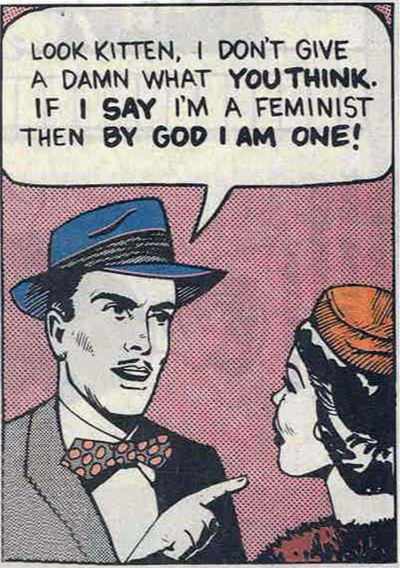
Comrade Physioprof in the comics

Take out the first sentence and this is perfect for Comrade Major Meltdown. (He actually does really, really, really, really, really care what women think of him.)

Society and the individual

I’ve pissed off feminists in my day. The reasons they give are going to revolve around me not understanding this or that, not automatically agreeing with them in the details, etc. (‘You don’t agree with me on this issue! Sexist!’ … ‘Why?’ … ‘Because!’) Basically, nothing specific.

But the problem isn’t some deep misogyny on my part. (Disagreement about what a picture of fat people means does not somehow magically equal hating women.) The problem, instead, is one of philosophical structure.

Feminism, as I’ve argued in the past, is a philosophy of consequence. It largely ignores intention, instead focusing upon the result of an action. It’s about as advanced as libertarianism. Of course, both philosophies have value, but when they’re promoted at the expense of everything else, they’re mere ideologies which inevitably lead to absurd conclusions. The same is true of all ethical and moral systems, including the ever-so-popular utilitarianism and egalitarianism (both of which I tend towards).

I got thinking about this because of a post by PZ on the lack of women in atheist and skeptic groups.

So I’m going to try something a little different. Instead of telling you my opinion, I’m going to forgo the essential principle of blogging (which is “Me! Me!”) and just ask people, especially women, to leave links to their godless/skeptical feminist blog or make suggestions or gripe or tell me what these stupid male-dominated conventions have to do to correct the imbalance…I shall be a passive receptacle for your ideas.

I do have to make one suggestion (the testosterone compels me) for something I’d really like to see happen…

Don’t mind his suggestion here (but at his site, he says a female-run conference on atheism/skepticism would be good). Take a look at the emphasis I’ve added. He says he is compelled, inherently, by the fact of being male. This is in line with a good bit of feminism, including the caricatures that haunt the Internet, but it’s a load of bull.

This idea that someone is compelled to do this or that may have a basis in sex, but philosophy is not the way to determine that. I want hard evidence. And, depending on just what is being discussed, there is plenty of evidence that men and women will tend towards certain behaviors because of their sex. Of course, that data often comes with the compounding factor of just what influence nurture has had, and the sociologists have a say there. But philosophy is not data. Logic can tell us nothing new; logic can only interpret the data we have.

What PZ does when he says it’s his maleness that makes him act one way or another is he devalues himself. (Hell, he even goes counter to all the feminist arguments that say the individual is responsible for rape/sexual abuse and ought not blame society – something with which I agree.) It’s a devaluing of the individual to place blame on some external source – especially without evidence. We may be able to blame an act of violence by a mentally ill person on his mental illness, but that principle does not extend to most people and most actions. It isn’t some external source that is to blame for individual actions among competent people 95% of the time. It’s the individual.

That said, there certainly is value to the arguments that say society is dominated by men and that that is an impediment to true equality between the sexes. Again, that doesn’t somehow magically mean a picture of two fat women is sexual objectification, but there are plenty of incidents where that domination is a serious problem, ones we gloss over on a daily basis. Watch just about any TV show. Women will be objectified and our culture allows it. That’s not a problem with the individual, but society. But it’s ridiculous, devaluing, and plainly wrong to claim that society is the whole problem.

The individual bears responsibility.

For the sake of language

He or she must ask himself or herself whether his or her sense of style could ever allow himself or herself to write like this.

~Richard Dawkins, The God Delusion

And there it is

Suzanne Franks has officially declared herself right by banning me from her blog. For someone as educated as she is, it’s surprising that she doesn’t realize it is unreasonable to say “Here’s why you’re wrong…hey! why are you responding?!?”

But then, she’s the sort of person who gets offended when others won’t play her Internet fantasy games by calling her “Zuska”.

I declare I am right!

There are a lot of bad arguments that come from Suzanne Franks and friends. These are caricature feminists who seem to almost revel in the notion of ignoring every philosophy that isn’t feminism. They see to despise the notion that intention matters (a la Kant et al). One user even said this.

Before you bring up Kant on a feminist blog, you need to read and contemplate Jane Flax’s chapter on Kant and Enlightenment thinking in “Disputed Subjects.”

The point I was raising with Kant (and others, but Kant is the most influential) is that intention matters. Feminism is largely a philosophy of consequence, but unlike, say, utilitarianism or humanism, it does not deal well with philosophies which place an emphasis on will (or, specific to Kant, Good Will).

I am unable to locate the article cited by that user, Comrade Svilova, but this piece by Ruth Dawson summarizes Flax by saying,

Jane Flax…argues that Enlightenment depends on the unspoken occlusion of women…

Again, we see an argument premised in consequence. The issues raised by Flax have little to do with the value of intention; she cares about the context of the writings and what they meant for women at that time. This line of argument is irrelevant because no one today is arguing from an 18th century perspective. The invocation of Kant (and more specifically, will/intention) has nothing to do with how past philosophers and others may have implemented particular ideas. Instead, the focus is on how we can and ought to apply these ideas in the cultural context of today. Take this article on the founding fathers and rights. While same-sex marriage was not directly discussed, I specifically had it in mind while writing the piece. The ideas of those men resonate today because they espouse a strive towards equality that many people want. That doesn’t mean any of those men would have favored same-sex marriage. The point is the ideas, not the people who wrote them.

And there are more times where some of the more prolific feminist sites will ignore intention, going so far as to set up blatant and offensive strawmen.

FAQ: What’s wrong with suggesting that women take precautions to prevent being raped?

Short answer: Because it puts the onus on women not to get themselves raped, rather than on men not to do the raping; in short, it blames the victim.

What I think this is trying to articulate is that it is wrong for people to say “She had it coming”. The article does not actually address prevention, as seen here.

Left to my own devices, I never would have been raped. The rapist was really the key component to the whole thing. I was sober; hardly scantily clad (another phrase appearing once in the article), I was wearing sweatpants and an oversized t-shirt; I was at home; my sexual history was, literally, nonexistent—I was a virgin; I struggled; I said no. There have been times since when I have been walking home, alone, after a few drinks, wearing something that might have shown a bit of leg or cleavage, and I wasn’t raped. The difference was not in what I was doing. The difference was the presence of a rapist.

This points out that the author did not have it coming and that rape is not dependent upon how a woman dresses. (While rape is generally about power, it shouldn’t be ignored that many rapists do not arbitrarily choose their victims, often instead opting for particular characteristics or traits – and that is still the fault of the rapist.) This point is not about prevention.

What is being implied here is that there are actually a significant number of people who really do think it is a woman’s fault for getting raped. Instead, the only close argument that actually gets made is that it is a good idea for women to not walk alone at night in dangerous places or that women should carry rape whistles and/or cell phones. This is not a philosophical claim that has implications of blaming anyone for anything. It’s practical advice that acknowledges there is danger out there. This would be like someone saying, “Hey, you should do X, Y, and Z if you come across a bear while hiking”, only to get the response, “What, are you saying it’s my fault if I don’t do those things?”. No, the bear is still the root of the problem and we ought to do what we can to control the population, but you shouldn’t start trekking the Appalachian Trail without knowing the dangers.

The warnings women get are misleading. They leave out the acts of the rapist himself. They focus on the situation. They also may focus on the “kind of man” the potential rapist is. If he’s a friend of a friend, or your uncle, he’s “safe.” It’s the stranger who’s the threat.

Who is disagreeing with this conclusion? Yes, non-strangers are threats, but so are strangers. Control the bear population. That doesn’t mean you should walk into a dark alley because you aren’t the one to blame.

On another FAQ, the question “What’s wrong with saying that things happen to men, too?” is asked.

Nothing in and of itself. The problem occurs when conversations about women can’t happen on unmoderated blogs without someone showing up and saying, “but [x] happens to men, too!” (also known as a “Patriarchy Hurts Men, Too” or PHMT argument, or a “What About The Mens?” or WATM argument). When this happens, it becomes disruptive of the discussion that’s trying to happen, and has the effect (intended or otherwise) of silencing women’s voices on important issues such as rape and reproductive rights.

This undoubtedly happens. In fact, it happens over and over within scientific discussions that get derailed by creationists. The difference, however, is that “derailed” means that the original topic had nothing to do with creationism. On Suzanne Franks’ blog, she specifically ‘addresses’ those who dissent. (Here, here, and here.) Once that happens, the doors are open – especially if she is pointing to specific individuals. It is fundamentally unfair to say, “Here’s why you’re wrong about X…but you can’t respond because I don’t want a discussion. I just want to tell you things.” (It also seems to fit the piss-poor definition of “mansplaining”.)

To what this point really boils is that if someone does not want a particular point of view expressed in a particular place, then that person needs to start banning people. Franks has threatened to do that to me (despite the attention she is giving to specific people on specific topics – it isn’t logically tenable to claim to not want to discuss particular issues in particular ways only to then create posts which specifically do that), and that’s fine. I expect she’ll do it in short enough order and that’s her discretion, as logically inconsistent as it may be. (On the other hand, I consistently edited Comrade Physioprof’s posts because I was attempting to discuss a particular issue whereas he was spamming and trolling. Had my post been a trolling post or spam, then it might make sense for me to allow that guy’s garbage.)

What really bites my goiter about these caricatures and the more well-articulated Fem 101 site is that actual arguments are few and far between. More often there are declarations. Ask why something is so and the result is either a “You don’t get it” sort of response or a referral to a website which is more verbose in how it declares “You don’t get it”. This sort of stuff is okay for high school and lower-level undergrad philosophy courses because it does back up certain claims with further, deeper premises, but that’s where it stops. ‘Arguments’ like these don’t make it into philosophy anthologies, however, because they fail to reach more fundamental issues. How does feminism answer the importance of intention? How does it address the arguments of libertarianism? Utilitarianism? It is not a philosophy of fundamentals but rather one of contextual consequence; it therefore must either rely on or refute the philosophies which penetrate more deeply, more universally (i.e., it could attempt to rely on utilitarianism by arguing that equality maximizes pleasure, or it could refute libertarianism by arguing that too much liberty leads to inequality and inequality undermines liberty).

What I think most reasonable people want is not to be told “You don’t get it, so go to this site”, but rather “These arguments are premised on these more fundamental ideas.” If feminist sites and supporters actually addressed substantial philosophical values (where appropriate, such as in the examples I have given), then progress could be more reasonably and effectively made for all involved.

It’s only clever when we do it

Suzanne Franks has another post about ‘mansplaining‘.

Over at the mansplaining thread, you can read literally hundreds of hilarious, annoying, frustrating, heartbreaking stories of how women are constantly subjected to intrusive, incessant, insensitive, inane mansplaining. Interspersed you will also find comments from d00dly d00ds whinging away about how awful it is that women are talking so MEAN about men, and their mansplanations about how mansplaining doesn’t exist. Then some douche tried to coin the phrase femsplaining.

Well, if she’s going to phonetically spell things and replace numbers with letters, I just don’t know how I’m going to compete.

I’m not about to defend the use of the word “femsplaining”. If it means to reference a particular ideological group that addresses dissent with condescension and disdain, then it may be accurate, but it isn’t useful. These are caricature feminists. They represent a minority which has developed a sort of in-group mentality, not some mainstream way of thought that is going to change much of anything.

The reason, though, that I don’t want to defend “femsplaining” is that it’s as dumb as “mansplaining”. Each loose (and always piss-poor) definition allows an extension that goes beyond sex and gender. In fact, at least one user picked up on this fact. Even the tried and true caricatures have pointed out in several places that ‘mansplaining’ is not specific to men. One is only left to wonder why they would bother even using it at all. (I think I just mansplained?)

Oh, and this isn’t a post for mocking ‘mansplainers’. While Franks and friends are interested in furthering their fuzzy community feeling by screeching “You don’t geeeeeeeeeeettttttt iiiiiiitttt!!!”, I am not. The caricature Gish Gallop is getting tiresome. “You don’t get it, you don’t get it, you don’t get it! This is mansplaining, this is sexist, these pictures are ALL misogynistic. Your perspective is bunk! Bunk, bunk, bunk! Almost all people think like you do! (Because I know how you think, you straight, white male – and I know your sexual orientation, didn’t you know.)” …well, let me just respond to your first point by saying…”MANSPLAINING!”

Finally, dissent over language does not equal some big, sexist conspiracy. Sometimes terms just suck. Get over it.