Old eggs, daphnia, and evolution

When predation is high, crustaceans and other water loving egg lay-ers are not hatched much. What often happens is that they will remain dormant until later in the year when the predators are much less active. This offers a great research opportunity into evolution.

By hatching these eggs, Hairston and others can compare time-suspended hatchlings with their more contemporary counterparts to better understand how a species may have evolved…

What happens is that some of these eggs can remain unhatched for years and years, not just seasons. This is the case with daphnia. These are normally seasonal crustaceans, but researchers have specimens which are upwards of 40 years old. They use these to compare the change which has happened to this species over time. Daphnia_DGC
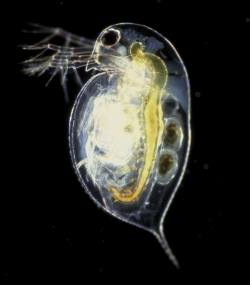
In the 1960’s, the lake from which these daphnia were taken had non-toxic levels of algae. But in the 1970’s, pollution had caused the algae to raise to a deadly imbalance. Currently, daphnia still reside in the lake, but researchers have found they are markedly different from the eggs they hatched. The older version of the species was unable to survive in the lake, poisoned by the overwhelming cyanobacteria. Clearly, the newer species had adapted to their new environment throughout the 70’s and subsequent decades.

Early Eyes in Evolution

I’ve already blogged about eyes and evolution, so I won’t go on about further research. But I will post an interesting article from sciencedaily.com.

ScienceDaily (Nov. 23, 2008) — Researchers unravel how the very first eyes in evolution might have worked and how they guide the swimming of marine plankton towards light.

Larvae of marine invertebrates – worms, sponges, jellyfish – have the simplest eyes that exist. They consist of no more than two cells: a photoreceptor cell and a pigment cell. These minimal eyes, called eyespots, resemble the ‘proto-eyes’ suggested by Charles Darwin as the first eyes to appear in animal evolution. They cannot form images but allow the animal to sense the direction of light. This ability is crucial for phototaxis – the swimming towards light exhibited by many zooplankton larvae. Myriads of planktonic animals travel guided by light every day. Their movements drive the biggest transport of biomass on earth.

“For a long time nobody knew how the animals do phototaxis with their simple eyes and nervous system,” explains Detlev Arendt, whose team carried out the research at EMBL. “We assume that the first eyes in the animal kingdom evolved for exactly this purpose. Understanding phototaxis thus unravels the first steps of eye evolution.”

Studying the larvae of the marine ragworm Platynereis dumerilii, the scientists found that a nerve connects the photoreceptor cell of the eyespot and the cells that bring about the swimming motion of the larvae. The photoreceptor detects light and converts it into an electrical signal that travels down its neural projection, which makes a connection with a band of cells endowed with cilia. These cilia – thin, hair-like projections – beat to displace water and bring about movement.

Shining light selectively on one eyespot changes the beating of the adjacent cilia. The resulting local changes in water flow are sufficient to alter the direction of swimming, computer simulations of larval swimming show.

The second eyespot cell, the pigment cell, confers the directional sensitivity to light. It absorbs light and casts a shadow over the photoreceptor. The shape of this shadow varies according to the position of the light source and is communicated to the cilia through the signal of the photoreceptor.

“Platynereis can be considered a living fossil,” says Gáspár Jékely, former member of Arendt’s lab who now heads a group at the MPI for Developmental Biology, “it still lives in the same environment as its ancestors millions of years ago and has preserved many ancestral features. Studying the eyespots of its larva is probably the closest we can get to figuring out what eyes looked like when they first evolved.”

It is likely that the close coupling of light sensor to cilia marks an important, early landmark in the evolution of animal eyes. Many contemporary marine invertebrates still employ the strategy for phototaxis.

Can you feel the beauty?