The erosion of progress by fundamentalism

I found this great video with Neil deGrasse Tyson where he talks about the rise in intellectual accomplishments by those in the Middle East between the years 800-1100 and how everything went downhill shortly thereafter. The rise was brought forth through free thought and inclusiveness of ideas from all walks of life. Unfortunately, one influential fundamentalist Muslim convinced people that mathematics was the work of the devil around 1100. From there everything started to fall apart. To make his point, Tyson notes that there are well over a billion Muslims in the world while there are about 15 million Jews. And how many Muslims have won Nobel prizes? A couple. How many Jews? Probably close to a quarter. It isn’t because there’s something inherently superior in the intellect of Jews; it’s because fundamentalism erodes scientific (and social and moral) progress. We face the same problem with intelligent design creationism today. If as a society we were to follow the course of the Christians (and Muslims and sometimes Jews and others) who advocate for that sort of anti-scientific/anti-science position, we would find ourselves down a very worrying path indeed.

Two final points. One, my post title is different from the video title because Tyson is not talking about religion in general. Two, you’ve got to love what he says at the end:

I want to put on the table not why 85% of the National Academy [of Science] rejects God, I want to know why 15% don’t.

Thought of the day

On the Super Bowl:

The Game: I had no horse in this race, but I’m glad the Packers won over the Steelers. And no, it’s not because I’m one of those sports fans who loves to indict players like Roethlisberger for non-sports related activities. I just think sports fans from Pennsylvania are crappy – even when they aren’t from Philadelphia.

The Halftime Show: Terrible, just terrible. I mean. Terrible.

The Commercials: I thought they were supposed to be entertaining. And while I recognize that the commercials around the halftime show weren’t the super expensive fancy ones, I still found it hilarious that there was a Toyota commercial which apparently used clip art.

IBM’s Watson

Anyone who has watched Jeopardy! for a moment has probably seen the ads for IBM’s Watson. It’s a program which uses “deep analytics” in order to determine the answers, or rather questions, to clues on the game show. It basically (insofar as anything about it is “basic”) uses a massive library of knowledge in order to search out key terms and then utilizes statistics in determining the answer. It’s pretty impressive; I know I’ll be watching it compete against Ken Jennings and Brad Rutter on February 14, 15, and 16.

On abortion

Let’s get one thing out the way first. People who view abortion as being the murder of human beings are not inherently anti-women’s rights. Just the same, people who view the issue as being a fundamental choice that ought to be left up to women are not inherently pro-abortion, much less pro-murder. Both arguments are just dishonest rhetoric.

The question of the morality of abortion can be viewed from a number of perspectives, but I want to focus on the most common issue: When does life begin? I don’t think the answer is so clear.

My big motivation for this post comes from a number of red herring theists, none of whom were able to argue in a coherent fashion. Since they insisted on avoiding the topic at hand (the support for their position), instead demanding I answer their questions (about my position), they are welcome over here in order to appropriately address where I stand on abortion.

Perhaps the most tempting way to define the beginning of humanity is the point of conception. And there’s some good reason. It marks the point where the genetic material for a person all comes together. Usually. In some instances of twinning the embyo can split in two up to four days after it was conceived. As a result, we have two groups of cells that, provided everything goes to plan, will end up as two living, breathing newborns. The problem that this raises is that we can no longer call the point of conception the absolute beginning of humanity. In these instances, conception results in one set of cells. It was only after conception that a new set of cells emerged. Unless we’re ready to call that ‘second’ twin non-human, we have to abandon this imaginary line in the sand.

But let’s go with the most logical counter-argument: Okay, it isn’t that conception marks the beginning of humanity; it’s something about conception that makes that mark. In that case, what? I think the best answer is that it is the emergence of cells which can result in the birth of a newborn which defines the beginning of humanity. That covers twinning. (The fact that the aforementioned red herring theists could not articulate something so simple and obvious makes me regret the time I wasted giving them any sort of respect.) But this answer isn’t without its problems.

What is it about this emergence of cells that is special? What makes this moment so important? The most logical answer is that it marks the beginning of development. (The red herring theists confused development for humanity.) It is the point where cells can start to form a full organism. But what more is this than the arbitrary declaration that a certain level of potential development is important? When gametes come together, yes, that marks the start of development, but so what? It isn’t development itself. It isn’t a full organism. It’s just a baseless valuing of potential. I could just as easily point to the emergence of a fully formed gamete and say that that marks a key point in development. “Why, a sperm has the potential to become a human!” And I would be right. The counter-argument would be, “A sperm can’t become human on its own” and the easy response is that neither can two gametes just because they’re combined. The whole process depends on a massive number of factors. That’s why it’s a process.

I like to compare the arbitrary line-drawing to the mark of American adulthood: the age of 18. It isn’t like a 17 year old is appreciably less mature the day before his next birthday compared to the day after. The line is ultimately an arbitrary one. That doesn’t mean it doesn’t have value. The fact is, if we want to have a coherent system of law, we must declare some age as especially important in distinguishing between childhood and adulthood. Eighteen is a reasonable number. Just the same, we need to do the same with how we want to define what it means to be human.

Now I need to clarify even further (or at least re-emphasize). The starting point of development is a technical concept; it isn’t a difficult one, but it is technical. That is when we can say the road to humanity has begun. If we want to go further and say that that is the marker of humanity itself, then we need to explain why. That is, “humanity” isn’t some technical, scientific term we can apply to conception. (We can apply it when we’re talking about species, presuming we’re using it interchangeably with “Homo sapien“, but we can’t go beyond that; we can only say “That is a human egg/that is a human sperm/that is a human zygote.” When we start using “human” as a noun rather than an adjective, we’ve lost all embryological meaning.)

So that brings us to my position. As I said, the line in the sand isn’t clear, no more than it’s clear that an 18 year old is or is not really an adult. I do believe that if an embryo is a human being, then we must protect it. There are persuasive arguments, especially from Judith Jarvis Thompson, which say we don’t have that responsibility even if humanity begins at conception, but I don’t buy into them. I value human life highly and as a result I feel it necessary to protect whenever possible. But I reject the idea that conception is some magical point where some cells go from non-human to human. I still see cells.

I hope it is clear that it is the process of development where I see real value. It is patently absurd to say a human life begins at conception, as if development is unimportant to how a person turns out. Take another look at twinning. There is a point where everything is exactly the same between each set of cells. At that instance, there is no difference between the twins. So how can anyone say we are looking at two different humans? If there is no difference, there is no difference. And if that’s true (and it is), then there must be something else which goes into defining a human. We call that development. And that isn’t without its problems.

Just as the assertion that humanity begins at conception suffers much like the assertion that an 18 year old is an adult, the process of development suffers from a lack of clear lines. But it does offer reasonable lines. We can figure out viability, ability to feel, development of consciousness, and even employ caution. This often brings us to approximately six months. But I’m open to moving that mark. Maybe there are key factors in development which take place by five months, even four. Maybe those factors matter in how we define the important aspects of what it means to be human. A persuasive argument might get me to adjust my position. And in all likelihood, that position will only move down in number of months, if it moves at all. It seems there is too much doubt in moving up beyond seven months. Certainly at the eight or nine month mark that line in the sand has almost completely vanished; it wouldn’t be reasonable to claim a fetus is not a human at 9 months, 1 week, and 6 days, but when it’s born at 9 months, 2 weeks, why, we have ourselves a full-fledged human. That’s just as arbitrary as declaring conception the beginning of humanity.

So discuss the issue. But keep this in mind: while I don’t normally moderate comments except for obvious spam (such as ads), I will be moderating them here for blatantly dishonest (and bad) rhetoric. In other words, don’t call someone pro-abortion or anti-women’s rights merely for holding an opposing view.

The red herring theist returns

I wrote a couple of months ago about the notorious red herring theist. That’s the person who will move the discussion from whatever the topic at hand is in order to attack atheists. It’s the same thing every time: “What? You think something is wrong? You have no basis for saying that because you don’t believe what I believe! Morality must be objective in order to say anything is true!” It’s tiresome if only because it’s pathetic. What’s more, there isn’t a person on the planet who somehow adheres to any sort of objective morality. People will claim they do, but they are necessarily interpreting ideas subjectively. When a believer says “God tells us what is moral”, they are coming to their conclusion through a subjective interpretation of (what they think is) the evidence. Furthermore, even if I grant that morality can be objective, theists undermine their case all the time.

What brings this on is my recent participation at the site of a religious nutbag. My first comment was to his bad post about Planned Parenthood. The important part of his post claimed that humanity begins at conception (whereas the rest of his post was the use of anecdotes to draw broad conclusions). When pressed on why conception is the best marker of humanity, he just kept repeating his position, sometimes citing anti-abortion websites which said the same thing. Great. But that doesn’t tell me anything. I eventually got one user to answer the question when she cited the coming together of chromosomes, but I was unable to get her to go further before the administrator nearly banned me. And I was the most respectful person the whole time. I know. It’s crazy.

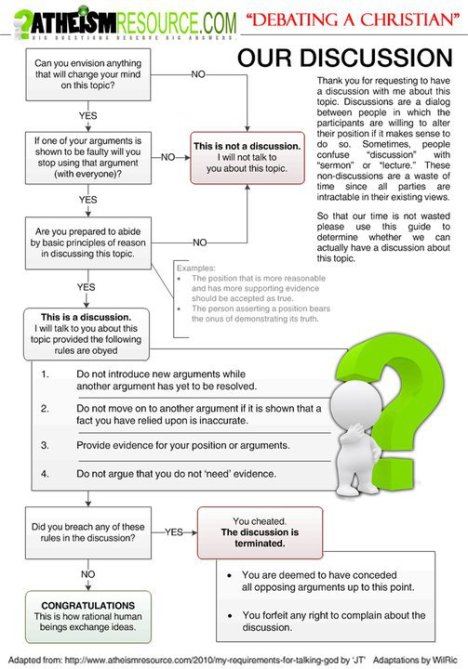
I plan on making a separate post about abortion, so I will address their dogma arguments there. Of course, that would be the appropriate thing to do, right? Not according to Roxeanne. She insisted that I tell her my personal views in response to the questions I was posing. That is logically inappropriate. The issue at hand needs to be resolved; it is only a red herring to go after my views as a means of defending her views. To help clarify:

And she isn’t even a Christian.

She violated number 1 in the list over and over again. That apparently makes me dishonest. Oh, and a “jerk” and “stupid” and somehow sexist. Okay, okay. The sexist part doesn’t come from that, I admit it. I actually accused her of grabbing the mantle of science. We all know how sexist that is, amirite? (Oh, and for the record, she said I called her anti-scientific; her point in claiming that was to brag about her undergraduate degree in engineering (because that constitutes authority in biology?), but she was wrong. She may very well be as anti-scientific as a creationist theist (just like the blog owner), but I was calling her position an attempt to misuse science. I said very little of her.)

Then there comes the Comments tab. The blog owner goes on and on about some random Internet guy and his supposedly bad arguments, but he only quotes one supposed comment. Who knows what the real context was. But since the author had some obvious flaws in what he said, I quickly pointed them out: 1) In addressing the charge of being censorious, he cited that awful creationist movie Expelled; 2) he said Darwinists insist that evolution explains the origins of the Universe; 3) he said reason and logic are “clearly” immaterial. The issues are obvious: 1) the false charge that anyone from Expelled was censored doesn’t even begin to address whether or not he was right to censor others; 2) it is creationists who often conflate evolution with the Big Bang – I have never once witnessed a Darwinist (he means atheist) do that; 3) reason and logic are products of the electrical impulses in our brains. So are our thoughts, our feelings, our perception of reality.

Of course, he hardly responded to any of that. Of what he did say, he had two revealing replies. First, I pointed out that when he says “morality”, he really means objective morality. This is a common error of assumption theists make. It’s annoying. If we’re going to compare objective and subjective morality, we need to use our qualifiers. Aside from creating a lack of clarity in discourse, it’s begging the question: if we’re trying to determine what is moral and one side is asserting that objectivity is the key factor, then they don’t get to assume “objective” in front of morality. It would be like saying, “What makes objective morality objective is objectivity.” This shows an unwillingness to approach the topic in a way resembling any sort of fairness (or logic). Second, he claimed that he embraces science. Let’s take a peek.

I don’t reject science, I embrace it as discovering how God put his universe together.

That sure doesn’t sound like an “embrace” of science to me. It sounds like he will only accept science which reaches the conclusion he already has. Need more proof? No problem.

My evidence comes before science. I see the evidence for God and the supernatural and I see evidence in the natural and how science sometimes gets it right.

That is an outright rejection of what science is, of what it stands for. By only accepting what reaches his pre-held conclusion, he shows an unwillingness to look at any evidence objectively; every idea he will ever have on science must be distrusted. He’s a walking stereotype.

The primary reason for this post was that I was apparently banned (despite being the only respectful person there – and you all know how dirty that makes me feel). I have no idea where the administrator said I would no longer be allowed to post, but I thank Dan Trabue for letting me know before I made some big reply. As it turns out, my comments are ‘only’ being held in moderation. As a result, I won’t be making any further posts over there; someone who feels the need to moderate perfectly rational discourse for no more reason than because he disagrees with it is not someone I can trust.

Seems like questionable advice to me

Thought of the day

I’m really not a fan of the myth of Reagan. He most certainly was not a great president: increasing the income gap, taking undue credit for the collapse of the Soviet Union, contributing to a massive increase in drug use, imprisoning poor, mostly black people for excessive periods (Obama recently helped fix some of this problem), and creating a bloated military. These ought to be the pillars of Reagan’s legacy, not some sanitized revisionism.

Oh, and that whole thing with trading hostages for arms with Iran. There was that, too.

Leniency for monsters

I wrote back in December that I had very little confidence in our judicial system in sentencing faith healing parents who are responsible for the deaths of their own children. Lenient sentences happen again and again – and bad parents keep praying for their children instead of seeking real medical help. This recent sentencing isn’t going to help.

Speaking in court, [negligent father] Herbert Schaible asked the judge [Carolyn Engel Temin]for leniency to allow the couple to support their family.

“We are grieving and will always feel the loss of our son,” Schaible said. “With God’s help, this will never happen again.”

Temin sentenced them to 10 years of probation, during which they are required to seek routine and emergency medical care for their seven children, ages 1 through 15.

No, with the help of the judiciary doing its job and discouraging other parents from neglecting their children, this will never happen again. With the help of the legislatures in the 30 states which offer protection for faith healing, this will never happen again. With the eradication of religion, this will never happen again.

Two of the three things I mentioned are within easy reach.

Judge denied end-run

Judge James DeWeese of Ohio was found to be in violation of the constitution when he hung a poster of the Ten Commandments in his courtroom in 2000. It was a pretty obvious finding, one the Supreme Court let stand. But did that stop DeWeese? Of course not. He’s Christian and American. Just like Jesus. He ought to have special privileges. Or not.

A three-judge panel of the 6th U.S. Circuit Court of Appeals upheld a federal district court’s ruling that Richland County Common Pleas Judge James DeWeese violated the constitutional separation between church and state by displaying [a second] poster…

The latest poster titled “Philosophies of Law in Conflict” shows the Ten Commandments in a column listed as “moral absolutes” and secular humanist principles in another column listed as “moral relatives.”

DeWeese attached a commentary to the poster that said he sees a conflict of legal philosophies in the United States — between moral absolutism and moral relativism — and that he believes legal philosophy must be based on fixed moral standards. At the bottom of the poster frame, readers are invited to obtain a pamphlet further explaining DeWeese’s philosophy.

It seems the only real conflict here is between DeWeese and the reality of the constitution. Let’s just hope he never gets to rule on a case trying to weasel creationism into the classroom.

Thought of the day

Now that there’s a growing consensus that Sarah Palin does indeed suck, can we all finally admit that her big intro speech to the nation in 2008 sucked just as much? People were fawning over the whole thing, but c’mon. It was terrible. The context around it – an attractive conservative white woman no one knew – created an atmosphere of excitement, but the speech itself? It was rendered poorly. Let’s just admit it.