First Cause proponents won’t get this

Since people who think the First Cause argument holds a lick of validity are obviously people who don’t understand really basic physics, I don’t think they will appreciate this. Everyone else, though, enjoy:

The science you won’t hear

Apparently a few global warming denialists skeptics have released some more DAMNING! emails from climate scientists. It appears that they’re actually from the same crop of hacked emails that were released awhile ago, but is anyone going to care? I make it a point to avoid FOX “News”, but I have no doubt that that station along with the other Republican propaganda machines out there will have no problem taking more things out of context whilst simultaneously presenting this stuff as brand new. Of course, what they won’t mention is this:

Climate-change skeptics have pointed to the emails as evidence that researchers were manipulating data to make global warming look more serious than it is. Multiple investigations by UEA, the U.S. Environmental Protection Agency, the National Science Foundation, the British House of Commons Science and Technology Committee, several independent panels and [climate scientist Michael] Mann’s home institution, Pennsylvania State University, found no evidence that these claims were true. The House of Commons did criticize the scientists and UEA for not releasing raw data and for handling freedom-of-information requests poorly. A 2011 parliamentary report concluded that it was time to “move on” from Climategate.

I have a conservative friend who made a big deal out of all this when it was new. (You won’t believe it, but there are conservatives out there who don’t understand a lick of science. Crazy, I know.) Then an early study came out exonerating the scientists of all the nasty claims being made by the anti-science right (sorry to be redundant). He dismissed that study, saying “this if far from over”. I followed up with him as more and more investigations concluded, asking which parts were still alive and kicking. Unfortunately, my follow-ups were all online, so he used the tactic common to many people who are wrong on the Internet – he ran away like a coward. It was really quite symbolic of much of the far right on this issue. And every other scientific issue once they get shown the facts.

And speaking of those who aren’t interested in science, remember the excitement the faster than light neutrino stirred up? No, no, not the genuine scientific excitement. I mean the excitement in the creationist/Christian community. “Why”, they ignorantly said, “this just shows that science doesn’t know what it’s doing!” Yes, yes, we all realize the religious don’t like the fact that science embodies the antithesis of faith. They’re more than happy to abuse the inherent nature of science in order to attack science. If it isn’t dogmatic and sure (based upon nothing more than faith, i.e., an overt lack of evidence), then it just can’t be good, right? That’s probably why this study isn’t likely to show up on too many Christian message boards:

An international team of scientists in Italy studying the same neutrino particles colleagues say appear to have travelled faster than light rejected the startling finding this weekend, saying their tests had shown it must be wrong…

They argue, on the basis of recently published studies by two top U.S. physicists, that the neutrinos pumped down from CERN, near Geneva, should have lost most of their energy if they had travelled at even a tiny fraction faster than light.

But in fact, the ICARUS scientists say, the neutrino beam as tested in their equipment registered an energy spectrum fully corresponding with what it should be for particles traveling at the speed of light and no more.

This doesn’t mark the end of the research on this specific subject, but it does act as a superficial blow to those non-science people who got so excited over all this. I say “superficial” because whether neutrinos can or cannot travel faster than light does no harm to science; the deeper reality is that none of this – absolutely none of it – will favor the religious mindset. But so long as so many people wallow in a fundamental misunderstanding of how science works – it rests upon bodies of evidence, damn it – these new results are unlikely to be promoted by anyone outside the scientific community.

Why this neutrino business is not worrying

It may have been noticed over the past couple of days that Christian and creationist blogs have been in a bit of a tizzy. Recent findings at CERN have shown something interesting about neutrinos and the cosmic speed limit:

Physicists on the team that measured particles traveling faster than light said Friday they were as surprised as their skeptics about the results, which appear to violate the laws of nature as we know them.

Hundreds of scientists packed an auditorium at one of the world’s foremost laboratories on the Swiss-French border to hear how a subatomic particle, the neutrino, was found to have outrun light and confounded the theories of Albert Einstein.

“To our great surprise we found an anomaly,” said Antonio Ereditato, who participated in the experiment and speaks on behalf of the team.

An anomaly is a mild way of putting it.

Going faster than light is something that is just not supposed to happen, according to Einstein’s 1905 special theory of relativity. The speed of light — 186,282 miles per second (299,792 kilometers per second) — has long been considered a cosmic speed limit.

This is exciting to the anti-science crowd because of a religious and/or ignorance mentality. That is, with religion we have doctrine and dogma and ingrained beliefs which are not to be challenged. If they are, it’s going to take some big steps to reconfigure things. Take the Catholic Church’s insistence that Earth was at the center of everything. It was embarrassing to find out just how wrong they were and they had to re-think a lot of their baseless declarations. But science isn’t so stubborn. And even with more secular ‘skeptics’ ignorance can be a problem. ‘What? Science has changed? But if it was right, it wouldn’t have changed!’

Of course, none of this is actually worrying in the least. Let’s assume something can go faster than light. That does bring about some significant changes, may have big research implications, and could lead to better insights into how the Universe works. But that doesn’t mean Einstein was wrong, no more than Einstein showed Newton was wrong. Yes, there are corrections, tweaks, re-writes, but that does not dismiss all the other stuff that is right. When Einstein and 1905 rolled around, apples didn’t stop falling from trees. Now that we have these CERN researchers in 2011, that doesn’t mean our GPS systems will stop working.

What I find so heartening about all this is that the majority of the articles I have seen have been done responsibly. For instance, from the article linked above:

If the experiment is independently repeated — most likely by teams in the United States or Japan — then it would require a fundamental rethink of modern physics…

“We will continue our studies and we will wait patiently for the confirmation,” [Antonio Ereditato] told the AP. “Everybody is free to do what they want: to think, to claim, to dream.”

And from an AP article:

Q. How likely is it that this finding is correct?

A. Experts are skeptical. Einstein’s relativity theory has withstood a lot of experimental tests over the years. The scientists who reported the finding say they’re still looking for flaws in their experimental procedures, and they’ve asked other labs to try to duplicate the results.

And another AP article:

The elegance of Einstein’s theory and its proven track record are why nearly every one of the more than a dozen physicists contacted by The Associated Press about the new findings has been cautious, skeptical or downright disbelieving.

Whether we’re talking about something as fundamental as Einstein’s theory or something as side-view as DEET, scientists again and again will say we must wait for confirmation, for scientific scrutiny. Physics isn’t going to get overturned based upon a single experiment. Yes, one experiment may lead to a turnover (and all the textbooks will be sure to note the original finding, not all the confirmations), but it takes repetition for something to be scientifically valid.

As one of my favorite bio professors once said, “Science is all about reproducibility. If you can’t reproduce your data, it’s all a load of horseshit.”

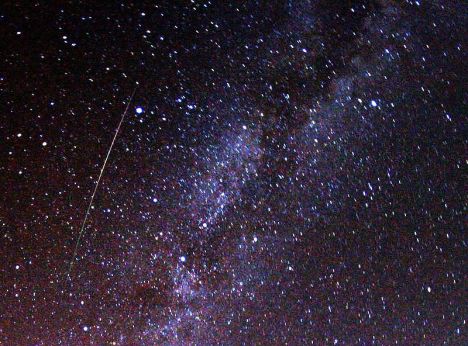
2011 Perseids

It slipped my mind to put up a reminder about the Perseid meteor showers for this year, so the peak has already gone by. But that doesn’t mean the shower isn’t still active and wonderful. At least until the 24th.

The first cause argument

I hate a lot of arguments for God. There isn’t a single good one. Not one. But the one I hate the most is the first cause argument. It runs smack into the face of science. Here’s why.

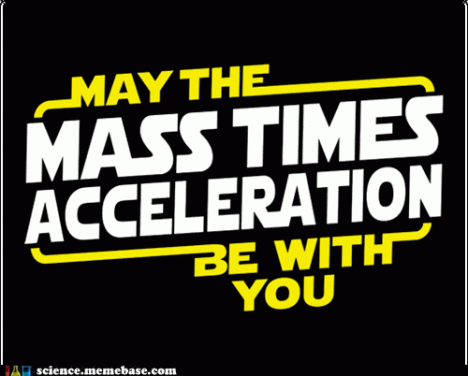
For something to be caused, a force must be exerted. Force is measured as mass x acceleration, F=ma. Acceleration is measured as the change in velocity of an object over time. Got it? Good. Now let’s look at this terrible argument from believers.

They say God is eternal. He exists outside time. Okay, let’s go with that. That means they believe he caused the Universe to exist from somewhere outside it. But do you see the problem? They already said he is outside time. As we just learned, something which is caused has a force placed on it. Something which has a force placed on it has mass and acceleration. Something which has acceleration has gone through time. Without any time, God cannot cause anything.

Science tells us, quite clearly, what is involved in causation – most importantly of which for my point is time. Yet in the premise of the believer’s argument is the explicit exclusion of time. They’ve defeated themselves. Any honest believer should immediately abandon this line of argument.

Wonders of the Universe with Brian Cox

I’ve never felt terribly comfortable with the display of passion from believers. It isn’t that it bothers me that people believe false things (though it does) or that someone is claiming to be so emotionally moved by their belief. It’s that it lacks something. It’s one of those intangible things that’s difficult to really identify. It’s like the body from Weekend at Bernie’s. Yeah, it was moving and it fooled a lot of people, but it was ultimately lifeless.

That isn’t to say I think believers are being insincere or that they aren’t really wrapped up in their belief. Of course they are. But when they try and convey that, they lose me. And it isn’t merely that I find what they believe to be silly. Hitler believed a lot of moronic things (including creationism), but when he conveyed them, he didn’t lose anyone in the room. He had a real passion, awful as it was.

And the same goes for a lot of figures, including one’s much more revered in history. Sticking with the WW2 theme, Churchill and FDR conveyed some real passion in their words. Moving further up in history, JFK and MLK both passed on their passion. You could feel it. You knew they meant what they were saying.

I think the same goes for a number of scientific figures, but probably for different reasons. With the political and social people I just mentioned, I’m not so sure what it is that really drove them. For Hitler, it was probably simple hate. For the others, they probably had convictions fundamental to who they were as humans, I would hazard to guess. But I’m not sure there was one underlying thing that made their passion so real. For people like Richard Dawkins, Carl Sagan, and Neil deGrasse Tyson, though, I think what makes their passion so special is that it is underlined by a deep understanding. When they speak their beliefs, they know they are as close to truth as anyone can get. Religious believers may think they’ve found truth, but since they have zero methods for determining as much, they can’t know it.

And that brings me to Brian Cox. He currently has a fantastic show on The Science Channel right now called Wonders of the Universe. Throughout every moment of the show, it’s obvious he has a passion. You can feel it. And along with the Dawkins’ and Sagan’s and Tyson’s of the scientific world, he conveys it in a way that is uniquely powerful, unavailable to mere believers.

I won’t be so bold as to call him the next Carl Sagan, but he has that same passion, that same fire. It’s really exciting stuff, under all of which lies an intensely deep understanding.

New Cosmos

A new Cosmos is in the works:

In partnership with Sagan’s colleagues Ann Druyan (who is also his widow) and Steven Soter, Seth MacFarlane — yes, that Seth MacFarlane — is going to produce a new 13-part series to serve as a sequel and modern update to Sagan’s masterpiece.

Taking over the hosting duties will be none other than well-known astrophysicist Neil deGrasse Tyson, who has served as host of NOVA ScienceNOW on PBS for the past five years, so he has plenty of experience making science accessible to the general public. It would be difficult to think of anyone who would be better able to succeed the late, great Carl Sagan.

The folks working on it will take their time and do it right — it’s not scheduled to air until sometime in 2013.

It will unfortunately be airing on FOX, which means the commercials will be ridiculous, but I suppose it’s good that it will be given a broader audience than PBS gets. And it’s hard to go wrong with Neil deGrasse Tyson.

Carina Nebula

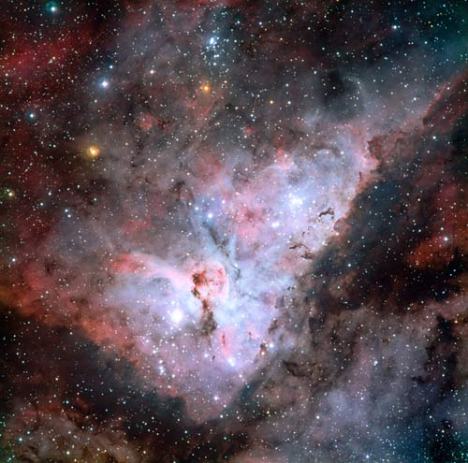
Another great space photograph. From the site:

Several well known astronomical objects in and near the Carina Nebula can be seen in this wide field image: to the bottom left of the image is one of the most impressive binary stars in the Universe, Eta Carinae, with the famous Keyhole Nebula just adjacent to the star. The collection of very bright, young stars above and to the right of Eta Carinae is the open star cluster Trumpler 14. A second open star cluster, Collinder 228 is also seen in the image, just below Eta Carinae. North is up and East is to the left.

“Missing” mass discovered

There are at least two types of mass in the Universe: dark mass (matter) and every day mass. The former represents about 83% of the matter in the Universe, but it has never been directly observed. In that way, it is “missing”. (Or at least it was before Zwicky proposed it – and it will still be “missing” if that theory, though generally accepted, proves to be wrong.) The latter type of mass, the sort we encounter every day, makes up 17% of the matter of the Universe, but of that 17%, some is “missing”. Until now:

Undergraduate Amelia Fraser-McKelvie made the breakthrough during a holiday internship with a team at Monash University’s School of Physics, locating the mystery material within vast structures called “filaments of galaxies”.

Monash astrophysicist Dr Kevin Pimbblet explained that scientists had previously detected matter that was present in the early history of the universe but that could not now be located.

“There is missing mass, ordinary mass not dark mass … It’s missing to the present day,” Pimbblet told AFP.

“We don’t know where it went. Now we do know where it went because that’s what Amelia found.”

Part of the reason dark matter has not been directly observed is that it doesn’t interact (by and large) with the electromagnetic spectrum. That makes it rather invisible – even if we utilize different wavelengths (such as infrared light or microwaves). But this other matter does interact with lightwaves. It just happens that the correct lightwaves are X-rays:

Fraser-McKelvie, an aerospace engineering and science student, was able to confirm after a targeted X-ray search for the mystery mass that it had moved to the “filaments of galaxies”, which stretch across enormous expanses of space.

This is pretty interesting stuff, especially since it was an undergraduate who combed the data to show that they had detected these “filaments”. She even got published in a prestigious journal, Monthly Notices of the Royal Astronomical Society. So congratulations to Amelia Fraser-McKelvie, and good luck in the future. I just hope her future work comes with more in-depth news articles for those of us who aren’t physicists.

New 3-D map of the Universe

This is pretty awesome:

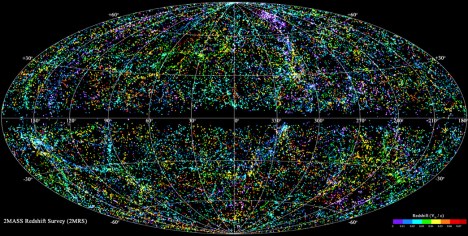
Astronomers have created the most complete 3-D map of our local universe, revealing new details about our place in the cosmos.

The map shows all visible structures out to about 380 million light-years, which includes about 45,000 of our neighboring galaxies (the diameter of the Milky Way is about 100,000 light-years across)…

The map was assembled using data from the Two-Micron All-Sky Survey (2MASS) Redshift Survey (2MRS), which took 10 years to scan the complete night sky in near-infrared light. The survey used two ground-based telescopes, the Fred Lawrence Whipple Observatory on Mt. Hopkins, Ariz., and the Cerro Tololo Inter-American Observatory in Chile.

Near-infrared light, which is of a longer wavelength than visible light, can penetrate the opaque clouds of dust common in galaxies. This allowed the 2MRS survey to extend its “eyes” closer to the plane of the Milky Way galaxy than has been possible in previous studies, because that area is heavily obscured by dust.

“This covers 95 percent of the sky,” Masters said. “In the infrared, we’re less affected by the gunk in the milky way so we’re able to see down closer to the plane of the galaxy.”


(Click to enlarge.)

And yet people believe that our solar system is somehow special.