Uh-oh, astrologers are angered

Astrologers are all in a huff over comments made by two astronomers on BBC2 recently. In the future, they want a fair and balanced perspective given to astrology, but they want the BBC to apologize for allowing the astronomers, Professor Brian Cox and Dara O’Briain, to denigrate their ‘field’ in the first place.

Shocking stuff, I think you’ll agree.

This is not the first time that Brian Cox has waded into the astrology controversy that has raged in science for literally almost none of the last couple of centuries. The hackles of Britain’s astrologers were raised last year, when Cox took a moment during his Wonders of the Solar System series to explain to the public that “astrology is a load of rubbish,” a statement which pretty much echoes the scientific consensus on the matter, which says that, “astrology is a load of rubbish.”

American media might give in, but I don’t expect to see an apology from the BBC anytime soon.

Okay, I have to steal this one

via PZ

Reminder: Lunar eclipse starting soon

I won’t be seeing tonight’s lunar eclipse due to the nice blanket of clouds overhead, but those fortunate enough to have clear skies should make an effort to have a look. It’s the first time it has happened in full on the Winter Solstice since 1638.

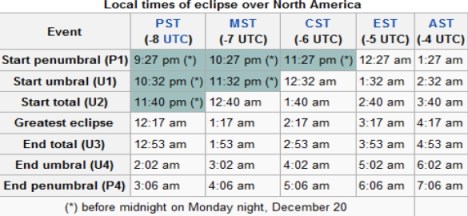
Here are the times:

Total lunar eclipse Monday night

Here are the times:

There is nothing complicated about viewing this celestial spectacle. Unlike an eclipse of the sun, which necessitates special viewing precautions in order to avoid eye damage, an eclipse of the moon is perfectly safe to watch. All you’ll need to watch are your eyes, but binoculars or a telescope will give a much nicer view.

The eclipse will actually begin when the moon enters the faint outer portion, or penumbra, of the Earth’s shadow a little over an hour before it begins moving into the umbra. The penumbra, however, is all but invisible to the eye until the moon becomes deeply immersed in it. Sharp-eyed viewers may get their first glimpse of the penumbra as a faint smudge on the left part of the moon’s disk at or around 6:15 UT (on Dec. 21) which corresponds to 1:15 a.m. Eastern Time or 10:15 p.m. Pacific Time (on Dec. 20).

The most noticeable part of this eclipse will come when the moon begins to enter the Earth’s dark inner shadow (called the umbra). A small scallop of darkness will begin to appear on the moon’s left edge at 6:33 UT (on Dec. 21) corresponding to 1:33 a.m. EST or 10:33 p.m. PST (on Dec. 20).

The moon is expected to take 3 hours and 28 minutes to pass completely through the umbra.

The total phase of the eclipse will last 72 minutes beginning at 7:41 UT (on Dec. 21), corresponding to 2:41 a.m. EST or 11:41 p.m. PST (on Dec. 20).

At the moment of mid-totality (8:17 UT/3:17 a.m. EST/12:17 a.m. PST), the moon will stand directly overhead from a point in the North Pacific Ocean about 800 miles (1,300 km) west of La Paz, Mexico.

The moon will pass entirely out of the Earth’s umbra at 10:01 UT/5:01 a.m. EST/2:01 a.m. PST and the last evidence of the penumbra should vanish about 15 or 20 minutes later.

Celestial Bauble

Hubble has another great capture. This one is being called a celestial bauble. And just in time for Christmas. What a crazy coincidence, I know. (SpaceDaily thought it prudent to dumb down the article title a bit.)

Celestial Bauble

This is called SNR 0509, which means it’s a supernova remnant. It’s located in the Large Magellanic Cloud, which looks a little something like this.

Large Magellanic Cloud

(None of this is here for or because of human existence, by the way.)

Hubble Ultra Deep Field

I recently realized the picture I’ve traditionally used for the Hubble Deep Field image isn’t so great. But rather than just get a better version of that image and stick with the old, I’ve uploaded the more recent and higher resolution Hubble Ultra Deep Field to my media library on WordPress. Enjoy the eye candy.

Recall, those are all galaxies. Only arrogance could say that all this exists and it’s really just for us.

Catalog of the skies

via Wikipedia and, as per request on the picture page, source.

300,000,000,000,000,000,000,000

That’s the number of stars – 300 sextillion – scientists now estimate to be in the observable Universe.

The research, led by Yale astronomer Pieter van Dokkum, is being published by the journal Nature. In an interview with Space.com, von Dokkum said the findings are based on data gathered when the researchers were analyzing “red dwarfs” — stars that are dimmer than our sun and much smaller.

The “faint signatures” of those red dwarfs in eight galaxies “located between about 50 million and 300 million light-years away,” led to the new calculation of how many stars are out there, Space.com writes.

This has also led von Dokkum to speculate that there are likely trillions of Earth-like planets out there. This makes sense given the mundane nature of our solar system. Why wouldn’t there be more planets like ours? And life on those planets? We may be locally rare, but on the scale of the Universe only arrogance could say we’re likely to be exclusive inhabitants.

A Universe From Nothing

I doubt anyone is likely to watch this video from Lawrence Krauss, but it is worth the time.

Following the evidence

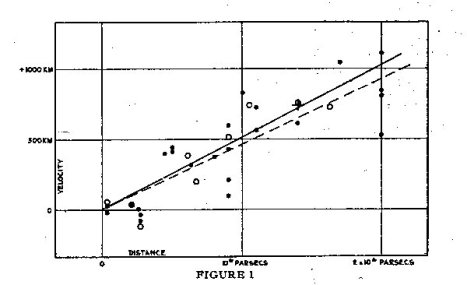
When Edwin Hubble first discovered that the Universe was expanding and all the galaxies (except those in our local cluster) were moving away from us, he found that distance was proportional to velocity. That is, those galaxies moving two times as fast from us as closer galaxies were twice as far away. If they were moving three times as fast, they were three times as far. This was all great – and correct – but there came a problem from this. And that problem can be seen in Hubble’s data.

Extrapolating from this data, the age of the Universe was about 1.7 or 1.8 billion years old. Whoops, right? Yes, but for an interesting reason. Hubble didn’t have a reliable light source to measure distance. He relied on the Doppler Effect to determine the speed at which the galaxies were moving, but he didn’t know how far they were in the first place. He had chosen a particular type of star for his measurements, but there were complications in knowing consistent luminosity due to the fact that the stars could be of different sizes. This video explains it all.

The point I want to make is that when Hubble’s calculations gave a wildly inaccurate age for the Universe – around the same time, we were coming to a conclusion as to the age of Earth at 4.6 billion years – it wasn’t based upon bad science. In fact, the scientific method worked wonderfully. The issue was with figuring out just what was needed to obtain more accurate observations. That is, the science was never weak – and, in fact, science never is weak – instead the problem was merely one of needing better evidence. Once we were able to find standard candles, we were able to better utilize Hubble’s observations. In essence, that is what science does. It relies upon interpreting observations according to a methodology; the reason why it changes is due to better observations, not a change in general methodology. Can religion say anything remotely similar?