“DEEP RIFTS”

Quite some time ago there was an article written about the Gnu Atheist movement that said there were “deep rifts” among so-called adherents. Or maybe it was some random blog post. I don’t know and it’s not important. What I do know and what is important is that PZ Myers made a post about it and ever since it has become a rallying cry for people who don’t want to address division amongst Gnu Atheists. That is, whenever someone raises the possibility that there isn’t a notable cohesiveness amongst atheists out there, the response from certain people (usually those of the freethoughtblogs.com persuasion) is to declare “DEEP RIFTS!” and then say atheists are a diverse group and blah blah blah. It’s generally a cop-out.

That isn’t to say atheists aren’t a diverse group. We necessarily are. After all, atheism is purely descriptive (something PZ doesn’t understand). We have no more normative connection with each other than anyone else has with, well, anyone else. That changes slightly with Gnu Atheism, of course, since Gnu Atheism is about using a more forceful and critical voice concerning religion; Gnu atheists are united in the value that religion is, mostly, not a good thing and should be confronted. However, that’s where the inherently shared values end. After that point, there is no reason to expect one atheist to believe the same thing as the next. That fact is even more significant when we’re talking about atheism sans any qualifiers (such as Gnu).

This presents a problem for some people. There is a desire amongst a handful of people to create a more cohesive group, to coalesce around certain ideas. That’s understandable and no one can be faulted for wanting to do that. However, it can’t be done merely under the banner of atheism – again and again and again, atheism is purely descriptive. No matter how much so many theists want to accuse atheists of believing this or that moral dictate and no matter how much some atheists want to parade particular atheist values, it can’t be done. The whole idea is philosophically incoherent. So what’s the solution? Enter Atheism+:

It illustrates that we’re more than just “dictionary” atheists who happen to not believe in gods and that we want to be a positive force in the world. Commenter dcortesi suggested how this gets atheists out of the “negativity trap” that we so often find ourselves in, when people ask stuff like “What do you atheists do, besides sitting around not-praying, eh?”

We are…
Atheists plus we care about social justice,
Atheists plus we support women’s rights,
Atheists plus we protest racism,
Atheists plus we fight homophobia and transphobia,
Atheists plus we use critical thinking and skepticism.

This sounds all welcoming and nice, and only the fourth point could really exclude a lot of people (at least on paper). Because, who rejects social justice? Who rejects women’s rights? Who embraces racism? Who doesn’t see critical thinking favorably? Of course, it’s clear that all these things are speaking of liberal values, just as “family values” is code for a conservative point of view. And that’s the rub. It isn’t one that’s meant to be hidden, nor is anyone trying to hide it, but it isn’t out there on paper: Atheism+ is meant first as a label for atheist, (caricature) feminist liberals. It is meant to create an exclusionary community of individuals who…ah, hell. Let’s not kid ourselves. It’s Freethoughtblogs. It’s a label for just about everyone who blogs at freethoughtblogs.com. Anyone who thinks Rebecca Watson is a mook need not apply.

So where’s the problem, then? Who gives a rat’s ass if a bunch of people already deep in groupthink want to give themselves a new label? What difference could it possibly make? Well. The answer is simple. It’s all about division.

“DEEP RIFTS” has become an inside joke among a fair number of atheists, atheists who don’t think there is any real separation in the community, but there’s no denying it any longer. The entire mentality of Freethoughtblogs and now Atheism+ is George W. Bush’s old chestnut, “Either you’re with us or you’re against us.” Don’t believe me? Take a look:

Atheism+ is our movement. We will not consider you a part of it, we will not work with you, we will not befriend you. We will heretofore denounce you as the irrational or immoral scum you are (if such you are).

Check it out in practice:

Let me summarize: “You disagree in the least bit?! You’re evil and you can go fuck yourself!”

There are even attacks on Richard Dawkins for who-the-hell-knows-what:

That great controversialist, that person who has been called too confrontational, that person who told everyone religion is delusion, that person who has debated beloved religious leaders, that person who has publicly faced down the nastiest pundits of our time–Richard Dawkins–has no better means of telling you you’re wrong than posting passive-aggressive tweets trying to attack ad revenue.

It then shows a series of Tweets from Dawkins where he tells people not to help out sites that drum up false controversy. I don’t know, nor do I care, what the specific details are behind this, but we can presume it has something to do with Freethoughtblogs. Take a look at some of the comments:

“When I first identified as an atheist I thought Dawkins was great but, the more I listen to him, the more he rubs me the wrong way.”

“I’ve always had and always will have great respect for Richard Dawkins’ work as a science communicator and an advocate for atheism. But lately, I’ve been losing a lot of respect for him otherwise.”

“He’s saying there is no real problem with bigotry in this movement, that you all are lying for money? M’kay.”

When a community that owes a huge part of its existence to one man – there are plenty of others, but Dawkins is easily the most significant – when that community starts going after him (and with shit logic, at that), it becomes extremely difficult to deny that the likes of PZ and others have created significant division. The deep rifts in the atheist community are very real; I don’t think I need quotations around them at this point. Freethoughtblogs, PZ Myers, Jen McCreight, and the pitfalls of groupthink have caused an ideological split amongst atheists today. In one camp we have those who have agendas external to Gnu Atheism, external to the problem of religion and the promotion of science. In the other camp, we still have reason and a commitment to basic Humanistic values, a commitment to promote a world that rejects superstition while embracing the wonder of science. In this other camp, this older camp, we have a group of people who are still focused on the task at hand.

Atheism on the rise

Since the last Gallup poll was taken, just before the emergence of so-called New Atheism, the rate at which people call themselves atheists has risen significantly:

The poll, called “The Global Index of Religiosity and Atheism,” found that the number of Americans who say they are “religious” dropped from 73 percent in 2005 (the last time the poll was conducted) to 60 percent.

At the same time, the number of Americans who say they are atheists rose, from 1 percent to 5 percent.

I don’t think this is a reflection of changing beliefs. Rather, it is a reflection of changing attitudes:

“The obvious implication is that this is a manifestation of the New Atheism movement,” said Ryan Cragun, a University of Tampa sociologist of religion who studies American and global atheism.

Still, Cragun does not believe the poll shows more people are becoming atheists, but rather that more people are willing to identify as atheists.

For a very long time, religiosity has been a central characteristic of the American identity,” he said. “But what this suggests is that is changing and people are feeling less inclined to identify as religious to comply with what it means to be a good person in the U.S.”

I’ve attributed this change in attitude to a number of facts in the past, including the Catholic Church’s rape problems, but I think a good deal of credit goes to Dawkins, Harris, Dennett, Hitchens, and others who have made the phrase “I am an atheist” something that is okay to say.

via The A-Unicornist

How to get public holiday displays banned

Many towns and cities will allow displays on public property around the December holidays. They do this mostly for Christians, but other groups have been taking advantage of things lately. In Olympia this led to a banning of all displays after atheists began adding their signs. Now the same is happening in Palisades Park in Santa Monica:

Nativity scenes and other private winter displays will no longer be allowed in Santa Monica’s Palisades Park after the City Council voted unanimously Tuesday to bar them.

For nearly six decades, private, life-size scenes celebrating Jesus Christ’s birth have been a fixture each December in the park that runs along the coastal bluffs. In recent years, displays have also celebrated the winter solstice and Hanukkah and have promoted atheism.

Last year, after requests for display space exceeded the space allotted, the city held a lottery to allocate slots fairly and legally. Atheists won 18 of the 21 plots. A Jewish group that sets up a menorah won another. The Nativity story that once took 14 displays to tell had to be crammed into two plots.

The reason this happened is because the Christian groups that usually win most of the lottery spots (by virtue of being the most numerical to throw their hat in the ring) had petitioned the city to forever deed them 14 of the spots. The City Council members recognized this was a lawsuit waiting to happen because, as it turns out, Christians aren’t to be given some special privileges under the law. (I hate that word, but I had no choice but to use it here.)

So all it takes to get rid of a set of displays on public property is to allow atheists to play. Do that and everyone is going to pick up their ball and go home. How tolerant.

Younger generations doubting God not ‘just a phase’

I have often found myself in debates where I raise the point that belief in God is significantly lower in younger generations than older generations. (We’re also more liberal, too). This often gets waved off as nothing more than a phase. “Why,” evidence deniers will say, “everyone flirts with these ideas in their youth, but everyone always becomes more religious as they age.” Of course, that’s an inappropriate response. Maybe it could be argued that people become more settled in their religious and political views into their 40’s and beyond, but that still doesn’t really cut it. And now it has to end all together because the wiggle room is gone:

The percentage of Americans 30 and younger who harbor some doubts about God’s existence appears to be growing quickly, according to a recent Pew Research Center survey. While most young Americans, 68%, told Pew they never doubt God’s existence, that’s a 15-point drop in just five years.

In 2007, 83% of American millennials said they never doubted God’s existence.

More young people are expressing doubts about God now than at any time since Pew started asking the question a decade ago. Thirty-one percent disagreed with the statement “I never doubt the existence of God,” double the number who disagreed with it in 2007…

“Notably, people younger than 30 are substantially less likely than older people to say prayer is an important part of their lives,” the report said.

“Research on generational patterns shows that this is not merely a lifecycle effect,” it continued. “The Millennial generation is far less religious than were other preceding generations when they were the same age years ago.”

There are a number of factors at work here, I think. In no particular order,

  • the Internet
  • higher education
  • Gnu Atheism
  • the Catholic Church

Surely there are far more aspects to this increase in doubt, but I think I’ve listed some of the major factors here.

Not too long ago the Internet was still considered a place for nerds. You blog? Ha! and You’re wasting your time! The latter may still hold some truth, but few people can utter it sans a load of hypocrisy. Facebook isn’t too far off a billion users right now. We’re all on the Internet and that exposes us all to a lot of different ideas. That has to breed doubt.

Next there’s education. This generation is the most highly educated age group in history. We’ve been given some worthwhile tools and access to a lot of different information. Moreover, just like the Internet, college is bringing together more and more diverse ideas. The days of black and white, Christian thinking is coming to an end; there’s nowhere left for religious arguments to hide now that everyone is talking. (It’s worth noting that cities tend to be more liberal than rural areas.)

Then we have Gnu Atheism. It would have been seen as absurd 10 years ago to be as openly critical of religion as so many people are today. Now we have books and bus ads and we’re even getting shout-outs from the President. That, of course, isn’t to say it wasn’t seen as absurd in 2006 when The God Delusion was released. It was. But in just the short time since then things have been changed. Gnu Atheism has worked in reverse to religion: Religious ‘moderates’ have always made space for fundamentalists (regardless of their intention), but now the aggressiveness of Gnu Atheism has made space for those who simply disbelieve but don’t necessarily see religion as a negative force.

Finally (at least insofar as my list goes) the Catholic Church messed things up. They associated religion with child molesters and rapists (all the while using the euphemism of “abusers”). Instead of facing up to their sins, they covered up as much as they could, as fast as they could. They became a meme, inviting mockery to no end. Priest jokes evolved from entering bars with rabbis to entering backrooms and more with choir boys. The idea of mocking a religious institution became more mainstream than ever. That helped, along with the Gnu Atheists, to open all religious institutions to mockery.

So this isn’t merely a phase. People really are doubting religion more and more. And that’s a great thing. I don’t say that simply as an anti-theist, but rather as someone who values science and a scientific way of thinking. Doubt is a good thing. We need to use it more, no matter what the subject. If we allow ourselves to close off an entire area to critical thinking, then we’ve put ourselves in some kind of danger. Why not shutter any other area? Why not put a stop to one line of research or another because it looks too difficult to ever come to fruition or because it conflicts with some group’s idea of ethics? We can’t do that. Without doubt we’ll stagnate. I know this generation is better than that.

At least I think I know we are.

In which I rejoice: The Rebecca Watson-fueled implosion

Rebecca Watson is sort of the Kim Kardashian or Paris Hilton of the ‘skeptic’ world. She’s famous for no reason and not really qualified to add anything of any importance to anything. There are really only two reasons most Gnu Atheists even know who she is. First, she mentioned in passing something about a socially awkward guy making a pass at her on an elevator. From there a number of small feminist blogs made an issue of it. Second, PZ Myers jumped on the bandwagon in order to up his cred amongst his ilk because, apparently, he has decided to switch from being a leader amongst Gnu Atheists to a leader amongst the entirely unrelated feminists. (I’m fine with that. PZ is as bad at philosophy as Michael Hartwell or Jack Hudson; I’d rather not have a person who doesn’t even understand the difference between normative and descriptive claims leading things.) Soon after PZ almost single-handedly blew things out of proportion, he began lying about things and blaming others. It was rather pathetic, but not surprising given that we’re talking about someone who thinks that skepticism* and feminism are at all related.

Anyway. After being out of the limelight for more than a few hours, Ms. Watson has made a self-important post about why she won’t be attending the next TAM meeting. It started when the guy in charge of the meeting, DJ Grothe, made this post somewhere in the bowels of the Internet:

Last year we had 40% women attendees, something I’m really happy about. But this year only about 18% of TAM registrants so far are women, a significant and alarming decrease, and judging from dozens of emails we have received from women on our lists, this may be due to the messaging that some women receive from various quarters that going to TAM or other similar conferences means they will be accosted or harassed. (This is misinformation. Again, there’ve been on reports of such harassment the last two TAMs while I’ve been at the JREF, nor any reports filed with authorities at any other TAMs of which I’m aware.) We have gotten emails over the last few months from women vowing never to attend TAM because they heard that JREF is purported to condone child-sex-trafficking, and emails in response to various blog posts about JREF or me that seem to suggest I or others at the JREF promote the objectification of women, or that we condone violence or threats of violence against women, or that they believe that women would be unsafe because we feature this or that man on the program. I think this misinformation results from irresponsible messaging coming from a small number of prominent and well-meaning women skeptics who, in trying to help correct real problems of sexism in skepticism, actually and rather clumsily themselves help create a climate where women — who otherwise wouldn’t — end up feeling unwelcome and unsafe, and I find that unfortunate.

I have highlighted what seems to be the most offensive portion. Apparently in Watson’s head, what Gouthe said was this:

DJ was blaming women skeptics for creating an unwelcoming environment.

(Yes, that is real. I was going to put in a fake, caricature quote, but the real deal is just as good.)

Reading skills, people. Get them. This really shouldn’t be that hard: Grothe said that a small number of people were guilty of fear-mongering without justification. That isn’t to say harassment doesn’t happen. It does. And it isn’t to say that the victim is at fault. Again, reading skills: It is to say that people are fucking fear-mongering. These skeptic-jacking feminists are the FOX News pundits of the Gnu Atheists.

Again, this shouldn’t be that hard to grasp. Grothe even quoted Watson from a USA Today interview:

“I thought it was a safe space,” Watson said of the freethought community. “The biggest lesson I have learned over the years is that it is not a safe space. . . ”

He disagrees that the environment is unsafe. I don’t really doubt him. The reports are few and far between of anything happening from his account, plus there is no reason to suspect that atheists and agnostics would be different from any other gathering of average Americans. But maybe every gathering of large crowds is hugely unsafe for women and everyone has just been oblivious. Quick, tell women to stop going to Wal-Mart!

But don’t try to argue any of this to PZ, skepchicks, or any other atheism-second people or groups. They’re all in a tizzy about this. And that gives me joy. I hope more of these people will cross themselves off the list for speaking at conferences and meetings and whatever else comes up. Gnu Atheism is interesting because it takes a hardline stance against religion from a scientific perspective. That is, it takes two descriptive angles: atheism and science. Separately, these things are fine and true, but together they can be made into a powerful normative case. The feminist faction, however, wants to take their pre-formed normative position and usurp the description of science – but not to a particular end. They aren’t interested in a strong incorporation of science into feminism but rather a strong mantle-claim. If they associate themselves closely enough with science, then maybe that objectivity will rub off on feminism a tad. It, of course, won’t be used in feminism, but the faux perception will be there. I don’t support any of that.

Anyway, I’m not sure if I’m enjoying the implosion or the take-downs more. Check out this hilarity. Also take a look in the comment section. I’ve got some great quotes from Mallorie Nasrallah.

*”Skepticism” is a meaningless word at this point and I resent its use. Simply being open to the possibility that there is a God, as Dawkins and Harris and Coyne and Dennett and I are, does not make one a skeptic. We’ve already taken up our positions, just as global warming deniers skeptics have. A real skeptical position is one where there is notable doubt. For instance, I was skeptical that this home brewed beer from Nate would be that good. (It turns out it is. Well done, old chap.)

What Christians keep telling me

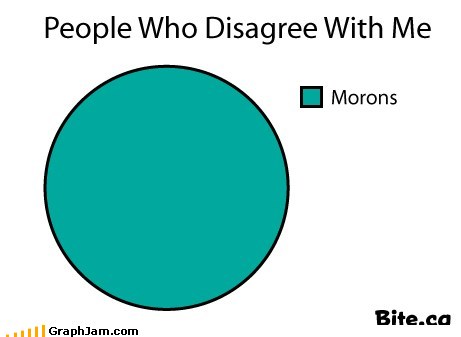
I keep hearing over and over that I think all Christians and anyone else who disagrees with me is plainly stupid. Here are the stats:

In fact, this post from a recently-removed-from-my-blogroll-blog largely had me in mind, as I was told shortly after it was written. But this goes beyond me. Richard Dawkins and other Gnu Atheists get the same crap – so much so that Dawkins even penned a piece about the issue six years ago:

“It is absolutely safe to say that if you meet somebody who claims not to believe in evolution, that person is ignorant, stupid or insane (or wicked, but I’d rather not consider that).” I first wrote that in a book review in the New York Times in 1989, and it has been much quoted against me ever since, as evidence of my arrogance and intolerance. Of course it sounds arrogant, but undisguised clarity is easily mistaken for arrogance. Examine the statement carefully and it turns out to be moderate, almost self-evidently true.

This is largely my position (including beyond the subject of evolution). I think Christian arguments are almost universally awful and I find most creationists to be ignorant, but that does not mean I think every person who holds a contradictory view to me is stupid. Sure, I’ve called people stupid. Sarah Palin comes to mind. Leading creationists who should know better, such as Ken Ham, are obviously lacking in intellect. I have no doubt Andreas Moritz is a dolt. But notice: I keep it specific. I’m not saying all Republicans are stupid because Sarah Palin is stupid. I’m not saying the creationist who hasn’t sat in a biology course since high school is a moron. I am not saying all alt-med quacks are idiots. If I wanted to say any of that, I would say it. I try to be exact in my language; it is unlikely I would ever make such an oversight in my writing.

I have no delusions about how I write. I’m aggressive and unapologetic. I have little patience for bad ideas that have little to no evidence for them. I often pepper my paragraphs with disparaging remarks about the quality of whatever argument it is I am facing. It has long been my view that undeserved respect is…well, undeserved. It would be dishonest of me to pretend I hold something in esteem when the fact is I think it’s just a steaming pile. However, none of this means I think others are morons by virtue of disagreeing with me. Such a conclusion is, I hate to say, just stupid.

High school student dresses up as Jesus for “Fictional Character Day”

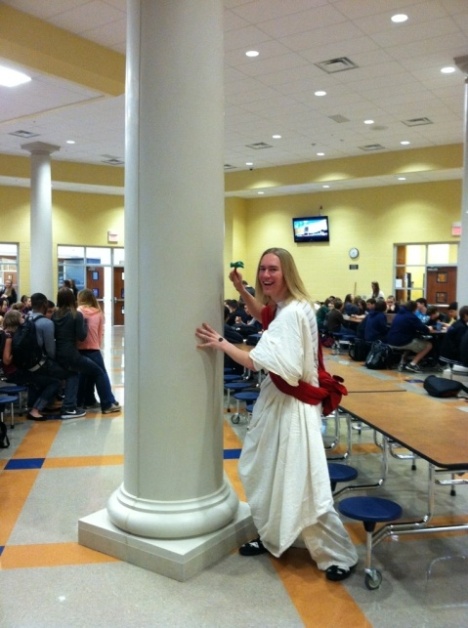
I don’t know as I would have done this in high school, but I certainly would seize such an opportunity now:

A couple of months ago, Summit High School in Spring Hill, Tennessee held a “Fictional Character Day” in which students could come to school dressed as their favorite fictional character. Like the Mad Hatter. Or Darth Vader. Or SpongeBob SquarePants.

Jeff Shott came dressed as Jesus.

Before class even started that day, Shott was asked by the principal and other staffers to remove his costume. It was inappropriate, they said.

That’s sort of the default excuse the courts have given to schools, isn’t it? You want to do something remotely controversial? Nah. Sit down and shut up so you don’t disrupt anything. Or, in other words:

Here is part of what Jeff had to say about this in his own words:

I’d arrived at school this Monday before 8:15 a.m. and waited in the cafeteria until classes started, eating breakfast with friends and adding finishing touches to my Jesus costume.

The head principal, Dr. Farmer, soon came up and asked me to come to his office. The assistant principal, Ms. Lamb, and Officer Pewit, school resource officer, were waiting outside the cafeteria. Dr. Farmer asked me whom I was portraying. I told him that I was Jesus Christ. He said he had been hoping my answer would have been Zeus (or some other variation of a mythological deity).

Even though I’m typically very openly atheistic and have no problem discussing my views, I was a little distraught that all three school authority figures were addressing me at once. Dr. Farmer claimed I couldn’t have things both ways — I couldn’t complain about teachers talking about Jesus and also dress up as Jesus on Fictional Character Day.

Apparently one of Jeff’s “science teachers” is a creationist and had expressed as much, undermining the theory and fact of evolution with typical creationist tripe. Now it looks like the administration at Jeff’s school understands the constitution about as well as its teachers understand science. The fact is, whether or not dressing as Jesus is allowed on school grounds, Jeff’s teacher was promoting Christian creationism in the classroom, something which has long been established as illegal. It doesn’t matter if Jeff has a problem with that and he wants to wear a funny costume. Indeed, what a teacher tells her students and what a student wears as a costume are independent situations.

Anyway, Jeff has been given a $1,000 scholarship from the Freedom From Religion Foundation because of all this, so the end result isn’t so awful. And even better? I guarantee more students have been talking about him at school than ever would have if he wore his costume for the whole day.

How not to run an institution of learning by Lenoir City High School

I’ve never been a fan of high school newspapers. It’s fine that they’re usually filled with the sort of stuff that only interests students, but I don’t like how they so often tend to be failed models. Fundamental to the freedom of the press is that whole “freedom” part. Schools have the right to edit and censor as they please – they can even punish students if they want. It’s all perfectly legal, well-settled law, but it obviously runs counter to the ideal of the First Amendment. Any school that is really committed to teaching students about journalism would be more than willing to give up every single right it has to censor. No exceptions.

Of course, that isn’t going to happen. After all, giving up the right to censor would allow those evil atheist students to have a voice. And places like Lenoir City High School in Tennessee wouldn’t want that:

In a recent editorial that Myers, 18, intended for the Lenoir City High School newspaper entitled “No Rights: The Life of an Atheist,” she questioned her treatment by the majority.

“Why does atheism have such a bad reputation? Why do we not have the same rights as Christians?” she wrote.

Myers’ editorial also accused school administrators, teachers and coaches of violating the constitution by promoting “pro-Christian” beliefs during school-sponsored events.

Lenoir City school authorities have denied Myers permission to publish her editorial in the Panther Press, the staff supervised student newspaper.

They also say their policies do not violate the constitutional rights of any students.

Schools Director Wayne Miller said it was the decision of the school authorities not to allow publication of Myers’ editorial because of the potential for disruption in the school.

“We do have the right to control the content of the school paper if we feel it is in the best interest of the students,” he said.

One has to wonder just how this benefits students. What interest does anyone have in not allowing Krystal Myers’ points? Aside from Christians and other religious zealots who are afraid that contrary views of the world are threats, I can’t think of one.

I’m having trouble in deciding what the worst part in all of this is. On the one hand, the school is suppressing unprotected but non-harmful speech. They have that right, unfortunately, but that right is purely a legal one. I do not believe they even come close to having a moral right. (I hope the government proceeds to one day extend full First Amendment protections to students, destroying the rights it created for administrators and the like.) On the other hand, however, they aren’t merely suppressing non-harmful speech that should be protected, but they are also suppressing a pretty good article. Myers’ didn’t write some anti-religious screed. She didn’t take any cheap shots. (Not that she couldn’t have done that and still had a great article.) She did criticize the school, something I know people who choose to spend their lives lording over teenagers just can’t stand, but she did it fairly. Any rational school would have been proud of one of their students putting out such quality of work. Any rational school would have welcomed the criticism – especially when that criticism exposed its illegal practice of promoting Christianity over and over. (I’m making the big assumption that schools prefer to be in line with the law.) Unfortunately, Lenoir City High School is not a rational school.

I wouldn’t normally post an entire article by someone else since it makes for a lengthy post, but I’m going to make an exception here. I hope everyone will give it a read:

No Rights: The Life of an Atheist

By Krystal Myers

The point of view expressed in this article does not necessarily reflect the point of view of the Panther Press, its staff, adviser, or school.

As a current student in Government, I have realized that I feel that my rights as an Atheist are severely limited and unjust when compared to other students who are Christians. Not only are there multiple clubs featuring the Christian faith, but youth ministers are also allowed to come onto school campus and hand candy and other food out to Christians and their friends. However, I feel like if an Atheist did that, people would not be happy about it. This may not be true, but due to pervasive negative feelings towards Atheists in the school, I feel that it would be the case. My question is, “Why? Why does Atheism have such a bad reputation?” And an even better question, “Why do Christians have special rights not allowed to non-believers?”

Before I even begin, I just want to clear up some misconceptions about Atheism. No, we do not worship the “devil.” We do not believe in God, so we also do not believe in Satan. And we may be “godless” but that does not mean that we are without morals. I know, personally, I strive to be the best person I can be, even without religion. In fact, I have been a better person since I have rejected religion. And perhaps the most important misconception is that we want to convert everyone into Atheists and that we hate Christians. For the most part, we just want to be respected for who we are and not be judged.

Now you should know exactly what an Atheist is. Dictionary.com says that an Atheist is, “a person who denies or disbelieves the existence of a supreme being or beings.” However, this does not mean that Atheists do not believe in higher causes; we just do not believe in a higher being.

With that being said, I can move on to the real issue. Before I begin, I want you to think about your rights and how your perceived “rights” might be affecting the rights of others.

There are several instances where my rights as a non-believer, and the rights of anyone other than a Christian, have been violated. These instances inspired me to investigate the laws concerning the separation of church and state, and I learned some interesting things. However, first, I would like you to know specifically what my grievances are against the school. First and foremost is the sectarian prayer that occurs at graduation every year. Fortunately, I am not the first one to have thought that this was a problem. In the Supreme Court case, Lee v. Weisman, it was decided that allowing prayer at graduation is a violation of the Establishment Clause of the First Amendment that says, “Congress shall make no law respecting an establishment of religion, or prohibiting the free exercise thereof.” Special speakers can pray, but the school cannot endorse the prayer or plan for it to happen.

Public prayer also occurs at all of the home football games using the public address system. This has, again, been covered by the Supreme Court case Santa Fe Independent School District v. Doe. The Court ruled that school-sponsored prayer is an unconstitutional violation of the Establishment Clause of the First Amendment. If a speaker prays, it is fine. However, as soon as the school provides sponsorship, it becomes illegal. Sponsorship can be almost anything, even something as simple as saying that the speaker can pray or choosing a speaker with a known propensity to pray or share his or her religious views.

However, it is not just the speakers who we have to fear at Lenoir City High School. We also have to fear some of the teachers and what they might say about their own religious beliefs. On at least two separate occasions, teachers have made their religious preferences known to basically the whole school.

One teacher has made her religious preferences known by wearing t-shirt depicting the crucifix while performing her duties as a public employee. Also, Kristi Brackett, a senior at Lenoir City High School, has said that the teacher, “strongly encouraged us to join [a religious club] and be on the group’s leadership team.” Yet again, this violates the Establishment Clause of the First Amendment. When asked if this was true, the teacher replied, “As a teacher I would never use my power of influence to force my beliefs or the beliefs of [a religious club] on any student in the school.” Regardless, the religious t-shirts are still inappropriate in the school setting. Teachers are prohibited from making their religious preferences known; the Constitution requires them to be neutral when acting in their capacity as a public school teacher.

Not only are religious preferences shown through shirts, but also through a “Quote of the Day” that some teachers write on the boards in their classrooms. One teacher has Bible verses occasionally as the teacher’s “Quote of the Day” for students. The Establishment Clause of the First Amendment has been violated, yet again with no regard for non-believers.

But perhaps I would have more hope in our school and the possibility of change on the horizon if our own school board did not open their meetings with prayer. A person who wished to remain anonymous that has been present at school board meetings says, “They do have prayers. They pray to ‘Our Heavenly Father’ and end with ‘In Jesus’ Name We Pray.’” Not only is this a violation of Supreme Court law, but also a violation of the board’s own policy that prohibits prayer at school-sponsored events. The whole foundation of how our school is conducted is established by obvious Christians. Somehow, this is unsurprising. If our School Board chooses to ignore the Establishment Clause of the First Amendment and the Supreme Court, then it is no surprise that teachers choose to do the same.

I know that I will keep trying to gain my rights as an Atheist and as an American citizen, but I also need your help in educating other people to realize the injustice done to all minority groups. The Christian faith cannot rule the United States. It is unconstitutional. Religion and government are supposed to be separate. If we let this slide, what other amendments to the Constitution will be ignored? I leave you to decide what you will or will not do, but just remember that non-believers are not what you originally thought we were; we are human beings just like you.

via Friendly Atheist.

Dawkins, the Bible, and titles

Richard Dawkins was recently on a BBC radio affiliate where he cited a poll which showed that only 35% of British Christians could identify Matthew as the first book of the New Testament. From this (in part), he was making the point that people in his home country aren’t as religious as most people think. That’s a fine argument, but I will leave it for now. I want to focus on the response he got from another guest on the show, Giles Fraser, former canon chancellor of St. Paul’s in London. Fraser asked Dawkins to recite the full name of Darwin’s On the Origin of Species. Dawkins responded:

“‘On The Origin Of Species’ … Uh. With, Oh God. ‘On The Origin Of Species.’ There is a subtitle with respect to the preservation of favoured races in the struggle for life.”

That’s pretty close. The actual title is “On the Origin of Species by Means of Natural Selection, or the Preservation of Favoured Races in the Struggle for Life”, which is more than a mouthful. But it wouldn’t matter if Dawkins couldn’t get past the first part of the title everyone knows. The poll he was citing in regards to Christians asked them a simple factoid, a mere piece of trivia. One would expect a high number to know it; to call oneself Christian is to profess a belief in a book. And not just any belief(s). We’re talking about the most profound beliefs a person can hold. It is not unreasonable to expect people to be familiar with a book on which they have placed their eternal salvation.

And there’s the difference. Dawkins’ has not placed some holy importance on Darwin’s work. He obviously views the man as tremendously important to scientific and human history – and rightly so – but that has nothing to do eternity. It has nothing to do with salvation. The Bible does. That makes it logically invalid to compare a biologist’s specific knowledge of a long-string of words to a Christian’s general knowledge of what Christians profess to believe as a matter of determining what happens to their soul.

Where the real persecution is

Christians in America have this habit of pretending that they are some persecuted minority: Our Muslim, socialist, communist, Nazi, white-hating, Kenyan, Marxist president has a war on religion; every December the nation’s retailers wage a war on Christmas; atheists want to ban Christian children from praying to themselves in school. And around and around it goes, Christians pretending that everyone is out to get them, that they have no power, and if we don’t all act fast, religious persecutions and moral decay are on their way. It is all a bald lie. Christians have nothing but power. They hold almost every political seat in the nation, whether on the state or federal level. They dominate the positions of authority in our legal system. Do you need to get time taken off your prison sentence? Don’t say you’ve found deep thinking in moral philosophers. Say you’ve found God and maybe you’ll get to see your family sooner than your atheist cellmate (presuming you are one of the rare people to experience such a person in an American prison).

The real belief-based persecution of people in America happens to two main groups: Muslims and atheists. The former is a relatively new, reactionary persecution related to September 11, but the latter has been happening since the inception of the nation. Look at any time period in the nation’s history to see who is being persecuted and I guarantee atheists will be mentioned every single time. Somewhere there is always someone seething over the idea that a person might not only reject the idea of a god in all its forms, but might also be a good person while doing it. Such an audacious lifestyle has had a strong history of garnering more than its fair share of emotion-based vitriol.

Unfortunately, it isn’t all history. Currently there is one openly atheist member of Congress. Compare that to at least 6 open gays. Or look at the fact that 9% of Americans would never vote for a Jew, yet 49% refuse to ever vote for an atheist. And then there are the actual lives of declared atheists:

[Take the story] of Harry Purdy, born in Manchester, the son of an American GI father he did not know. A year after the US government opened up its records, the then 46-year-old stepped off the plane at Louisville Airport, Kentucky in May 1991 and became the first of the lost GI babies to be reunited with his father. Purdy eventually took up American citizenship and moved over to live in 1993.

“It was a good thing I met him for the first time,” he told me when we met at a roadside restaurant near his home, “but this is Kentucky, this is the Bible Belt. I’m an atheist.” One by one, members of his new family turned against him because of his lack of belief. Harry doesn’t see any of his American family any more. “The last one I saw was my cousin, Ronnie. Every time he invites me over to dinner, he turns to religion. Last time I saw him, I didn’t back out, I took him full on.

“I’ve been told things like ‘I hope you have an accident, die and go to hell.’ So that’s what I’ve been up against.”

Friends have rejected him. “I used to be a good running friend with somebody who doesn’t live far from here. I mentioned on one occasion that I was an atheist and I’ve never seen him again … I came here knowing this was the Bible Belt, but I didn’t realise it was a more like a totalitarian Christian society: you’re either one of them or you’re not and there’s no in between. So I’ve learnt this lesson, to keep it to myself as much as possible.”

It might be suggested that one “solution” is to hide one’s lack of belief. This isn’t going to solve any problems, and even if it did, it isn’t going to solve the right ones. It’s telling people to lie about what they believe because the majority doesn’t want to hear certain voices.

From the outside, keeping your views to yourself may not seem such a problem. But this is only if you think that it’s easy to live hiding who you really are from almost everyone around you, even close family. Take Matt Elder, who lives in Festus, Missouri (pop. 11,602). When I met him in a downtown St Louis diner, he came across as a cheerful, friendly guy, not someone living under a kind of persecution. “They’re not going to cut me off or throw me to the wolves,” he says of his Christian family and in-laws. But if Elder is typical of the trying-to-keep-their-heads-down atheists scattered around the Bible Belt, then his story shows that none of them has it easy.

Elder says with a smile that when he goes out wearing his black T-shirt with its large scarlet A – the symbol of the atheist Out Campaign inspired by Richard Dawkins – “you’ll see mothers bring their children a little closer and step a little quickly away”. Elder is not militant and tries to be as accommodating as he can without being a hypocrite. “I would go to church with my wife about every week, just for community. But now, I don’t go because there’s really weird conflicts.” Weirdest of all is his regular appearance on the weekly prayer list. “There are times when people stand up and say stuff out loud to every­one else, and my wife did that while I was there.” I asked him what she said, and his paraphrase was: “My husband no longer believes in God and I’m scared for him and my family.” No wonder Elder feels that now at the church “there’s a target on my back”.

The statistics aren’t any better:

A now famous University of Minnesota study concluded that Americans ranked atheists lower than Muslims, recent immigrants, gays and lesbians and other minority groups in “sharing their vision of American society”. Nearly 48 per cent said they “would disapprove if my child wanted to marry a member of this group” (many more than the next most unpopular category, Muslims, at 33.5 per cent).

I can say I’ve personally experienced someone turning me down for the explicit reason that I’m an atheist. I’m not so arrogant as to pretend there couldn’t be other factors, but it isn’t like people are in the habit of letting others down easy by going straight to religious (and non-religious) beliefs. Of course, it is understandable that a person would want to date a like-minded person, but that isn’t what the above poll was about. People were asked how they would feel about their child dating an atheist. The fact that there is a nearly 50% chance my would-be date’s parents were happy with her decision without knowing a thing about me is distressing. It betrays the prejudice which underlies so many of the misconceptions religious folks have about atheists.

A real solution to all these problems is for atheists to make their presence known. That means, when asked or relevant, to proudly state “I am an atheist” in front of absolutely anyone. No quibbling with “non-believer” or other terms of avoidance. Those phrases should be reserved for specific instances and linguistic purposes. If we can’t get rid of the stigma around the word “atheist”, then how can meaningful progress be had?

Some people will disagree with that strategy (such as Sam Harris, as quoted in the article), but for people to know they know atheists is the first step. This isn’t about trumpeting atheism around the public square or getting in anyone’s face; this strategy is not exclusive to Gnu atheists. Anyone who believes there is insufficient evidence for God in the same way there is insufficient evidence for celestial teapots ought to don a scarlet A, whether literally or figuratively. Letting people know we exist is the best way to combat the systematic scorn and persecution so many atheists face in America.