This is a piece of logic that most believers can’t seem to grasp:

Filed under: Atheism/Humanism, Humor | Tagged: New York Times | Leave a comment »

 | septrose14 on Reddit layoffs |
 | shelldigger on Thought of the day |
 | The Sauciest Duck on Chauvin and Rittenhouse |
 | Michael on Chauvin and Rittenhouse |
| Stephen Moreton on Chauvin and Rittenhouse | |
 | Mele Kalikimaka | Fo… on Merry Christmas |
| Mele Kalikimaka | Fo… on Mele Kalikimaka |
 | somdeblahiriyahoocoi… on Thought of the day |
| Michael on Wuhan virus and one last… |
| Quick correction | F… on The A-Unicornist, Bernie Bro… |
This is a piece of logic that most believers can’t seem to grasp:
Filed under: Atheism/Humanism, Humor | Tagged: New York Times | Leave a comment »
There’s a bit of a hub-bub over a lawsuit by the group American Atheists. Some of it is expected while other reactions are mildly surprising. Here’s the gist. An atheist group is suing over attempts to use a World Trade Center crossbeam as part of a public memorial. The crossbeam is a “t” and basically is viewed as symbolic of the cross of Jesus. We all know this. The atheist group knows it, Christians know it, liberals know, conservatives know it. Anyone who says the beam is not being revered because it represents a particular aspect of a particular religion is just being insincere.
As expected, most Americans find this lawsuit offensive. By and large, it is Christians who really care – this is a symbol of their religion and they believe it is okay to display it publicly while using public funding and government property. But those who are sympathetic to religion also believe the crossbeam ought to be displayed. Or, perhaps more commonly than that, people believe this is a trivial issue. Of course, if we were talking about a Mosque a few blocks away, it might be a different story.
One other reaction has been from PZ. His beef is that this is the wrong battle to pick. People aren’t going to see this at all rationally (plus he sees it as relatively trivial). September 11, 2001 was an emotional day for a lot of people. Attacking any method they use in order to cope is going to be viewed extremely negatively. I can understand that, but I still find this disappointing. PZ doesn’t tend to be one to back away from controversy. Besides that, I’m not sure when the last time it was that he cared about how people are going to react to offensive things. Jon Stewart and Richard Dawkins have also come out against the suit. Stewart did so in part because he views this as a trivial issue over which to sue, but also probably because he has so much emotion tied up in the whole day. Dawkins has posted articles on his site which defends the display as one of many.
As for myself, this seems like a fine lawsuit. Yes, it is politically difficult, and no, it isn’t going to help the image of any atheist group, but so what? The short-term effect will be negative with all the press, but should American Atheists succeed, it will represent a significant win. That crossbeam is only being viewed as special because it is being viewed as representative of the cross on which Jesus died. Atheists, Jews, Muslims, deists, agnostics, and Buddhists don’t see it as special. Why should any of us have to pay for it to be displayed? Why should we be forced to remember all the murdered non-Christians with a Christian symbol? Why can’t we just leave it at the church where it has been? I don’t see any particularly good justification for why it ought to be used as part of a public memorial. And besides, if anyone found any piece of rubble which represented the symbol of any other religion, we all know there would be an uproar against its public display.
Filed under: Atheism/Humanism, News | Tagged: American Atheists, Jon Stewart, pz myers, Richard Dawkins | 8 Comments »
This is fantastic.
via PZ
Filed under: Atheism/Humanism, Philosophy, Science | Tagged: Scientists talk about God | 3 Comments »
Some schmo of whom I’ve never heard, Be Scofield, has an article about 5 Myths Atheists Believe About Religion. He actually just lists points of disagreement, semantics, and his own inaccurate characterizations. Greta Christina takes him apart rather systematically on all that, but I want to focus on one thing he said in his assertion that atheists believe atheism is synonymous with being anti-religious:
This false belief stems from a fundamental misunderstanding of what atheism and religion are. Atheism is not in any way shape or form related to an opinion about religion. It is simply the assertion that god does not exist, nothing more and nothing less. Religion is a broad category that encompasses traditions which include supernatural belief and those that do not.
He starts out okay: atheism is not related to opinions about religion. Unfortunately, he veers off the road in his very next sentence when he purports that atheism bears a relation to positive claims. It doesn’t. For the nth time, atheism is descriptive. I’m so tired of people saying otherwise that at this point I have to conclude that people like Scofield are either extremely ignorant, extremely stupid, or extremely dishonest.
Just consider this simple thought experiment: If I ask you to finish this sentence, can you? “I am an atheist, therefore I believe…” What would you say? You can tell me what I don’t believe, sure. You can say I don’t believe there are any gods and you would be correct. But if you switch the sentence around and say I believe there are no gods, you have profoundly changed the sentence. Here’s why.
“I don’t believe there are any gods” tells you about an absence of belief I have. One can play semantics and claim this is itself a belief, but such a claim would be trivial. All I have told you is that I do not hold a certain belief. That does not mean I think the belief is itself false – though I may for reasons unrelated to atheism.
“I believe there are no gods” implies certainty and is a positive claim. But very few atheists ever make such a claim, and when they do, they aren’t doing so out of atheism. After all, is there evidence against gods? Perhaps we can trace the origins of particular gods back to mistaken and sometimes dishonest scribes, and that will give us strong suspicion, but that is only good circumstantial evidence. It isn’t proof. And if we’re talking about more nebulous, general concepts of gods, then we’re simply stuck trying to prove a negative. It isn’t going to happen and this is why atheists tend to not make these sort of positive claims.
That said, it may well be the case that atheists make claims in practical language. “There is no god” is a common statement made with such practicality. While it is ultimately backed with skepticism and a demand for evidence, that doesn’t make for such a good slogan. Furthermore, it wouldn’t be very pragmatic to begin every discussion about gods with an explanation such as this one. Atheists such as Dawkins, Coyne, Hitchens, the blogging community, myself and others recognize this and turn to simplified rhetoric in order to get broader – and certainly more important – points across. But that does not excuse Scofield for inaccurately defining atheism when his entire premise rested on that definition itself.
Filed under: Atheism/Humanism | Tagged: atheism, Bo Scofield, Greta Christina | 4 Comments »
In all the drama surrounding Elevatageddon, there has been a lot of rhetoric thrown around. As always, I find myself appreciating it, even if I actually disagree with the point being made. But that appreciation can only go so far. Even if I think people are wrong in what they’re saying, and even if I think they’re letting their rhetoric get the best of their argument, I can take solace in the fact that at least they’re being honest. But once that honesty stops, so does all my appreciation. Enter Greg Laden:
Recently, Richard Dawkins said (full quote below) that a woman should not be concerned about her own safety if she finds herself in an elevator (under some sort of threat, presumably), because it is trivially easy to get out of an elevator if you are under attack.
This is an outright lie and Laden needs to apologize. He is being blatantly dishonest, and he even undermines his own lie by posting two of the three comments Dawkins has made. He has been caught, much by his own fumbling hands, and he needs to own up to that. Forget all the stupid drama surrounding a guy who isn’t very good at interacting with women he doesn’t know very well. Laden lied, and unless his intelligence is as low as his general blogging quality*, he knows it. Grow up and say you’re sorry, Laden.
*I used to have his blog in the blogroll widget some time ago, but the guy makes consistently muddled, ugly posts with little useful content.
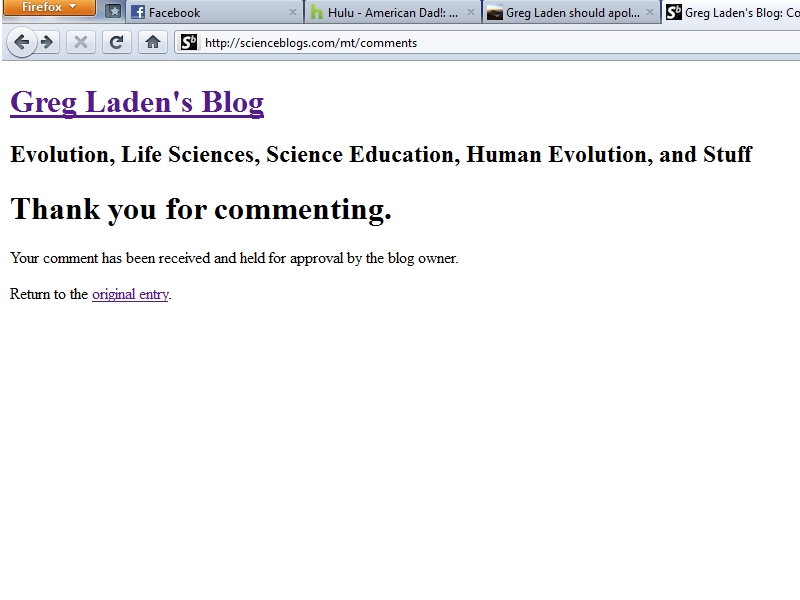
Update: I told Laden he needs to apologize for misrepresenting Dawkins’ statements. He has put all my comments in moderation. As is my policy, I will no longer post there (not that I planned on it anyway) since he is not trustworthy. Here is the last thing I said (who knows if it will appear):
There are three times when my comments get held in moderation. One is when there is a blanket policy for all first-time posters. The second is when it’s a Christian blog and my comments are likely to be edited. The third is right now. And per my policy when people show their cowardice, I’m out.
Now grow up, correct your blatant (and I would hope embarrassing) lies, and apologize, Laden.
Double update: Laden is claiming my comment wasn’t being held. This picture says different.
Filed under: Atheism/Humanism | Tagged: Elevator Guy, Greg Laden, Rebecca Watson, Richard Dawkins | 15 Comments »
I’ve lightly been following some incident that happened after an atheist conference. Rebecca Watson suffered the indignity of being talk to by some guy. (Relevant part starts around 4:40.)
Presuming you’re too lazy to watch the video, she was at a bar with a number of people, decided to go back to her room around 4 a.m., and when she got on the elevator so did a guy who was apparently engaged in previous group conversation (or at least listening). The guy said he found the talk she gave earlier interesting and asked if she wanted to go back to his hotel room for a cup of coffee to discuss things more. It’s not a very good line, but I bet it has worked more than once. (And who knows, maybe he was being genuine. I doubt it, but let’s at least throw it out there.) She was uncomfortable and declined. And that was that – he didn’t press further, nor did he lay a finger on her.
Fast forward a bit and PZ makes a post on the topic. His focus was on an issue that arose with Watson calling out her critics by their names. Apparently one person was a student or some such thing and Watson really singled her out. I don’t know (or care) enough about the details to really give it a fair shake, but those sort of criticisms can be dicey. Hell, I’ve put out a publication around my school where I really wanted to criticize the worst professor I have ever had. I decided against it for various reasons, not the least of which was because those sort of things aren’t always clear. Besides, there are more appropriate channels.
Next PZ made a post where he gave no-brainer advice to avoid being a creeper. It was condescending, even if largely right, and I can only be thankful he stopped before giving sex advice.
It is from that post, however, that things get interesting. Richard Dawkins jumped into the comment section and gave his position in response to another user:
Dear Muslima
Stop whining, will you. Yes, yes, I know you had your genitals mutilated with a razor blade, and . . . yawn . . . don’t tell me yet again, I know you aren’t allowed to drive a car, and you can’t leave the house without a male relative, and your husband is allowed to beat you, and you’ll be stoned to death if you commit adultery. But stop whining, will you. Think of the suffering your poor American sisters have to put up with.
Only this week I heard of one, she calls herself Skep”chick”, and do you know what happened to her? A man in a hotel elevator invited her back to his room for coffee. I am not exaggerating. He really did. He invited her back to his room for coffee. Of course she said no, and of course he didn’t lay a finger on her, but even so . . .
And you, Muslima, think you have misogyny to complain about! For goodness sake grow up, or at least grow a thicker skin.
Richard
And how have people interpreted that? Poorly:
However, the existence of greater crimes does not excuse lesser crimes, and no one has even tried to equate this incident to any of the horrors above. What these situations demand is an appropriate level of response…
The elevator incident demands…a personal rejection and a woman nicely suggesting to the atheist community that they avoid doing that.
No, wrong. The elevator incident demands a personal rejection and some better communication skills for that guy, but it certainly does not demand the damnation of the entire atheist community.
The point Dawkins was making was not that, ‘Oh, there are worst things in the world, so get over it.’ He isn’t stupid. He was making the point that even if this is a great offense (and it isn’t), the response it has gotten makes a mountain out of a mole hill. A man asking a woman to go back to his room for coffee, whether innocent or with the greatest of hopes in his mind, might deserve a quick admonishment of the guy later on – if a friend of mine did that, I would tell him he should have chosen a better location than in a small, temporarily inescapable room. And if he hadn’t personally talked to the woman at all prior to that moment, I would wonder why he thought he was in a position to ask her anything close to that – and I would tell him he had been less than smooth. What I wouldn’t have done was create a video about the incident, make the guy out to be the greatest misogynist in the world, and condemn an entire group of people. Dawkins was advocating for some perspective.
And hell, has anyone stopped to think that maybe this guy just isn’t very good at ‘picking up’ women? His line was weak, he apparently didn’t speak with Watson directly (or at least not much), and he didn’t consider his location very well. In fact, it wouldn’t surprise me if he chose the elevator because it was private. I don’t know many guys who are willing to ask women out or invite them some place in front of a group of people. Just tonight, actually, I saw a TV show that featured a man talking to a beautiful woman in front of his friends. It struck me as immediately odd because that sort of scenario is rare, at least among strangers and near-strangers. I don’t want to defend the guy on this basis, but I doubt anyone, especially PZ, even bothered to consider it.
It’s this sort of stuff that hurts feminism.
Update: I’ve just seen a second response from Dawkins:
No I wasn’t making that argument. Here’s the argument I was making. The man in the elevator didn’t physically touch her, didn’t attempt to bar her way out of the elevator, didn’t even use foul language at her. He spoke some words to her. Just words. She no doubt replied with words. That was that. Words. Only words, and apparently quite polite words at that.
If she felt his behaviour was creepy, that was her privilege, just as it was the Catholics’ privilege to feel offended and hurt when PZ nailed the cracker. PZ didn’t physically strike any Catholics. All he did was nail a wafer, and he was absolutely right to do so because the heightened value of the wafer was a fantasy in the minds of the offended Catholics. Similarly, Rebecca’s feeling that the man’s proposition was ‘creepy’ was her own interpretation of his behaviour, presumably not his. She was probably offended to about the same extent as I am offended if a man gets into an elevator with me chewing gum. But he does me no physical damage and I simply grin and bear it until either I or he gets out of the elevator. It would be different if he physically attacked me.
Muslim women suffer physically from misogyny, their lives are substantially damaged by religiously inspired misogyny. Not just words, real deeds, painful, physical deeds, physical privations, legally sanctioned demeanings. The equivalent would be if PZ had nailed not a cracker but a Catholic. Then they’d have had good reason to complain.
Richard
Naturally, the interpretation here has been that Dawkins thinks words don’t matter. He still isn’t stupid. He makes the point that the man was polite and did no harm to the woman. She may have been offended, but he caused her no turmoil from the forgettable incident. Perhaps if he was rude, or cursing, or plainly asked her if she wanted to fuck, then hey, we’ve got ourselves something disgusting. But he asked her for a cup of coffee. That does not get us here from there.
Filed under: Atheism/Humanism | Tagged: atheism, Feminism, pz myers, Rebecca Watson, Richard Dawkins | 13 Comments »
The reason Christians don’t know what happened before the Big Bang is because they aren’t very adventurous. Every atheist knows it was preceded by the Big Foreplay.
Filed under: Atheism/Humanism, Humor | Tagged: Big Bang, Big Foreplay | 3 Comments »
One of the biggest whines I hear from theists about The God Delusion is that Richard Dawkins just doesn’t know enough about all that wonderful theology. Why, if only he knew more! Maybe then he would totally be a Christian.
But I’m wondering. What would that knowledge actually change? Aside from making Dawkins a great Jeopardy! player, it’s obvious the whiny little Christians really don’t have an answer. After all, just think about it. Has anyone even bothered to give a single example where having a deep theological background would have changed a single bit of The God Delusion?
The truth is, theology is nothing more than literary criticism with a narrow focus. What’s more – and here’s the kicker – Christian theology assumes God. Why in the hell would Dawkins ever defer to theologians? Using theology to prove God is classic question begging and has no place in a serious debate about the existence of God. I hardly believe anyone who says any different is even really interested in these sort of discussions.
Filed under: Atheism/Humanism | Tagged: Richard Dawkins, The God Delusion, theology | 3 Comments »
 For the Sake of Science