Only in the light of evolution

Now that finals are over, I can devote more time to my dear, neglected blog. I begin with a series:

I am following a specific chapter in Jerry Coyne’s Why Evolution is True.

The fossil record: We should see fossils in a certain order if evolution is correct. They should go from simple to more complex overall, and the fossils we see in the most recent strata should resemble extant life much more than the fossils we see in old strata.

We should also see changes within lineages. We should be able to observe instances of gradual change in species that eventually leads up to either current species or at least to the time of extinction for these species.

Here’s a simple timeline of life’s history. Click it.

What the evidence shows is gradual change. First we find simple bacteria which survived off energy from the Sun, then we see more complicated cells known as eukaryotes arise. (You are a eukaryote.) Next we see a slew of multi-cellular animals arise. They’re still simple, but much more complex than the original bacteria. A few million years later more complicated life arrives. Early (and simple) plants begin to take hold. Soon the fossil record begins to show more plant complexity with low-lying shrub such as ferns, then conifers, then deciduous trees, and finally flowering plants. Gradual changes occur in the oceans and fresh waters which lead to fish and then tetrapods (Tiktaalik comes to mind).

One of my favorite fossils is trilobites. They’re extremely common due to their hard bodies. In fact, even their eyes are well-preserved because of their hard mineral make-up. I personally recall entering touristy-stores seeing countless fossils of these guys in the mid-west to the west (which, unsurprisingly, was once a shallow sea). This image shows the different lineages of this organism. Studies show that the ‘rib’ count has changed over time in each individual species, often without regard to how the other species changed. Going back further, there is less and less divergence in each species. Eventually, as evolution predicts, they all meet at a common ancestor.

So naturally the next step is to find fossils which show more significant changes. Let’s take birds and reptiles. They hold similarities between each other, both morphologically (certain shapes and structures) and phylogenetically (genetic sequence). A good hypothesis is that they came from one common ancestor. If this is true, the links between birds and its ancestors and reptiles and its ancestors should lead to the same point. They do. Dinosaurs are the ancestors of both. The links between birds and dinosaurs are so incredibly well established that I’d prefer to not go over them in detail. But for starters, some dinosaurs sported feathers and claws and had the same proteins for the feather-making process as extant birds. The links between reptiles and dinosaurs is easier just on intuition, so I’ll leave it at that for now.

Other transitional fossils include the already mentioned Tiktaalik. A view of the history of life can be see here. This shows the change in head and neck structure. Recent research on long-ago discovered Tiktaalik fossils has shown the importance in the gradual bone changes in the neck. These changes – a hallmark of evolution – were important to the ability to turn its head. This is a hallmark because natural selection only modifies what already exists. This is precisely what happened.

Going further with this example, evolution makes predictions as to how early fish evolved to survive on land. If there were lobe-finned fish 390 million years ago and obviously terrestrial organisms 360 million years ago (which is what the fossil record shows), then if scientists are to find transitional fossils, they should date in between that time frame. There should be an animal that shows both features of lobe-finned fish and terrestrial animals. Tiktaalik is that animal. It has fins, scales, and gills, but it also has a flat, salamander-like head with nostrils on top of its nose. This is a good indication that it could breathe air. Its eyes were also placed there, indicating that it swam in shallow waters. Furthermore, it was lobe-finned, but shows bones (which eventually evolved into the arm bones you used to get out of bed today) that were able to support its weight to prop itself up. And of course, it dates to 375 million years ago.

Next, evolution says the fossil record should show recent fossils being more closely related to extant species than are early fossils. This is precisely what happens. Sixty million years ago there were no whales. Fossils resembling modern whales only show up 30 million years ago. So, again, evolution makes a predication: if transitional fossils are to be found, they will be within this gap. And so it is.

We begin with Indohyus. It was an artiodactyl. This is important because extant whales have vestigial bones which indicate that they came from this order: scientists expected to find this because, again, evolution predicted it. It should be of no surprise that this fossil dates to about 48 million years ago, right in the predicted gap. From here there is a gradual evolution shown in the fossil record which leads up to modern whales.

It doesn’t force you to be an atheist

Evolution simply allows you to be one.

There are two primary reasons people reject evolution: ignorance and assumption. The ignorance is abundantly obvious; creationists are wholly unable to go toe-to-toe with anyone who has a modicum of knowledge about evolution. Ignorance isn’t a crime, but it’s far from a virtue. Assumption, on the other hand is less clear.

People equate evolution with atheism: if you believe in evolution, you must be an atheist. It’s not that far off the mark, but it does make assumptions. Evolution does not force atheism, it simply allows for it. But let’s not confuse the specifics. Evolution absolutely does deny the existence of virtually every god that man has so far created. The more popular gods out there come with a whole bag of characteristics that are incompatible with reality – the most notable that humans are an intentional result of some sort of pre-ordained plan. This is inconsistent with an intense compilation of science that shows humans are a product of a long timeline of change and adaptation; humans are no more pre-ordained than a snail or where a falling rock will land. Contrary thought it wishful thinking unsupported by evidence.

Of course, the magic playland of human-created gods isn’t the same as the concept of a hands-off, deistic being. An intentional creator of the Universe has the possibility of existing, even if it’s tremendously unlikely. Most people don’t like this idea because it offers a cold and useless explanation for the Universe; a deistic being says how the Universe came to exist, but doesn’t make humans as special as most people like to think. Beyond that, it still leaves open the question of how the deity itself exists. It’s a useless middleman that is equal in validity to any theistic beliefs, just without all the baggage.

It doesn’t force you to be an atheist

Evolution simply allows you to be one.

There are two primary reasons people reject evolution: ignorance and assumption. The ignorance is abundantly obvious; creationists are wholly unable to go toe-to-toe with anyone who has a modicum of knowledge about evolution. Ignorance isn’t a crime, but it’s far from a virtue. Assumption, on the other hand is less clear.

People equate evolution with atheism: if you believe in evolution, you must be an atheist. It’s not that far off the mark, but it does make assumptions. Evolution does not force atheism, it simply allows for it. But let’s not confuse the specifics. Evolution absolutely does deny the existence of virtually every god that man has so far created. The more popular gods out there come with a whole bag of characteristics that are incompatible with reality – the most notable that humans are an intentional result of some sort of pre-ordained plan. This is inconsistent with an intense compilation of science that shows humans are a product of a long timeline of change and adaptation; humans are no more pre-ordained than a snail or where a falling rock will land. Contrary thought it wishful thinking unsupported by evidence.

Of course, the magic playland of human-created gods isn’t the same as the concept of a hands-off, deistic being. An intentional creator of the Universe has the possibility of existing, even if it’s tremendously unlikely. Most people don’t like this idea because it offers a cold and useless explanation for the Universe; a deistic being says how the Universe came to exist, but doesn’t make humans as special as most people like to think. Beyond that, it still leaves open the question of how the deity itself exists. It’s a useless middleman that is equal in validity to any theistic beliefs, just without all the baggage.

It doesn't force you to be an atheist

Evolution simply allows you to be one.

There are two primary reasons people reject evolution: ignorance and assumption. The ignorance is abundantly obvious; creationists are wholly unable to go toe-to-toe with anyone who has a modicum of knowledge about evolution. Ignorance isn’t a crime, but it’s far from a virtue. Assumption, on the other hand is less clear.

People equate evolution with atheism: if you believe in evolution, you must be an atheist. It’s not that far off the mark, but it does make assumptions. Evolution does not force atheism, it simply allows for it. But let’s not confuse the specifics. Evolution absolutely does deny the existence of virtually every god that man has so far created. The more popular gods out there come with a whole bag of characteristics that are incompatible with reality – the most notable that humans are an intentional result of some sort of pre-ordained plan. This is inconsistent with an intense compilation of science that shows humans are a product of a long timeline of change and adaptation; humans are no more pre-ordained than a snail or where a falling rock will land. Contrary thought it wishful thinking unsupported by evidence.

Of course, the magic playland of human-created gods isn’t the same as the concept of a hands-off, deistic being. An intentional creator of the Universe has the possibility of existing, even if it’s tremendously unlikely. Most people don’t like this idea because it offers a cold and useless explanation for the Universe; a deistic being says how the Universe came to exist, but doesn’t make humans as special as most people like to think. Beyond that, it still leaves open the question of how the deity itself exists. It’s a useless middleman that is equal in validity to any theistic beliefs, just without all the baggage.

What science is all about

All which is between “~~~” is from Jerry Coyne.

~~~

I have sometimes written that evolutionary biology doesn’t have much practical value in medicine or other areas impinging on humanity’s material well being. Here is one example of what I’ve said. However, my friend and colleague David Hillis at The University of Texas in Austin — who played a big role in trying to make the Texas State Board of Education teach real science – has taken exception to my view. I asked him to let me know how he thought that evolutionary biology had been of use in medicine, and he wrote me an email with his answer, which he’s given me permission to post. He’d wants to emphasize that it’s an off-the-cuff response rather than a comprehensive reply, which of course I appreciate; but I think it’s worth posting:

OK, here are just a few examples from the thousands that are in the literature, off the top of my head:

Using positive selection to identify the pathogenic mechanisms of HIV in humans: PNAS 102:2832-2837 (one of many such studies that are now appearing and are using positive selection in pathogens to identify pathogenic mechanisms).

Using phylogenies and positive selection to predict which currently circulating strains of influenza are most likely to be closely related to future flu epidemics: Science 286: 1921-1925.

Using evolutionary analyses to track epidemics in human populations: many examples that have wider health implications, but our study of transmission in a forensic case was an interesting example with a specific legal application; PNAS 99:14292-14297.

Using evolutionary analyses to identify new disease outbreaks: new examples in every single issue of Emerging Infectious Diseases.

Using phylogenetic analyses to identify whether polio outbreaks are from native circulating viruses or from reverted, escaped vaccines (which tells health workers which vaccines to use in these areas to eradicate disease): see review in Bulletin of the World Health Organization, Vol. 82, No. 1.

Identifying changes in sodium channel genes that are under positive selection for TTX resistance, which has led to understanding the function of human diseases that are caused by the corresponding substitutions in human sodium channel genes: Mol. Biol. Evol. 25(6):1016–1024. (I included this one to show that all of the examples are not from virus work; this is the original evolutionary work from Manda Jost and Harold Zakon, with our collaboration, but there has been follow-up on the understanding of human diseases that are produced from these same mutations, now that they have been replicated by in vitro mutagenesis)

This just scratches the surface. I think there are now more papers that use evolutionary methods and analyses in the human health literature than all other areas of biology combined. I think it is crazy to not acknowledge the numerous and important human health applications of evolutionary theory and methods.

David

Well, this is good enough for me–I gladly retract my earlier opinion that evolutionary biology hasn’t been of much use in medicine. Thanks, David.

~~~

Imagine a creationist making the claim that evolution doesn’t have much practical value in medicine (something with which I am hugely surprised Jerry Coyne ever said) and then retracting it when presented with counter-evidence. It would never happen. Creationism rejects all principles of science.

Cancer

I’ll post more on this later, but the jist of it is an improved way of treating cancer.

The team’s goal is to successfully treat 10 dogs with NO-Cbl and slingshot the drug into human use as soon as possible. Because of the genetic similarity between dogs and humans, Bauer says his approach should have a much better chance of getting through the FDA’s strict drug approval chain.

Whoa! “Genetic similarity”? Now, let’s back up this gravy train. It’s clear that dogs and humans were magically created at separate times, no lineages attached to their genes. Any similarities are pure coincidence. Afterall, science is conducted through dogmatic declaration, right?

Thank goodness creationism doesn’t drive medicine. We’d still be (uselessly) praying for an end to The Plague.

Language

Language is a dicey thing. It’s especially dicey for scientists. Take Einstein for example. He used to use the word “God” quite often. He usually did not mean anything related to the Christian god (or any other god concept). Let’s look at the Einstein phrase “Did God have a choice in creating the Universe?” He wasn’t literally asking if any particular god had a choice. He was asking if the Universe could have come into being in more than one way. Incidentally, the fact that the answer to this question is unknown should throw some light on that awful argument, the “anthropic principle“. Allow me to digress.

The anthropic principle is the creationist delusion that their particular god made the Universe with humans soley in mind. It’s likely the most arrogant concept ever presented. Beside that, it basically says “Humanity (or life in general) is too well adapted to the Universe for everything not to have been made for humans/life”. Humans are evolved to the Universe (at least one, insignifcant part of it that holds no special relevance). The whole argument ignores this fact. Of course, that is the creationist motif: hear no facts, see no facts, speak no facts. What’s more, it’s just an argument from personal incredulity: “The Universe is just too perfect to not be for me! I can’t believe anything else! It’s too much!” Mooks.

But I return. Language in biology can be difficult. In order to popularize the subject, scientists will use personifying terms. “Genes want to replicate”, or “Cuts and bruises want to heal”. There shouldn’t be anything wrong with this. It’s human nature to do this. We call computers stupid or say “the flowers danced in the sun” (for the more poetic among us). Of course, there is a contingent of people who hear these terms and think they are literal. They also happen to often be people who don’t realize the Bible is metaphoric in its entirety and therefore take it literally.

Take the comment section from a recent thread. Not to harp on a particular commenter, but the term “code” is taken wildly out of context. Rather than read for what it is, it is read as being something with intention at its root. Let’s examine.

Biologists may say “DNA codes for the genome”. This is true, but it has no connection to intentionality. What it means is simply that DNA is in one form until it is translated and transcribed into another form. In other words, it goes from being a series of amino acids into a series of proteins and enzymes. This does not require some grand creator or intelligence. It requires a slow, gradual process that provides for plenty of random variation while being governed by a non-random mechanism. Evolution by natural selection fits the bill.

Discovery Institute is shut out; whines

The Vatican held another meeting trying to squeeze its tiny God into the ever shrinking gaps of reality as brought to us by science. (Apologies for the FOX Noise link, but it is an AP article.) Even though they have most things fully 1/2 wrong, them there Catholics do have some things entirely correct.

The Discovery Institute, the main organization supporting intelligent design research, says it was shut out from presenting its views because the meeting was funded in part by the John Templeton Foundation, a major U.S. nonprofit that has criticized the intelligent design movement.

Good. The Discovery Institute is filled with hacks who are purely motivated by religion, not science. They are, by definition, liars.

Organizers of the five-day conference at the Pontifical Gregorian University said Thursday that they barred intelligent design proponents because they wanted an intellectually rigorous conference on science, theology and philosophy to mark the 150th anniversary of Charles Darwin’s “The Origin of Species.”

The implication being – though not as eloquently as I am about to put it – is that people who actually think intelligent design is science are fucking mooks who have no idea what science actually is. Honestly. Can any IDist actually give one prediction made by intelligent design ‘theory‘? Does any IDist understand why his failure to do this is one of the major reasons intelligent design is not science?

Muslim creationists also complained about the conference.

Oktar Babuna, a representative of a prominent Turkish creationist, Harun Yahya, was denied the right to speak at the opening session Tuesday.

Notice this says “right to speak”. I assume this is in the same sense that I have a right to swing my fists. That right ends once it impedes someone else’s liberty. At that point, we no longer refer to my fist-swinging as a right: harassing, dangerous, disturbing, etc, perhaps we call it one of these, but certainly not a right. So surely Babuna couldn’t have been figuratively swinging his fists with his gaping mouth of creationist inanity, correct? After all, he was denied a right, not the ability to harass people or spew dumb, disturbing ideas of stupidity.

Participants took the microphone away from Babuna when, during a question-and-answer session, he challenged them to give proof of transitional forms of animals in Darwinian evolution.

Organizers said he hadn’t formulated a question and was just stating his point of view.

Babuna said afterward that the conference was clearly undemocratic. A statement from Yahya said, “Although there are discussion parts, they want this discussion to be one-sided.”

Surprise. It looks like Babuna took his verbal fists and started throwing them around the conference. It’s fortunate there’s no muscle to back them up.

Scientists can keep pointing to these fossils, but creationists just keep asking the same question over and over. They’re like little kids who keep asking their parents “why?” no matter what the answer. They aren’t actually seeking any information, truth, or answers; they just want attention because no one takes their childish ideas seriously.

Jerry Coyne

I’ve recently been reading Jerry Coyne’s book, Why Evolution is True. The amount of direct information this man delivers is phenomenal. In many cases, creationism-evolution arguments need to rely on a lot of rhetoric – the evolutionary rhetoric being based on reality and the creationism rhetoric being based on what some ignorant pastor or website said (yeah, rhetoric like that). Coyne, however, does this for his opening (as is the nature of openings), but then basically refutes every ignorant creationist qualm with specific examples. My favorite section thus far is on biogeography. It isn’t news to anyone, but Coyne elucidates the concept beyond any single work I’ve encountered to date.

This is one of the better books on evolution out there. It is needed reading for any individual who is driven by religion and emotion to deny the beautiful facts of life as revealed through science.

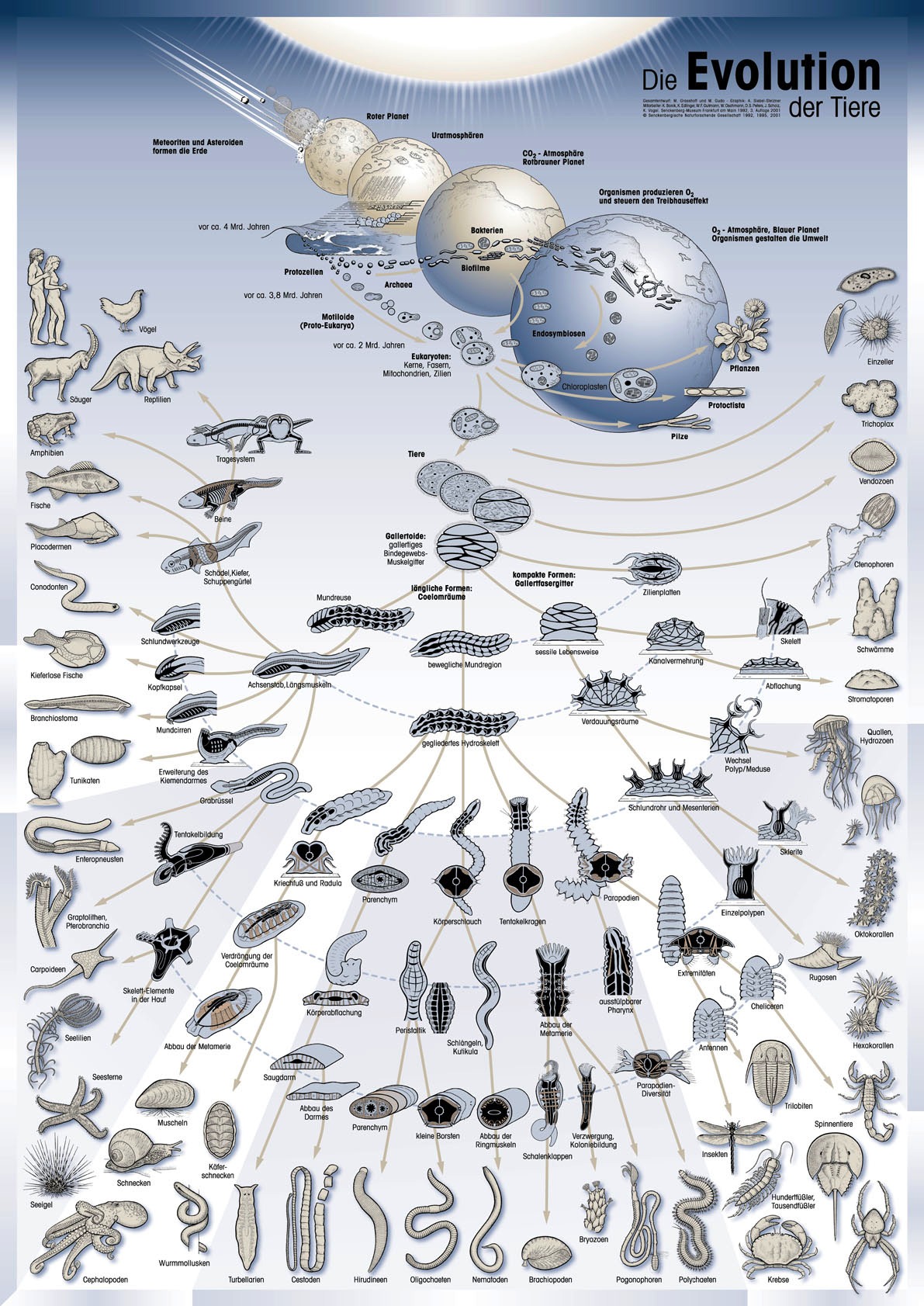
This image is stunning

Thanks to PZ for finding it.

animalsevolution_lg