Hartlaub’s Turaco

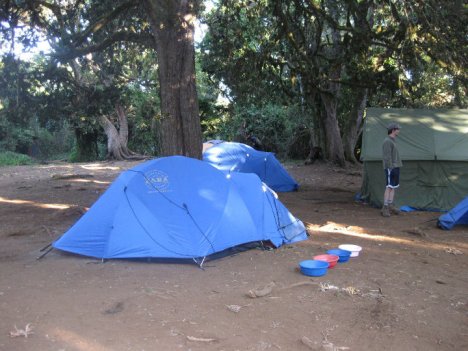
Look at these manly legs.

This comes from Shira Camp 1, the first and least creatively named camp site on my trek up Kilimanjaro (or perhaps Shira Camp 2 wins that title). Since it was practically dark by the time we rolled in that first day, I’m going to hazard this comes from the morning of Day 2. (Actually, the warm water for washing – say it with a Swahili accent – tells me it definitely was morning.) So that means you’re seeing me as I wonder just what all the sounds were from the prior night.

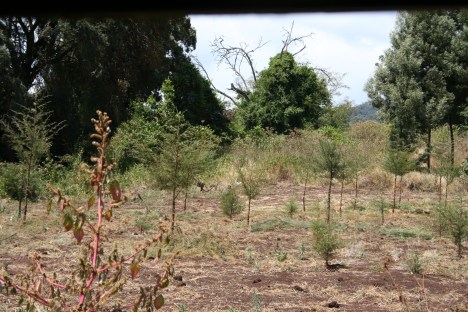
My initial thought was baboon. In fact, several baboons. We had seen some on the way to the head of the Lemosho route.

They aren’t easy to make out, but they are there. And as far as I know, they may have stayed there because they actually weren’t surrounding the camp site that night. Or if they were, they were tucked in their beds snug as could be. What was actually making all the racket was the Hartlaub’s Turaco.

It’s a pretty awesome bird that is native to Kenya, Tanzania, and Uganda. From what I’ve been reading, it appears to be most numerous in Kenya, at least in small part because of excessive hunting in Tanzania. Fortunately, however, it faces no significant danger to its overall health as a species at this point. (In fact, its conservation status is “LC” or Least Concern, the lowest, and thus best, it can be.)

But I know as great as pretty pictures are, what everyone really wants is some sound. (It will link you out, but do click anyway.)

ARKive video - Hartlaub's turaco - overview

I think the deep throatiness of the baboon is discernible through the Hartlaub’s Turaco’s call. But perhaps it was the quiet of the encompassing night that made it seem all the more phenomenal to me; I couldn’t help but be convinced I was hearing baboons. Without a deeper knowledge, I can only speculate why the bird makes such a sound: perhaps it is imitation, but that doesn’t strike me as the most plausible explanation off-hand.

Thanks to Mike for providing the necessary information, the first photograph, and even the link to the video. I appreciate it.

Are humans “more advanced” than other organisms?

I recently had a discussion with a friend where he asserted that he was more advanced than, say, a plant. By the common connotations that come from the word “advanced”, we would have to agree that his statement was true. But it asks an interesting question: What do we really mean when we say we’re advanced?

To put the discussion in a proper framework, think in evolutionary terms. That means we can’t compare Albert Einstein to Sarah Palin and say, “Why, yes, he was more intellectually advanced than she is.” Of course that is true, but if we’re going to discuss evolution and what it means to be advanced, we’re necessarily comparing species, not individuals. That is what makes my friend’s initial comparison to plants a reasonable starting point.

But it is only a starting point. Because what are we comparing exactly? In terms of brain development, yes, he beats that plant handily. But what about in terms of ability to photosynthesize? Well, the plant just got a knockout in that round. Clearly there is a difficulty in making useful (and, in my view for this discussion, any) comparisons between species. Maybe we need to find a species that is closer in relation to humans. (It certainly would help for it to have a brain in the first place.) The animal I chose for the discussion and the one I am choosing for this discussion is the skunk. Jerry Coyne is the inspiration.

It does not always [evolutionarily] pay to be smarter, either. For some years I had a pet skunk, who was lovable but dim. I mentioned this to my vet, who put me in my place: “Stupid? Hell, he’s perfectly adapted for being a skunk!” Intelligence comes with a cost: you need to produce and to carry that extra brain matter, and to crank up your metabolism to support it. And sometimes this cost exceeds the genetic payoff. A smarter skunk might not be a fitter skunk.

A skunk is vastly more well adapted to life as a skunk than any human ever could be. All the things it takes to be a skunk? A skunk has them nailed down pretty well. The counter to this point was to say that if humans decided to destroy all skunks, we could. True enough. But does that make us more advanced? Of course our intelligence allows us to wipe out many other species, but the whole point of bringing up a skunk and its adaptation is to say that a comparison of intelligence is not valid for purposes of this discussion in the first place! (As always, you know I mean it when I use the lazy-man’s exclamation point.)

When we choose to compare intelligence in order to define what it means to be advanced, we have two massive assumptions going on. First, we’re assuming that intelligence is better than toothiness or having sharp claws or any other characteristic we see in nature. This assumption is untenable because some environments might call for all or any of those characteristics over intelligence. To put things in perspective, try thinking on an evolutionary timescale. So far I have only been comparing humans to other extant organisms (plants and skunks). But what if we go back 100 million years? 200 million? 500? 600? Any human put into an ancient enough environment would die. We know this because the right foods would not be available or because there would be no proper shelter or because the atmosphere would be poisonous or because our immune systems would not be evolved to cope with the bacteria and viruses present at the time or because…and so on. The assumption that intelligence is better than anything else is clearly wrong once we recognize that evolution and the ability of a species to survive depends largely upon environment.

The second assumption in this whole discussion is that we can even say something in evolution is “advanced”. We can say more complex or better suited to a particular environment, but “advanced”? That implies evolution is on the march towards some goal, to some end. That is not true. Science has demonstrated this again and again by showing what a contingent process evolution is. Take the Lenski experiments, for example. (I’m rather disappointed I never wrote about them here.) Richard Lenski and his researchers followed several lineages of E. coli for 20 years (in fact, they’re still following them). They would freeze samples every 500 generations so they could go back and re-run the tape of evolution should some fundamental change occur. And, eventually, such change did occur. Some E. coli were able to consume a natural by-product of their environment after nearly 30,000 generations. Lenski et al. unfroze the old generations to see just what enabled the bacteria to obtain their new found skill. As it turned out, they had to go back many thousands of generations; it wasn’t just one mutation, but at least three. The first two were effectively random. But they were necessary in order to get to the third mutation – the one that opened up a new food product for the colonies. But in the re-running of the tape, not all lineages re-evolved the new mutations. The chance involved in the process was too great to be inevitable; evolution is contingent.

So my answer to the question, Are humans “more advanced” than other organisms?, is to say it is an inappropriate question in the first place. There are several things we should not be assuming:

  • Intelligence is the best trait (whether to this point or in terms of possibility)
  • Evolution is goal oriented
  • The ability to destroy other species and still survive is a mark of advancement

I mentioned the argument for point three, but I have yet to address it. This one is pretty straight-forward, I think: We may be able to destroy many species, but that really only applies for large organisms. The vast majority of life is microbial. Since we would never be able to destroy it all (or even a minute fraction of it), does that mean it is more advanced than we are? What about all the bacteria we need to keep us alive? We certainly could not destroy all the mitochondria of the world and still survive.

Evolution is a contingent process that has no march towards any end. It is about the ability to survive. Our genes are interested in propagating themselves and that is why we are here. Life may mostly (though not entirely) be more complex since it first sprung forth nearly 4 billion years ago, but it always depends upon its environment – and that makes some characteristics more valuable than others. Sometimes.

Butchering science

Creationists hate science. They hate its conclusions, they hate its methods, they hate that it doesn’t support their silly beliefs. It’s that hatred that motivates them to butcher scientific articles and papers.

One recent butchering comes from Jack Hudson. I’m sure regulars here remember him. If not, it isn’t important. He’s a creationist with a background in introductory biology courses from 20 years ago. It’s doubtful he has much experience reading scientific papers, but that doesn’t stop him from trying.

In his post he butchers two articles. I’m going to focus on the first one, but I’ll briefly mention the second one. In that one researchers found that some negative mutations don’t change the protein sequence yet they are still negative. This one is simple. The entire sequence of a gene is not devoted to just the protein sequence. A mutation can therefore change one aspect of a gene without changing another – but it can still change another process that is important in forming proteins. Alter shape in one place and you have a good chance of seeing change somewhere else as a result. Biology is still all about shape.

The second paper, though. Woo. What a doozy of a butchering. First let me summarize the paper.

In asexual populations alleles can become fixed rather quickly. Their evolution is more straight forward because they aren’t mixing and matching genes. They produce offspring with the exact same genome, less there be a mutation. If there is a mutation, it can become fixed because things are generally less complicated with asexual populations and thus more black and white. Is this mutation good or bad? As the paper says and as Jack repeats upon hearing the term for the first time, alleles sweep through a population.

But when it comes to sexually reproducing populations, things become more complicated. And this is what the paper is about. The question is, do alleles sweep through populations in sexually reproducing populations like they do in asexual populations? The answer is no.

Now, if we’re to believe Jack, this means that evolution has failed because, why, evolution predicts an advantageous allele to reach 100% fixation, of course. Except it isn’t so black and white with sexually reproducing populations. (Nor does evolution predict that anyway.)

What the researchers did was study over 600 generations of fruit flies. They let them breed naturally, but then selected out the eggs which were produced the most quickly. This led to significantly faster reproducing populations. They then tracked specific alleles to see if they would become fixed. What they found was that they don’t.

Signatures of selection are qualitatively different than what has been observed in asexual species; in our sexual populations, adaptation is not associated with ‘classic’ sweeps whereby newly arising, unconditionally advantageous mutations become fixed. More parsimonious explanations include ‘incomplete’ sweep models, in which mutations have not had enough time to fix, and ‘soft’ sweep models, in which selection acts on pre-existing, common genetic variants. We conclude that, at least for life history characters such as development time, unconditionally advantageous alleles rarely arise, are associated with small net fitness gains or cannot fix because selection coefficients change over time.

The conclusion here is that selection for a particular trait in sexually reproducing populations acts upon many different aspects and genetic variants within the genome, not merely a single gene or SNP.

This suggests that selection does not readily expunge genetic variation in sexual populations, a finding which in turn should motivate efforts to discover why this is seemingly the case.

This is the actual conclusion of the paper. To put it another way (and to repeat myself), advantageous variants do not wipe out other genetic variants in a sexually reproducing population, instead acting on variation in a more subtle and complicated way. The big conclusion here is that there is a difference in how genes become fixed (or not fixed) in asexual populations versus sexually reproducing populations.

And Jack’s conclusion?

In short, if the activity failed to occur in the lab under optimal conditions, it is unlikely that traits are going to be transmitted this way in nature.

The traits are still being transmitted through natural selection working on variation. Jack’s conclusion has little to no connection to anything from the paper. In fact, it is abundantly clear that he read an article somewhere, figured out how to butcher it, and then went and read a few lines from the original paper.

I’ve said in the past that what takes a creationist 30 seconds to say takes an educated person 3 hours to correct. This post and the research required for it didn’t take that long, but the sentiment remains true – it’s a real hassle to untangle the carelessly mushed writings of a creationist.

Repost: Only in the light of evolution

There are two reasons I want to make a repost of a post from about a year and a half ago. First, it’s always interesting to go back and read old posts for me. From time to time I have no recollection of making a certain post, so when I see it, it’s almost like it’s brand new to me. I do happen to remember this one very clearly, but it is at least understandable why I was skimming posts from May 2009. Second, I average significantly more views now than I did a year and a half ago. I feel this post is a pretty important one, and now that more people can see it, I would like to throw it back up.

~~~

I am following a specific chapter in Jerry Coyne’s Why Evolution is True.

The fossil record: We should see fossils in a certain order if evolution is correct. They should go from simple to more complex overall, and the fossils we see in the most recent strata should resemble extant life much more than the fossils we see in old strata.

We should also see changes within lineages. We should be able to observe instances of gradual change in species that eventually leads up to either current species or at least to the time of extinction for these species.

Here’s a simple timeline of life’s history. Click it.

What the evidence shows is gradual change. First we find simple bacteria which survived off energy from the Sun, then we see more complicated cells known as eukaryotes arise. (You are a eukaryote.) Next we see a slew of multi-cellular animals arise. They’re still simple, but much more complex than the original bacteria. A few million years later more complicated life arrives. Early (and simple) plants begin to take hold. Soon the fossil record begins to show more plant complexity with low-lying shrub such as ferns, then conifers, then deciduous trees, and finally flowering plants. Gradual changes occur in the oceans and fresh waters which lead to fish and then tetrapods (Tiktaalik comes to mind).

One of my favorite fossils is trilobites. They’re extremely common due to their hard bodies. In fact, even their eyes are well-preserved because of their hard mineral make-up. I personally recall entering touristy-stores seeing countless fossils of these guys in the mid-west to the west (which, unsurprisingly, was once a shallow sea). This image shows the different lineages of this organism. Studies show that the ‘rib’ count has changed over time in each individual species, often without regard to how the other species changed. Going back further, there is less and less divergence in each species. Eventually, as evolution predicts, they all meet at a common ancestor.

So naturally the next step is to find fossils which show more significant changes. Let’s take birds and reptiles. They hold similarities between each other, both morphologically (certain shapes and structures) and phylogenetically (genetic sequence). A good hypothesis is that they came from one common ancestor. If this is true, the links between birds and its ancestors and reptiles and its ancestors should lead to the same point. They do. Dinosaurs are the ancestors of both. The links between birds and dinosaurs are so incredibly well established that I’d prefer to not go over them in detail. But for starters, some dinosaurs sported feathers and claws and had the same proteins for the feather-making process as extant birds. The links between reptiles and dinosaurs is easier just on intuition, so I’ll leave it at that for now.

Other transitional fossils include the already mentioned Tiktaalik. A view of the history of life can be see here. This shows the change in head and neck structure. Recent research on long-ago discovered Tiktaalik fossils has shown the importance in the gradual bone changes in the neck. These changes – a hallmark of evolution – were important to the ability to turn its head. This is a hallmark because natural selection only modifies what already exists. This is precisely what happened.

Going further with this example, evolution makes predictions as to how early fish evolved to survive on land. If there were lobe-finned fish 390 million years ago and obviously terrestrial organisms 360 million years ago (which is what the fossil record shows), then if scientists are to find transitional fossils, they should date in between that time frame. There should be an animal that shows both features of lobe-finned fish and terrestrial animals. Tiktaalik is that animal. It has fins, scales, and gills, but it also has a flat, salamander-like head with nostrils on top of its nose. This is a good indication that it could breathe air. Its eyes were also placed there, indicating that it swam in shallow waters. Furthermore, it was lobe-finned, but shows bones (which eventually evolved into the arm bones you used to get out of bed today) that were able to support its weight to prop itself up. And of course, it dates to 375 million years ago.

Next, evolution says the fossil record should show recent fossils being more closely related to extant species than are early fossils. This is precisely what happens. Sixty million years ago there were no whales. Fossils resembling modern whales only show up 30 million years ago. So, again, evolution makes a predication: if transitional fossils are to be found, they will be within this gap. And so it is.

We begin with Indohyus. It was an artiodactyl. This is important because extant whales have vestigial bones which indicate that they came from this order: scientists expected to find this because, again, evolution predicted it. It should be of no surprise that this fossil dates to about 48 million years ago, right in the predicted gap. From here there is a gradual evolution shown in the fossil record which leads up to modern whales.

Ignoring evolution

There were two major factors which contributed to the ruining of Soviet agriculture from the 1930’s into the 1950’s. First, Stalin accused wealthy farmers of withholding production from the state. This led him to institute a policy of force collectivization where small-scale farms were forced to be managed as single large-scale productions. The government would take the amount of grain it thought it should have while also placing peasants in work camps to complete the ideal of big time farming for the community. Unfortunately, it was from these peasants, not the few wealthy farmers, where grain had been taken. This discouraged workers from producing more; those in camps tended to die. The ideal of people working for the good of the group had been undermined by what was effectively slavery; workers were forced into collectivization and had no power to determine working conditions (thank goodness for unions in the U.S.).

Second, and far, far, far more importantly, Trogim Lysenko emerged to become a major political figure (though he called himself a scientist). The government recognized that its policies of the late 20’s and early 30’s had failed to produce more output, and now they needed to find a way to not only fix their political liabilities (angry and disenchanted peasants), but they also needed to make their land produce more.

The big deal with Lysenko was that he rejected Mendelian genetics, instead favoring Lamarckism. This seemed intuitively sound on an extremely immature and scientifically ignorant level; it was that intuitive appeal that helped convince Stalin:

But that is not the point just now. The point is that our practice, our reality, is providing new arguments against this theory, but our theoreticians, strangely enough, either will not, or cannot, make use of this new weapon against the enemies of the working class. I have in mind our practice in abolishing private ownership of land, our practice in nationalising the land, our practice which liberates the small peasant from his slavish attachment to his little plot of land and thereby helps the change from small-scale peasant farming to large-scale collective farming.

Stalin was using “theory” in reference to political theories, but we can see clearly that he was willing to favor his own ideology (“practice”) over anything remotely abstract. That is why Lysenko became so political successful. His own theories jived with the Soviet ideal of forced collectivization; perform a little biological magic on some crops and voila! everyone has enough food and an angry peasantry isn’t all that important.

During the years Lysenko’s ideas reigned, Soviet agriculture suffered tremendously. He was ignoring how evolution works; populations are not permanently improved through environmental changes. Change may happen through epigenetics, but as Jerry Coyne explains, this does nothing to alter the basis of biology. In order to improve agriculture, practice (not in the ideological sense) has its role, but ultimately we must be sure our ideas fall within the theoretical (in the scientific sense) framework we have established – especially since we know it is true.

Six year old boy debunks ID

There’s a wonderful post over at Atheist Nexus about a father teaching his son the facts of life as well as a few creation myths. It’s a good example of how necessary it is to tell kids all the basics in science (and especially biology) at a young age. Give them the facts first and they tend to laugh when they’re told all the silly things (young and old Earth) creationists believe.

I had been spending so much time teaching him about evolution by natural selection that I forgot to tell him the lie he would be confronted with someday. Just a few weeks ago I had asked him what evolution was. He responded by saying, “It’s a gradual change in species that happens slowly over really long periods of time.” I couldn’t hope for a better answer from him. Talk about a proud poppa moment; almost made me cry.

I decided that it was time that he heard the creation story that I grew up with. I hopped on the internet and googled “childrens creation story.” In .2 seconds I was greeted with 2,230,000 results to choose from. I chose the top one from dltk-Bible.com. As soon as I got to “Let there be light,” he started giggling. By the time I got to the morning of the third day he was laughing quite a bit.

I read on, “So, he put all the water in one place and all the dry land in another.” He stopped laughing instantly so I asked him, “What?”

“Why do we have to save water then? Wouldn’t God make enough for everybody?” he asked. I smiled and nodded just a bit before reading on.

After I finished reading about the third day he was beginning to catch on. “So God made everything?” he asked.

“Well that’s what some people believe,” I stated, “but I don’t think so.” This sent him into hysterics.

“He made South America!” I wasn’t sure why this was so funny to him but he continued to laugh and list the things that God had “made.” Squirrels, Dr. Seuss, and cat butts had him laughing especially hard. “Doesn’t he have any brains? Cause he made some weird stuff in this world.” A six year old debunks Intelligent Design with a simple observational idea that ID proponents can’t even grasp. That had me chuckling for a moment before I read on.

When I told him about the creation of the sun on the fourth day he became serious again. He wrinkled up one eye and stated matter-of-factly, “Light has to be from the sun.” And I thought I was the only one in the room that would have a problem with light being created three days before the sun. My six year old was quickly demonstrating that he was a better critical thinker than people who believe the creation story.

Goodness, gracious. I can only hope to have a child this intelligent and insightful one day. I can’t help but imagine just how embarrassed I would feel going up against him if I was an IDiot.

The fundamentally dishonest creationist intelligent design crowd is always whining about not being given equal time and blah blah blah. But the fact of the matter is, these people don’t give a shit about a presentation of evidence – if they did, they wouldn’t be promoting creationism. They want to obfuscate sound science so that children will harbor unwarranted doubts; when those children grow up and realize that they will some day die, it is the hope of the IDiots that they will seek comfort in religion (and, very specifically, Christianity). After all, it was the combination of indoctrination and fear of death that motivated most IDiots to where they are.

I’ll give the final word to the young boy.

“I think the scientists are correct and the other guy sounds crazy. I think I want to be a scientist when I grow up and study water, animals, and space.” What an amusing array of choices. I had to inquire about them. “I want to find out where the water came from, for real, and dig up animal bones and put them together.”

“What about space?”

“I want to go there…”

How to write a news article

It’s unfortunately common that journalists are always so eager to seek out all sides on an issue. It’s this sort of blind following of protocol that has resulted in the anti-vax crowd rising to the prominence it has, or the fact that creationists will often get to spout lies concerning recent scientific discoveries. And do the journalists ever challenge those lies? Not really. It’s apparently enough that we hear what two groups think, even if one of those groups is incompetent.

That’s why I really like this article by Ashley Yeager of Duke. Without simply presenting us her point of view, something for which we have plenty of bloggers and the like, she informs the reader of what happened at a particular event – and she doesn’t ask for the needless opinions of dissenters.

People filed into Page Auditorium on Oct. 3 carrying The Greatest Show on Earth: The Evidence for Evolution tucked under their arm. The scene was typical of a lecture given on a college campus, except the instructor was the controversial and outspoken British biology writer Richard Dawkins.

Dawkins’ lecture used no props or PowerPoint slides. For 45 minutes, he simply talked his listeners through his latest book, mixing scientific discussion with scathing jabs. He cited evidence for his argument that “we stop calling evolution a theory and call it a fact.”

He spoke about the family trees that linked all animals and how some would argue that “God deliberately deceived us.” Maybe God did, Dawkins conceded. But if so, “I’m not sure if that is the kind of God you want to worship,” he said.

“You have all the arguments on your side. (Students) may say well my parents, say or my preachers say this. Well, damn your preacher, these are the facts.”

You know when you watch a DVD of a TV show and it has that weird cut where you feel like you’re about to watch a commercial? Well, this is the point in this article where most other journalists would go to some priest or well-known creationist for a dissenting view. I can just feel it. But Yeager doesn’t do that. Here is the next paragraph.

One audience member asked Dawkins if he and religious groups that advocate for many of the same causes as his foundation — natural disaster relief, education reform, among others — could ever work together. No, Dawkins said. At a fundamental level, the two groups’ views would have them debating much more than aiding others, he said.

She just continues on with her account of the event. I love it. This is a good example of how journalism should be done.

Just because there is another side doesn’t mean it’s a side worth hearing.

Thought of the day

The Ancestor’s Tale by Richard Dawkins is a delight. Go buy it, read it, love it.

Incidentally, it’s subtitled A Pilgrimage to the Dawn of Evolution (or “Life” rather than “Evolution”, depending on the copy). I had someone draw an issue with this. I was told that a pilgrimage is a religious or spiritual journey and that Dawkins can’t just go around changing words. I need not address the definition of the word but more than briefly since it is obvious that “pilgrimage” need not be religious, but I do want to note the narrowness I find with which many people (not simply this one person) view language.

I’ve said it before: language is expression, express it. We need rules, we need consistency, yes. This does not, however and of course, translate to shackles, to restraint. Even if Dawkins was using a religious word in a way that was itself not religious, that does not make him wrong. For example, say “pilgrimage” really was only religious. We still recognize it as meaning a significant journey that leads to something important. Even if the word is technically wrong (and it isn’t), context has informed us what is meant; clear meaning has been conveyed. That ought to be appreciated.

On another quick note, I’ve encountered several people who have said or implied Dawkins is not a quality writer in one way or another. Such statements and notions are risible.

Unraveling black widow silk

I no longer find it amazing how much of a basis evolution forms in various bits, pieces, and even chunks of research projects; it is expected.

Thought of the day

The only thing which can (and does) correctly explain all the dinosaur fossils of Utah and the rest of the world is evolution.