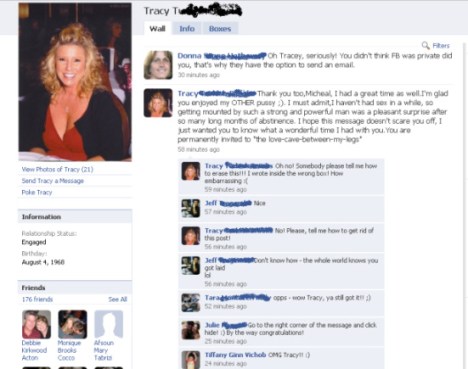
Didn’t we already know this?

A new study says older brains are less nimble than younger brains:

The elderly have a harder time multi-tasking than young adults because older people are far less nimble at switching neurological connections in their brains between activities, according to research released on Monday.

The findings of neuroscientists from the University of California at San Francisco add new insights to a growing body of studies showing that one’s ability to move from one task to another in quick succession becomes more difficult with age.

I thought this was already pretty clear. I don’t mean from the stand point of common sense – it is clear from the position, but evidence is important in actually knowing what is true. What I mean is that for the past several years Facebook has been open to everyone. Once the company did away with requiring school email addresses to sign up, the number of technologically inept people skyrocketed, primarily with old people. (As I’ve said before, “old” does not necessarily refer to age here.) It wasn’t too long until it became obvious that quite a few old people were unable to deal with Facebook like adults. From responding to other posts by making wholly new status updates to trying to keep their conversations straight between posts, links, and statuses, anyone who has been paying attention knows that Facebook is not the place for old people.

(Click to enlarge. If old, retrieve your reading glasses.)

Harvard twins cannot undue FB settlement

Good:

A federal appeals court ruled Monday that former Harvard University schoolmates of Facebook founder Mark Zuckerberg can’t undo their settlement over creation of the social networking site.

The 9th U.S. Circuit Court of Appeals said Monday that Tyler and Cameron Winklevoss were savvy enough to understand what they were agreeing to when they signed the agreement in 2008. The deal called for a $20 million cash payment and a partial ownership of Facebook. A third classmate, Divya Narendra, was part of the settlement with the twins but did not pursue the second lawsuit seeking to undo the agreement.

Monday’s ruling upholds a lower court decision enforcing the settlement during the six years of litigation that grew so contentious that the dispute was dramatized in the Oscar-nominated film, “The Social Network.”

The settlement is now worth more than $160 million because of Facebook’s increased valuation.

As much as I have a love-hate relation with Facebook, this is good news. It’s nothing but manipulative greed and bitterness to go after more money here.

Moral progress in Arkansas

The Arkansas Supreme Court has ruled the will of the people of Arkansas invasive and unwarranted:

The Arkansas Supreme Court on Thursday rejected a voter-approved initiative that barred gay couples and other unmarried people living together from serving as adoptive or foster parents.

Associate Justice Robert L. Brown wrote for the court that the law would encroach on adults’ right to privacy in the bedroom.

“Act 1 directly and substantially burdens the privacy rights of `opposite-sex and same-sex individuals’ who engage in private, consensual sexual conduct in the bedroom by foreclosing their eligibility to foster or adopt children,” Brown wrote.

Just like with most civil rights issues, it’s going to take the courts to bring the country up to speed – especially the south.

Good news for the wrong reasons

A man in Texas and a man in Arizona narrowly avoided being murdered this week. In each instance (despite the poorly written article on the man from Texas) the reasoning had to do with inadequate anti-murder protection. That in itself isn’t absolutely awful, but a far, far, far, far, far superior reason would be that murder is wrong. And two wrongs don’t make a right – even if the second wrong helps emotionally.

I can’t wait for the U.S. to catch up with the modern world.

It couldn’t be that drivers have become better!

Unless they’re old:

Highway deaths have plummeted to their lowest levels in more than 60 years, helped by more people wearing seat belts, better safety equipment in cars and efforts to curb drunken driving…

“Too many of our friends and neighbors are killed in preventable roadway tragedies every day,” said Transportation Secretary Ray LaHood. “We will continue doing everything possible to make cars safer, increase seat belt use, put a stop to drunk driving and distracted driving and encourage drivers to put safety first.”

Emphasis mine.

Take a look at that article. It mentions a number of factors which have contributed to the decrease in highway deaths, but it never goes through hoops to make sure we all know that it isn’t because drivers have become better. In fact, the part I put in bold says it all: In addition to safety measures that are independent of the people behind the wheel, drivers are putting safety first. In other words, people are more aware and cautious, i.e., better drivers. But that wasn’t the case when the article was about teens:

“It’s not that teens are becoming safer,” said Russ Rader, spokesman for the Insurance Institute for Highway Safety, an Arlington, Va.-based research group funded by auto insurance companies.

“It’s that state laws enacted in the last 15 years are taking teens out of the most hazardous driving situations,” such as driving at night or with other teens in the car, he said.

In fact, it’s likely teens today are better drivers than teens of past generations. All the laws that are in place do get followed by most teens, whether people want to admit it or not. Even if it only happens once they get caught the first time, they are still following these laws for most of their teenage driving careers. That, by frickin’ definition, makes them better drivers. We can say the same thing about everyone else as well.

The only difference is that no one seems to want to say it.

Exploiting children

I remember working my high school job at a grocery store. As I recall, I could only work 4 hours and until 9 p.m. on school nights when I started. I soon turned 18 and was able to work longer and later. And that I did. I soon took on the role of supervisor, something that unfortunately translated to working until close – 11 p.m. I remember just how rough it was getting up in the morning for school. I had to be there by 7:15 a.m., so I was up by 6:50 a.m. at the latest. That is, if I even went to school. In my Senior year I skipped like crazy; in just one quarter I missed 11 days. My grades didn’t suffer (as I recall, I had a 94 average that particular quarter), but I was also fortunate in going to a school that granted Junior/Senior privileges. Depending on the week, I either had 2 or 3 days in which I could go home and sleep from about 11 to 1.

But that isn’t the case for everyone. First, not every school has the system mine did. Second, many students are going to struggle to do moderately well, much less achieve privileges (if their school even has them). Allowing kids to work that awful schedule I dumbly undertook in high school is an obvious mistake that will negatively impact education. Well, it’s obvious unless you’re a member of the Maine GOP:

Rep. Burns, who did not respond to an interview request Tuesday, apparently thinks Maine’s kids are not only underworked, but also overpaid.

And how would Burns correct this, ahem, problem?

Well, he’d remove any limit whatsoever on the number of hours kids over 16 can work on a school day — the current limit is four on most days and eight on the last school day of the week.

He’d raise from three to four the maximum hours kids under 16 can work on a school day.

And finally — listen up, kids — he’d whack the pay for any high school student under the age of 20 from Maine’s $7.50-per-hour minimum wage to a “training wage” of $5.25-per-hour for the first 180 days on the job.

This has to be the worst idea I have heard from Republicans since we invaded Iraq. Kids don’t need to be working late nights while trying to juggle school and their social lives. It sucked for me under relatively fortunate circumstances; it will suck just as much, if not more, for everyone else.

Co-sponsor of the bill Rep. Bickford had this to say:

“I would support removing the cap for daily and weekly hours, but I would also support amending it to six hours when school is in session, so the student could get home from school — say 3:00 — and could work from 4:00-9:00. They’d still have plenty of time for homework,” Bickford added. “Most of these kids are generally up well past 10:00. They could work a 3:00-9:00 shift.”

So let’s just keep them up later. Hell, I used to stay up until 12:30 a.m. quite often. How about we let kids work until midnight? Or, hell, let’s allow them to do overnights. They can go to work at 11:00 p.m., work an 8 hour shift, get to school at 7 the next morning, sleep from about 2:30-10:30 p.m., then head back to work. It’ll be a real resume builder.

Aside from being an education-second bill, the whole point of this legislation is to cheapen up labor for Maine’s tourist industry. Anyone who has ever been to the Maine coast in the summer knows that teenagers get hired all over the place – and for less than 180 days. Burns and Bickford want to allow businesses to pay teenagers less money for the same work that those over 20 are doing. It’s horseshit. It’s unfair, without a good or reasonable basis, and it will have negative ramifications on the educations of working teens.

But hey, how about some science?

Citing no fewer than eight published studies, [Maine Women’s Lobby direction Laura] Harper said the data consistently show that holding down a job while in high school is actually a good thing for most kids — up to a point:

One study, appearing in the “American Educational Research Journal,” found that kids who work between one and 15 hours per week are actually more likely to complete high school. Pass the 15-hour mark, however, and the dropout rate starts to rise.

Ditto for another study in “Sociology of Education” that found “intensive work involvement” of more than 20 hours a week leads to higher numbers of kids giving up on school.

Then there’s the “Journal of Educational Research” study that found a direct correlation between hours worked and academic performance — the more the hours go up, the more grades and standardized test scores go down.

Meanwhile, as Harper noted in a recent letter to the committee, “no evidence presented suggests that there is an unskilled labor shortage in this state.”

Sad lulz

Arizona has enacted a stupid new law that bans abortions that are done for the sake of selecting race or gender. This is the part that really got me:

Backers of the measure said the ban is needed to put an end to sex- and race-related discrimination that exists in Arizona and throughout the nation. They insist the issue is about bias rather than any broader stance on abortion.

Lulz. Arizona wants to put an end to race discrimination?

Bahahahahahahaha

One reason U.S. health care sucks

I hate hearing this moronic meme that the United States has the best health care in the world. It doesn’t. Anyone who thinks otherwise is ideologically deluded. I’m looking at you FOX Noise.

One major reason for our tendency to suck is that we have relatively little emphasis on preventative care. Countries with real health care, such as Canada, tend to pay a whole lot less overall in their costs while detecting diseases and illnesses early. (As it happens, this tends to help out poor people quite a bit, but hey, that might shrink the unsustainable, ideologically-driven, money-powered, larger-than-pre-1929 income gap we have going on right now.)

Exemplifying the issue is the recent approval of an insanely expensive prostate drug:

Medicare officials said Wednesday that the program will pay the $93,000 cost of prostate cancer drug Provenge, an innovative therapy that typically gives men suffering from an incurable stage of the disease an extra four months to live.

The good news is that the drug extends survival rates by about 4 months versus no treatment and two months versus chemotherapy. The bad news is that Dendreon, the company that makes Provenge, is about to make a billion or so dollars off the taxpayer. It claims this reflects the billion they put into research, but how much of that was subsidized by the government? And are they going to reduce the cost once they recoup their money? (Hint: No.)

But bioethicists who study health care decisions say Medicare’s ruling on Provenge mirrors the bias of the overall U.S. health system, which emphasizes expensive treatments over basic medical care. Health care costs account for nearly one fifth of the U.S. economy, more than any other country.

“We tend to put our health care dollars into very high-tech interventions that produce very marginal improvements,” said Dr. Steven Miles, a professor at the University of Minnesota’s Center for Bioethics. “The problem is that we have created a health care system that is uniquely inadequate in terms of access to primary health care, which is where you get the most bang for your buck.”

One of the big problems with our new health care law is that the stubbornness and fear Americans have towards change has prevented a single-payer system. “But my lib3rty!!!11!!!”, they say. Well, I hope you like a side of late-stage cancer with all that freedom. (Wait…do dead people have liberty?)

Maine governor removes own picture

In an effort to be consistent, Maine governor Paul LePage has announced that he is removing his own picture from the official state of Maine website. “I just don’t see how I can show my face and not be a contradictory asshole”, said LePage.

LePage was referring to his previous douchebaggery act of removing a mural featuring great moments in Maine’s labor history from the Department of Labor building. When asked why he was being such a prissy little dick, he told reporters that the mural was hostile towards business owners who enter the Labor building. Now in an effort to be consistent, LePage has said he will take down his own image from Maine.gov.

“It wouldn’t be fair of me to leave my fat fucking face up there. It’s clear that not only am I hostile to the simple aesthetics of the website, but my face represents an anti-common sense, anti-labor, anti-poor people, anti-black people, anti-paying taxes honestly, anti-science, anti-intelligence point of view. If the Department of Labor mural’s hostility to business values justifies its removal, then certainly my anti-all things good values justifies the removal of my mug.”

Opposition to LePage was stunned. Democratic leader Emily Cain of Orono expressed utter amazement. “This guy has been a pure douche for the past 3 months. He has made Maine look like a fucking joke. I can’t believe he would actually go and do something intelligent for once.”

LePage’s supporters were less enthusiastic, but all said they understood. “This is a real hit to the Republican party, but at least the dickface is being consistent”, said Bangor council member and frequent radio guest Cary Weston.

The reaction of the Maine people is yet to be seen, but early comments indicate an appreciation of the first grain of honesty from the current administration.

“Ayuh, I don’t like the douche, but I’ve always felt his face made Maine’s website pretty hostile to a whole lotta common sense things. Gotta agree with LeDouche on this one”, said Joe Blow.

The administration reports that its replacement of LePage’s mug with a black hole is only temporary, however no objections have been raised. In fact, everyone has so far agreed that the new image really makes a lot of sense.

Thought of the day

As most Mainers know by now, our governor has taken to removing a labor mural from the Department of Labor. His whole point is to be a prissy little dick to everyone who isn’t a Teabagger. That is frustrating enough. But what really gets me is that he keeps telling people to get over it and to talk about something important – Hey, Paul LeDouche, you started this conversation. This is purely your fault. Own your idiocy.