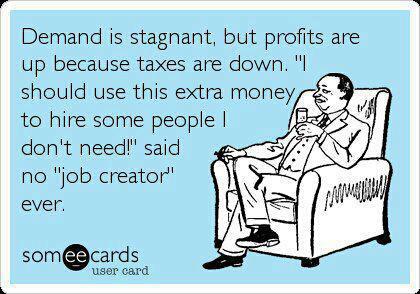
Republicans don’t want small government

Now that we’ve seen the recent hyped crazy of the GOP in action for the past 2 or 3 years, especially in state legislatures, I think it’s clear: Republicans are not interested in small government except insofar as it furthers the growth of their own wallets as motivated by nothing more than greed. Supporting this claim is that fact that most Republican-led legislatures have done very little in terms of economic improvements and acts, instead focusing on immigration (Arizona), abortion (multiple states), and, most recently, pushing religion:

North Carolina Republican lawmakers may have abandoned their plan to declare Christianity as the state’s religion…

As I’m sure many people saw, NC Republicans recently wanted to ignore the federal constitution so that they could create laws respecting the establishment of a religion – the Christian religion, in particular. Which sect of the religion they wanted was never made clear, but none of it matters now that the proposal has died (not that it would have had a chance in court). Of course, that hasn’t stopped them from attempting to intrude into the lives of citizens:

…but conservative legislators in the state are still pushing forward with a plan to require a two-year waiting period on all divorces, a plan that require the couple to attend classes and workshops designed to prevent them from divorcing.

According to the Charlotte Observer, state Senators Austin Allran (R) and Sen. Warren Daniel (R) proposed the “Healthy Marriage Act” last week, which mandates a two-year wait before judges will grant married couples a divorce, two years during which they must complete counseling courses and workshops designed to improve “communication skills” and “conflict resolution.”

It’s undeniable at this point that the Republican party is not one of principle. The ideas they chuck out there are in clear contradiction, but these people don’t really care. They merely want to line their own pockets and the pockets of their wealthy supporters while imposing draconian social policies that invade the privacy of Americans.

Darwin v Lincoln

As many may have noticed, today is the birthday of both Abraham Lincoln and Charles Darwin. Each was born in 1809 and each made a massive impact on the world. For Lincoln, he maintained the United States and freed millions. Darwin, however, had a much more worldwide impact. His theory of evolution proved to be the cornerstone of one of the most important branches of science; as Theodosius Dobzhansky said, nothing in biology makes sense except in the light of evolution. Of course, this wasn’t all his theory did. Indeed, Darwin’s most emotional critics came from religious camps. If man evolved right along with all the other animals and organisms, they said, then we are no longer special. Unique, perhaps, but not special. On that point I believe they were and are right. Unfortunately, far too many people believe such a point is a valid basis for dismissing fact.

It’s no secret that most scientists are not religious. This includes biologists, in large part due to what Darwin had to tell us all. In fact, one reason many lay people reject religious dogma is because of evolution (amongst many other areas of science); science is a part of our culture and it influences our fundamental views about the world. This is huge.

With the importance of both Lincoln and Darwin in mind, I have to wonder who had the bigger impact. Surely most Americans will automatically say Lincoln, whether they be creationists or rational, but this isn’t a popularity contest. In terms of changes to world views, to the day-to-day lives of individuals, and to world cultures as a whole, my money is on Darwin.

How should we treat cloned Neanderthals?

Harvard geneticist George Church was recently interviewed by a German magazine where he said that we need to start talking about the ethical and other implications of cloning a Neanderthal. He said that, whereas the technological possibility is foreseeable in the relatively near future, we need to start the conversation today. Unfortunately, English-based media sensationalized his comments and falsely claimed that he was looking for a surrogate mother:

Harvard geneticist George M. Church was quoted in the Daily Mail as looking for an “adventurous woman” to serve as a surrogate for a “cloned cave baby.” The shocking headline spread quickly across the media with no small amount of help from major news aggregators like the Drudge Report…

“I’m certainly not advocating it,” Church told the Herald. “I’m saying, if it is technically possible someday, we need to start talking about it today.”…

Church added that he wasn’t even involved in the particular aspects of the Human Genome Project focused on Neanderthals. Nonetheless, he hopes to use the mistake made by the media for the greater good. “I want to use it as an educational moment to talk about journalism and technology,” he said.

To compound the mistake made by the media, people like Arthur Caplan, writing for CNN, continues to spread falsehoods even after the correction has been made:

Despite a lot of frenzied attention to the intentionally provocative suggestion by a renowned Harvard scientist that new genetic technology makes it possible to splice together a complete set of Neanderthal genes, find an adventurous surrogate mother and use cloning to gin up a Neanderthal baby — it ain’t gonna happen anytime soon.

My beef is with the baseless accusation that Church was being intentionally provocative. Here is what he actually said:

SPIEGEL: Mr. Church, you predict that it will soon be possible to clone Neanderthals. What do you mean by “soon”? Will you witness the birth of a Neanderthal baby in your lifetime?…

SPIEGEL: Would cloning a Neanderthal be a desirable thing to do?

Church: Well, that’s another thing. I tend to decide on what is desirable based on societal consensus. My role is to determine what’s technologically feasible. All I can do is reduce the risk and increase the benefits.

In other words, the magazine asked him all these things. He gave pretty uncontroversial answers, even choosing to take a rather neutral stance when asked if we should clone a Neanderthal. I think the evidence is clear that not only was Church not being intentionally provocative, he was actually attempting to give benign answers.

At any rate, this all does raise the interesting question of how we would treat Neanderthals if we did clone them. Would we give them the same rights and protections? Would we develop a new application for the old scourge of apartheid? I’m not sure the answers to these questions, but I do have some input on how we should go about considering them.

Humans are awfully fond of talking about our special status in the animal kingdom. Indeed, many of us refuse to even consider ourselves animals, disregarding the affront to biology such a stance is. Of course, we have some good reasons for separating ourselves, at least in the context of morality and ethics. Though such practices, common across many taxa, are little more than game theory working itself out amongst genes and individuals, humans take it to another level. So while, for example, our ape cousins will show rudimentary understandings of right and wrong, we have far more complex rules for our society, rules that we can reason out and justify by way of our higher level of intelligence. We are different and that’s important.

How different, though, are Neanderthals? We know a fair amount about them, but they haven’t been around for 20 or 30 thousand years. No one has interacted with them, so a cloned baby would be an experiment in every sense of its life. So how different would it be? Would we have criteria established that said, ‘If the Neanderthal is different in these certain ways, it will not enjoy the same rights afforded everyone else under our laws’? I don’t know, but the concern is an interesting one because it raises the issue of why we think we’re so special.

Evolution is a continuous process. We are descended from species which were not human, but at no point did one species give birth to a brand new one. Every mother gives birth to offspring that are categorized in the same way she is. However, when enough time has passed, we’re given the luxury of defining different groups as species within this or that Genus under one or another Family. But look over the tape of evolution and everything eventually converges and lines blur. Just think about human evolutionary history: Back things up 100,000 years and we’re largely the same. How about 150,000? 300,000? 1,000,000? At some arbitrary point we pick, we’re going to start defining significant differences, but if we continually shrink the window of time, the differences start to disappear. (This is all a huge problem, in my view, for the Catholic or other theistic evolutionist who believes only humans have souls.) So from 500,000 years ago to 100,000 years ago, there will be notable change, but that change will be smaller between 400,000 and 200,000 years ago. And the differences become less when we look at our history from 300,000 to 200,000. Keep going and we may be talking about how different our ancestors from 272,000 years ago were from our ancestors living 271,000 years ago. Forget that our investigations into the history of life can’t get that specific. What’s important is that we have to realize there is no line in the sand that says “Species A ends there and Species B begins here”.

So if we do decide that Neanderthals are less deserving of the rights given to humans, we have to admit that humans, at some point in our lineage, were also not deserving. That is, our intelligence and consciousness become more and more comparable to our cousin apes (and now extinct man-like cousins) as we go back in time; we eventually arrive to a point where we would not give our ancestors the same rights that we enjoy. That means we are not inherently special, and I think that’s a major blow to a lot of our assumptions. The supposedly humble Neanderthal shines light on our human arrogance.

This

SoBasic

Should we ask our politicians specific science questions?

Every time a politician is asked if he believes in evolution or how old he thinks Earth is, there is the inevitable complaint from the right: “It’s a gotcha question!” It’s as if to say the whole point is to make certain people, usually Republicans, look stupid during their run for public office. I’ve got to disagree, though.

I find these sort of questions to be valid for at least two reasons. First, it gives us a very general idea of the background of the person. Someone who says he rejects the fact of evolution is almost certainly a young Earth creationist, and I think that’s important to know. (It’s important even if he’s an old Earth creationist.) We expect just about every politician in the U.S. to express some religious piety (unfortunately), but it’s hard to believe at least a few them aren’t mailing it in. The ones who actively reject significant fields of science, though, are probably sincere. I want to know that so I can be confident in my vote against them.

Second, this can give us a general gauge on intelligence. Now, I’m not saying people who reject evolution or global warming or any other scientific fact are stupid. I wouldn’t be so clumsy as to play into such an atheist caricature. What I’m saying is we can get a grip on the scientific literacy of a person based upon some of these questions. Of course, this is sort of a one-way street: A person who reject science can be deemed to have low literacy, but a person who accepts the facts of a few key issues is not necessarily engrossed in science. Regardless, these questions do often correlate with other facts in a useful way. For a prime example, look up anything the likes of Sarah Palin has said about fruit fly research and funding.

I think people should have a pretty good idea about a lot of theses issues, such as evolution or the age of Earth, but even if they’re ignorant, that’s no crime. If someone running for office is asked how old the world is and he doesn’t know the exact number, it would suffice to say something like, “Millions or even billions. I’m not sure.” He would get corrected, but no one would make that big of a stink about it. The stink only arises when a politician starts spouting off things about 6,000 years and ‘no missing lin’k. There’s just no excuse for that sort of stuff.

The national debt explained

On the 2nd Amendment

Let’s start from the beginning:

A well regulated militia being necessary to the security of a free state, the right of the people to keep and bear arms shall not be infringed.

If one is to look at the history of the Second Amendment, there’s plenty of arguments on either side for ways to interpret it. However, I think the most compelling argument is that it went through numerous revisions specifically designed to emphasize its militia/military aspects. Here’s what that says to me: The right to own a gun has limits. I do not believe, as our modern courts have been hinting at, that the Second Amendment gives a citizen free reign over gun purchases and ownership. The government has a right to put forth limits on gun ownership; states and the feds can outlaw guns in national and other parks, cities can ban their sale, and background checks can be as big of a pain in the ass as a group of representatives or voters wish to make them.

All that said, I do happen to favor a fairly unfettered right to gun ownership. There are clearly weapons which serve no purpose other than to terrorize, but for the vast majority of gun purchases, I have no issue. People are often safer if they own a gun or if they’re in an area with an average law-abiding, gun-toting member of the NRA (the awfulness of that organization aside). However, there are limits to this argument: specifically, to the United States and similar countries. We already have prolific gun ownership and a thriving black market for guns. To attempt to curb it at this point will most likely just end up in a greater disparity between law-abiders and criminals who have guns – the line being skewed in favor of the latter group. After all, that black market isn’t thriving because it’s too easy to obtain a gun legally. However, on the flip side of things, I don’t think my arguments work in much of Europe. They have low gun ownership rates, strong gun laws, and a significantly reduced black market, all with the result of fewer gun crimes and deaths. Gun control is a success on that side of the pond. End of story.

So, while I do happen to be fairly in line with current mainstream, and especially conservative, view on the pragmatic end of this matter, I part in my basis. I favor liberal gun ownership in the United States, but I don’t think the Second Amendment gets us there.

The most offensive opportunistic politicization of the recent shootings

As events unfolded in the Connecticut shootings, many people took to Facebook to express their horror at what had happened. Some of it was surely the same attention getting grief that we saw with Steve Jobs, but it’s clear that no one found any pleasure in any of these events, to say the least. However, this supposed grief didn’t stop anyone from politicizing the issue from whatever angle they could. Gun advocates said teachers need to be armed. Gun-control advocates said we need better laws. Others said we need to move beyond all that for just a moment. Still others said this is the time to discuss these issues. I tend to agree with that last one. We might call that politicization, but we can’t just ignore what’s happening; I don’t find those sort of discussions offensive. What I do find offensive is illogical, sexist attacks:

Through history, there have been a lot of suggestions as to the cause of mass shootings. In the 60s, it was the permissive culture. In subsequent decades, it’s been the teaching of evolution, working mothers, birth control pills, and “evangelical jockocracies.” The interesting thing about all of these suggestions is that they may point indirectly at a much more plausible explanation. To begin with, we must ask who is offering these explanations in the first place. Overwhelmingly, the answer is white males. Most likely not coincidental is the fact that since 1982, one very specific type of mass shootings has been almost entirely perpetrated by white males.

Rachel Kalish and Michael Kimmel (2010) proposed a mechanism that might well explain why white males are routinely going crazy and killing people. It’s called “aggrieved entitlement.” According to the authors, it is “a gendered emotion, a fusion of that humiliating loss of manhood and the moral obligation and entitlement to get it back. And its gender is masculine.” This feeling was clearly articulated by [the Columbine shooters], the perpetrators of the Columbine Massacre. [One of them] said, “People constantly make fun of my face, my hair, my shirts…” A group of girls asked him, “Why are you doing this?” He replied, “We’ve always wanted to do this. This is payback… This is for all the sh*t you put us through. This is what you deserve.”

This is ugly in is stupid simplicity. From a response I saw on Facebook:

That’s all very interesting but this theory fails to account for the Asian kid at Virginia Tech. The Fort Hood Shooter. The D.C. Sniper and his accomplice. Race is incidental in these crimes. Why should it be any different with white men?

And what about mental illness? What about emotional instability? What about the specific experiences of these shooters? This isn’t some black and white issue (no pun intended). To pretend that it is is nothing more than an awful, disgusting excuse to pursue one’s pet agenda.

Let’s point to our gun culture. Let’s point to the way our media glorifies these shootings*. Let’s point to our mental healthcare apparatus. And let’s not make our points mutually exclusive with one another. There’s a lot going on here.

*I have edited out specific names of shooters. They don’t deserve the personalized attention we give them; CNN has noticed this and, though they are far from perfect, they’ve made an effort to only utter this most recent shooter’s name once per broadcast. For more, watch this:

Remember this about Political Figure Antonin Scalia:

Earlier this year I made a prediction about how Political Figure Antonin Scalia will rule when he finds legal briefs on marriage equality for gay people on his desk: I don’t think he will hold to any of the ‘principles’ he has spent the past several decades selectively applying. Specifically, he has said that the ruling in Lawrence v Texas opened the door for equality in marriage:

“Today’s opinion dismantles the structure of constitutional law that has permitted a distinction to be made between heterosexual and homosexual unions, insofar as formal recognition in marriage is concerned,” Scalia wrote.

Justice Anthony Kennedy’s majority opinion said the Court’s ruling against anti-sodomy laws “does not involve whether the government must give formal recognition to any relationship that homosexual persons seek to enter.”

Scalia’s retort: “Do not believe it.”

“This case ‘does not involve’ the issue of homosexual marriage only if one entertains the belief that principle and logic have nothing to do with the decisions of this Court,” he wrote.

First, I find it abhorrent that part of this guy’s ‘logic’ in his dissent was nothing more than a slippery slope argument he needed to make in order to defend the personal political and religious agenda he was clearly infusing into his response. Second, it is abundantly clear that if he has any integrity, he must force himself to rule in favor of marriage equality, regardless of how much it offends his personal sexual immaturity and bronze age ideas of morality.

I’m not expecting anyone to be surprised after this ruling, though.

Know your charities

If you’re going to give to a charity this holiday season (or any other time), make sure you pick the right one. There are a lot of scams out there, of course, but there are also a lot of charities that are just, well, shitty:

The Salvation Army recently released a statement:

“Scripture forbids sexual intimacy between members of the same sex. The Salvation Army believes, therefore, that Christians whose sexual orientation is primarily or exclusively same-sex are called upon to embrace celibacy as a way of life. There is no scriptural support for same-sex unions as equal to, or as an alternative to, heterosexual marriage.”

I would recommend giving to Red Cross or, heck, Atheists of Maine’s fundraiser for Camp Sunshine. There’s no need to support a charity that is out to promote a bunch of garbage. Whatever good the Salvation Army may do, there are hundreds of charities out there that do just as well – and without the bigotry.