


Filed under: Personal | 1 Comment »

 | septrose14 on Reddit layoffs |
 | shelldigger on Thought of the day |
 | The Sauciest Duck on Chauvin and Rittenhouse |
 | Michael on Chauvin and Rittenhouse |
| Stephen Moreton on Chauvin and Rittenhouse | |
 | Mele Kalikimaka | Fo… on Merry Christmas |
| Mele Kalikimaka | Fo… on Mele Kalikimaka |
 | somdeblahiriyahoocoi… on Thought of the day |
| Michael on Wuhan virus and one last… |
| Quick correction | F… on The A-Unicornist, Bernie Bro… |
Ants don’t have lungs. They take in O2 and expel CO2 through pores in their bodies. This, as it happens, also enables them to live up to 14 days under water.
Some ants also have within them antibiotics. In some cultures it has been practiced that a rag would be thrown on an ant nest, allowing the ants to crawl all over it. The rag would then be shaken free of the little bastards and then wrapped around a wound, bringing about virtually immediate healing.
Filed under: Misc | Tagged: Ants, Fun fact | 3 Comments »
Whenever I need to use a bogus, overly broad definition of a word, I close out of dictionary.com and head on over to merriam-webster.com.
Filed under: Misc | Tagged: Dictionaries, Thought of the day | Leave a comment »
Where are all the pre-Cambrian primates anyway?
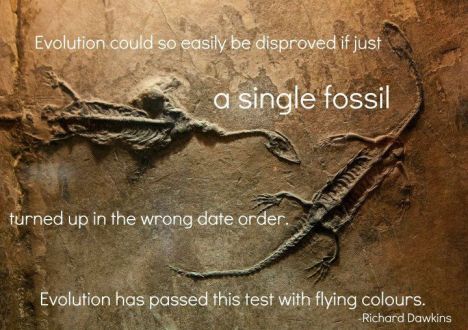
Filed under: Evidence, Evolution | Tagged: Evolution, Richard Dawkins | 9 Comments »
I think Yellowstone is one of the greatest national parks, but there’s something to be said of Acadia in summer.
Filed under: Misc | Tagged: Acadia, Thought of the day | Leave a comment »
It has been proposed and well evidenced that human chromosome 2 is the result of a fusion event between two chromosomes in our evolutionary past. Briefly, here is the evidence:
All great apes except humans have 24 pairs of chromosomes. We only have 23. That means we need an explanation for such a difference that dates back only a relatively short period of time (5-7 million years). As it happens, human chromosome 2 shows strong evidence of being two fused chromosomes. The way we know this is that all chromosomes have telomeres and centromeres. Telomeres are repeating units of DNA that serve to protect the ends (and therefore middles) of chromosomes, sort of like a good pair of shoes and a strong helmet. Centromeres are DNA units located somewhere between the telomeres of chromosomes, generally relatively close to the center. Their function is to help assemble the two parts of a chromosome during cellular replication and reproduction. In human chromosome 2, we see that there are actually two telomeres fused together in the center. There are also telomeres on the end, but between each end and the center are centromeres. That means we have three telomeres (one of which is fused) and two centromeres.
I bring this up because I was recently reading yet another excellent post by The A-Unicornist and he was dealing with this stuff:
ID is really nothing but an argument from ignorance – it claims that certain things simply cannot be explained by science, so it must be ‘best explained’ by a designer instead. Take for example this post from The New Creationist. I often point creationists to the Ken Miller video where he explains the Chromosome-2 fusion in humans, because it’s a perfect example of the theory of evolution making a falsifiable prediction that ended up being powerful evidence that evolution is true – something that ID has never done and in principle cannot do, which is why it will never be a science. Now, this “new creationist”, who incidentally sounds just as credulous as the old ones, argues that such a fusion is impossible – that the chromosome should never have been able to fuse at all.
Being that I’m not a biologist, I have no idea how to directly refute what he’s arguing. But it’s conspicuously odd that rather than, I dunno, ask a biologist or two (like, golly I dunno, write a letter to Ken Miller?), he simply frames his argument as though the unanswered question itself creates a major problem for the theory of evolution.
Since I’ve used chromosome 2 as an argument for evolution, I am familiar with the creationist responses. As such, I want to address what the blogger known as The New Creationist is arguing:
If the fused chromosomes in an end-to-end fusion are ripped apart by the centromeres during cell division and cells must divide to produce an embryo then how does an embryo develop with two previously fused but now ripped apart chromosomes? We know that the loss of just one chromosome would be lethal and here we have the loss of both of the two
fused chromosomes. If fused chromosomes do not make it through cell division then how could a fused chromosomal configuration be a result of common descent since there would be no descendants by a biological pathway. Such would be miraculous. Indeed, I believe it is a miracle not only because it can not be explained by any natural pathway but also because it is contradicted by experimental data.
What he is trying to say (and what he later says a little more clearly) is that two centromeres would cause division and assembly to occur in two separate places. This would be an all around mess that would prevent not only mitosis, but meiosis as well. So what could the solution be? Well, he answers it himself:
Now, it has been proposed that the deactivation of one of the centromeres in the fused chromosome would prevent the rupture and subsequent loss of the newly formed fusion…
And that is the case. One of the centromeres has been deactivated. One possible reason for this could relate to the fact that the area near the deteriorated centromere (the pericentromeric sequences) has gone through a large number of duplication events, but this isn’t known and requires certain confirming evidence around other deactivated centromeres. I don’t know if any significant research has been done in this area since the 2006 paper about chromosome 2.
The New Creationist continues:
…but this poses another equally lethal problem during the pairing off of homologous chromosomes.
Let’s say that if C2A fused with C2B forming C2 (which has 2 centromeres) in the paternal germ line, the male’s sperm. Now, that sperm would have to fertilize an egg where both C2A and C2B not having been fused would have to pair off with the paternal C2 BUT if C2 has been prevented from being ripped apart because one of its centromeres has been deactivation then the corresponding maternal C2B (or C2A) will not combine with C2 in the mother’s egg because that centromere would have been deactivated.
In other words, he is saying that if two ancestral primates had offspring with the fused chromosome, then that offspring would have 23 chromosomes whereas the rest of the population still had 24. Mating between the two could not occur as a result, thus the fused chromosome could never make it beyond a single generation.
The most obvious solution to this problem is that several members of a population experienced a fusion event. It could have been a completely chance event, or it could have been due to a particular mutation that had spread down the line. That is, my money is on a mutation existing in a population that caused the fusion between two specific chromosomes. Perhaps all the pericentromeric duplications (which pre-date the fusion event, incidentally) gave rise to a gene that was free to mutate neutrally in the population. After some time, it managed to survive the generations, and made a marked difference. (That’s what has happened, minus the specific duplication events, with Richard Lenski’s E. coli.) Or maybe a mutation popped up just out of completely random chance, as opposed to being connected to any particular type of event. It’s hard to say just how any of this happened, but there are good hypotheses to be had on the question.
To conclude, the first argument presented here was defeated before it was even made. One of the two centromeres was deactivated long ago, as stated in the original paper. Indeed, that very paper even suggested a correlating factor in centromere deactivation that could be useful for future research. As for the second argument, I’m going to give Mike the last word:
[T]he fact that an explanation is either unknown or not immediately apparent would not refute the fact that the theory of evolution made this falsifiable prediction, nor would it suggest that there cannot be a rational explanation at all. Our new creationist seems to think that because he does not know how to explain it that a rational explanation is not merely unknown, but in principle impossible. Ergo, Goddidit. That ain’t how science works, kids.
Filed under: Biology, Creationism, Evidence, Evolution | Tagged: Centromeres, Chromosome 2, Richard Lenski, Supernova, Telomeres, The A-Unicornist, The New Creationist | Leave a comment »
 For the Sake of Science