Datechguy does not grasp evolutionary theory

I mentioned a little while ago that the Internet became a better place when Roxeanne de Luca ceased her blogging activities. As it turns out, her old website is gone, but she is still blogging at some site called Datechguy. I don’t care to read anything she has to say given how uniformly uninformed she is on all issues (not to mention the fact that she is crazy), but I did poke around her new location. In doing so, I came across this atrocious piece by the owner of the blog, Datechguy himself:

I think people often confuse “natural selection” and survival and the fittest, which is certainly scientifically sound and full blown evolution the creation of one species from another.

The second has several problems the biggest of which for me is the math.

What makes this interesting is that Datechguy spent a good portion his post disowning creationist arguments, including young Earth creationism. In fact, he is a member of the Catholic Church, a group that claims to embrace the theory of evolution. (The reality is that the Church rejects what the theory actually says, but they still claim to embrace it, at least superficially.) So there is no reason one should expect him to go on about “the math” since that’s nothing more than code for common creationist canards. Yet here we are:

Here is what you need for evolution of that nature to work:

  • You need some kind of mutation.
  • Said mutation needs to be a beneficial mutation so it doesn’t increase the likely hood of the creature caught by a predator.
  • You need a mutation that doesn’t prevent breeding with a similar creature
  • The result of that breed must carry said mutation so it has to be dominant trait
  • Continual breeding has to take place so that dominant trait spreads until all members of the species without that dominant trait disappear.

I really should just point to The Blind Watchmaker and call it a day, but I’m a sucker for punching bags, so let’s get started. First Datechguy says mutations are necessary for speciation. This isn’t all that far off from the truth, but it isn’t exactly accurate. Mutations are going to happen – each one of us has about 150 in our DNA right now – but they are not entirely necessary. All that needs to happen for a speciation event is for enough time, space, and natural selection to take place. That is, natural selection is a honing process, so it is theoretically possible for it to promote some alleles while eliminating others in a way which prevents breeding between two populations that once were able to produce offspring.

The second point is myopic in nature. Datechguy appears to be implying that mutations are for the sake of prey. I never realized that predators and organisms without predators were not involved in evolution. But I digress. We see beneficial mutations all the time. For example, humans which began to utilize animal milk once we started to create civilizations had their lactase producing gene left on after childhood, thus enabling the break down of lactose. That legacy continues in many Europeans and those of European descent. Datechguy has not made a significant point here.

The third point is plainly weird. This guy is saying that for a speciation event to happen, a mutation cannot cause a breeding split within a population. That is false. As we see with human chromosome 2, one very plausible way that it spread throughout the population was that it separated our ancestors with 48 chromosomes from those with 46 chromosomes. That is, a small number of individuals had a mutation which prevented breeding with other members of their population. (It is worth noting, however, that many speciation events are merely a matter of time and the breeding is continuous. That is, a population may be considered one species at Point X, it continues to breed in a way which causes no distinct split (e.g., no division that is present in a single generation), then after, say, 100,000 years, it is considered a different species.)

The fourth point is another weird one. A mutation needs not be dominant to be carried throughout a population. If it did, Mendel never would have had green or wrinkly peas.

The final point – that “continual breeding has to take place so that dominant trait spreads until all members of the species without that dominant trait disappear” – is my favorite. Datechguy is arguing that fixation is necessary for speciation to occur. As we saw with the 2010 Burke paper, evolution still very much occurs with or without complete fixation. In fact, allelic fixation varies between sexually and asexually reproducing populations, so it is improper to speak of it in blanket terms.

The rest of Datechguy’s post is a mix of the Boeing 747 creationist canard and the creationist intelligent design irreducible complexity argument. For instance:

It doesn’t mean it can’t have happened. In theory I can roll snake eyes 50000 times straight

Or to put it another way, if you saw me roll snake eyes 10 times in a row, what would be the first logical thought? Luck or fixed dice? How about 100 times? How about 1000?

(That comes from the comment section on the post.)

It’s a common mistake to believe that any given trait or characteristic needs to evolve in either one giant leap or through a series of perfectly coordinated mutations. Fortunately, that isn’t how evolution works. Natural selection operates via incredibly tiny steps, one by one. When looked at over the course of hundreds of thousands of years or more, we have a huge number of mutations and allelic changes that appear impressive, but the reality is that virtually all of those changes were individually likely. And, just as importantly, each one of those changes is individually useful. (I’m ignoring historical contingency for the sake of brevity.) For instance, an eyespot won’t enable any creature to see danger or prey from miles away, but it is useful for detecting light and dark and, eventually, color, shape, and size.

I imagine Roxeanne and Datechguy will be very happy together at a site that, as with her last one, entirely lacks all scientific value.

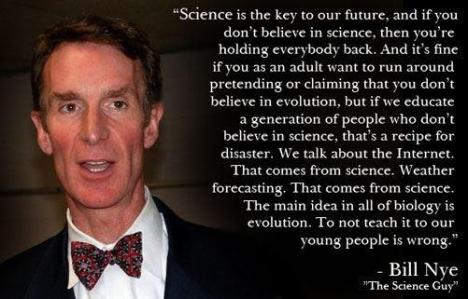
Good on you, Bill Nye. Good on you.

Bill Nye recently had this to say:

“I say to the grownups, ‘If you want to deny evolution and live in your world that’s completely inconsistent with everything we’ve observed in the universe that’s fine. But don’t make your kids do it,'” said Nye, best known as host of the educational TV series “Bill Nye the Science Guy.”…

“When you have a portion of the population that doesn’t believe in (evolution) it holds everybody back, really,” he said….

Nye said that while many adults may believe in creationism, children should be taught evolution in order to understand science. Absent a grasp of evolution, he said, “You’re just not going to get the right answers.” And he called evolution the “fundamental idea in all of life science, in all of biology.”

Teaching children the building blocks of science is essential for the country’s future, he added, saying, “We need them. We need scientifically literate voters and taxpayers for the future.”

Here is the video:

Not once

Where are all the pre-Cambrian primates anyway?

Dissent on feminism is not like dissent on evolution

One of the popular memes out there in the feminist blogosphere is to compare a person who disagrees with a feminist position to a creationist who disagrees with all of evolution. There are two problems with this.

First, there is a general attitude amongst caricature/Internet feminists that if a person dares disagree on even a single feminist point, that person must be a rape culture apologist who just wants to rape. Also, rape. And elevator rape. Rape. Rape. Rapey rape. Rapedy rapedy rape rape rape. That, of course, makes no sense, especially in the context of comparing dissent on feminism to dissent on evolution by creationists. A person who disagrees with one or even a few parts of feminism is not like a creationist because a creationist rejects virtually every bit of science discovered since Darwin. (If we get more specific and go with young Earth creationists, we can include every bit of science since the beginning of the Enlightenment.) A person who disagrees with some part of feminism does not think women are second-class citizens by default, nor does such a person necessarily reject other parts feminism. More importantly, such a person does not necessarily reject the basic idea of equality. This is unlike the creationist who can only reject evolution by rejecting vast swaths of science.

Second, feminism is – at best – a philosophy. It is not science. It is not fact. It isn’t any more provable than anything Kant ever said about the good being found in good will itself. That isn’t to say it isn’t useful, but it is not some established, objective observation of the world. (I have to include that last line because omitting it means I think feminism is nothing but garbage and rape is awesome.) Evolution, on the other hand, is science. It is fact. It is an established, objective observation of the world. To express dissent to it is to express an ignorance that can be countered with objective facts and education. Feminism does not enjoy that same, dare I say, privilege. If it did, then so would egalitarianism. Or any other philosophy. It would be an inherent contradiction: Philosophy is a subjective interpretation of the world, so to say it can be objectively true makes no sense. It certainly uses facts and the latest knowledge of the world to support and build its propositions, but from that use ultimately comes non-scientific, subjective interpretations. Moreover, virtually all philosophies make or are developed for the purpose of making normative claims. That is, they make value claims. The subjectivity is unavoidable.

The only reason this ‘feminist dissent is like evolution dissent’ meme is popular is because cheap rhetoric is so easy. The two topics enjoy a cross section that would be the link on a Venn diagram labeled “liberal/progressive”. By attempting to appeal to what much of that link already accepts – evolution – the feminist side of the aisle is attempting to invent a shameful comparison: ‘Why, you’re just like a creationist! Don’t you feel silly now?’ It’s hardly any different from the argument that atheism is a religion. (Oh, hey, look. Many feminists share my position that there is no God and that religion is bad, so I know a lot of them have been accused of having a religion. I also know that that accusation is annoying, so no one in her right mind would want to make it herself. Yet here we are, with feminists making just that sort of argument. I have exploited my own Venn diagram link. Isn’t lazy rhetoric fun?)

Evolution, fruit flies, and counting

Don’t let any creationist tell you complex things don’t come from simple precursors:

US and Canadian researchers have evolved a population of fruitflies that can count. The result, presented on 9 July at the First Joint Congress on Evolutionary Biology in Ottawa, Canada, supports the notion that the neural mechanisms underlying basic arithmetic skills first emerged hundreds of millions of years ago. It could also eventually offer a key to understanding why some people have problems with numbers…

During a 20-minute training period, flies were exposed to either two, three or four flashes of light — two and four flashes coincided with a vigorous shake administered by placing a electric toothbrush next to the box containing the flies. After a brief rest, the flies were returned to box and shown the light flashes. Despite a dislike for being shaken, most of the flies were not able to learn to associate the negative stimulus with the number of flashes. But 40 generations later, they could.

The researchers caution that the work is preliminary and that they do yet know what genetic changes are behind the insects’ evolved number sense.

What I find interesting is exactly how this constitutes selection pressure. The flies certainly don’t like being shaken, but that’s entirely irrelevant if there isn’t some sort of reproductive advantage to be had from recognizing when the shaking will occur. Clearly there is, and we could speculate all day long as to why flies that associate the flashes with negative stimulus pass on more of their genes than the other flies, but I would like to see some experimental data showing the details. Does shaking disorient the flies? Does it interrupt the mating process? Does it affect fertility? Perhaps the paper that comes from all this can shed some light.

Now excuse me while I go murder the fruit flies that appear to have evolved to make my kitchen just awful for the past week.

Evolution does not stop

One thing I often hear regarding evolution is the notion that it can end. That is, I hear people make the claim that in one way or another, a species can (or has) reached a point where it will no longer evolve. This idea is generally applied exclusively to humans, but perhaps advocates would extend their arguments. I’m not sure. At any rate, it’s a surprisingly popular claim. Geneticist Steve Jones even made a version of it. He was speaking more of rates than anything, and I’m likely to chalk up his statements to hyperbole, but he did title one of his talks, “Human Evolution is Over.” Unfortunately for him, he’s wrong.

Evolution at its most basic is the transmission of genes from one organism to another. That isn’t to say individuals can evolve – they can’t – but broken down to its constituent parts, evolution is the flow of alleles from one vehicle (individual organism) to another. So long as that is occurring, evolution is occurring. To put it another way:

Evolution happens every single time an organism reproduces.

Evolutionary rates – generation time, mutational rate, environmental pressures, frequency of drift, etc – will vary from species to species and over great swaths of time, but they can never reach zero for any given population unless that population ceases to exist. At the point where members of the group no longer produce offspring is when evolution stops. It is literally the only time it can stop.

The fact is, evolutionary theory is the most integral part of the field of biology. The famous Theodosius Dobzhansky paper and now phrase, ‘Nothing in biology makes sense except in the light of evolution’, couldn’t be any more true; from the moment the first replicator evolved into something more, evolution has not once taken a break. So long as there is life, there is evolution.

This is why no one respects the South

You’d think Tennessee, of all places, would know better:

Tennessee, where the nation’s first big legal battle over evolution was fought nearly 90 years ago, is close to enacting a law that critics deride as the “monkey bill” for once again attacking the scientific theory.

The measure passed by the Tennessee General Assembly would protect teachers who allow students to criticize evolution and other scientific theories, such as global warming. Republican Gov. Bill Haslam said this week he would likely sign it into law.

Interestingly, the governor is claiming that the law will basically do absolutely nothing while changing approximately zilch. The truth is different:

The bill says it would encourage critical thinking by protecting teachers from discipline if they help students critique “scientific weaknesses.”

In other words, teachers won’t be punished for telling students lies.

I think a great test of this horseshit bill would be for a teacher to go into a dead-pan routine where he questions the validity of the theory of gravity. Talk about its weaknesses, cast doubt on its validity, and maybe even propose some alternatives. Of course, those “alternatives” would need to be couched in science-y language, but I’m sure there are plenty of creationist groups out there willing to lend their expertise to those who wish to abuse science.

Bill Nye knows what’s going on

The scale of the Universe versus the complexity of life

I have often found myself contemplating which is more amazing, the sheer scale of the Universe or the complexity of life? It isn’t easy to find an answer, but I’ll do my best to very briefly explain my thinking on this.

Despite my field being biology, and despite finding nothing more amazing on Earth than the evolution and subsequent complexity of life, I have to fall on the side of the size of the Universe. I think I’m going to be in the minority on this one, but I’ve given it some thought. Here is why I think what I do.

It isn’t possible for an individual to know everything about a single field. I’ve had incredible biology professors who have told me that they are lucky to understand 1/3 of what they read in scientific journal articles concerning biology. This is because in order to become an expert on anything, it requires one to focus on a relatively small subset of facts within a field. Just look at how biology breaks down: microbiology, biochemistry, genetics, cell biology, zoology, botany, anatomy, physiology, embryology, evolutionary biology, molecular biology, and so on. This sort of division is going to be true of just about any field. (I can’t think of any exceptions.) How can we expect anyone to understand it all? We simply cannot. But that isn’t to say we can’t understand it all as a species. In principle, we can understand everything that has to do with biology. We can break it down and analyze each bit, no matter how esoteric and specific. That doesn’t mean we necessarily ever will, but there is nothing preventing us from doing so. We have the ability, when we pool all our resources and minds, to understand everything there is to understand about life and its evolution.

I don’t think we can say that same thing about the sheer scale of the Universe. For the sake of argument, I will limit myself to the observable Universe. But right there. Look at what I just did. Without fear of losing any ground in my argument, I limited my scope. Yet my whole point is scope. That’s just how huge the Universe is. And how can anyone truly appreciate that? No human is going to travel any distance from Earth that is notable on the scale of the Universe. Even our space probes that are now on their way to interstellar space have done so little; being impressed by that distance would be like being impressed that an atom moved a tiny fraction of a fraction of a fraction of its radius to the right. I would say to now imagine that analogy increased trillions upon trillions upon trillions upon…of times, but of course you can’t. No one can. We don’t have any way, in our small lives, to really comprehend something like that. The Universe is enormous. Just enormous.

We can pool our minds together as a species and come to a great understanding of all that surrounds us. All our physicists and astronomers and cosmologists can give us a tremendous understanding, via science, of how it all works. They can even describe, with numbers on paper, how large the observable Universe is. They can show us incredible pictures of thousands of galaxies (in just a small sliver of the sky), each with billions of stars and billions of planets. And it really all is wonderful. But no matter how many brilliant minds we put to the task, we can never appreciate the sheer scale of what is. It is, in every meaning of the word, beyond us.