

There’s nothing more exciting than evolution.
Filed under: Misc | Tagged: Evolution, Thought of the day | Leave a comment »

 | septrose14 on Reddit layoffs |
 | shelldigger on Thought of the day |
 | The Sauciest Duck on Chauvin and Rittenhouse |
 | Michael on Chauvin and Rittenhouse |
| Stephen Moreton on Chauvin and Rittenhouse | |
 | Mele Kalikimaka | Fo… on Merry Christmas |
| Mele Kalikimaka | Fo… on Mele Kalikimaka |
 | somdeblahiriyahoocoi… on Thought of the day |
| Michael on Wuhan virus and one last… |
| Quick correction | F… on The A-Unicornist, Bernie Bro… |
There’s nothing more exciting than evolution.
Filed under: Misc | Tagged: Evolution, Thought of the day | Leave a comment »
One of the creationists favorite pieces of bullshit rhetoric is to say to anyone who accepts the facts of evolution, “You are beholden to your evolutionary past! Why would you do anything good if the point of life is to merely survive? Checkmate, atheists.” It’s an awful line that just won’t go away, but I figure if I make a post like this, at least I will have an easy stock response on hand. So here’s why it’s so awful.
First, it is a conflation of descriptive and normative claims. (I am thoroughly convinced most Christians do not understand the difference.) Evolution deals with the facts of biology as discovered via the powerful methodology of science. It’s a description of observation; it does not have a say on how one ought to act. Morality, on the other hand, is nothing but normative claims. It is the way in which we say what is right and wrong. It is the precise opposite of descriptive claims like those made by science.
Second, it reflects a fundamental misunderstanding of evolution. Simply because the history of all life is marked with ruthless struggle does not mean that we must display such ruthlessness at all times. Or any times. In fact, I think we would want to do just the opposite at most times. But none of that is really pertinent. The facts of our evolution do not mean we must act in this way or that way. It would be like saying all Americans must love the French now and forever because we got so buddy-buddy with them during the Revolutionary War. Could you imagine how upset FOX Noise would be if that were true?
This line of argumentation from creationists is really just an excuse to disengage. Rather than openly debate the merits of this or that moral position, they just appeal to a red herring of an argument. And it isn’t merely creationists. The same tactic is often used by theistic evolutionists. It does a disservice to logical, philosophical debate, but perhaps worse, it undercuts the science at the heart of it all. Ultimately, it is a misunderstanding of the issues: Evolution is a descriptive fact; morality is normative. No matter what moral conclusions one draws, evolution still remains true. Even if one draws conclusions about morality (i.e., not moral positions, but ideas concerning the concept of morality) which conflict with the descriptive fact of evolution, Mr. Darwin’s great idea, with all its modern day modifications, still remains true. And should someone think that evolution leads to particular consequences such as ruthlessness and mayhem (which, incidentally, is an invalid reason to reject acceptance of evolution), even that is immaterial. In addition to those people being wrong on the facts, evolution, once again, still remains true.
So, no, logically inept creationists and friends, you haven’t added anything of value here. As usual. Evolution is descriptive and so has no say on morality. Moreover, even if it did dictate how we ought to live, we would not therefore be beholden to our past anyway. Even if you were right, you’re still wrong. Or as I really need to say more often, you’re wrong in your wrongness.
Filed under: Atheism/Humanism, Evolution, Philosophy | Tagged: Argument from Consequence, Descriptive, Evolution, morality, Normative | 3 Comments »
The primary reason so many Americans reject the theory and fact of evolution is religion. I think that’s pretty undisputed. However, there is a lot of incorrect information out there promulgated by journalists who get in way over their heads, and that is also a contributing factor. For the most recent example, let’s turn to the obituary of Lynn Margulis:
The [endosymbiotic] hypothesis was a direct challenge to the prevailing neo-Darwinist belief that the primary evolutionary mechanism was random mutation.
Rather, Dr. Margulis argued that a more important mechanism was symbiosis; that is, evolution is a function of organisms that are mutually beneficial growing together to become one and reproducing. The theory undermined significant precepts of the study of evolution, underscoring the idea that evolution began at the level of micro-organisms long before it would be visible at the level of species.
This is just awful. Just awful.
Margulis’ theory showed that some organelles – primarily mitochondria and chloroplasts – were once bacteria before being taken up into eukaryotic cells. This did not overturn any major precepts, nor did it shake the biological world. It was a big idea, one that turned out to be correct, and it marked a major turning point in our understanding. But that turning point was more complementary than it was subtracting. That is, it added a good deal of knowledge, it explained some mysteries, and it opened up a lot of avenues of research (as correct ideas often do) while fitting into the broad model of evolution, but it did not diminish the importance of random mutation, natural selection, genetic drift, or any other aspect of the theory.
Moreover, Margulis’ theory did not show that “evolution is a function of organisms that are mutually beneficial growing together to become one and reproducing”. It showed that sometimes endosymbiosis happens. And when it does, it sometimes has huge contingent importance. For instance, without the mitochondria in our cells, the history of life on Earth is not even remotely the same. But there are other hugely important events which, while ultimately reliant upon historic events like moments of endosymbiosis, can be explained without the need to appeal to Margulis’ theory. For example, the rise of mammals. Of course we are eukaryotes and so we depend upon the endosymbiosis event that happened billions of years ago, but that would be like appealing to the formation of Earth to describe the construction of a skyscraper. It just isn’t necessary and, besides, planetary accretion doesn’t happen every time a worker pours some concrete.
Stuff like this is why I say science is so undermined by so many science journalists.
Filed under: Evolution, News | Tagged: Bruce Weber, Endosymbiosis, Endosymbiotic Theory, Evolution, Lynn Margulis | 2 Comments »
Associating something with Hitler does not make that something wrong. Most believers won’t preface their (incorrect) associations of Hitler and evolution with that statement; it’s basic, bald dishonesty.
That said, Hitler was a creationist. In Mein Kampf, he said this:
Walking about in the garden of Nature, most men have the self-conceit to think that they know everything; yet almost all are blind to one of the outstanding principles that Nature employs in her work. This principle may be called the inner isolation which characterizes each and every living species on this earth.
Even a superficial glance is sufficient to show that all the innumerable forms in which the life-urge of Nature manifests itself are subject to a fundamental law–one may call it an iron law of Nature – which compels the various species to keep within the definite limits of their own life-forms when propagating and multiplying their kind.
It is obvious that, yes, Hitler believed that species did not evolve. So what about the Nazi utilization of eugenics? Well, I’m glad you asked such an easy question.
Hitler believed Aryans were inherently superior to everyone else. This is practically identical to the beliefs of most white people (in regard to whites) prior to Darwin. That is, people have long believed their own race to be superior to other races. But Hitler also believed that breeding Aryans with each other would increase Aryan characteristics throughout the population. This wasn’t some idea that depended upon evolutionary theory. People knew for thousands of years that they could produce certain traits within animals by creating breeding programs. Besides that, they obviously recognized that their own children would inherit features from their parents. Hitler extended this common knowledge to Aryans. It had no basis in evolution. Anyone who says otherwise is either woefully ignorant or an unabashed liar.
But how is this different from the position of modern day creationists? Hitler believed traits could be passed on and come to dominate a population. At no point does this have anything to do with speciation from his perspective – nor from the perspective of creationists. This is the so-called “microevolution” that is consistent with the silly creationist view. Hitler did not merely hold it – he embraced it.
Of course, it was not that he was embracing creationism itself. Don’t get me wrong – he did embrace creationism and he was a self-proclaimed creationist many decades before his rise to power – but it was not creationism itself he was embracing. He was using every day intuition about how reproduction works. These ideas stretch back formally at least 2400 years, and probably much further informally in terms of what early humans could observe as obvious. It was day-to-day ideas Hitler was utilizing in his quest for raising the German “superman”. Those ideas really had nothing to do with evolutionary theory, and even if they did, Hitler did not accept that species evolved anyway.
Filed under: Creationism | Tagged: Creationism, Eugenics, Evolution, Hitler, Mein Kampf | 4 Comments »
Pew has put out a new survey in which it asks Evangelical Christians what they believe about life:
First, and probably of no surprise to anyone, is the result of the question regarding acceptance of the scientific theory of evolution. The survey posed the question:
“Which statement comes closest to your own views?” – the options being:
1. Humans and other living things have evolved over time due to natural processes such as natural selection.
2. A supreme being guided the evolution of living things for the purpose of creating humans and other life in the form it exists today.
3. Humans and other living things have existed in their present form since the beginning of time.In other words the choices are evolution, intelligent design of the Michael Behe variety, and standard creationism. It is important to note that the Pew foundation used a wording for the evolution option that, unlike some previous surveys, doesn’t specifically exclude a role for God: for instance, someone who believes that God set up the laws of nature and that biological evolution is just one of the consequences of these laws should answer option A.
What proportion of evangelicals accept the scientific theory of evolution?
The answer is 3%
In addition to this confusion over the underlying foundation of all of biology, many Evangelical leaders don’t seem to be so sure of what their little cultural god is telling them:
“A majority (73%) of the leaders from the Global North consider alcohol consumption to be compatible with being a good evangelical Christian. By contrast, a similarly large majority of the leaders from the Global South (75%) say alcohol consumption is not compatible with being a good evangelical.”
And there really is no way to resolve the issue. The Bible, written and changed by men, is like any other piece of literature – all interpretations of it are subjective. These divides amongst Christians – even Christians of the same subgroup, no less – amply demonstrate that fact. Furthermore, even where something is straight-forward and hardly ambiguous, it is still interpreted by humans, under human constructs, and by the human brain. It can’t help but be subjective. And unlike, say, science, it doesn’t have any methods which can remedy these facts in a way that works.
What’s more, there appears to be a marked difference in views on how women should be treated.
“Among U.S. leaders, 44% agree women should stay at home, while 53% disagree. Leaders in Europe, however, reject the idea of women staying at home by a more than two-to-one margin, 69% to 28%.”
and
“European leaders (62%) and North American leaders (54%) are especially likely to reject the idea that a wife must always obey her husband. On the other hand, upwards of 60% of leaders from sub-Saharan Africa, the Middle East-North Africa and the Asia-Pacific region agree that a wife must always obey her.
Even the “good” numbers (62% and 54% for the latter part) are awful.
I’m well aware that many fields today are dominated by men. That is often a legacy of past sexism as well as a problem of current, though undeniably reduced, sexism. It’s true of science, it’s true of atheism, it’s true of video games, and it’s true of so many other fields. But those areas don’t tend to attempt to perpetuate the worst of their legacies. That isn’t what we see with Evangelicals.
More liberal and/or more aware Christians have this habit of denying the nature of the fundamentalists within their religion. ‘Surely they aren’t as bad as everyone describes them, right?’ Wrong. This Pew survey pulls back the curtain and shows many of these people for what they are. And let’s not forget just how many people we’re talking about. Estimates of Evangelicals in the U.S. range from 25-30% of the population. That means, to put some of the results into real numbers, about 35 million people in the U.S. believe a woman should obey her husband. (And how many of those people ironically also describe themselves as libertarian, I wonder?) Only a few million of these people are willing to accept established and overwhelmingly evidenced science. And when we look at Evangelicals around the globe, they sometimes demonstrate a deep confusion over what their particular cultural god is telling them. (Yet how many claim that the Bible is objectively true or that they can objectively know something?) This all presents a very real challenge to the progress of the nation and the world at large. The delusions and confusions of faith-based thinking are holding back real knowledge and clarity of thinking, and that ought to make everyone nervous.
Filed under: News, Religions | Tagged: anti-science, Evangelical Christians, Evolution, Pew, Sexism, Subjective | 3 Comments »
I’m doing another repost, this time taking from an article I did about the origins of vision. Note that the quote coloring is reversed from how it normally appears.
Vision likely originated as simple eyespots in simple organisms. It also is traced back to jellyfish and their own simplistic eyespots, which are actually still present in some manner today. That is, jellyfish have areas of photoreceptor cells which don’t allow vision as we know it (they don’t even have brains), but they do allow a sensation of particular wavelengths of light to be perceived. These wavelengths often indicate depth (and maybe predators), which in turn may indicate food source (pelagic jellyfish don’t tend to get to plump).
Recent research has discovered the genetic pathway involved in light sensitivity in a close relative of the jellyfish.
“We determined which genetic ‘gateway,’ or ion channel, in the hydra is involved in light sensitivity,” said senior author Todd H. Oakley, assistant professor in UCSB’s Department of Ecology, Evolution and Marine Biology. “This is the same gateway that is used in human vision.”
This allows for a prediction using evolution: all organisms alive today which share a common ancestry with hydras will share this same genetic gateway. Organisms like flies, as the article points out, do not share this ancestry with vertebrates and as such do not share this genetic gateway. If they did share it, then wow. Creationists could actually trot out their improbability arguments.
“This work picks up on earlier studies of the hydra in my lab, and continues to challenge the misunderstanding that evolution represents a ladder-like march of progress, with humans at the pinnacle,” said Oakley. “Instead, it illustrates how all organisms — humans included — are a complex mix of ancient and new characteristics.”
(End different quote coloring.)
I looked this post up because I recently ran across a creationist who actually trotted out that old “the eye is irreducibly complex” bull and I was searching for some other links. But what’s interesting is what a different creationist was saying in the comment section:
You premised your claim of cnidarian relationship to vertebrates and humans on a gene they share in common. You said specifically, “This allows for a prediction using evolution: all organisms alive today which share a common ancestry with hydras will share this same genetic gateway.” I pointed out that certain beetles share certain genes with vertebrates and humans that other insects do not – and by your logic, that would mean these beetles share an ancestry with humans other insects do not.
As I pointed out at the time (and as the creationist failed to even come close to grasping), my claim was not based upon the sharing of individual genes, but rather on the sharing of complex genetic pathways. It is these pathways that ultimately allow for such a prediction. The creationist then confused the discussion on pathways with the article focus of a gateway. (I pointed out his error to him, but to no avail.) It is these pathways, by and large, which first get us to the point of where we can say that hydra and humans share a common ancestry in terms of vision. From that point we can look at the particular gateway in question and make the prediction I originally made. (One caveat: organisms which have lost their ability to see may not share the gateway.)
Filed under: Evidence, Evolution | Tagged: Evolution, eyespots, Hydra, Jellyfish, Vision | 1 Comment »
This is just more confirmation of the general superiority of Canada to America.
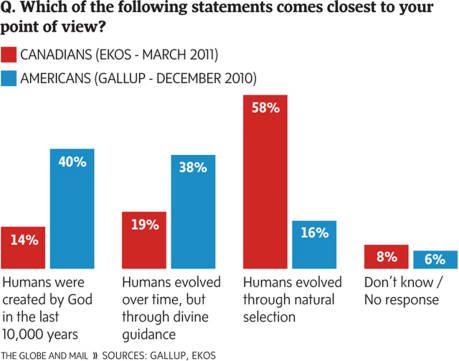
And if that wasn’t bad enough, the Canadians apparently beat us in another department as well…
Filed under: Politics and Social | Tagged: canada, Canadas got 'em some big schlongs, Creationism, Evolution, Penis size | 3 Comments »
 For the Sake of Science