How inviting

I have been cordially invited to attend a viewing of Expelled at the University of Maine at Augusta campus on Tuesday, April 7 at 5:30 p.m. until 8:00 p.m. (You must be logged into Facebook to view.) Here is the event description.

We will be watching “Expelled: No Intelligence Allowed”

The debate over evolution is confusing and to some, bewildering: “Wasn’t this all settled years ago?” The answer to that question is equally troubling: “Yes…and no.”

The truth is that a staggering amount of new scientific evidence has emerged since Darwin’s 150-year-old theory of life’s origins. Darwin had no concept of DNA, microbiology, The Big Bang, Einstein’s Theory of Relativity or of the human genome.

Then after we will be hanging out and discussing it

For more information on this move check out http://www.expelledthemovie.com/aboutthemovie.php

Amazing. First, they still think evolution is up for debate. Creationist ignorance check point one. Next, they call it a theory of “life’s origins”. How does evolution imply that at all? Creationist ignorance check point two. Then, of course, we get unrelated theories in physics. That’s three. And they could have hit so many more. Where’s the second law of thermodynamics? The ‘natural selection if a tautology’ bs? Come on! Amateurs!

I’m rather undecided about attending this. I am certainly not going to see the movie. I saw it once and that was torture enough, but I will be on campus around the time they will be having their discussion (and by this I mean ‘spreading of disinformation’). Perhaps I can lend my voice to be sure they don’t think this somehow supports intelligent design. Yes, that’s right. The person with whom I originally saw the movie (a young creationist minister) said he “loved that there was a lot of great science”. Of course, there is no science behind intelligent design, but the movie doesn’t even make an attempt to discuss science. It’s wholly about how there’s a big, mean conspiracy to keep intelligent design advocates down and out because “Big Science” is so evil. Oh, and evolution caused the holocaust. Can’t forget that gem.

I’ll keep you updated.

Language

Language is a dicey thing. It’s especially dicey for scientists. Take Einstein for example. He used to use the word “God” quite often. He usually did not mean anything related to the Christian god (or any other god concept). Let’s look at the Einstein phrase “Did God have a choice in creating the Universe?” He wasn’t literally asking if any particular god had a choice. He was asking if the Universe could have come into being in more than one way. Incidentally, the fact that the answer to this question is unknown should throw some light on that awful argument, the “anthropic principle“. Allow me to digress.

The anthropic principle is the creationist delusion that their particular god made the Universe with humans soley in mind. It’s likely the most arrogant concept ever presented. Beside that, it basically says “Humanity (or life in general) is too well adapted to the Universe for everything not to have been made for humans/life”. Humans are evolved to the Universe (at least one, insignifcant part of it that holds no special relevance). The whole argument ignores this fact. Of course, that is the creationist motif: hear no facts, see no facts, speak no facts. What’s more, it’s just an argument from personal incredulity: “The Universe is just too perfect to not be for me! I can’t believe anything else! It’s too much!” Mooks.

But I return. Language in biology can be difficult. In order to popularize the subject, scientists will use personifying terms. “Genes want to replicate”, or “Cuts and bruises want to heal”. There shouldn’t be anything wrong with this. It’s human nature to do this. We call computers stupid or say “the flowers danced in the sun” (for the more poetic among us). Of course, there is a contingent of people who hear these terms and think they are literal. They also happen to often be people who don’t realize the Bible is metaphoric in its entirety and therefore take it literally.

Take the comment section from a recent thread. Not to harp on a particular commenter, but the term “code” is taken wildly out of context. Rather than read for what it is, it is read as being something with intention at its root. Let’s examine.

Biologists may say “DNA codes for the genome”. This is true, but it has no connection to intentionality. What it means is simply that DNA is in one form until it is translated and transcribed into another form. In other words, it goes from being a series of amino acids into a series of proteins and enzymes. This does not require some grand creator or intelligence. It requires a slow, gradual process that provides for plenty of random variation while being governed by a non-random mechanism. Evolution by natural selection fits the bill.

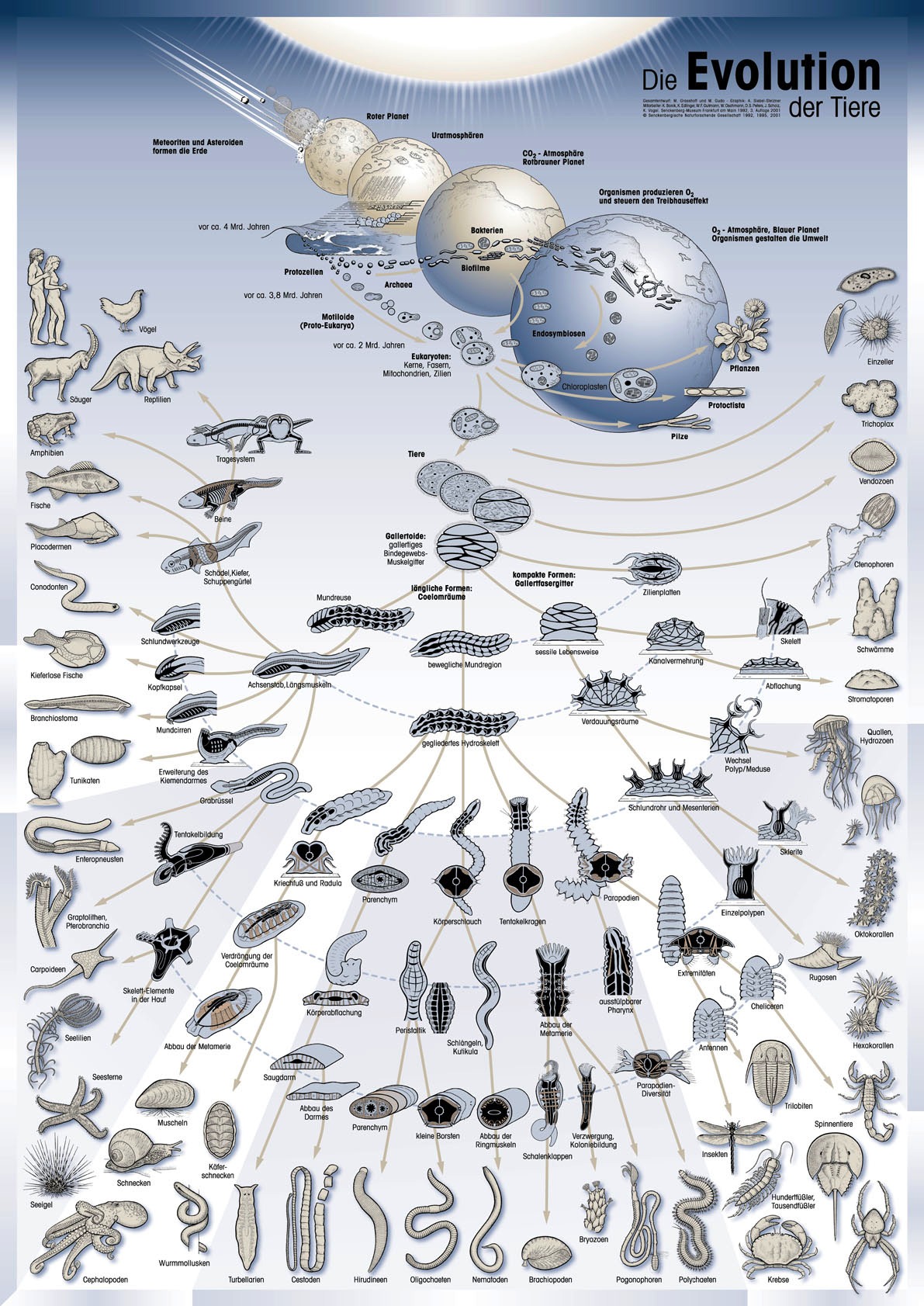
This image is stunning

Thanks to PZ for finding it.

animalsevolution_lg

Our morality is rooted in evolution

Duh.

MONKEYS and apes have a sense of morality and the rudimentary ability to tell right from wrong, according to new research.

In a series of studies scientists have found that monkeys and apes can make judgments about fairness, offer altruistic help and empathise when a fellow animal is ill or in difficulties. They even appear to have consciences and the ability to remember obligations.

The research implies that morality is not a uniquely human quality and suggests it arose through evolution. That could mean the strength of our consciences is partly determined by our genes.

This isn’t exactly news, though I suppose the studies are recent. As expected, they go to confirm that “evolution could not have evolved” is a patently stupid statement made without basis. It’s a favorite of creationists and is just a variation on the God of the Gaps argument – “It’s soooo complicated! I can’t explain it and I’ve insolated myself from all forms of science because it is SATAN so I don’t know about any evidence, so it couldn’t have evolved! It just couldn’t have! LA LA LA LA!”

Anyway, off the creationists and on the science:

The animals were asked to perform a set of simple tasks and then rewarded with food or affection. The rewards were varied, seemingly at random. De Waal found the animals had an acute sense of fairness and objected strongly when others were rewarded more than themselves for the same task, often sulking and refusing to take part any further.

Another study looked at altruism in chimps – and found they were often willing to help others even when there was no obvious reward. “Chimpanzees spontaneously help both humans and each other in carefully controlled tests,” said de Waal.

Other researchers, said de Waal, have found the same qualities in capuchin monkeys, which also show “spontaneous prosocial tendencies”, meaning they are keen to share food and other gifts with other monkeys, for the pleasure of giving.

“Everything else being equal, they prefer to reward a companion together with themselves rather than just themselves,” he said. “The research suggests that giving is self-rewarding for monkeys.”

Words from a ‘respected’ theologian

Why we still respect theologians is beyond me. These people are nothing more than literay critics with a very narrow focus. At least this one only seems to have made headlines at a Christian site. On top of that, he actually said some things which aren’t batshit crazy.

“If you understand Christianity or even Theism – the belief of a sovereign creator God – and evolutionary theory in its dominant form , I find it impossible to reconcile the two,” Dr. R. Albert Mohler Jr., president of Southern Baptist Theological Seminary, said on his radio program Thursday, the 200th birthday anniversary of Charles Darwin.

I wouldn’t go so far as to say impossible, but it is tremendously difficult.

The seminary head went on to explain how the “originating mechanism of creation” is where theism runs right into collision with where modern evolutionary theory is.

Whereas the Biblical account of creation accepts the role of a Creator, the theory of evolution “suggests that natural selection is indeed the mechanism and that it is entirely natural and in no case supernatural,” said the theologian.

“There is no way for God to intervene in the process and for it to remain natural,” he asserted.

He’s sort of right. Theism and evolution can intersect. It’s just that the theism has to be precisely superfluous with evolution. That, of course, makes the theism rather useless, but it does solve the issue of being irreconcilable: a god just needs to match the established scientific fact. A religion like that would be a very powerful force, indeed. Aside from having the noteworthy property of being true, it would also have the worthwhile attribute of being beautiful.

Archbishop Gianfranco Ravasi, head of the Pontifical Council for Culture, said last week that the idea of evolution could be traced to St. Augustine and St. Thomas Aquinas, according to the Telegraph in London. Both theologians had observed that big fish eat smaller fish and that forms of life had been transformed slowly over time.

This is a bug creationists love. Attempting to discredit Darwin seems to give them a tingle up their legs. I don’t quite understand why this is so popular but let’s just state a fact: Charles Darwin and Alfred Wallace discovered evolution independently around the same time. No one else gets credit for this big discovery. That’s because no one else described what they observed (nor even observed the same things) like Darwin and Wallace. These two men get the credit. End of story, you filthy, lying creationists.

Although Mohler said he rejected evolution as a way to explain the origin of all things, he acknowledged that there are changes in animals that take place over time.

“No Conservative Christian should deny there is a process of change that is evident within the animal kingdom. And there is even a process of natural selection that appears at least to be natural,” he said, adding all one has to do is look at a herd of cattle to find evidence of adaptation and a competition of genes.

Apparently in la-la land principles of change stop applying once they become inconvenient. “Oh, sure, gravity applies to apples and such, but certainly not galaxies. I mean, that’s too much to fathom!”

A Gallup poll released on Feb. 11 found that 200 years after Darwin most Americans still don’t believe in evolution, with only 4 out of 10 Americans saying they accepted the theory.

“I believe the reason why they cannot believe in evolution is because when they look in the mirror they cannot see an accident,” remarked Mohler.

It is true many humans have quite the ego, but I’d also propose that the campaign of ignorance as waged by the Discovery Institute, Ben Stein, and other dishonest creationist organizations/creationists is a much larger factor.

Perhaps if this literary critic went to school for a real education, he’d have far less ignorance on which to rely. But whom am I to talk? Mohler has a Master of Divinity and Ph.D. in “Systematic and Historical Theology”.

Words from a 'respected' theologian

Why we still respect theologians is beyond me. These people are nothing more than literay critics with a very narrow focus. At least this one only seems to have made headlines at a Christian site. On top of that, he actually said some things which aren’t batshit crazy.

“If you understand Christianity or even Theism – the belief of a sovereign creator God – and evolutionary theory in its dominant form , I find it impossible to reconcile the two,” Dr. R. Albert Mohler Jr., president of Southern Baptist Theological Seminary, said on his radio program Thursday, the 200th birthday anniversary of Charles Darwin.

I wouldn’t go so far as to say impossible, but it is tremendously difficult.

The seminary head went on to explain how the “originating mechanism of creation” is where theism runs right into collision with where modern evolutionary theory is.

Whereas the Biblical account of creation accepts the role of a Creator, the theory of evolution “suggests that natural selection is indeed the mechanism and that it is entirely natural and in no case supernatural,” said the theologian.

“There is no way for God to intervene in the process and for it to remain natural,” he asserted.

He’s sort of right. Theism and evolution can intersect. It’s just that the theism has to be precisely superfluous with evolution. That, of course, makes the theism rather useless, but it does solve the issue of being irreconcilable: a god just needs to match the established scientific fact. A religion like that would be a very powerful force, indeed. Aside from having the noteworthy property of being true, it would also have the worthwhile attribute of being beautiful.

Archbishop Gianfranco Ravasi, head of the Pontifical Council for Culture, said last week that the idea of evolution could be traced to St. Augustine and St. Thomas Aquinas, according to the Telegraph in London. Both theologians had observed that big fish eat smaller fish and that forms of life had been transformed slowly over time.

This is a bug creationists love. Attempting to discredit Darwin seems to give them a tingle up their legs. I don’t quite understand why this is so popular but let’s just state a fact: Charles Darwin and Alfred Wallace discovered evolution independently around the same time. No one else gets credit for this big discovery. That’s because no one else described what they observed (nor even observed the same things) like Darwin and Wallace. These two men get the credit. End of story, you filthy, lying creationists.

Although Mohler said he rejected evolution as a way to explain the origin of all things, he acknowledged that there are changes in animals that take place over time.

“No Conservative Christian should deny there is a process of change that is evident within the animal kingdom. And there is even a process of natural selection that appears at least to be natural,” he said, adding all one has to do is look at a herd of cattle to find evidence of adaptation and a competition of genes.

Apparently in la-la land principles of change stop applying once they become inconvenient. “Oh, sure, gravity applies to apples and such, but certainly not galaxies. I mean, that’s too much to fathom!”

A Gallup poll released on Feb. 11 found that 200 years after Darwin most Americans still don’t believe in evolution, with only 4 out of 10 Americans saying they accepted the theory.

“I believe the reason why they cannot believe in evolution is because when they look in the mirror they cannot see an accident,” remarked Mohler.

It is true many humans have quite the ego, but I’d also propose that the campaign of ignorance as waged by the Discovery Institute, Ben Stein, and other dishonest creationist organizations/creationists is a much larger factor.

Perhaps if this literary critic went to school for a real education, he’d have far less ignorance on which to rely. But whom am I to talk? Mohler has a Master of Divinity and Ph.D. in “Systematic and Historical Theology”.

Happy Darwin Day

Today is the 200th anniversary of the birth of Charles Darwin. The discover of the principles of the most important theory yet formulated, Darwin also wrote his landmark book, On the Origin of Species, 150 years ago this year (though not this day).

As more people are likely to note, it is also the 200th anniversary of the birth of Abraham Lincoln. Certainly a man of high significance, his contributions to humanity have been greatly smaller than those of the aforementioned great scientist. Evolutionary theory is the backbone of life itself. It goes to explain far more important things than Lincoln’s actions affected mankind.

I am tentative in the qualifiers and apologies within these statements because it is abundantly clear Darwin trumps in greatness most men, at least insofar as contributions to his fellow species are concerned. However, this post isn’t intended to tarnish the image of Lincoln. Rather, we recognize Lincoln as one of the great men in history, one of the great contributors. In contrasting and comparing the man with Darwin, the intention is to illuminate the significance of Darwin’s theory of evolution. Lincoln was great. I hope we agree. Darwin was greater.

Let’s not forget, however, that Darwin is great for his discovery, but greater still is the discovery itself. It explains so much.

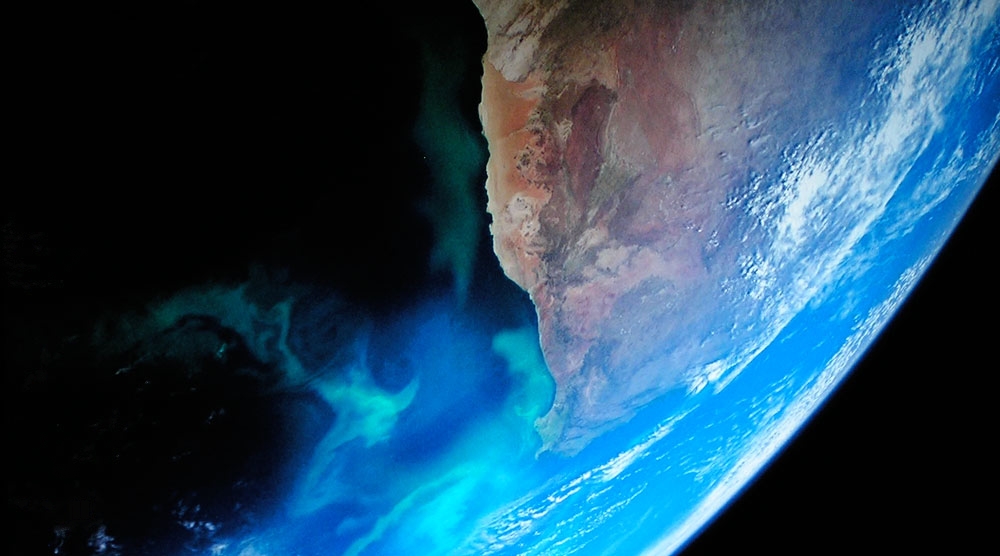
Earth

Ancestral environments and reverse evolution

There’s been a long debate regarding whether evolution can be reversed or not. The general trend has been that it can not. The idea goes that once one evolutionary pathway has been crossed, it cannot be retraced back to its origins. It turns out that is not entirely true.

Says [researcher] Henrique, ‘In 2001 we showed that evolution is reversible in as far as phenotypes are concerned, but even then, only to a point. Indeed, not all the characteristics evolved back to the ancestral state. Furthermore, some characteristics reverse-evolved rapidly, while others took longer. Reverse evolution seems to stop when the populations of flies achieve adaptation to the ancestral environment, which may not coincide with the ancestral state.

What the researchers did was subject fruit flies to various selection pressure for multiple decades, i.e., they changed their environment over and over. The ‘end’ result was fruit flies that were markedly different in their traits as compared to the original specimens. That’s evolution. Children should understand that. What happened next was the researchers mimicked the original environment of the fruit flies from decades gone by. In response, the fruit flies adapted to those environments, possessing many of the same allele frequencies they originally had. What I find particularly interesting is that they did not evolve exactly the same, but they still evolved in a way that was similar to the original phenotypes. This helps to explain why sharks and horseshoe crabs remain so similar for so long: the gene pool of the population centers around certain allele frequencies because, well, they work. Change may happen – in fact, it certainly does – but ancestral pheno- and genotypes can evolve to such similar future counterparts as to make little difference in show, even though we know there to actually be differences, at least in contigency. It’s a bit like how two people of very different backgrounds and even different alleles can come to have the similar tones to their skin. Their evolutionary contigency, or histories, are different, but the result is virtually the same.

Another point of note here is that evolution can produce similar things, but it will almost never produce the exact same thing. The history of life, if rerun, would be much, much different in all likelihood. When exolife is discovered, we’ll have indirect confirmation of this. Until then, it should be important for people to realize that nothing in biology is inevitable – including humans.

Playing with language

It’s become quite popular, especially since the release of The God Delusion, for the proponents of religion to throw certain terms on to their secular counterparts. Take for example this excerpt from a recent interview with Richard Dawkins.

So, ironically, you have an evangelistic zeal about this.

As a science teacher, it is an important thing. “Evangelistic” would be an unfortunate word, if it suggested loyalty to some sort of book. It’s loyalty in my case to scientific evidence.

“Zeal” I’m happy to live with.

The zest with which those of religious persuasions thrust terms on to atheists that are generally reserved for their own world views is getting out of hand. The above excerpt is just one example. Pay attention and you’ll see far more. Atheists and humanists are “devoted” and evolution is a “religion”.

These terms can generally be discarded because 1) they tend to just be rhetoric, 2) they tend to come from people who believe in dinosaurs around the time of the agricultural revolution, and 3) they’re blatantly wrong and ill-thought. We should, however, pay some attention because they’re also delightfully ironic.

Evolution is called religious belief. People say “I don’t have enough faith to be an atheist”. Blah, blah, blah. That’s fine rhetoric, but it’s also fine humor. What is the point in calling evolution “religious” or using terms related to faith when speaking of atheism? It’s to indicate that these things have little to no basis; those who use these terms are being derisive – that’s the whole point. Faith in evolution is a bad thing because it is merely faith. It has no substance behind it. Of course, that’s patently stupid. Evolution is nothing but evidenced. But these creationists/less-honest-creationists-who-hide-behind-the-lie-of-intelligent-design are correct about one thing: faith is a bad thing. It should be derided. It serves little purpose but to delude people.

I suppose I’m fine with Bible-thumpers calling me a man of faith. I just hope they begin to realize that by doing so they are undermining the very basis for their beliefs in magic and skyfairies.

This would change everything

Edge asked its readers what would change everything. Richard Dawkins has responded.

But such ‘essentialism’ is deeply un-evolutionary. If there were a heaven in which all the animals who ever lived could frolic, we would find an interbreeding continuum between every species and every other. For example I could interbreed with a female who could interbreed with a male who could … fill in a few gaps, probably not very many in this case … who could interbreed with a chimpanzee.

We could construct longer, but still unbroken chains of interbreeding individuals to connect a human with a warthog, a kangaroo, a catfish. This is not a matter of speculative conjecture; it necessarily follows from the fact of evolution.

People often fail to realize this. Of course, humans were magically given souls at some point, so there’s no need to worry about this continuum. A god simply decided, at some arbitrary point, that a mother and father were not human but their offspring were. While the mother and father were clearly underserving of such a gift, the children, being full-fledged humans, were given a pass into an afterlife.

1. The discovery of relict populations of extinct hominins such Homo erectus and Australopithecus. Yeti enthusiasts notwithstanding, I don’t think this is going to happen. The world is now too well explored for us to have overlooked a large, savannah-dwelling primate. Even Homo floresiensis has been extinct 17,000 years. But if it did happen, it would change everything.

But I thought dinosaurs still existed? Oh, wait. He means the real world, not Ken Ham’s world. Indeed, this discovery would be wonderful. How would humans treat this new species? We’ve grown out of the old world notion of slavery, so would grant the species some rights, at least insofar as freedom is concerned. But would we allow them a part of our society? Would they not meet our arbitrary cut for being granted human rights?

4. The human genome and the chimpanzee genome are now known in full. Intermediate genomes of varying proportions can be interpolated on paper. Moving from paper to flesh and blood would require embryological technologies that will probably come on stream during the lifetime of some of my readers. I think it will be done, and an approximate reconstruction of the common ancestor of ourselves and chimpanzees will be brought to life. The intermediate genome between this reconstituted ‘ancestor’ and modern humans would, if implanted in an embryo, grow into something like a reborn Australopithecus: Lucy the Second. And that would (dare I say will?) change everything.

Between this, the discovery of how molecules can replicate and evolve new information on their own, and the discovery of exolife, the future is very exciting, indeed. It’ll hopefully also be very damning to religious zealots who base their lives on prose and poetry rather than reality. No longer will they be able to hide behind the veil of special privilege