For the sake of…Twitter?

Apparently FTSOS got a couple of hits from Twitter. I’m curious which posts were linked and who did it. I encourage such activity greatly. Two million more times and I’ll be as popular as PZ.

The prof

A blogger once noticed that people who don’t like PZ Myers refer to him as “Paul Zachary Myers”. Now there’s a new level of contempt. Mark Looy of Ken Ham’s staff will only call him “the prof”

…He was standing with the prof and 10-12 SSA members, and I stopped to hear what was being said—especially since the prof was being filmed at the time and that was creating some congestion.

I actually counted twelve instances of Looy using “the prof” to reference PZ. He slips up and writes “the professor” once. Perhaps his heart soften for just a moment. But at no point in Looy’s post (or Ken Ham’s surrounding post) does “PZ Myers” appear. They even refuse the often creationist-preferred “Paul Zachary Myers”. Looy, Ham, and ilk seem to have decided that the best way to express their deep, vitriolic hatred of PZ is to be as humanely impersonal as absolutely possible. Whatever. They still know shit about science.

The Prof

If some blogger can morph this with an image of PZ, that would probably garner a few hits.

Creationists hate honesty

It’s long been known that creationists love to quote-mine. They’ve long done it Charles Darwin, Richard Dawkins, Stephen Gould, Albert Einstein, and plenty of other scientists in order to support their positions. No one is really all that surprised when they keep doing it again and again.

So it is nonchalantly* that I present yet another example. This time it’s Creation “Museum” supporter Tom Estes.

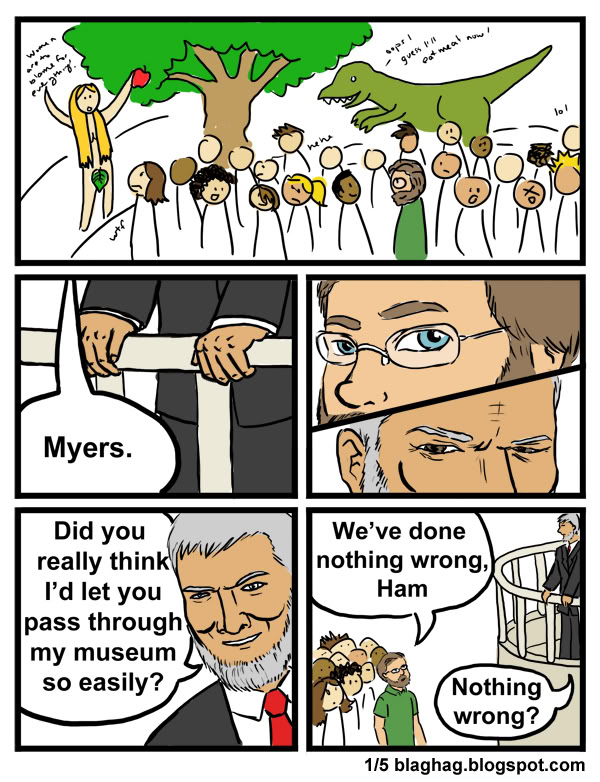
So I have been wondering; why do atheists have such animosity for Ken Ham? He is attacked so viciously, so often by atheists that I wonder if they have pure, unadulterated hatred for the man. And again I wonder, why? Before I go on, I want to share this cartoon that was drawn by Jennifer over at http://blaghag.blogspot.com.

Okay, got it? Estes is looking to support the idea that atheists simply hate Ken Ham. The hatred is so intense it’s even unadulterated. So what’s he do? He reposts a cartoon. Here’s what he featured.

PZHam1
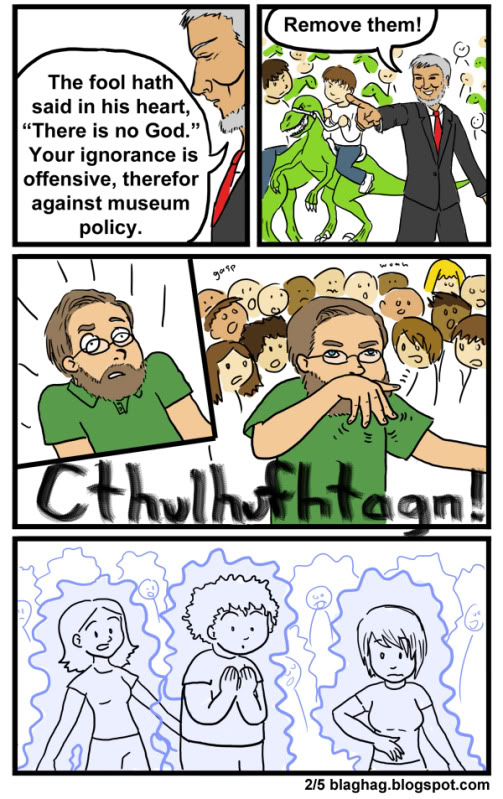
PZHam2-1

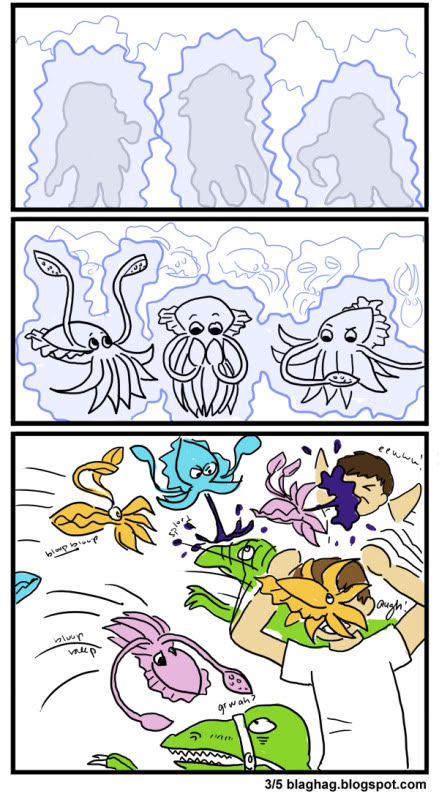
PZHam3

To see the rest of this cartoon, visit the Blaghag.

This seems to support Estes point quite well. Clearly, the cartoon is indicating the pure desire of atheists to express their unadulterated hatred for Ken Ham. But wait!

PZHam4

PZHam5

As it turns out, the cartoon is actually showing that, yes, atheists don’t like Ham very much. He misrepresents science as much as humanly possible. That’s a bad thing. But the point is a far cry from unadulterated hatred. It’s a play off the whole Expelled debacle combined with PZ Myers’ love of squid and squid-like creatures and a mockery of Ken Ham’s silly beliefs about dinosaurs. It’s a bit of fun, and in the end it shows something decidedly less cool but clearly more welcomed – everyone being civil to each other. Estes chopped off this portion of the comic (adding a link back to the front page – not the original post – of the cited blog). He’s just another creationist. He’s willing to ignore what’s inconvenient to him in order to support his position. It’s sort of like the entire concept behind Ken Ham’s bad “museum”.

*Doesn’t it seem like “chalant” should be a word? Instead of “So it is nonchalantly that I present…” it would be way better to say “So it is without chalant that I present…”. Just sayin’.

Thought of the day

PZ Myers is the everyday voice of the atheist community. Richard Dawkins is the overarching tone-setter.

Marriage is between people, not disparate ideas

There are a couple of articles floating around about a new site run by Francis Collins and Karl Giberson

Our Mission: Faith and science both lead us to truth about God and creation. The BioLogos Foundation promotes the search for truth in both the natural and spiritual realms, and seeks to harmonize these different perspectives.

It’s just another accomodationist point of view. These people want to marry science and religion. It’s politically very tactful: people don’t like extremes, so taking a sort of middle-road is very appealing. Beside that, many people know enough to realize that biologists aren’t lying when they say evolution underscores all of biology but they don’t know enough to recognize they should reject their particular cultural god(s).

But here’s the kicker. These people aren’t really middle-of-the-roaders. They are creationists gussied up once again. They aren’t concerned with science at all. What they want to do is twist established fact to fit their preconceived worldview, science be damned. Let’s call these people what they really are: the New Creationists.

Simon Conway Morris presents a different perspective, arguing humans, or a human-like species, are actually an inevitable part of evolution. Morris is not proposing a different mechanism for human evolution, merely a different observation of its possible outcomes. Morris would agree that any slight difference in the history of human DNA would result in a different evolutionary path. Unlike Gould, however, Morris argues each of those possible pathways would inevitably lead to something like the human species. Morris writes:

“The prevailing view of evolution is that life has no direction — no goals, no predictable outcomes. Hedged in by circumstances and coincidence, the course of life lurches from one point to another. It is pure chance that 3 billion years of evolution on Earth have produced a peculiarly clever ape. We may find distant echoes of our aptitude for tool making and language and our relentless curiosity in other animals, but intelligence like ours is very special. Right?”

“Wrong! The history of life on Earth appears impossibly complex and unpredictable, but take a closer look and you’ll find a deep structure. Physics and chemistry dictate that many things simply are not possible, and these constraints extend to biology. The solution to a particular biological problem can often only be handled in one of a few ways, which is why when you examine the tapestry of evolution you see the same patterns emerging over and over again.” 4

The patterns Morris mentions are also referred to as convergences in the evolutionary process. In his most recent book, Life’s Solution, Morris gives many examples of physical traits or abilities found repeatedly among different species.5 Normally, such similarities are understood asthe result of common ancestry. However, the species in Morris’s examples are known to be distantly related. In many cases, not even these species’ common ancestor shared the same trait. The implication is that several different species have independently developed similar traits.

There is just so much wrong here. First of all, this is saying the roads of evolution are limited, thus humans (or something similar to humans) were inevitable. This is only true if one is to start from a certain, late point. An ape, for example, is limited to being a mammal for many thousands, even millions of years. It is bound to the land for a significant period of time. But go far enough down the line and it isn’t possible to count the possibilities of ape evolution. Taking this principle, we can walk back in time. Deep time. Three and a half billion years ago, eukaryotes weren’t inevitable. Hell, four billion years ago and life wasn’t inevitable, much less humans. It’s an absurd argument being peddled that is designed to harm the atheist position while strengthening creationists. This isn’t about marrying science and religion at all; it’s about propping up religion at the expense of actual science.

Second, this is saying that because similar features have evolved again and again and not as a result of common ancestory, this is evidence for limited pathways in evolution. This doesn’t speak to any of that goobbity-goop. What this says is that natural selection has a tendency to take common initial pathways and make similar structures. The eye is a good example. This website, being a creationist site, naturally abuses the example of eye, so I hope I can fix that a bit.

The eye has evolved independently about 40 times. This doesn’t mean that the eye is absolutely inevitable. If it did, then we should see more species with eyes. What we actually see is an entire planet with the same basis for life – DNA. From this DNA, we see cells. In eukaryotes, we see certain similarities with Vitamin-A parts of molecules in all eyed animals. In addition, most animals (regardless of whether or not they have eyes) have photoreceptor cells. All it really takes for an eye to evolve is a small pit, indent, or even surface area for these cells to rest. Having just a tiny bit of vision can give enormous benefits to any animal. Some squid, for example, have eyespots which allow them to detect the wavelengths of light. This helps them ‘know’ (they have no brains, only nervous systems) in which direction to go. Say a certain shade of green is common on the sea floor, which is where the squids food source (let’s say) lives. Being able to decipher between green and other shades is beneficial. Natural selection will favor those with better green detection. Going further, other animals can develop the same basic idea through mutation yet evolve it in completely different ways at completely different times. This isn’t evidence for some things being so improbable that ‘God done it’. It’s evidence for common chemistry and biology being molded by the far-from-improbable mechanism of natural selection.

Worth repeating

Via PZ Myers

Via PZ

The valuable points

PZ Myers has a post about the people who are obsessed with making science out to be the accommodating factor for religion. It simply isn’t true and I want to emphasis an important point; this can’t be repeated enough.

Funny thing is, in those situations (as well as in the classroom) I just focus on telling the story of the evidence. That is our strength, right? I don’t have to announce that the Book of Genesis is wrong and silly, but I also don’t have to go out of my way to tell them some pretty excuse to allow them to continue to believe in talking snakes. And if I’m asked, I tell them straightforwardly that literal religious accounts are falsified by the evidence.

The most important (implicit) point here, I think, is that science is not approached from a theistic or atheistic point of view. Of course, it best supports an atheistic view point (with at least a worthwhile case being made for a deistic view), but that doesn’t mean that atheism is assumed in science. It simply isn’t. Science influences our philosophies and religions; it should never be the other way around. The only philosophy that should influence science is the one that says evidence matters above all else. Of course, that can be applied to just about anything. The big difference between science and “just about anything” is that scientists actually do apply that philosophy.

It is interesting. I think a lot of people recognize that no philosophy is more important than that one. That’s why creationists are always trying to claim the prestige of science. First it started with the de facto assumption that science supported particular gods. Then it moved to the term “creation science”. When that failed, “intelligent design” was introduced (or rather, reintroduced – it’s just a rehashing of Paley’s Watchmaker). Now there’s a mesh of ID and out-and-out lying. Creationists want science to support their inane views because they know the very word “science” lends credit to any idea. BS diet pills, penis extension pills/creams, chiropractors, acupuncturists, and other kooks/kook companies will always slap “clinically proven” or talk about the “science” of their fields because they realize the exact same thing.

But the creationists are fundamentally flawed. They don’t actually follow any evidence. Most creationists either have no college education or have no education in biology. They can’t follow the evidence because they don’t understand the evidence. Wholly, it’s frustrating. Every week I gain a new detail in one of my biology courses, I recognize that it would make absolutely no sense without evolution. That paper by Theodosius Dobzhansky titled “Nothing in Biology Makes Sense Except in the Light of Evolution” held only a rhetorical position in my mind many years ago. As I’ve grown to better appreciate the immensity of the evidence for evolution, I find myself saying it with meaning at least once a week.

And here’s the big kicker. My atheism hasn’t once influenced any of my thoughts on evolution. It doesn’t work that way. Evolution influences my atheism (though doesn’t force it). Imagine for a moment an experiment. Let’s take the Lenski experiments. Can anyone name me the point where atheism or theism influenced anything here? It isn’t possible. Why? Because science is not approached from those point of views. How could Lenksi? “Well, God must exist, so my result must reflect that. Instead of describing just my scientific methods, I will attribute any results to prayer.” Reversing that for an atheistic point of view is equally non-sensical.

Science should never be harmed for the sake of a point of view. It is the best representation of the truth that is available to anyone. Purely for that reason – that it is true – it should be held in regard far above any theisms or lack thereof.

Drink of my blood

Just a notice people living in the Augusta area that there will be a blood drive on March 9. Here is the information. A few more results for the area (and other parts of the country as well) can be found here.

Penney Memorial Church 1038 Perkins Hall
35 Grove St
Augusta, ME 04330

Because giving blood is far more effective than pretending to drink it. UPDATE: Here’s a thought. PZ Myers had a whole big deal where he desecrated a Catholic wafer. It was to prove a point that nothing is sacred (basically). But instead of a wafer, how about dumping out some blessed ‘blood of Christ’ outside a donation location? It’d be especially poignant to do it outside a church. But this time the point wouldn’t be that nothing is sacred but rather that deep belief, prayer, and silly rituals* are far less effective than simply being a good person and doing good things (for example, like actually helping people by giving them real blood).

*To be fair, PZ surely mocked these things as well throughout wafer-gate.

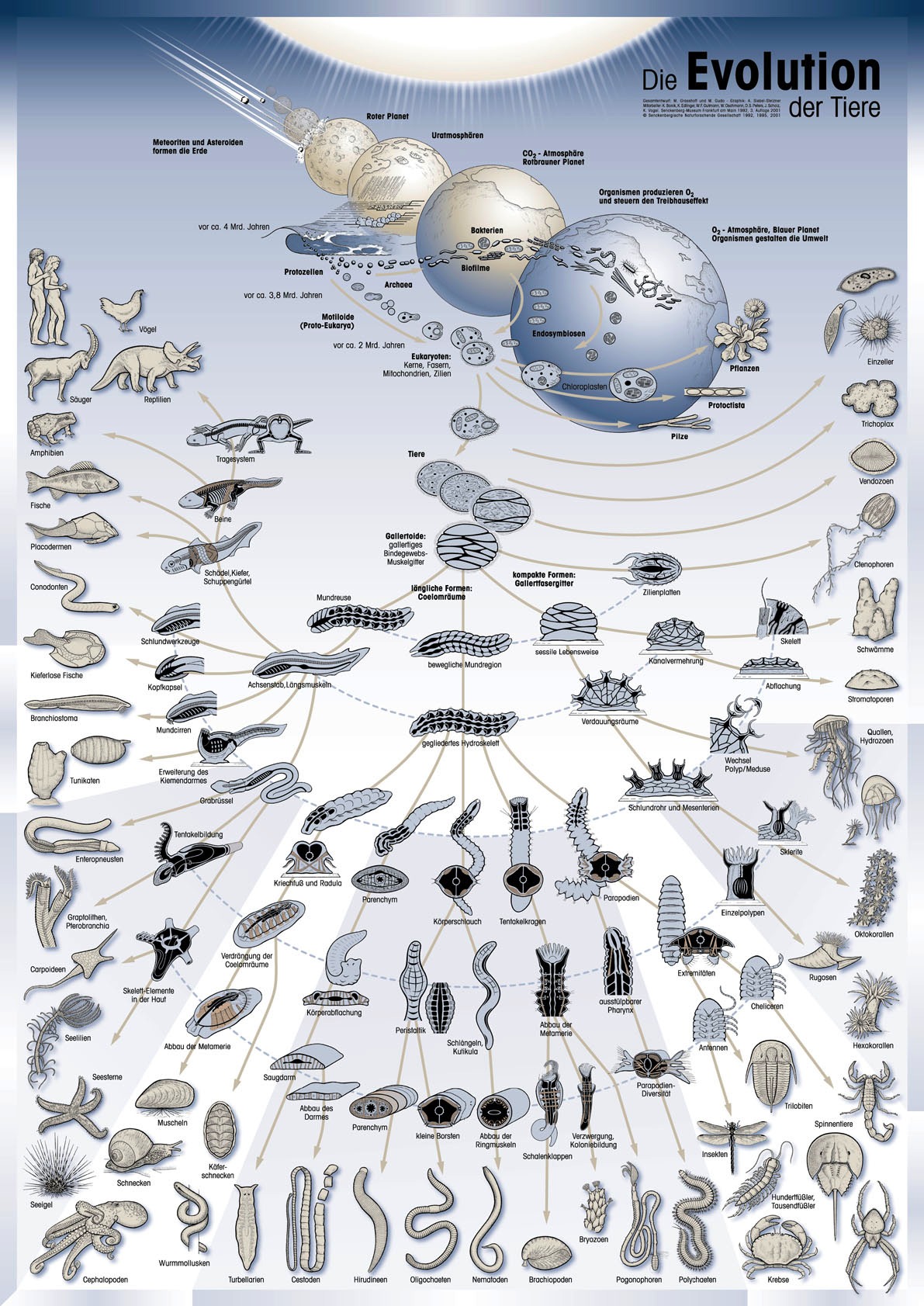
This image is stunning

Thanks to PZ for finding it.

animalsevolution_lg

Shared errors

Over at Pharyngula, PZ Myers has a post which first destroys some creationist misconception, but then, far more interestingly, goes on to interpret a recent peer-reviewed paper on copy number variants, or CNVs. The whole piece is worth reading, but what I think is worth of a little extra attention is the brief point our shared errors.

An architecture does not imply intent or purpose, but they often imply a history. The pattern described — that chimps and humans share some common structural elements in their genomes — is better described as evidence of common ancestry than of well-designed function. An intron, for instance, is a piece of random, usually useless DNA inserted into the middle of the sequence of a gene that must be excised from RNA before it can be used to make a functional protein. It’s a little piece of garbage that must be cleaned up before the gene product can do its job. That a human and chimpanzee gene has identical introns is an example of an architecture, true enough, but it is of a shared error. Some all-knowing god—he seems to be consistently making the same mistake.

Okay, let’s take the recent hoo-hah with Coldplay and Joe Satriani. Basically, Satriani is claiming Coldplay ripped off one of his songs. There is some fairly compelling evidence to this claim, but it is far from airtight. What we have are four of the same chords repeating through parts of the songs, but only three consecutive notes are truly in common. We can potentially call this one a coincidence (especially since this song has been around forever and Satriani is only suing now that after Coldplay has won a slew of awards. Essentially, we see two instances of people creating similar things.

Now let’s consider someone learning the Satriani song. I don’t feel like finding the actual chord progressions, so let’s just say it goes A, B, C, D. The person begins to learn things, but is apparently a horrible musician and substitutes an F# for the C. Okay, fine. So we have a version of the song out there which is now A, B, F#, D. Now let’s say this person has a friend who wants to rip the song off. But instead of listening to the original Satriani version, he listens to the mutated version with the F#. Now we have some evidence of a copycat. It isn’t very strong evidence because there is just one error. In both instances, we have just four chords. But let’s say another error is made further along in the song. A chord in the bridge is misinterpreted by the original person learning the song. And, naturally, the copycat makes the same error. As we go deeper and deeper into errors, we begin to get better and better evidence of a common origin – the friend was learning from the interpreted version of the song, not the Satriani version, because it is unlikely he would make, say, 5 of the same errors as his friend. The chance for coincidence shrinks while the odds of identifying the correct source rise.

The way this is like CNVs is that we are seeing common errors being made again and again – and these errors are present in both human and chimp genomes. Of course, it should be noted that it isn’t entirely clear if these errors were directly inherited from a common ancestor or if it was the hotspot for ‘making’ errors is what was inherited, but at any rate, it is evidence for our common ancestory with the other apes. There are far too many common errors being made to simply file this under ‘God did it’. The evidence says that is – still and again – superfluous.