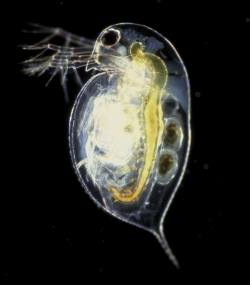
Old eggs, daphnia, and evolution

When predation is high, crustaceans and other water loving egg lay-ers are not hatched much. What often happens is that they will remain dormant until later in the year when the predators are much less active. This offers a great research opportunity into evolution.

By hatching these eggs, Hairston and others can compare time-suspended hatchlings with their more contemporary counterparts to better understand how a species may have evolved…

What happens is that some of these eggs can remain unhatched for years and years, not just seasons. This is the case with daphnia. These are normally seasonal crustaceans, but researchers have specimens which are upwards of 40 years old. They use these to compare the change which has happened to this species over time. Daphnia_DGC

In the 1960’s, the lake from which these daphnia were taken had non-toxic levels of algae. But in the 1970’s, pollution had caused the algae to raise to a deadly imbalance. Currently, daphnia still reside in the lake, but researchers have found they are markedly different from the eggs they hatched. The older version of the species was unable to survive in the lake, poisoned by the overwhelming cyanobacteria. Clearly, the newer species had adapted to their new environment throughout the 70’s and subsequent decades.

Abusing science

Conservapedia is back to abusing science. This is from their “news” section.

The study, which was published on July 14, 2009 in the peer-reviewed journal Nature Geoscience, found CO2 was not to blame for a major ancient global warming period and instead found “unknown processes accounted for much of warming in the ancient hot spell.” The press release for the study was headlined: “Global warming: Our best guess is likely wrong.”

“In a nutshell, theoretical models cannot explain what we observe in the geological record,” said oceanographer Gerald Dickens, a co-author of the study and professor of Earth science at Rice University. “There appears to be something fundamentally wrong with the way temperature and carbon are linked in climate models.”

The mistake Conservapedia made is so readily linking to the abstract.

We conclude that in addition to direct CO2 forcing, other processes and/or feedbacks that are hitherto unknown must have caused a substantial portion of the warming during the Palaeocene–Eocene Thermal Maximum. Once these processes have been identified, their potential effect on future climate change needs to be taken into account.

While the idiots over at Dumbopedia (good one, right?) are claiming that this study PROVES!!! that global warming is not man-made (thus implying that any polluting business practice is a-okay), the study is saying no such thing. This is referencing a period of warming where CO2 alone does not account for all the warming. That isn’t to say that the rise in CO2 can be dismissed during that time – nor is it saying anything about our time. It’d be like saying natural selection doesn’t account for all the change in evolution, therefore evolution is false. CO2 still was a huge factor by which warming was initiated (upwards of 38 degrees F). Today it remains a huge factor.

Let’s just say it. Conservatives are not concerned about science. They care about allowing businesses to practice as they please. That’s it.

A Short History of Nearly Everything

I am currently in my fourth and a half listening of the audio version of Bill Bryson’s “A Short History of Nearly Everything“. It’s about 6 years old, but I’ve only recently been introduced to it. I’ve been severely missing out.

This is an overwhelmingly encompassing account of, well, nearly everything. Bryson goes through, with engrossing detail, the history of science. He begins with, naturally, the Big Bang and much of physics. From there he jumps to just about every topic (in an order I cannot recall), from chemistry to biology to geology to mathematics to astronomy. He gives a set of Britannica Encyclopedias’ account of so many scientists, what they were thinking, why they were thinking it, and why they were right or wrong or on the right track or distracted or petty or prideful or anything of which I would never think to ask or consider. This is the best science book I have ever heard or read, and it isn’t even specific like, say, The Selfish Gene (which was also excellent).

One of the best things about this audio book is Bryson’s voice. It’s soothing. It’s also not boring. As much as I love The Science Channel and all the science shows I can find, I have come to the conclusion that I can only watch these if I’m wide awake. It isn’t that the topics are boring. The presentation is usually just very monotone. (One notable exception is the Discovery Channel’s Walking With Cavemen narrated by Alec Baldwin.) Bryson’s book suffers from no such calamity.

Get this book, preferably the audio version (though I’m sure the text version is equally fantastic).

More Rosenhouse

I have had intense discussions with people about obscure points of the Buffyverse, but I don’t expect anyone who is not a Buffy fan to regard such discussions as interesting or important. The trouble is that many of the participants in this session made Christian theology sound like much the same thing. They had various personal reasons for accepting Christianity, but at no point provided any basis for their beliefs that could be recognized as evidence by those outside the community. Theology came off seeming like an in-house discussion among those who share a particular set of premises. Which would be fine if they forthrightly admitted that’s what theology is. The trouble comes when they act as if theology is actually giving us knowledge or understanding of something, or that it is a branch of human inquiry that deserves a place at the table alongside science. Give me some reason to think that Christian theology has any more basis in reality than does Buffy studies, and then I will start taking it seriously.

Rosenhouse

Very frustrating, but entirely typical for creationists. They have a single intuition, that functional systems do not evolve gradually by undirected processes. Virtually all of their scientific arguments are based on attaching poorly understood jargon to that intuition. They have no real understanding even of what the questions are, much less what to do to find answers.

Rosenhouse

Absurd

Here’s a video of FOX Noise trying to embarrass a proponent of recycled toilet paper.

Fair and balanced? Really? This moron reporter was attempting to mock her interviewee throughout the entire segment. This is completely typical of the level of quality that FOX Noise has to offer.

The same evidence

We all have the same evidence in front of us. We just have different interpretations.

For instance, most scientists believe we think with our brains. But that’s merely one circumstantial interpretation. We can never know if we really think with our brains. Why not another organ?

I submit that we actually think with our kidneys. These amazing little machines are, at their core, a microcosm of humanity. We humans are always striving to become better and better people. We want to get rid of the parts of ourselves that are no good and better manage and improve the parts of ourselves which are beneficial. Kidneys do exactly this.

Our kidneys help to filter our blood, improving its quality and use. They also are key in getting rid of a lot of our waste – namely urine.

Humans are always thinking of how to gain in quality and discard internal waste. Our kidneys have long known just how to do this. It makes sense that our ability to think would be intricately linked to an organ which displays the very same attributes we constantly seek in our lives.

Right?

More bats

How prophetic.

So, in honor of this story (which I don’t think is over – we have little idea of where these things are originating)…

Another attack last night. I hear them in the ceiling.

Oh, Jesus

There’s a story floating around the interwebbings that says “Study shows evolution guided by ‘invisible hand'” or some variation of that. Most of the actual articles take this idea too far.

A study in the University’s School of Psychology sought to explain how turn-taking has evolved across a range of species. The conclusion is that there is an “invisible hand” that guides our actions in this respect.

That isn’t really the conclusion. The researchers did use the phrase “invisible hand”, but they didn’t come to a scientific understanding that, “OO! Magic!” is what’s going on here. Here’s some actual meat.

The researchers state: “Turn-taking is initiated only after a species has evolved at least two genetically different types that behave differently in initial, uncoordinated interactions with others. Then as soon as a pair coordinates by chance, they instinctively begin to play ‘tit for tat’. This locks them into mutually beneficial coordinated turn-taking indefinitely. Without genetic diversity, turn-taking cannot evolve in this simple way.”

Tit-for-tat is a model of behavior that results in a form of altruism. It’s pretty much what it sounds like: you scratch my back, I’ll scratch yours. A lot of organisms have it, and it’s especially strong among kin or even likely kin. The basis is that closely related organisms tend to have highly similar genes. While helping out (in one form or another) one’s brother may seem detrimental, it actually isn’t. That brother has 50% of the genes, on average, that the helper has. He’s really helping a lot of his own genes. On top of that, the brother is likely to help back at some point in the future (afterall, genes for altruism, if in one brother, are likely to be in the other brother).

What happened in the aforementioned study is that tit-for-tat is already assumed in the model. That is, it has already evolved within groups. What needs to be explained is specific turn-taking. And that’s exactly what the researchers did. They showed that it takes a random throw of the dice to find the right gene combination, so to speak. Once that point is reached, the non-randomness of natural selection can subject those genes to adaptations.

Professor Colman added: “In our simulations, the individuals were computer programs that were not only dumb and robotic but also purely selfish. Nevertheless, they ended up taking turns in perfect coordination. We published indirect evidence for this in 2004; we have now shown it directly and found a simple explanation for it. Our findings confirm that cooperation does not always require benevolence or deliberate planning. This form of cooperation, at least, is guided by an ‘invisible hand’, as happens so often in Darwin’s theory of natural selection.”

Let’s be fair to Professor Colman. There’s no way of telling from this if he too is trying to sneak a vague concept of a god into all this. I doubt he is. Unfortunately, it doesn’t matter because he’s a scientist and his languages suggests religious connotations. That is why the media especially latched onto this story. It isn’t like turn-taking grabs the attention of the average layman.

Dawkins

What has theology ever said that is of the smallest use to anybody? When has theology ever said anything that is demonstrably true and is not obvious? I have listened to theologians, read them, debated against them. I have never heard any of them ever say anything of the smallest use, anything that was not either platitudinously obvious or downright false. If all the achievements of scientists were wiped out tomorrow, there would be no doctors but witch doctors, no transport faster than horses, no computers, no printed books, no agriculture beyond subsistence peasant farming. If all the achievements of theologians were wiped out tomorrow, would anyone notice the smallest difference? Even the bad achievements of scientists, the bombs, and sonar-guided whaling vessels work! The achievements of theologians don’t do anything, don’t affect anything, don’t mean anything. What makes anyone think that “theology” is a subject at all?