The reasonableness of absolute uncertainty

One of the complaints raised over a recent post came from my presumption that the phrase “There’s probably no God” is one way to describe atheistic thought. I’ve expanded on that idea in the past, so I didn’t feel it necessary to discuss it in my recent post (plus it was besides the point I happened to be making). But more than that, the notion seems so simple.

In The God Delusion, Richard Dawkins actually spends more time than should be necessary on the point of how to define atheism. He creates a 7 point scale where a “1” is an absolute believer, someone with no doubt in the existence of God, and a “7” is the polar opposite, an absolutely certain atheist. In the middle are varying levels of belief or disbelief. Dawkins places himself as a “6”, describing himself as nearly certain there are no gods, but allowing for the possibility, however slim it may be. This is how a huge swath of atheists also describe themselves. (It’s at the root of some of the messages being put out on the bus campaigns, in fact.)

The complaint to this is the belief that atheism means absolute certainty. What requires this? The word means “without theism”. That does not imply certainty of what is true, but rather a degree of certainty of what is not true. In modern connotations, the term includes a rejection of deism and usually anything supernatural. But how does this rise to become certainty?

Many people, for whatever reason, insist that any lack of certainty thus equals agnosticism. There are two issues with this. First, no, it doesn’t. Atheism, again, does not require certainty. Second, the only way one can arrive at this conclusion is to use the modern connotations of atheism. The problem comes when the connotations of agnosticism are then ignored, ever so conveniently. That is, the fact that atheism is usually taken to mean a complete rejection of all things supernatural is employed, but then the fact that agnosticism is usually taken to mean a 50/50 uncertainty is ignored. This is why Dawkins needed his scale. Few people are right in the middle (“4”). Most of us lean one way or the other. In fact, I hope a majority of people do not categorize themselves as “1”, pretending as if they’re absolutely certain of their God’s existence. We should all have doubt; the lack of it is a mark of fundamentalism.

In essence, the argument that atheism is absolute certainty is a blatantly dishonest one. If the term means absolute certainty, then it cannot be ignored that agnosticism usually means a perfect middle ground. It is bad form to ground an argument in cherry-picked connotations; in this case, demanding a self-proclaimed atheist call himself “agnostic” due to a lack of 100% certainty is weak because the common notion of a 50/50 split for agnostics is being ignored – clearly the self-proclaimed atheist is not 50/50 on the existence of gods. This would be like demanding that anyone who says unicorns are possible must also believe the mythical beasts have a 50/50 shot of existing. Of course unicorns are possible – and everyone should acknowledge that fact – but they are exceedingly unlikely. And more importantly, there is not a shred of evidence for their existence. This does not make anyone agnostic towards unicorns except in the strictest, most semantic, most useless sense.

Old people hate new things

That’s just the way it is. As a person approaches old age, the likelihood of outrage at new things approaches 1. Take, for instance, J.P. Devine of Waterville, Maine.

Don’t do it. Don’t even think about it. It will only depress you. You really can’t go back.

For you lucky folks, the old neighborhood is only a few blocks away, or maybe in another town 15 minutes down the pike. If you’re young, Mama is still there and Grandma is still baking.

But for some of us who are from away, far away, a million years ago and a million miles away, it’s forever alive, because we haven’t been back. We tell ourselves that it’s still there with the same smells and faces.

Our childhood buddies and girlfriends are still standing on the corner, waiting for us to come home. So let’s take a trip back. Put a seat belt on your heart.

Ladies and gentlemen, I give you Google Earth Street View, a gala gimmick, a carnival ride to yesterday. Meet Google Street View — The destroyer of illusions, the shatterer of dreams.

Most of you with a computer, and who hasn’t one, are familiar with the program. You can press a few keys, slide a mouse and there you are, back in your old hometown, riding the Google car down the streets of your childhood.

This upsets Devine. It’s technology, so it’s distressing to the older generation.

You can Google ride through small towns all over America and see how much your memories have faded and how your America has changed. Up and down neighborhood streets, warm wooden picket fences have given way to frightening rows of icy cold cyclone wire fences for people to hide behind. Strangely, there are almost no people in Google Land views, no paper boys on bikes, no kids’ lemonade stands or wandering dogs. There is no sound in Google Land. On my street, there were a few cars, parked cheek by jowl, but looking as though they were abandoned when the mysterious dark wind of progress came along and sucked away all life.

I’m actually amused by the common lament for the past I hear from old people. It’s surprisingly frequent in the letters to the editor in the local paper (the same paper that published this piece). We all yearn for the past at one point or another, sure, but the current elders of the world seem to complain more about current technology than anything else. There’s something scary and dangerous about an evolving world.

With a touch of a button, I drove away, ran away, flew away as fast as I could. Google Street View is indeed a gala gimmick, a carnival ride to yesterday. It can take you to Philadelphia, to Paris or Madrid. It can take you to outer space … but It can’t take you home.

One thing, however, about this particular older person is the quality of writing. For the sake of readability, aesthetics, and just plan making my point I’ve excluded quite a bit of the article; it’s a shame. This article, despite being a mark of oldness, is very well written. Do read the whole thing (and maybe be glad you aren’t old, should you be so lucky).

The religion prize

PZ Myers complained last week over the London Times calling the Templeton Prize a prize for “scientific thought”.

Say what? There’s no amount of science you can do that will win you a Templeton prize. It’s a prize for religious apologetics, nothing more.

That’s pretty accurate, so maybe this Yahoo! article can do some soothing…

A one-time priest who later became an evolutionary geneticist and molecular biologist and helped scientifically refute creationism with his research was honored Thursday with one of the world’s top religion prizes.

Of course, it would be better if all that money was just given out as research grants.

Thought of the day

Science simply represents our best effort to understand what is going on in this universe, and the boundary between it and the rest of rational thought cannot always be drawn.

~Sam Harris

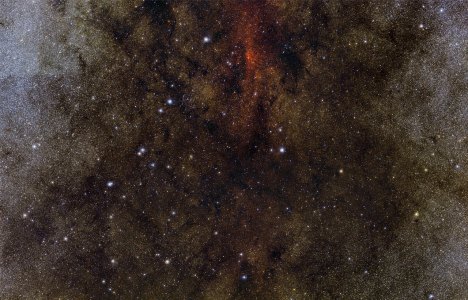
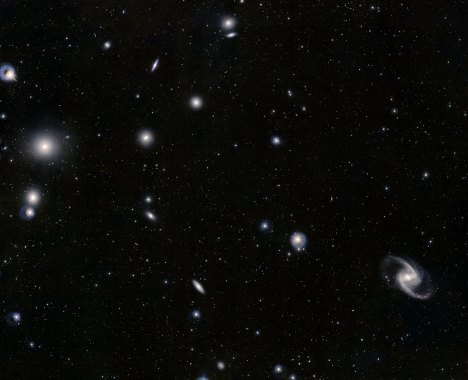
VISTA images

VISTA (Visible and Infrared Survey Telescope for Astronomy) is a survey telescope working at infrared wavelengths and is the world’s largest telescope dedicated to mapping the sky.

Because VISTA is a large telescope that also has a large field of view it can both detect faint sources and also cover wide areas of sky quickly. Each VISTA image captures a section of sky covering about ten times the area of the full Moon and it will be able to detect and catalogue objects over the whole southern sky with a sensitivity that is forty times greater than that achieved with earlier infrared sky surveys such as the highly successful Two Micron All-Sky Survey. This jump in observational power — comparable to the step in sensitivity from the unaided eye to Galileo’s first telescope — will reveal vast numbers of new objects and allow the creation of far more complete inventories of rare and exotic objects in the southern sky.

It has already taken some breathtaking images.

Where are these boundaries anyway?

Believers are often railing that atheism, and especially Richard Dawkins, goes beyond the bounds of science in its claims. What is never actually articulated is how. How does atheism go beyond these bounds?

But that other comment about going “beyond the boundaries of science” is a curious one. Where? I think that when you invoke an invisible, undetectable ghost in the sky who diddles quanta or turns into a man who raises the dead, then you are going beyond the boundaries of science. When someone points out that there is no evidence of such activities, that the claims of supernaturalists are contradictory and unreasonable, or explains that the material claims of priests are fair game for critical examination, they are actually operating entirely within the domain of science.

Atheism is not science, but as I’ve said in the past, it reflects the essence of science.

Acceptance without proof is the fundamental characteristic of Western religion. Rejection without proof is the fundamental characteristic of Western science. ~Gary Zukav

While Zukav is otherwise uninteresting, his quote is concise and spot on. The onus is on the positive claimant to show his evidence. This is why the common comparison of God and gods to gnomes and unicorns is so apt; atheism is a rejection of certain claims which have no proof.

Of course, an absence of evidence is not evidence of absence. But an absence of what should be present is evidence of absence. This is just common sense we use all the time; if a prosecutor claims John shot his friend but there is no bullet hole in the friend and there hasn’t been time for anything to heal, then that is evidence that John never did shoot his friend. Faith, the basis for all religious belief, is not good enough here. It’s laughable.

To put it another way,

If Susie tells us she stopped a train in its tracks a la Superman, we would rightfully demand some real evidence of this (assuming we didn’t outright reject her claim as obviously false). We would even call Susie’s claim impossible. But that isn’t to actually say it is impossible. In theory, at least, it could have happened. All the atoms which made up the train could have spontaneously disassembled in a manner consistent with how they would have been altered had Superman actually been standing in front of the train. Of course, there is a huge difference between something being possible and something being plausible. This scenario fits the former while falling far short of the latter.

Atheism is much the same.

Atheism does not violate any boundaries of science (though it is not required to fall within a scientific purview to be true); instead it is a reflection of science. It is not built upon superstition or faith or unevidenced claims. Atheism is a rational view of reality which does not overstep anything. In fact, it embraces particular bounds – the bounds of human knowledge. “There probably is no God” perfectly reflects current human knowledge because, to date, there is no evidence for any gods. None. Let that sink in. It isn’t that the evidence is disparate, poorly argued or presented, poorly collected or organized…no. No, it’s that there is no evidence for any supernatural being. It cannot, with any respect for reason, be asserted that atheism is the boundary-stomping culprit here. Atheism is a standing demand for evidence as a result of a standing lack of reason, rationality, knowledge, and, well, evidence.

We appreciate your concern

But no thanks.

It is difficult to avoid the observation that, whenever believers give advice to atheists on how to run our movement, it is always in the direction of telling us to be more quiet, to tone it down, to be less confrontational and less visible. I have yet to see a believer advise the atheist movement to speak up more loudly and more passionately; to make our arguments more compelling and more unanswerable; to get in people’s faces more about delicate and thorny issues that they don’t want to think about; to not be afraid of offending people if we think we’re right. I have received a great deal of advice from believers on how atheists should run our movement… and it is always, always, always in the direction of politely suggesting that we shut up.

You’ll have to forgive me if I question the motivation behind this advice, and take it with a grain of salt.

Impressive

Take a look at the 25th picture from this (first) Kilimanjaro photo gallery.

Well done, Greece

Greece has made a step in the right direction.

The Greek government has announced it will start taxing churches as part of its efforts to get out of its financial crisis. A new draft bill to be tabled in parliament next week imposes a 20 per cent tax on the Orthodox church’s real estate income, reportedly worth over 10 million Euros (US $14.8 million) a year, the Wall Street Journal reports.

In Euros, Greek debt is 216 billion, so it’s no secret that this new tax is going to generate very little. But it’s still good because there’s no reason churches should be tax exempt in the first place. There is nothing special about religion which warrants it special economic considerations or status.

Now if only we can do the same for religious institutions in America – especially when they violated the conditions set out for them under current law.

Let me tell you about a friend of mine