What a shame – Pharyngula on strike

This is too bad. PZ Myers is on a blogging strike over internal (and to an extent, external) issues going on at Scienceblogs.com. From what I’ve read, people are upset they aren’t being consulted first on a number of issues, not to mention the concerns PZ lists. This has resulted in something crazy like 20 of the 80+ bloggers shutting their doors and moving on. (I can’t say I’m sad to see that Suzanne Franks is leaving; Scienceblogs needs people more honest than that.)

The most unfortunate aspect of this is that PZ pulls in a boatload of hits – 190,000 yesterday alone (though this was somewhat of a spike). He’s a huge resource for science lovers and atheists. Aside from bringing a lot of knowledge and extremely strong argumentation skills to the table, he gets all the good links. This give a lot of cues to other bloggers (myself included), both in direct content as well as auxiliary leads.

I hope this is resolved quickly and for the better.

Thought of the day

Big cities are highly, vastly, crashingly overrated.

Letter to the editor: LePage will harm science

I’ve written a letter to the editor which appeared in the Kennebec Journal today. As is ever so common, the KJ threw in some poor editing. One of the changes I’ve noticed has to do with an omission – I refer to Paul LePage as a loon. Another is that they changed “okay” to “OK”. I half-expected the first change; the second change is just bad writing. I would never use “OK” anywhere besides maybe a text message.

But then there’s the big change. Here’s how the paper starts my letter.

In a televised debate on May 27, Paul LePage seems to indicate he thinks public schools ought to teach creationism to children.

No, no, no. Paul LePage actually, literally, without any doubt said he supports the teaching of creationism in public schools. He is a creationist. The KJ is effectively lying when they put these words into my mouth. I would never make such firm claims on such flimsy (and poorly written) grounds. Here’s how I actually started my letter.

Paul LePage thinks public schools ought to teach creationism to children.

He’s a loon.

Now does that sound a bit more like me?

In addition to this malarkey, the KJ also changed my final sentence, taking away its punch. Whereas I say, “Do not vote for Paul LePage”, they’ve pretended I said, “Do not vote for LePage”. In addition to this, they also made the title of the letter “Irreparable harm to science if LePage elected”. That’s crap. Bush harmed science greatly, but it isn’t irreparable.

Given all the errors the KJ has forced upon me, I will be giving them a call very shortly. I may report back on it. Until then, enjoy the letter I really wrote.

Paul LePage thinks public schools ought to teach creationism to children.

He’s a loon.

Creationism, in one version, means telling students that Adam and Eve really existed, that the entire globe flooded (in just over a month, no less), and that the Universe is 6,000 years old.

All these things are falsehoods. And LePage is okay with teaching them to children because he doesn’t really understand science.

This isn’t just some abstract misfortune in science education. There will be real world consequences including, for example, the harming of future conservation and management efforts.

Biologists often use genetic markers to determine variation within and between populations to determine the best way to maintain healthy species. One example involved the use of microsatellites to determine the temporal and spatial population structure of Atlantic cod populations across the Gulf of Maine. Were we seeing several distinct populations or was there breeding between seemingly distant groups? How much variation was there within populations that were being treated as separate? These were just some of the questions that had to be asked in order to better manage Maine’s Atlantic cod population.

Under LePage, students could be discouraged from ever getting to know what microsatellites are, what their importance in genetic testing is, or what they mean to management services in Maine. LePage could instead encourage students to reject science – especially biology and its underlying theme and fact of evolution – by having teachers instruct them that faith is an okay way of knowing. If LePage has his way, the future of Maine biologists – and all the species they manage – will be threatened. And that’s just the first field of science we know he could harm.

Do not vote for Paul LePage.

Thought of the day

The fact is that we all get one life. Extracting the most possible pleasure from it – something which does not inherently equal selfishness – is the only sensible course.

Everything does not happen for a reason

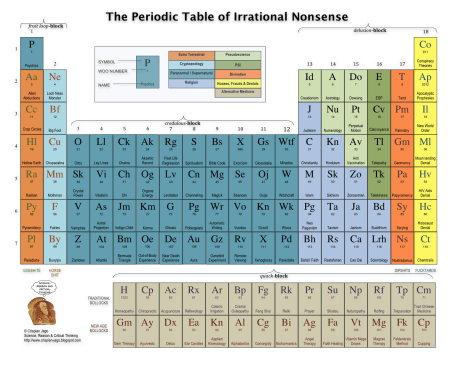
The Table of Irrational Nonsense

I can only wonder if element 68 wouldn’t be listed if FTSOS and Pharyngula and everyone else didn’t go after the nonsense of a certain quack.

Via Crispian Jago.

Atheists, new atheists, and anti-theists

There’s confusion afoot. A lot of people aren’t sure what the difference is between atheists, new atheists, and anti-theists. Thank Zeus I’m here to clarify everything.

An atheist is someone without theism. This applies to those who actively reject all theologies but it can also apply to those ignorant of all theologies. The former point is clear enough (and includes deists), but the latter point begs for expansion.

Someone who is ignorant of all theologies is a bit of a rarity in one sense but then ever so common – in fact, they become commoner every day. In the first sense, few adults are without any form of theism. Anyone who amalgamates belief in a creator with normative statements has some theism. For instance, if someone says there is a creator of the Universe and that creator has commanded that people ought to act, behave, or believe in a particular way, that is a form of theism. (It isn’t necessary that an organized religion be the basis, but it does happen that even those who reject all religion tend to incorporate pieces of predominant cultural religious beliefs in their own personal theism.) On the other hand, someone who is a pure deist does not incorporate any statements of value into his belief (‘An entity started the Universe and that is it’) and is therefore an atheist, though connotations cause us to hesitate to such a label for a deist.

In the second sense, a baby is an atheist. This point draws the ire of a lot of theists who desire ever so deeply to incorrectly label their children things like “a Catholic child” or “a Baptist boy”, but this is part of the confusion. Remember, an atheist is simply someone without theism. A baby has no concept of God, except maybe in the sense that mommy and daddy are all-knowing and all-powerful. Until the child develops the ability to comprehend values, no theism can be said to exist.

A consequence of this definition is that all non-human things can be said to be atheists. A rock, a tree, speakers, spaghetti, metal, waterfalls. They’re all without theism. This is utterly correct, even if generally useless. Definitions are not required to acquiesce to popular connotations. A possibly helpful, if complicating, distinction can be made with the terms active atheism and passive atheism. An active atheist is aware of theologies, but rejects them. A passive atheist has no idea of any theology. An adult atheist would be an active atheist while a baby, tree, or spaghetti would be a passive atheist.

A new atheist is someone who rejects the existence of all gods, takes a strong stance against religion, and utilizes a strong tone. It originated in 2006 as a result of books written by Richard Dawkins, Daniel Dennett, Christopher Hitchens, Sam Harris, and Victor Stenger. It does not refer to the novelty of any particular arguments, but rather the type of presentation of arguments. All the listed authors criticize religion, invariably making the statement or implication that religion is bad. This is a normative statement and it offers insight to a key difference between atheists and new atheists.

New atheists make value statements. Atheism is a descriptive position. To take a recent post, “Many people think bugs are gross” is descriptive. No judgement on the grossness or non-grossness of bugs has been passed. All that has been said is a statement of what many people think. On the other hand, “Bugs are gross” is a normative statement because it passes judgement on bugs. (It is necessary to qualify that atheism is “mostly” a descriptive position because this applies to active atheism. Passive atheism is a lack of description but gives the same result.)

New atheists aren’t merely rejecting the existence of all gods; they’re also saying religion, especially its component of faith, is bad. They’re saying something more about religion than that it isn’t true. They’re saying it’s a negative force in the world and we ought to find better alternatives such as reason, rationality, and science. Atheism, passive or active, does not make any of these claims.

An anti-theist is similar to a new atheist. Normative claims are made and belief in God is rejected. There are essential differences, however. One is that an active crusade against faith is not necessarily encouraged. Whereas a new atheist is considered out-spoken, an anti-theist may be as quiet as a mouse. In addition to this, tone is also not an inherent point. An anti-theist may take a gentle approach, offering respect towards religion and faith. New atheism, on the other hand, is partially defined by the vigor and forthrightness of its tone, as especially exemplified by the argument that says most religious claims have not earned anyone’s respect. In other words, new atheism is somewhat of a strategy (though that strategy is largely defined externally rather than internally by those who bear the label) while anti-theism may encompass a wide swath of individuals who believe in a wide swath of different ways to best attack the veracity of religion; new atheism takes one general path towards beating back religion (though it does not adhere solely to any individual path) while anti-theism makes no inherent claims of best strategy or approach.

Dawkins and Chopra

Here’s an excerpt from Richard Dawkins’ “Enemies of Reason” documentary. It’s a bit old, but it’s important. I’ve long come to realize that anyone trying to utilize quantum mechanics for the sake of dishing out spiritual or medical advice is playing everyone for a sucker.

Thought of the day

Here is a descriptive claim:

Many people think bugs are gross.

It is not a value statement. Now here is a normative claim:

Bugs are gross.

It passes judgement on bugs and is therefore a value statement.

I wish more people could separate these two types of claims.

Gay marriage now legal in Argentina

Another nation takes a step towards the right side of history.

Argentina’s Senate passed a gay marriage law early on Thursday following more than 14 hours of charged debate, as hundreds of demonstrators rallied outside the Congress in near-freezing temperatures. Senators voted 33-27 for the proposal, with three abstentions.

“We’re now a fairer, more democratic society. This is something we should all celebrate,” Maria Rachid, a leading gay rights activist, said as supporters of the law hugged each other and jumped up and down after the vote.

Argentine President Cristina Fernandez supports gay marriage on human rights grounds and is expected to sign the law after her return from a state visit to China.

Good. There will be more happy individuals in Argentina, with no adverse effects on society whatsoever.