Eternal meaninglessness

It is often the cry of theists that atheism makes everything meaningless. They equate and conflate it with nihilism, claiming it reduces all of human existence to nothingness because life will eventually end and no one will remember anything. To this I have two responses, one pragmatic and one philosophical. First, let me quote the late Christopher Hitchens in Hitch-22:

It could be that all existence is a pointless joke, but it is not in fact possible to live one’s everyday life as if this were so.

Go ahead. Try and live life as a nihilist. See if that is even possible. See if one’s interactions with others somehow cease to have any meaning.

On the philosophical end, what is this nonsense that assumes that for something to have meaning, it must also be remembered? Of course life still has meaning without some external entity remembering it forever. Saying otherwise is an additional, unnecessary attachment to what “meaning” itself means. Moreover, those who argue that for something to have meaning it must never be forgotten are gaming the issue. They are defining “meaning” itself to mean unending; it’s circular. That is, they are trying to argue that for something to have meaning it must be unending, but they seek to prove their point by effectively defining “meaning” to mean “unending and eternal” in the first place.

So let’s get our definitions and arguments straight and linear. “Meaning” simply refers to the level and sort of value and importance one places on something. I place value and importance on many things, including science and writing. They hold great meaning to me. No one can say otherwise. Furthermore, the fact that I will end does not magically disappear the history of that meaning. It will still have existed because, unless someone has evidence to the contrary, the Universe exists independently of me. That means that every event which has happened, whether consciously remembered or not, has happened no matter what I do, no matter what anyone remembers, and no matter whether there is a god or not.

Now let’s flip the coin. The theistic argument is that for meaning to be meaning, it must also be eternal. This is really no more than a value statement on their part; it is not a descriptive argument of reality and can thus be dismissed as actually being factual. But let’s pretend it is correct. What does that mean?

For something to be eternal means that it has no reference to time. It is not possible to look back on something that has happened because “has happened” holds no significance. This means that it is impossible to compare to events. Indeed, it is impossible, under this scenario, to compare two emotions or thoughts or feelings. Happiness will hold no meaning if it cannot be contrasted with sadness. Anger is incoherent if there is no pleasure or joy. Literally every single human concept is rendered meaningless by the claim that eternity is how something derives meaning. That is, “meaning must be eternal to mean anything” is inherently self-contradictory.

The theistic argument is wrong in its wrongness. First, atheism (which is not nihilism) allows for meaning because “meaning” itself refers to the importance and value placed on a thing or idea by humans (or any conscious being). Attempts to play semantics and redefine “meaning” aren’t going to fly. Second, even if we did allow theists to game the argument, what they are saying still fails because eternity takes all meaning from everything. It inherently disallows and denies reference, providing an incoherent path for arguing in favor of something (“meaning”) which is itself premised in reference.

tigtog doesn’t get it

I recently came across an old post from hoydenabouttown.com that referenced an argument about rhetoric I made on Pharyngula. Basically, I was saying that one’s argument should match one’s goals. The sexist goals of PZ and others do not match their goals of making people more aware of what they see as sexism, thus their rhetoric is just awful. That isn’t to say it is awful for their in-group discussions. I expected to see harsh rhetoric from PZ and his followers. That’s what his audience wants, so he delivered. The problem is when they want to appeal to anyone else. No one is going to listen. Try getting an event organizer to book more female speakers by calling him a sexist, privileged pig who wants to take away women’s rights to vote. See what happens. So once I made my argument and everyone thoroughly misunderstood it, I cited Cicero who made the same basic point all day long: rhetoric should match goals. Unfortunately, author “tigtog” of hoydenabouttown.com doesn’t seem to get it:

Using this quote as if Cicero thus obviously advocated politely rational rhetoric is so hilariously ignorant about how Cicero actually used rhetoric in practice to garner an audience and persuade them to his will! Nobody who was actually familiar with Cicero’s most famous successes as an orator could possibly imagine that he was recommending civil argumentation.

(I didn’t actually use a quote, but I digress.)

tigtog then went on to discuss specific tactics Cicero used. None of it got to my point. Again, rhetoric needs to match goals. The times when Cicero used harsh rhetoric matched his goals and spoke to his audience. If he did the same thing in 21st century American politics, he may have been seen as just another asshole who is petty and flies off the handle. Or not. All politics are local, so – as always – it all depends on his audience.

People just don’t seem to get it. I’m all for harsh tones when harsh tones work. I feel they are more honest, so I prefer them. Just look at the hilarious lashing Richard Lenski gave to creationists. The second letter he sent to the morons at Conservapedia was far from nice, but it’s hard to deny its greatness. And, oh gee, look at his third sentence:

I expect you to post my [second] response in its entirety; if not, I will make sure that is made publicly available through other channels.

In his first response he was fairly cordial. He was just responding to a few silly creationists. However, his second response was designed to be seen by scientifically-oriented people. That’s why he explicitly said he would make it public one way or another. So in each letter we see appropriate rhetoric: in the first he answered nicely so as to more easily move on from the situation while remaining professional; in the second he ripped them apart so everyone could laugh. That pretty much nails the sentiments and arguments of Cicero in every regard.

So, again, my argument is simply that one’s rhetoric must match one’s goals. In fact, that was Cicero’s argument. This makes tigtog wrong twice. First, she has implied that I would not advocate for harsh tones. Saying as much is to willfully disregard everything I have said. Harsh tones are great when used correctly. Second, I never argued what Cicero thought was the best or worst specific rhetoric one way or another anyway. That’s just poor reading comprehension on her part.

Oh, and using an embarrassing misunderstanding of another person’s argument as a premise for one’s own argument is also bad rhetoric. I don’t know if Cicero ever felt the need to be explicit on that point, so maybe tigtog can enlighten us all.

Glenn Beck defines “bigot” correctly

I figured Glenn Beck had slithered back into his hole, but apparently he still does and says stuff. For instance, in recently speaking of gay marriage he gave a correct definition of bigotry:

Beck started the conversation off by offering up the definition of the word “bigot” — a term that is often utilized in the gay marriage debate. “The definition of bigot is somebody that won‘t listen to anybody else’s side, because of their point of view…they try to shut down everyone else’s point of view,” he explained. “If you won’t tolerate someone else’s point of view, then you are a bigot.

His first part isn’t entirely correct – that’s just a common action of bigots – but the part I bolded is perfectly correct. Bigotry comes down to tolerance. I’m not sure Beck is smart enough to distinguish between that and non-acceptance, but is at least on the right track.

Now the next step is for the bigoted Beck to stop being intolerant of equal rights for gays before the law.

Thought of the day

New linky link

I have added The Right Atheist under “Teh Conservatives” widget on the right of the site. While it always pains me a little bit to promote conservative views, he is an atheist. As happens so often, that brings with it a good degree of reasonableness.

Check out his site.

Government widens definition of rape

I was a little worried when I read the headline that the government is widening its definition of rape. As I wrote last month, the CDC already has a definition that includes acts which, although horrible, are not rape. Such inaccurate definitions dilute what it means to be raped. I can’t imagine doing anything much worse than that. Fortunately, the government is not going homeopathic on the term:

Until now, the FBI’s standard counted only forcible vaginal penetration of a woman as “rape.” The new definition expands rape to include oral and anal sex acts against women as well as men. It also says if a victim cannot give consent for any reason, the crime is a rape even if force is not used.

That includes any victim who cannot consent due to alcohol or drug use, who is under the age of consent, or who is mentally or physically incapable of consent.

Who knew that men weren’t included? Or anal and oral penetration? In fact, forced penetration with objects has not been included until now. All of these exclusions have always been a part of my definition of rape, as I have specifically said in the past. I had no idea, though, just how much I was only talking about my definition.

None of this is going to affect how crimes are prosecuted since states have their own definitions, but this will impact the accuracy of reporting:

“This major policy change will lead to more accurate reporting and far more comprehensive understanding of this devastating crime,” said Valerie Jarrett, a senior adviser to President Barack Obama.

“Without an accurate understanding of the magnitude of the problem, how can we effectively solve it? Definitions matter because people matter,” she added.

Now we just need organizations like the CDC to get on board. Reporting molestation and other terrible non-rape crimes as rape undermines the life-shaking experiences of those who actually have been raped, whether orally or anally or vaginally or with a foreign object. This change is a good thing.

“Booooo” Santorum

Rick Santorum is campaigning in New Hampshire, one of the few states that does not discriminate against gays in marriage and the site of the first Republican primary. I don’t think he’s going to do well there, but then who knew he was going to do well in Iowa. Of course, while Iowa also does not discriminate against gays in marriage, many of its citizens would prefer to turn the clock back. That gives Santorum and all the vile things he says a little power there. That probably won’t be the case in New Hampshire, and it certainly was not the case in front of a bunch of college students in Concord:

Rick Santorum was booed after a lengthy back-and-forth with several students in Concord, N.H., on the issue of same-sex marriage, which is legal in New Hampshire.

As Santorum addressed a group of college students, one asked him how same-sex marriage affects him personally and why not have legal same-sex marriage as long as it’s not religious in nature.

Santorum answered that for “230 years marriage has been between one man and woman. So if you want to change the law…you have to make the positive argument about why.”

This actually is sort of correct. In order for change to happen, those in favor of said change need to say why it should happen. However, the game has been rigged. People like Santorum never made their positive argument for marriage 230 years ago. They didn’t even give a second thought to gays and so marriage was assumed to be between one man and one woman. The onus is actually on him.

And what are his arguments? Appeals to tradition and inapt comparisons. The former is just an extension of the rigged game and is thus logically invalid; it isn’t a positive argument at all. The latter is why “Santorum” has the frothy definition it does.

But to Frothy’s credit, he stuck by his guns and tried to make the students justify their positions:

Santorum responded, “Are we saying that everyone should have the right to marry?”

Several members of the crowd loudly yelled, “Yes!”

At that point, the former senator from Pennsylvania compared same-sex marriage to polygamy.

“So anyone can marry can marry anybody else? So if that’s the case, then everyone can marry several people … so you can be married to five people. Is that OK?” Santorum asked.

I’m a little disappointed in the response. Students shouted back that they weren’t discussing polygamy. That is true and Frothy was creating a red herring, but I’m perfectly happy responding to his question: Yes, it is okay for a number of people to get married to each other at the same time. The only issue anyone can draw about that is how taxes would work out. New codes and laws would need to be created, and I’m not sure how that would or should go. But on the moral question, there is no doubt: there is nothing wrong with polygamy.

Frothy then got a little weird:

The student answered that [people] should [be allowed to do what makes them happy] as long as no one was harming anyone else. Santorum countered, raising his voice and asking, “Who decides if they are harming other people? Is there an objective standard?”

Wasn’t it Frothy who told people they needed to make positive arguments in order to defend their positions? If it is his contention that people are harmed by gay marriage, then he needs to say why. I have yet to see a remotely convincing argument for that position. Ever.

Santorum continued, but threatened to end the discussion, telling the crowd, “I’m going to give people one more chance and then we are going to move on. I’m going to ask the question again. If three people happen to get married based on what you just said, what makes that wrong and what you said right?”

“That’s irrelevant,” the student responded. “My personal opinion is, ‘Yeah go for it,’ but what I’m asking [is] for you [to] justify your belief and your high morals about all men created equal-”

At that point, Santorum cut off the student and, for the third time, asked, “What about three men?

Emphasis added.

Politicians tend to be pretty good when it comes to rhetoric. They certainly misstep, but they’re still better than the average Joe when it comes to this stuff. That includes Frothy. Except in this case. Using good rhetoric means, in part, appealing to one’s audience. If he was speaking to a bunch of sexually immature, sexually insecure Evangelicals, then sure, mention the idea of three men having sex. That would gross them out. “Icky!”, they would think. But saying that in front of a bunch of pro-equality college students is going to fall flat. In fact, it just made him look even worse.

When he wrapped up, several questions later, the crowd loudly booed him.

I think Frothy still has some learning to do. Maybe he should look to his biggest opponent. After all, I’m sure Romney wouldn’t have had a problem saying whatever would have please the crowd.

Mallorie Nasrallah

Mallorie Nasrallah is an active atheist who recently had the gall – the god damned gall! – to say that other people do not speak for her. While anyone who has wasted their time reading the feminist shell games that have dominated the atheist community as of late knows, there have been a lot of accusations that there is some especially awful stuff that happens to women at atheist conventions and atheist websites. Sometimes this is true. Other times, such as when Rebecca Watson faced the horror of being asked a question, saying “no”, and having the guy take “no” for an answer, it is not true. The latter is the case most of the time. Mallorie recognizes this:

For as long as I can remember I have been welcomed in to communities which were generally considered “sausage fests”. If not for the constant noting of this fact I would have never noticed. You guys were always just
my friends.

As I’ve gotten older these subcultures have become more vocal about wanting to include more women, the discussion has become “how can we make the community more welcoming to women”.

As a woman who has been here all along this is distressing to me, I love you guys for who you are, from my table-top strategy gaming group though my political debate forum right in to the skeptical community. You have never been anything but awesome and welcoming. Who made you think you weren’t?

I am here, in my various communities because I like you guys, and I like the basis of the movement. The idea that you have to set time aside to cater to me, because my vagina imbues me with some special needs is becoming increasingly insulting. These communities are about our minds, not our genitals and as far as I can tell my mind is just like yours.

The point is obvious. Her experience has been horribly misrepresented by the feminists faction of the atheist community. They aren’t interested in presenting reality but rather an agenda-driven account of what is happening. Again, look at the Rebecca Watson case. A man asked her back to his hotel room. He did so in an elevator, indicating to me that he was likely too nervous to ask the question in front of a bunch of people and the elevator was his first chance. He should have re-thought that one, if only because it makes for an awkward situation, but regardless, when Watson said “no”, his response was effectively, “Okay”, and that was that. Not a bit of sexism or misogyny to be found anywhere. Any reasonable person – and that includes Mallorie – will recognize the facts as such.

I am writing about this for two reasons. First, I want to once again express my exacerbation at this conflation between atheism and feminism. Neither one has anything to do with the other. Moreover, “new atheism” is about the evils and harm of religion. That needs to be the primary focus. If other people wish to focus on feminism, do it elsewhere. Second, Friendly Atheist linked to Mallorie’s Facebook profile. (Mallorie responded in the thread and did so by logging in via her profile.) I sent her a message saying she did a good job on the article, and then I sent a friend request. She accepted. From what I’ve read (most of which is public anyway), she hasn’t gotten much professional publicity from this. That wasn’t her intent at all, plus her profession is photography so this sort of topic isn’t going to help much anyway, but I figured I would do what I could to promote her work. It actually is of a pretty good quality. Take a look here and here.

I’m glad we have voices like Mallorie’s. Strong women who don’t want special care taken for them is exactly what the rhetoric of the feminist movement is seeking. It just so happens that it is those outside the movement who recognize how to achieve this.

The burden of fitness

I have written a number of times recently about the problem of obesity. It is a public health crisis that needs to be addressed, of course, but my focus has been different. Whereas the fact of being fat is a bad thing from a public stance (and a private stance for those who are, indeed, fat), it is not a moral issue. Where morality does play a role, however, is in the lack of an honest effort to be healthy. I call this the burden of fitness.

The first things which come up when I start making this argument are whining about how I’m not sensitive to how difficult it is to be fat, how hard it is to eat healthy for the poor, and why I think it is okay for me to impose my morality on others. To address them for the nth time (not that most people are interesting in understanding this argument): the burden of fitness one person bears will be different from the burden another person bears. A fat person cannot be expected to run 5 miles with any bit of ease or even regularity. A poor person cannot be expected to eat the best foods possible. They still need to do what is within their power to be as fit as possible, but I fully acknowledge that their power is limited. (None of this, of course, addresses the millions and millions of Americans who are fat and relatively wealthy and/or relatively able.) And on morality, I don’t want to impose my morality on anyone. That doesn’t mean that I can’t hold a moral position on the matter. After all, if it is wrong to intentionally and willingly mistreat a human body, I don’t see why that logic should not apply to one’s own body. The only difference comes when the issue of societal enforcement is addressed. Clearly a person’s autonomy is the biggest factor there.

Now that I have that out of the way, it is because I see people as bearing a burden of fitness that I fully support an effort in Georgia to aggressively go after the issue of childhood obesity:

“Being fat takes the fun out of being a kid,” read graphics of a TV ad in which a young girl tells of how she doesn’t like going to school because she’s bullied over her weight.

It is part of a video and print campaign to combat childhood obesity in Georgia, which has one of the highest childhood obesity rates in the nation…

“We needed something that was more arresting and in your face than some of the flowery campaigns out there,” said Linda Matzigkeit, senior vice president of Children’s Healthcare of Atlanta.

Some people are naturally worried that this will stigmatize fat kids, but I think that worry ought to be secondary. First of all, fat kids are becoming the majority. There is no more “the fat kid” in class. The article has been changed to “a”. Being overweight still brings with it unfortunate mockery, but today’s environment cannot possibly be anything like that of years past. Second, none of the efforts thus far have worked. Coddling fat people and telling them to be proud of their bodies is detrimental not only to them but to society in the form of healthcare costs and lost productivity. We need this new approach.

But let’s not lose sight of things here. As I said, one’s burden of fitness will change under different conditions. That is, context matters. Poor or disabled people bear less of a burden. Children, then, must bear little to no burden, depending on age. They don’t control what food is bought for them, nor should we expect them to be well educated on health or even have great foresight on the matter. That is why this campaign is also targeting parents:

The organization also made a point to specifically target parents. One TV spot shows a child looking miserable and asking his mother “Mom, why am I fat?” His equally overweight mother sighs and looks ashamed.

Good. Adults are to blame for virtually every case of obesity in America. It is their responsibility to do a better job. If that means guilt-tripping them into action, then so be it.

Something has to be done. Even for all the people who don’t see how morality factors into this (not that anyone ever addresses that argument), it cannot be denied that there are important issues at stake here. The nation is on its way to overwhelming healthcare costs, even as we improve our ‘system’. Our productivity has to be impacted. Even our ability to respond to natural disasters is impacted – how much clean up effort can be had from a person carrying an extra 100 pounds? We have to do something to get people moving again. The health of the nation clearly depends upon the health of its citizenry.

Jobs, Obama, and Bush

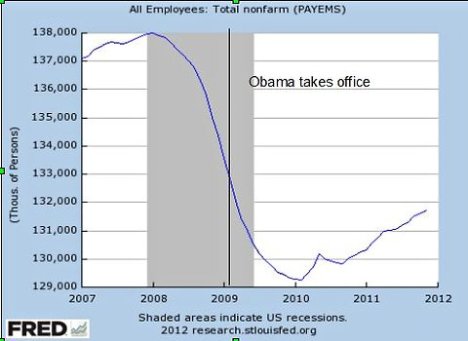
Here are two charts concerning job losses and gains. The first represents the time shortly before President Obama took office until roughly today:

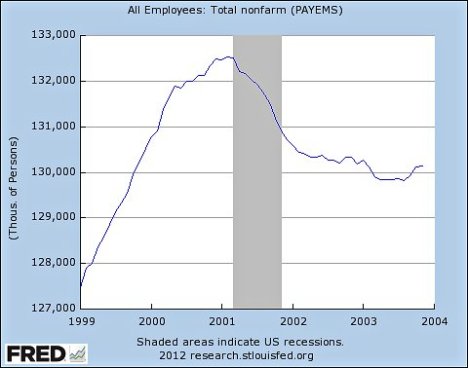
And this next one represents the recession faced by Bush, plus a comparable period of following years as compared to the previous chart:

via Paul Krugman