

Go on. Click it. It’s interactive and all that jazz.
Filed under: Astronomy/Cosmology/Physics | Tagged: Mars | Leave a comment »

 | septrose14 on Reddit layoffs |
 | shelldigger on Thought of the day |
 | The Sauciest Duck on Chauvin and Rittenhouse |
 | Michael on Chauvin and Rittenhouse |
| Stephen Moreton on Chauvin and Rittenhouse | |
 | Mele Kalikimaka | Fo… on Merry Christmas |
| Mele Kalikimaka | Fo… on Mele Kalikimaka |
 | somdeblahiriyahoocoi… on Thought of the day |
| Michael on Wuhan virus and one last… |
| Quick correction | F… on The A-Unicornist, Bernie Bro… |
Go on. Click it. It’s interactive and all that jazz.
Filed under: Astronomy/Cosmology/Physics | Tagged: Mars | Leave a comment »
The Perseids have actually been active for several weeks now, but whereas it’s a cloudy weekend where I am, they are naturally at their peak over the next few days:
Experts predict this year’s Perseid meteor shower will be an impressive sky show, with a waning crescent moon expected to interfere only slightly with the night sky display. During the meteor shower’s peak this weekend (late Saturday night and into early Sunday morning), many fireballs may also visible in the night sky, NASA officials said.
“We expect to see meteor rates as high as a hundred per hour,” Cooke said in a statement. “The Perseids always put on a good show.”
Filed under: Astronomy/Cosmology/Physics | Tagged: Perseids | 1 Comment »
This is one of the cases where the circumstantial evidence is overwhelmingly convincing – the gun has smoke and fingerprints, we saw the murderer buy it, we saw him take it with him, we know he was at the scene, and we know he wanted to pull the trigger, but we didn’t actually see him fire the gun:
To the layman, the Higgs boson is the “God particle” and a key puzzle piece in the scientific explanation of the origin of the universe. Physicists around the globe—and perhaps elsewhere, given the size of the universe—have invested billions of dollars in research and have been hunting for the Higgs boson for decades.
Researchers at the European Organization for Nuclear Research (or CERN) are expected to announce Wednesday that they have proof of its existence, reports The Associated Press.
The Higgs boson appeared 13.7 billion years ago in the chaos of the Big Bang and turned the flying debris into galaxies, stars and planets.
Its formal discovery, according to a broad scientific consensus, would be the greatest advance in knowledge of the universe in decades and a key to confirming the standard model of physics that explains what gives mass to matter and, by extension, how the universe was formed, according to the AP…
[S]cientists are in a bit of a quagmire, according to the AP. While they appear to have enough evidence to report the existence of the “God particle,” they still hedge on whether to report “a discovery.” It’s a fine line, indeed, but one that scientists will likely continue to debate.
“I agree that any reasonable outside observer would say, ‘It looks like a discovery,'” British theoretical physicist John Ellis, a professor at King’s College London who has worked at CERN since the 1970s, told The Associated Press. “We’ve discovered something which is consistent with being a Higgs.”
I’m actually not sure if my analogy does all this justice. They may be closer than any layman really knows. And since my whole thing is biology, I’m not going to bother trying to dissect it all. I will, however, be ready to post whatever great explanations I do find on this. (I’m look at you, Ethan Siegel.)
Filed under: Astronomy/Cosmology/Physics, News | Tagged: CERN, Ethan Siegel, God Particle, Higgs boson, physics, Starts With A Bang | Leave a comment »
Have you ever wondered what 200,000 galaxies look like? Thanks to the European Southern Observatory’s VISTA telescope, now we all know:

Filed under: Astronomy/Cosmology/Physics | Tagged: Deep space, European Southern Observatory's VISTA telescope, Galaxies, UltraVISTA survey | 1 Comment »
I have often found myself contemplating which is more amazing, the sheer scale of the Universe or the complexity of life? It isn’t easy to find an answer, but I’ll do my best to very briefly explain my thinking on this.
Despite my field being biology, and despite finding nothing more amazing on Earth than the evolution and subsequent complexity of life, I have to fall on the side of the size of the Universe. I think I’m going to be in the minority on this one, but I’ve given it some thought. Here is why I think what I do.
It isn’t possible for an individual to know everything about a single field. I’ve had incredible biology professors who have told me that they are lucky to understand 1/3 of what they read in scientific journal articles concerning biology. This is because in order to become an expert on anything, it requires one to focus on a relatively small subset of facts within a field. Just look at how biology breaks down: microbiology, biochemistry, genetics, cell biology, zoology, botany, anatomy, physiology, embryology, evolutionary biology, molecular biology, and so on. This sort of division is going to be true of just about any field. (I can’t think of any exceptions.) How can we expect anyone to understand it all? We simply cannot. But that isn’t to say we can’t understand it all as a species. In principle, we can understand everything that has to do with biology. We can break it down and analyze each bit, no matter how esoteric and specific. That doesn’t mean we necessarily ever will, but there is nothing preventing us from doing so. We have the ability, when we pool all our resources and minds, to understand everything there is to understand about life and its evolution.
I don’t think we can say that same thing about the sheer scale of the Universe. For the sake of argument, I will limit myself to the observable Universe. But right there. Look at what I just did. Without fear of losing any ground in my argument, I limited my scope. Yet my whole point is scope. That’s just how huge the Universe is. And how can anyone truly appreciate that? No human is going to travel any distance from Earth that is notable on the scale of the Universe. Even our space probes that are now on their way to interstellar space have done so little; being impressed by that distance would be like being impressed that an atom moved a tiny fraction of a fraction of a fraction of its radius to the right. I would say to now imagine that analogy increased trillions upon trillions upon trillions upon…of times, but of course you can’t. No one can. We don’t have any way, in our small lives, to really comprehend something like that. The Universe is enormous. Just enormous.
We can pool our minds together as a species and come to a great understanding of all that surrounds us. All our physicists and astronomers and cosmologists can give us a tremendous understanding, via science, of how it all works. They can even describe, with numbers on paper, how large the observable Universe is. They can show us incredible pictures of thousands of galaxies (in just a small sliver of the sky), each with billions of stars and billions of planets. And it really all is wonderful. But no matter how many brilliant minds we put to the task, we can never appreciate the sheer scale of what is. It is, in every meaning of the word, beyond us.
Filed under: Astronomy/Cosmology/Physics, Biology, Science | Tagged: Astronomy, Biology, Cosmology, Evolution, physics, Scale of the Universe, Science | 2 Comments »
I’ve been following a comment thread over at The A-Unicornist that has mostly revolved around the First Cause argument. In it was this gem from family-harasser Jack Hudson:
…causation isn’t logically dependent on time.
This made me literally laugh out loud. It demonstrates what is one of the most incoherent view of reality I think most Christians hold. I’ve explained how it all works on FTSOS as well as in the comment thread, but I think it bears repeating one more time what, exactly, causality is.
Newton’s third law says that for every action there is an equal and opposite reaction. Another way of saying this is, for every cause there is an equal effect. Or, to use exactly equal language again, for every force there is an equal opposing force. With that under our belts, let’s look at what force is.
Simply put, force is mass multiplied by acceleration, or f=ma. Let’s break it down further. What is acceleration? It is the change in velocity of an object over time. In other words, find the change in velocity in an object and divide that change by the amount of time it took for said change to occur and you’ve got acceleration.
I think if I left things at this point many people would be able to figure out the implications of what I’m saying. However, since I know Jack (who is obsessed with FTSOS) and other Christians will be reading this, I will spell it out. In order for something to have a force, it must have mass and acceleration. And in order for something to have acceleration, it must have velocity. And in order for something to have velocity, it must go through time. Tie it all together and we see that time is of the essence. At least to introductory physics. Without time, there is no causality. And what did we have ‘prior’ to the Big Bang? Certainly not time as we understand it. Therefore, it is logically incoherent to use the idea of causality in order to argue about how the Universe began.
If more Christians understood science, we wouldn’t have these sort of problems.
Filed under: Astronomy/Cosmology/Physics, Philosophy | Tagged: Causality, First cause argument, Jack Hudson, Newton, The A-Unicornist | Leave a comment »
I have long wanted to put forth the point that there are more planets than stars in the Universe. This goes to my contention that it is reasonable, even necessary, to believe that there is copious life in the Cosmos. After all, from the time when Earth’s surface cooled to when life began to appear was relatively short. It appears that all it takes for self-replicating molecules to get going is the right conditions. With so many planets, the opportunities are so vast; it has surely happened over and over again.
But I haven’t been able to make this exact point. I have still made the same effective point, but I had to rely on the trillions and trillions of stars. Of course, plenty of people have inferred over the years, especially the past decade, that there must therefore by billions, maybe trillions of planets. But we need something more concrete. We need observation. And now it looks like we’re there:
Three studies released Wednesday, in the journal Nature and at the American Astronomical Society’s conference in Austin, Texas, demonstrate an extrasolar real estate boom. One study shows that in our Milky Way, most stars have planets. And since there are a lot of stars in our galaxy — about 100 billion — that means a lot of planets.
It could be that the Milky Way is a weird outlier, a galaxy where planets are easy to make. But there isn’t any reason to suspect that. The observations show that we are an average galaxy with an expected array of stars. What’s more, we are seeing what happens around stars. It isn’t just that these giant gas balls form in space and that’s that. No, it’s much more. Most of them come with their own planetary pals. An accurate average of the star-to-planet ratio remains to be seen (they say 1.6 planets per star, but that is probably extremely low), but it is clear that we’re talking about trillions and trillions out there.
None of this changes the thrust of my argument about exo-life, but it does allow me to be much more specific. This is very nerdexciting.
Filed under: Astronomy/Cosmology/Physics | Tagged: American Astronomical Society, Exo-life, Exoplanets, Galaxies, Nature | 2 Comments »
I literally said “whoa” when I saw this:
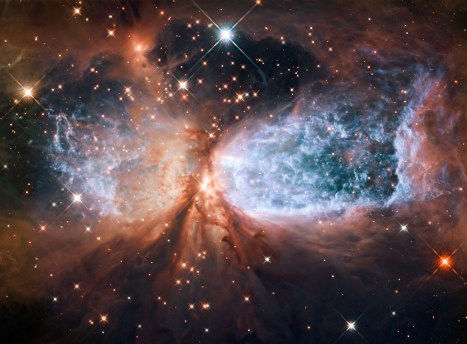
Filed under: Astronomy/Cosmology/Physics | Tagged: hubble, Snow Angel | 5 Comments »
The final total lunar eclipse for the next three years is set to take place this Saturday morning. It apparently will be pretty awesome for those on the west coast of the U.S., showing off some purdy deep reds, but I’m sure it won’t be disappointing on the east coast either.
It is scheduled to start at 1:45am EST and continue for a couple of hours. By 3:05am, the moon should be completely engulfed by Earth’s shadow.
Filed under: Astronomy/Cosmology/Physics, News | Tagged: Lunar Eclipse | Leave a comment »
The Universe is enormous. Just enormous. It isn’t possible to truly grasp the scope of space out in…space. There are literally more stars – far more stars, in fact – in the Universe than there are grains of sands on all the beaches and in all the oceans of Earth. It’s really mind-boggling. But that mind-bogglitude (yeah, “bogglitude”) does lead to a few things that are comprehensible and expected. Enter NASA’s recent discovery:
NASA’s planet-hunting Kepler spacecraft has confirmed the discovery of its first alien world in its host star’s habitable zone — that just-right range of distances that could allow liquid water to exist — and found more than 1,000 new explanet candidates, researchers announced today (Dec. 5)…
The potentially habitable alien world, a first for Kepler, orbits a star very much like our own sun. The discovery brings scientists one step closer to finding a planet like our own — one which could conceivably harbor life, scientists said.
“We’re getting closer and closer to discovering the so-called ‘Goldilocks planet,'” Pete Worden, director of NASA’s Ames Research Center in Moffett Field, Calif., said during a press conference today.
This is certainly exciting, but it is also practically expected. With the billions and billions of galaxies out there, along with the trillions and trillions of stars and planets, there is bound to be more than a few balls of rock that are very, very similar to Earth. Moreover, not only is our galaxy quite common, but so is our solar system. We have an average star with an average array of planets. There isn’t anything special or privileged about our location. To believe otherwise is to be deluded or desperate or tremendously small-minded. We’re going to see many more Earth-like planets in the coming years.
I expect the future findings of NASA to be very exciting indeed.
Filed under: Astronomy/Cosmology/Physics, News | Tagged: Ames Research Center, Exoplanet, Goldilcks, Habitable Zone, NASA, Pete Worden | 2 Comments »
 For the Sake of Science