


Filed under: Astronomy/Cosmology/Physics, Atheism/Humanism | Tagged: Carl Sagan, Cornell, Neil DeGrasse Tyson | 1 Comment »
VISTA images
Posted on March 29, 2010 by Michael
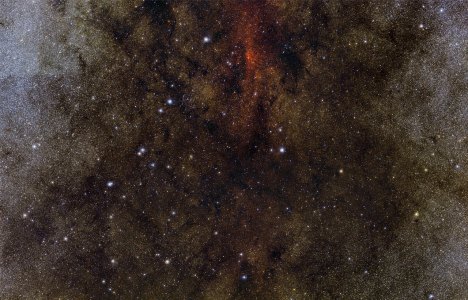
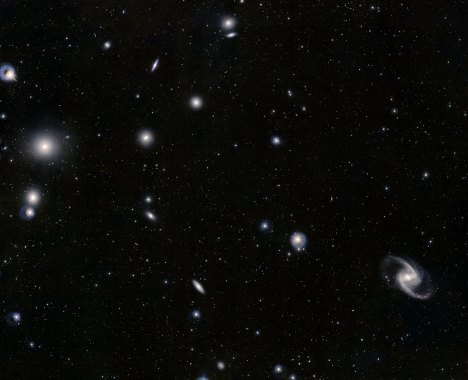
Because VISTA is a large telescope that also has a large field of view it can both detect faint sources and also cover wide areas of sky quickly. Each VISTA image captures a section of sky covering about ten times the area of the full Moon and it will be able to detect and catalogue objects over the whole southern sky with a sensitivity that is forty times greater than that achieved with earlier infrared sky surveys such as the highly successful Two Micron All-Sky Survey. This jump in observational power — comparable to the step in sensitivity from the unaided eye to Galileo’s first telescope — will reveal vast numbers of new objects and allow the creation of far more complete inventories of rare and exotic objects in the southern sky.
It has already taken some breathtaking images.

Filed under: Astronomy/Cosmology/Physics | Tagged: space, Telescope, Visible and Infrared Survey Telescope for Astronomy, VISTA | 1 Comment »
Hubble in Imax
Posted on March 15, 2010 by Michael
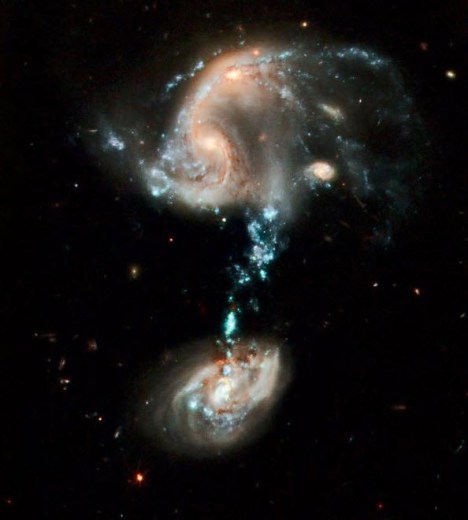
A short film about the history of Hubble and the images it captures – called “Hubble 3D” – premiered this past weekend.
But here are the money shots: The telescope’s new Wide Field Camera and infrared eye can look at– and shoot — stars, gas and dust 2.5 million light years out. Taking those photos and using advanced computer visualization, the film whisks viewers on scientifically realistic flights through time and space.
One rushes at, yes, warp speed (actually much faster) past the star Sirius, 50 trillion miles from Earth, to peer into the nursery of developing galaxies in the star cluster known as Orion’s Belt. A journey through our galaxy, the Milky Way, to neighboring Andromeda, reveals 2,000 galaxies and a massive black hole.
The article says Leonardo DiCaprio “ably” narrates the 43 minute film. Mayhaps one journalist doesn’t much like the actor.
The film is slated for wider Imax release for this coming weekend and then an even larger release in August. While it would be nice if everyone liked science for, well, the sake of science, there’s nothing wrong with a little eye candy. Especially in 3D.
Filed under: Astronomy/Cosmology/Physics | Tagged: hubble, Hubble 3D, IMAX, Leonardo DiCaprio, NASA | 1 Comment »
Orion nebula
Posted on March 12, 2010 by Michael
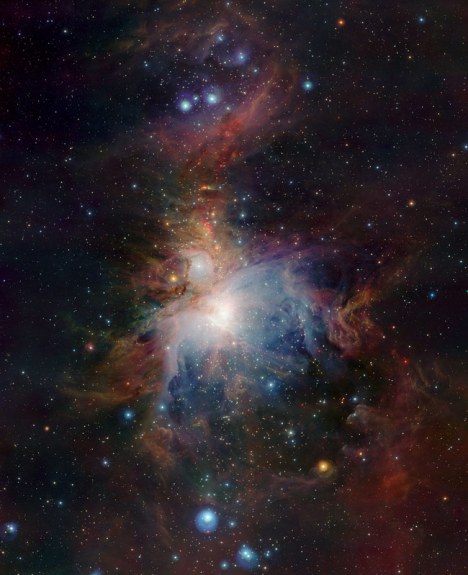
Observing infrared wavelengths of light, researchers have detected certain molecules which are pre-cursors to life as we know it. Such findings happen from time to time, this time in Orion’s nebula.
By sifting through the pattern of spikes in Orion nebula’s light signature, or spectrum, astronomers have identified a few common molecules that are precursors to life-enabling molecules, including water, carbon monoxide, formaldehyde, methanol, dimethyl ether, hydrogen cyanide, sulfur oxide and sulfur dioxide. Each spike in the spectrum corresponds to a particular molecule.
“This HIFI spectrum, and the many more to come, will provide a virtual treasure trove of information regarding the overall chemical inventory and on how organics form in a region of active star formation. It harbors the promise of a deep understanding of the chemistry of space once we have the full spectral surveys available,” said Edwin Bergin of the University of Michigan and the principal investigator of the HEXOS Key Program on Herschel.
Filed under: Astronomy/Cosmology/Physics | Tagged: Edwin Bergin, Herschel's instruments, HEXOS Key Program, Orion Nebula, space, VISTA infrared survey telescope | 1 Comment »
Another great Hubble shot
Posted on March 9, 2010 by Michael

I don’t know any details on this one and it isn’t recent, but it sure is purdy.
Filed under: Astronomy/Cosmology/Physics | Tagged: hubble, Hubble fotos, Hubble images, Hubble Photos | Leave a comment »
Hubble
Posted on February 24, 2010 by Michael
While my traffic has been way up since the Andreas Moritz incident, I know it isn’t going to stay that way. That’s why it’s especially disappointing that my Hubble contest post no longer shows up on Google images on the first page. It had been there for quite a long time, artificially boosting my stats, which in turn did raise the profile of FTSOS, if even only slightly. But since WordPress took me down for a couple days, that image has vanished from Google images. I suppose the best I can do is link back to it from time to time. More importantly, I suppose I can start making a few more posts about Hubble and Hubble news now.
But other than one of those slow news day stories, there doesn’t seem to be much out there. So in lieu of a real post, here is some eye candy.
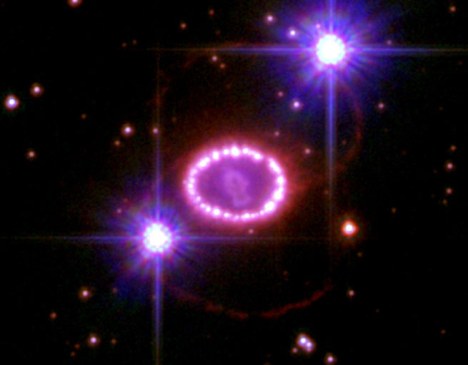
1987 Supernova
Filed under: Astronomy/Cosmology/Physics | Tagged: Google, hubble, Hubble images, Hubble Space, SN 1987A, space, Supernova, Telescope | 3 Comments »
Hubble captures Saturn’s aurorae
Posted on February 15, 2010 by Michael
Two times every 30 years it is possible to view Saturn’s aurorae from where the Hubble telescope is positioned. Since the telescope will be out of commission 30 years from now, this is the only image it will ever take where each aurora can be viewed simultaneously.
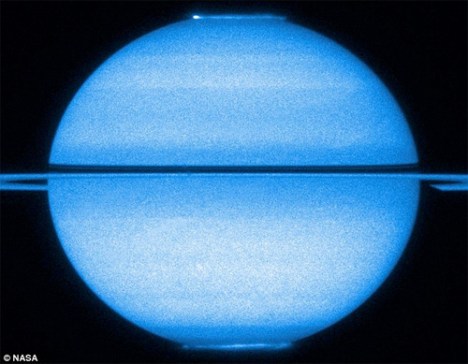
The principle behind these aurorae is the same that’s behind the aurora borealis, or northern lights.
Filed under: Astronomy/Cosmology/Physics | Tagged: Aurora, Aurora borealis, hubble, Hubble Foto, Hubble images, Hubble Photos, Saturn aurorae, Saturn rings, Saturn's aurorae, Saturn's Rings | Leave a comment »
Hubble captures Saturn's aurorae
Posted on February 15, 2010 by Michael
Two times every 30 years it is possible to view Saturn’s aurorae from where the Hubble telescope is positioned. Since the telescope will be out of commission 30 years from now, this is the only image it will ever take where each aurora can be viewed simultaneously.

The principle behind these aurorae is the same that’s behind the aurora borealis, or northern lights.
Filed under: Astronomy/Cosmology/Physics | Tagged: Aurora, Aurora borealis, hubble, Hubble Foto, Hubble images, Hubble Photos, Saturn aurorae, Saturn rings, Saturn's aurorae, Saturn's Rings | Leave a comment »
Astrology is bunk
Posted on February 7, 2010 by Michael
We are connected. Not in the trivial ways that the pseudoscience of astrology promises, but in the deepest ways.
Filed under: Astronomy/Cosmology/Physics | Tagged: Carl Sagan, Cosmos | Leave a comment »
No two galaxies are alike
Posted on January 25, 2010 by Michael
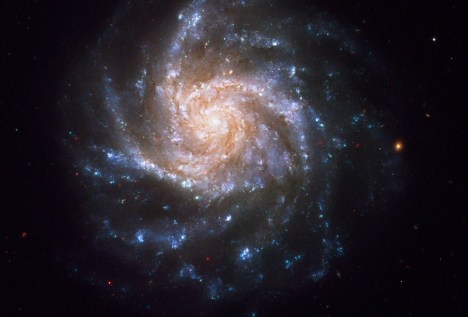
NASA has recently taken an image of a galaxy which is suppose to resemble a snowflake. I guess I can see it, but it’s hard not to just think “Oo, a spiral galaxy” instead.
Filed under: Astronomy/Cosmology/Physics | Tagged: Eridanus, Galaxies, Galaxy, hubble, Hubble Foto, Hubble fotos, Hubble Photo, Hubble Photos, NGC 1376, NICMOS, Rodger Thompson, Snowflake-Shaped Galaxy | Leave a comment »
 For the Sake of Science
