Pipeline nixed

I meant to post this yesterday, but it slipped my mind. Anyway, the pipeline has been delayed for now:

The Obama administration rejected the Canada-to-Texas pipeline because there was not enough time to complete a review of TransCanada’s $7 billion project, which included finding a new route around the sensitive region in Nebraska.

TransCanada said it would reapply for a permit and would continue to work with the state.

What we have is two sets of politics. One is stupid and the other makes sense/was forced. First off, the Republicans pushed for this issue to go ahead without proper reviews, without full input from the affected states, and they did so because their constituency likes to pollute stuff. The Obama Administration, on the other hand, denied this in part to appease environmentalists ahead of the election, but also because there wasn’t really much of a choice here.

So now TransCanada has reapplied for its permit. It will probably get approved in 2013 or shortly thereafter, but this could have all occurred even earlier if the Republicans didn’t shoot themselves in the foot. If they really cared about getting this thing built, they would have given time to let it be studied as to how to best go through Nebraska and other states. As it stands, they were just looking to make the President look bad; they were not concerned with getting anything done.

The Republicans only have themselves to blame for this one.

Paula Deen has diabetes

It looks like overweight TV personality Paula Deen has diabetes. She hasn’t officially confirmed it, but rumors have been swirling for over a year (I guess), and she is reported to be doing some interview tomorrow. She is also throwing her support behind some diabetes drug.

Take note, PZ. This is your fate if you don’t get your act together.

Martin Luther King Jr

Fat apologetics

When I wrote my recent post on the burden of fitness, I came across a disappointing, if unsurprising, movement: the fat acceptance movement. I’m all for treating fatties equally, but I’m not for suspending the use of terms like “fatties”. It is that sort of respect this movement is demanding; they don’t merely want respect for individuals – they want respect for fatness itself. I will never give into something that vile.

So that brings me to a recent spread by PLUS Model Magazine:

A magazine dedicated to plus-size fashion and models has sparked controversy with a feature claiming that most runway models meet the Body Mass Index criteria for anorexia.

Accompanied by a bold shoot that sees a nude plus-size model posing alongside a skinny ‘straight-size’ model, PLUS Model Magazine says it aims to encourage plus-size consumers to pressure retailers to better cater to them, and stop promoting a skinny ideal.

Everyone and their overweight mother [insert standard comment about Nate’s mother] has been promoting this link on Facebook recently. I don’t think any of them have given it much thought. If they did, they would see that it is filled with lies.

First, there is no anorexia criteria on BMI charts. Take a look. There is a category of “severely underweight” (not reflected in the provided image), but there is no indication given for what the cause is for being so underweight. And there shouldn’t be. BMI charts are meant to give a broad indication of the health of a population. They are not diagnostic tools for individuals. Just imagine someone who is 5’9″ and 185lbs. According to the chart, that person has a BMI of 27+ and is thus overweight. And for the general population, that will be accurate. But if we look at say, Wes Welker of the New England Patriots, we see that those are his stats. He isn’t fat by a long shot, but the BMI chart cannot tell us that. Pretending otherwise would be ridiculous. However, that is exactly what PLUS Model Magazine is doing at the other end of the chart.

Second, anorexia is generally characterized as a psychological disorder. Simply being skinny is not a disorder. This magazine should feel a little shame right now.

Third, most ads do cater to people in shape, but there are plenty of stores with plenty of clothing for larger women. I’m not one to peruse the lady areas of a store unless forced, but I have never been in a department store that sells clothing where there was not a preponderance of women’s clothes. (This is especially true as compared to men’s sections.) I find it hard to imagine all those clothes are size 3. This isn’t about getting companies to supply better garments. It’s about using fat models in order to make fatness more socially acceptable.

Fourth, there is nothing wrong with promoting a skinny ideal. I don’t place any moral significance on whether or not someone is actually fit, but I do place plenty on whether or not they try to be fit. Giving goals is a good thing. And if those goals are extremely difficult to reach, then all the better. I hope people will try even harder, even if they don’t make it all the way.

One [spread], printed alongside a photo of the Russian beauty holding a tape measure across her rear, reads: ‘Twenty years ago the average fashion model weighed 8% less than the average woman. Today, she weighs 23% less.

Maybe fashion models have become skinnier over the years. I don’t think I can deny that possibility, and, in fact, my inclination is to believe it is true. But that certainly is not the whole story. How about the fact that the average woman has become fatter? Just look at the analysis in my post about average breast size. Bra sizes have increased over the years. Part of the reason probably has to do with retailers altering what they consider to be A cups, B cups, C cups, etc, but most of the reason is likely the average increase in weight. And since breasts don’t tend to increase in size all by themselves without surgical intervention, I’m going to take a wild guess and say that average waistlines have been increasing as well. If PLUS Model Magazine was at all honest, they would have never used the above stat.

I don’t have a problem with efforts to make people feel good about themselves. Fine, do what you need to do to get through the day. But don’t try to convince me that fat people are healthy and doing just dandy. It isn’t true. What’s more, it’s a danger not only to society, but individual human lives as well.

Unemplyoment bill in SC

I can’t say I entirely disagree with efforts in South Carolina to reform how unemployment benefits are paid out. Basically, they want to get people back to work doing something. Some of it makes sense:

A Senate panel advanced bills Tuesday that would require people laid off in South Carolina to pass a drug test to receive unemployment benefits, then volunteer 16 hours weekly with a charity or public agency to keep receiving a check…

Another policy change would require people drawing unemployment benefits to accept job offers that pay incrementally less than their previous wages.

The change means those drawing unemployment benefits must accept job offers that pay 90 percent of their previous wage after four weeks. The percentage would drop every four weeks. After 16 unemployment payments, they’d have to accept 70 percent of their previous income. Once federal extensions kick in at 20 weeks, they’d have to accept minimum wage labor.

I can agree with the volunteer work to an extent. Currently there are companies which state that people out of work for certain periods of time need not apply. There have been movements to make it illegal to do that (which I support), but I don’t know of any state that has actually passed any legislation. Having people volunteer in certain areas would counter some of the concerns of the douchebag companies out there. (I don’t know the ins-and-outs of the bill, but it would make sense to include internships as well.)

Of course, this doesn’t come without its problems. A person on unemployment in South Carolina gets about $235 a week. As a single individual with roommates, I could get by on that if need be, but anyone with kids is necessarily going to struggle. I can’t imagine it would be easy to pay for daycare or a babysitter for 16 hours a week while already on such a tight budget. For some people the SC bill is only going to make life more difficult, thus forcing them onto welfare for longer. That would be counter-productive for everybody.

On drug tests, I think that’s just a stupid idea. Relatively few people on welfare spend their money on illegal drugs, so the whole idea isn’t practical. And for those who do imbibe such substances, the testing costs are astronomical compared to the savings for the states.

On forcing people to accept job offers that suck, there are two obvious problems. First, fuck you to anyone who forces a person to work at a particular place or for a particular wage. Given how fond Republicans are of pretending that taxes are somehow akin to enslavement, I would think they might be more sensitive to forcing people into certain actions regarding their economic well-being. Second, any company that sees a large gap in a person’s work history is liable to intentionally offer that person the lowest wage they know they can get away with. All this does is create cheap labor for businesses by unfair means. If the state wishes to encourage people to get off welfare, they should use the carrot, not the stick.

So, some of these ideas aren’t entirely terrible. I think it’s likely the volunteer idea is motivated by the Republican perception that poor people are inherently lazy and bad, but it does have some merit to it. Indeed, the drug testing idea has a similar motivation, though it has no merit. The forced-work/slavery idea is a terrible one, but it has seemingly decent enough motivations. But then, this is South Carolina. I really don’t expect them to fix any of their problems in a way which resembles anything rational. (Sorry, native South Carolinian Stephen Colbert.)

Government widens definition of rape

I was a little worried when I read the headline that the government is widening its definition of rape. As I wrote last month, the CDC already has a definition that includes acts which, although horrible, are not rape. Such inaccurate definitions dilute what it means to be raped. I can’t imagine doing anything much worse than that. Fortunately, the government is not going homeopathic on the term:

Until now, the FBI’s standard counted only forcible vaginal penetration of a woman as “rape.” The new definition expands rape to include oral and anal sex acts against women as well as men. It also says if a victim cannot give consent for any reason, the crime is a rape even if force is not used.

That includes any victim who cannot consent due to alcohol or drug use, who is under the age of consent, or who is mentally or physically incapable of consent.

Who knew that men weren’t included? Or anal and oral penetration? In fact, forced penetration with objects has not been included until now. All of these exclusions have always been a part of my definition of rape, as I have specifically said in the past. I had no idea, though, just how much I was only talking about my definition.

None of this is going to affect how crimes are prosecuted since states have their own definitions, but this will impact the accuracy of reporting:

“This major policy change will lead to more accurate reporting and far more comprehensive understanding of this devastating crime,” said Valerie Jarrett, a senior adviser to President Barack Obama.

“Without an accurate understanding of the magnitude of the problem, how can we effectively solve it? Definitions matter because people matter,” she added.

Now we just need organizations like the CDC to get on board. Reporting molestation and other terrible non-rape crimes as rape undermines the life-shaking experiences of those who actually have been raped, whether orally or anally or vaginally or with a foreign object. This change is a good thing.

“Booooo” Santorum

Rick Santorum is campaigning in New Hampshire, one of the few states that does not discriminate against gays in marriage and the site of the first Republican primary. I don’t think he’s going to do well there, but then who knew he was going to do well in Iowa. Of course, while Iowa also does not discriminate against gays in marriage, many of its citizens would prefer to turn the clock back. That gives Santorum and all the vile things he says a little power there. That probably won’t be the case in New Hampshire, and it certainly was not the case in front of a bunch of college students in Concord:

Rick Santorum was booed after a lengthy back-and-forth with several students in Concord, N.H., on the issue of same-sex marriage, which is legal in New Hampshire.

As Santorum addressed a group of college students, one asked him how same-sex marriage affects him personally and why not have legal same-sex marriage as long as it’s not religious in nature.

Santorum answered that for “230 years marriage has been between one man and woman. So if you want to change the law…you have to make the positive argument about why.”

This actually is sort of correct. In order for change to happen, those in favor of said change need to say why it should happen. However, the game has been rigged. People like Santorum never made their positive argument for marriage 230 years ago. They didn’t even give a second thought to gays and so marriage was assumed to be between one man and one woman. The onus is actually on him.

And what are his arguments? Appeals to tradition and inapt comparisons. The former is just an extension of the rigged game and is thus logically invalid; it isn’t a positive argument at all. The latter is why “Santorum” has the frothy definition it does.

But to Frothy’s credit, he stuck by his guns and tried to make the students justify their positions:

Santorum responded, “Are we saying that everyone should have the right to marry?”

Several members of the crowd loudly yelled, “Yes!”

At that point, the former senator from Pennsylvania compared same-sex marriage to polygamy.

“So anyone can marry can marry anybody else? So if that’s the case, then everyone can marry several people … so you can be married to five people. Is that OK?” Santorum asked.

I’m a little disappointed in the response. Students shouted back that they weren’t discussing polygamy. That is true and Frothy was creating a red herring, but I’m perfectly happy responding to his question: Yes, it is okay for a number of people to get married to each other at the same time. The only issue anyone can draw about that is how taxes would work out. New codes and laws would need to be created, and I’m not sure how that would or should go. But on the moral question, there is no doubt: there is nothing wrong with polygamy.

Frothy then got a little weird:

The student answered that [people] should [be allowed to do what makes them happy] as long as no one was harming anyone else. Santorum countered, raising his voice and asking, “Who decides if they are harming other people? Is there an objective standard?”

Wasn’t it Frothy who told people they needed to make positive arguments in order to defend their positions? If it is his contention that people are harmed by gay marriage, then he needs to say why. I have yet to see a remotely convincing argument for that position. Ever.

Santorum continued, but threatened to end the discussion, telling the crowd, “I’m going to give people one more chance and then we are going to move on. I’m going to ask the question again. If three people happen to get married based on what you just said, what makes that wrong and what you said right?”

“That’s irrelevant,” the student responded. “My personal opinion is, ‘Yeah go for it,’ but what I’m asking [is] for you [to] justify your belief and your high morals about all men created equal-”

At that point, Santorum cut off the student and, for the third time, asked, “What about three men?

Emphasis added.

Politicians tend to be pretty good when it comes to rhetoric. They certainly misstep, but they’re still better than the average Joe when it comes to this stuff. That includes Frothy. Except in this case. Using good rhetoric means, in part, appealing to one’s audience. If he was speaking to a bunch of sexually immature, sexually insecure Evangelicals, then sure, mention the idea of three men having sex. That would gross them out. “Icky!”, they would think. But saying that in front of a bunch of pro-equality college students is going to fall flat. In fact, it just made him look even worse.

When he wrapped up, several questions later, the crowd loudly booed him.

I think Frothy still has some learning to do. Maybe he should look to his biggest opponent. After all, I’m sure Romney wouldn’t have had a problem saying whatever would have please the crowd.

The burden of fitness

I have written a number of times recently about the problem of obesity. It is a public health crisis that needs to be addressed, of course, but my focus has been different. Whereas the fact of being fat is a bad thing from a public stance (and a private stance for those who are, indeed, fat), it is not a moral issue. Where morality does play a role, however, is in the lack of an honest effort to be healthy. I call this the burden of fitness.

The first things which come up when I start making this argument are whining about how I’m not sensitive to how difficult it is to be fat, how hard it is to eat healthy for the poor, and why I think it is okay for me to impose my morality on others. To address them for the nth time (not that most people are interesting in understanding this argument): the burden of fitness one person bears will be different from the burden another person bears. A fat person cannot be expected to run 5 miles with any bit of ease or even regularity. A poor person cannot be expected to eat the best foods possible. They still need to do what is within their power to be as fit as possible, but I fully acknowledge that their power is limited. (None of this, of course, addresses the millions and millions of Americans who are fat and relatively wealthy and/or relatively able.) And on morality, I don’t want to impose my morality on anyone. That doesn’t mean that I can’t hold a moral position on the matter. After all, if it is wrong to intentionally and willingly mistreat a human body, I don’t see why that logic should not apply to one’s own body. The only difference comes when the issue of societal enforcement is addressed. Clearly a person’s autonomy is the biggest factor there.

Now that I have that out of the way, it is because I see people as bearing a burden of fitness that I fully support an effort in Georgia to aggressively go after the issue of childhood obesity:

“Being fat takes the fun out of being a kid,” read graphics of a TV ad in which a young girl tells of how she doesn’t like going to school because she’s bullied over her weight.

It is part of a video and print campaign to combat childhood obesity in Georgia, which has one of the highest childhood obesity rates in the nation…

“We needed something that was more arresting and in your face than some of the flowery campaigns out there,” said Linda Matzigkeit, senior vice president of Children’s Healthcare of Atlanta.

Some people are naturally worried that this will stigmatize fat kids, but I think that worry ought to be secondary. First of all, fat kids are becoming the majority. There is no more “the fat kid” in class. The article has been changed to “a”. Being overweight still brings with it unfortunate mockery, but today’s environment cannot possibly be anything like that of years past. Second, none of the efforts thus far have worked. Coddling fat people and telling them to be proud of their bodies is detrimental not only to them but to society in the form of healthcare costs and lost productivity. We need this new approach.

But let’s not lose sight of things here. As I said, one’s burden of fitness will change under different conditions. That is, context matters. Poor or disabled people bear less of a burden. Children, then, must bear little to no burden, depending on age. They don’t control what food is bought for them, nor should we expect them to be well educated on health or even have great foresight on the matter. That is why this campaign is also targeting parents:

The organization also made a point to specifically target parents. One TV spot shows a child looking miserable and asking his mother “Mom, why am I fat?” His equally overweight mother sighs and looks ashamed.

Good. Adults are to blame for virtually every case of obesity in America. It is their responsibility to do a better job. If that means guilt-tripping them into action, then so be it.

Something has to be done. Even for all the people who don’t see how morality factors into this (not that anyone ever addresses that argument), it cannot be denied that there are important issues at stake here. The nation is on its way to overwhelming healthcare costs, even as we improve our ‘system’. Our productivity has to be impacted. Even our ability to respond to natural disasters is impacted – how much clean up effort can be had from a person carrying an extra 100 pounds? We have to do something to get people moving again. The health of the nation clearly depends upon the health of its citizenry.

Jobs, Obama, and Bush

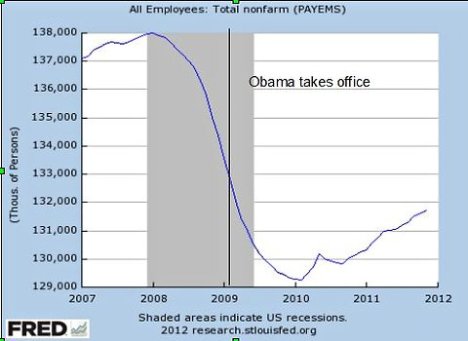
Here are two charts concerning job losses and gains. The first represents the time shortly before President Obama took office until roughly today:

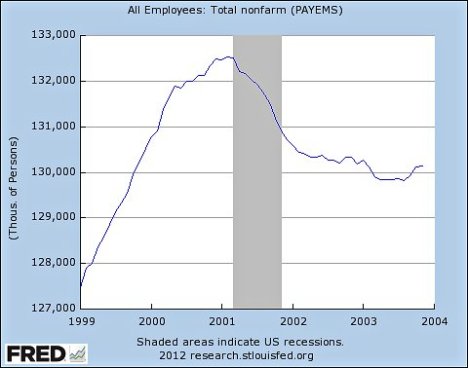
And this next one represents the recession faced by Bush, plus a comparable period of following years as compared to the previous chart:

via Paul Krugman

Well, that was interesting

I recently praised PZ for finally looking to shed his extra pounds. Aside from his lack of health being disrespectful to his own body, he runs the chance of leaving his loved ones behind too early – and for no good reason. I stand by that praise, and even though I am fully aware that it comes across as if I am just trying to insult a fat guy, I do genuinely mean it.

Unfortunately, PZ doesn’t see it that way. In the comment section of the post that inspired what I wrote, things took an ugly turn. I presented my argument that it is wrong to not try to be healthy. The first reaction – and it is always the first reaction – is to say I think it is wrong to be fat. I don’t. The issue is with putting forth an honest effort to be healthy. The results are not important, morally speaking. And just as I did in my post about obesity, I allowed for a huge swath of caveats. Some people have conditions which prevent them from putting forth the same effort as others. Other people work long hours and have to take care of children at the end of the day. Still other people have limited access to healthy food. It would be unreasonable to expect everyone to be able to put forth the same effort. That doesn’t mean, though, that it is magically impossible for people to attempt all they can – there is almost always a better choice available on the grocery store shelves – but I fully acknowledge that it can be difficult. I always have.

This, unfortunately, led to an extended discussion on poor people and food stamps. Apparently I hate them all because I don’t want to subsidize lobsters. The truth is, welfare funds are a limited resource. If we allow people to spend money on expensive items, they will have less for what they actually need. I saw this first hand while working at a grocery store in high school. People would use the last of their food stamps regularly on $30-70 worth of lobster. I can think of far better ways to use those funds.

The “counter” (if you can call it that) to this argument is that people get X amount of dollars and so it doesn’t matter how they spend them. (Oh, and I don’t think poor people deserve nice things, apparently.) This is a patently stupid argument. If I am given $200 a month for food and I need $300, $100 is coming from my pocket. However, if I buy luxury items, that eats into what I have been given. That means I will get one nice meal, but that might add another $30 to what comes out of my wallet. This does not help the poor; it allows some people to abuse their funds, forcing them to stay on welfare longer. That is, nobody is going to get back on their feet by spending money on things they don’t need at the expense of things they do need.

And, of course, this all means I must be a Ron Paul-loving, Reagan-blowing libertarian Republican. Right. No, my position is a utilitarian one. Welfare funds are not unlimited. It doesn’t make sense to allow them to be used to buy anything under the Sun. In fact, PZ and co are in the minority in what they think. Most states restrict the use of food stamps on some items (such as expensive energy drinks), and certainly no state allows the funds to be used for restaurants. And the states are right to do so. But what’s really interesting about this is that PZ and everyone else, once we get past the government intervention, is kicking into uber-libertarian mode. “Who are YOU to say what people should buy?!” Right. I’m the libertarian here.

The end result has been a ban. I suppose I’m okay with this. After all, throughout my Maloney troubles, PZ never responded to a single email or request for help. He, of course, is not required to do so, but let’s not be coy. I have disagreed with his rampant sexism in recent months, so he has no interest in helping me fight junk science. Emotion overrides logic here; if I never commented on his site, he would have been the first to help me. Besides that, the majority of his posts have nothing to do with atheism anymore. Sure, he has those spammy “Why I am an atheist” posts that have given my scrolling finger a good workout, but he mostly writes about feminism and stupid Internet polls. Overall I have still enjoyed him, but that is happening less and less each day. Without the writing he had as of a few years ago, I don’t care for much of what he has to say anymore. I’ll stick with Jerry Coyne, Friendly Atheist, and Starts With A Bang! for my big name bloggers.

At any rate, I hope PZ does manage to lose the excess fat he has. He’s older and has had health issues, so I don’t expect fantastic results, but I’m happy he is at least trying. After all, that’s all that matters.