Our failing schools

It isn’t possible to list and discuss every single problem public schools in America face today. It would probably even be unwieldy to discuss just a small percentage. But there are some big issues that need to be tackled.

Researchers found that only 28 percent of biology teachers consistently follow the recommendations of the National Research Council to describe straightforwardly the evidence for evolution and explain the ways in which it is a unifying theme in all of biology. At the other extreme, 13 percent explicitly advocate creationism, and spend at least an hour of class time presenting it in a positive light.

This presents an obvious issue: teachers aren’t telling students a fundamental truth about the world. That’s more than a shame and we need to correct it. First, fire every single biology teacher that professes creationism to students. Second, give the teachers that are too timid or ill-prepared on the topic better tools. (I don’t know why a biology teacher should be ill-prepared to teach something so basic to an entire field, but here we are.) There are plenty of computer programs, textbooks, popular books, videos, documentaries, etc out there that can bring evolution to life for students.

But there is a deeper issue here. We have national standards for education that just aren’t being implemented. Sometimes it’s because the standard is only recommended, other times it’s because of bad teachers, and still other times it’s because of conflicting local standards. I know how popular it is to claim that local governments should be putting forth their own ideas on education, but it isn’t that black and white. There are necessary levels students need to be obtaining in order to be prepared for higher education. When local governments are given too much power, we often see lower standards.

That’s no good.

There is an expectation on the higher education level that students often are not meeting. This either slows down introductory courses or forces students to take sub-100 level classes in order to catch up. It’s a waste of money and time. Part of the solution has to be better implementation of national standards. This is what colleges and universities across the country need. It is at that level that the tempo is being set; we need to force our primary and secondary schools to meet that challenge.

And if anyone wants local control, by all means, draft proposals that require students to exceed far beyond anything our national standards might demand.

The original study can be found here. Thanks to Nancy H for the links.

On abortion

Let’s get one thing out the way first. People who view abortion as being the murder of human beings are not inherently anti-women’s rights. Just the same, people who view the issue as being a fundamental choice that ought to be left up to women are not inherently pro-abortion, much less pro-murder. Both arguments are just dishonest rhetoric.

The question of the morality of abortion can be viewed from a number of perspectives, but I want to focus on the most common issue: When does life begin? I don’t think the answer is so clear.

My big motivation for this post comes from a number of red herring theists, none of whom were able to argue in a coherent fashion. Since they insisted on avoiding the topic at hand (the support for their position), instead demanding I answer their questions (about my position), they are welcome over here in order to appropriately address where I stand on abortion.

Perhaps the most tempting way to define the beginning of humanity is the point of conception. And there’s some good reason. It marks the point where the genetic material for a person all comes together. Usually. In some instances of twinning the embyo can split in two up to four days after it was conceived. As a result, we have two groups of cells that, provided everything goes to plan, will end up as two living, breathing newborns. The problem that this raises is that we can no longer call the point of conception the absolute beginning of humanity. In these instances, conception results in one set of cells. It was only after conception that a new set of cells emerged. Unless we’re ready to call that ‘second’ twin non-human, we have to abandon this imaginary line in the sand.

But let’s go with the most logical counter-argument: Okay, it isn’t that conception marks the beginning of humanity; it’s something about conception that makes that mark. In that case, what? I think the best answer is that it is the emergence of cells which can result in the birth of a newborn which defines the beginning of humanity. That covers twinning. (The fact that the aforementioned red herring theists could not articulate something so simple and obvious makes me regret the time I wasted giving them any sort of respect.) But this answer isn’t without its problems.

What is it about this emergence of cells that is special? What makes this moment so important? The most logical answer is that it marks the beginning of development. (The red herring theists confused development for humanity.) It is the point where cells can start to form a full organism. But what more is this than the arbitrary declaration that a certain level of potential development is important? When gametes come together, yes, that marks the start of development, but so what? It isn’t development itself. It isn’t a full organism. It’s just a baseless valuing of potential. I could just as easily point to the emergence of a fully formed gamete and say that that marks a key point in development. “Why, a sperm has the potential to become a human!” And I would be right. The counter-argument would be, “A sperm can’t become human on its own” and the easy response is that neither can two gametes just because they’re combined. The whole process depends on a massive number of factors. That’s why it’s a process.

I like to compare the arbitrary line-drawing to the mark of American adulthood: the age of 18. It isn’t like a 17 year old is appreciably less mature the day before his next birthday compared to the day after. The line is ultimately an arbitrary one. That doesn’t mean it doesn’t have value. The fact is, if we want to have a coherent system of law, we must declare some age as especially important in distinguishing between childhood and adulthood. Eighteen is a reasonable number. Just the same, we need to do the same with how we want to define what it means to be human.

Now I need to clarify even further (or at least re-emphasize). The starting point of development is a technical concept; it isn’t a difficult one, but it is technical. That is when we can say the road to humanity has begun. If we want to go further and say that that is the marker of humanity itself, then we need to explain why. That is, “humanity” isn’t some technical, scientific term we can apply to conception. (We can apply it when we’re talking about species, presuming we’re using it interchangeably with “Homo sapien“, but we can’t go beyond that; we can only say “That is a human egg/that is a human sperm/that is a human zygote.” When we start using “human” as a noun rather than an adjective, we’ve lost all embryological meaning.)

So that brings us to my position. As I said, the line in the sand isn’t clear, no more than it’s clear that an 18 year old is or is not really an adult. I do believe that if an embryo is a human being, then we must protect it. There are persuasive arguments, especially from Judith Jarvis Thompson, which say we don’t have that responsibility even if humanity begins at conception, but I don’t buy into them. I value human life highly and as a result I feel it necessary to protect whenever possible. But I reject the idea that conception is some magical point where some cells go from non-human to human. I still see cells.

I hope it is clear that it is the process of development where I see real value. It is patently absurd to say a human life begins at conception, as if development is unimportant to how a person turns out. Take another look at twinning. There is a point where everything is exactly the same between each set of cells. At that instance, there is no difference between the twins. So how can anyone say we are looking at two different humans? If there is no difference, there is no difference. And if that’s true (and it is), then there must be something else which goes into defining a human. We call that development. And that isn’t without its problems.

Just as the assertion that humanity begins at conception suffers much like the assertion that an 18 year old is an adult, the process of development suffers from a lack of clear lines. But it does offer reasonable lines. We can figure out viability, ability to feel, development of consciousness, and even employ caution. This often brings us to approximately six months. But I’m open to moving that mark. Maybe there are key factors in development which take place by five months, even four. Maybe those factors matter in how we define the important aspects of what it means to be human. A persuasive argument might get me to adjust my position. And in all likelihood, that position will only move down in number of months, if it moves at all. It seems there is too much doubt in moving up beyond seven months. Certainly at the eight or nine month mark that line in the sand has almost completely vanished; it wouldn’t be reasonable to claim a fetus is not a human at 9 months, 1 week, and 6 days, but when it’s born at 9 months, 2 weeks, why, we have ourselves a full-fledged human. That’s just as arbitrary as declaring conception the beginning of humanity.

So discuss the issue. But keep this in mind: while I don’t normally moderate comments except for obvious spam (such as ads), I will be moderating them here for blatantly dishonest (and bad) rhetoric. In other words, don’t call someone pro-abortion or anti-women’s rights merely for holding an opposing view.

The red herring theist returns

I wrote a couple of months ago about the notorious red herring theist. That’s the person who will move the discussion from whatever the topic at hand is in order to attack atheists. It’s the same thing every time: “What? You think something is wrong? You have no basis for saying that because you don’t believe what I believe! Morality must be objective in order to say anything is true!” It’s tiresome if only because it’s pathetic. What’s more, there isn’t a person on the planet who somehow adheres to any sort of objective morality. People will claim they do, but they are necessarily interpreting ideas subjectively. When a believer says “God tells us what is moral”, they are coming to their conclusion through a subjective interpretation of (what they think is) the evidence. Furthermore, even if I grant that morality can be objective, theists undermine their case all the time.

What brings this on is my recent participation at the site of a religious nutbag. My first comment was to his bad post about Planned Parenthood. The important part of his post claimed that humanity begins at conception (whereas the rest of his post was the use of anecdotes to draw broad conclusions). When pressed on why conception is the best marker of humanity, he just kept repeating his position, sometimes citing anti-abortion websites which said the same thing. Great. But that doesn’t tell me anything. I eventually got one user to answer the question when she cited the coming together of chromosomes, but I was unable to get her to go further before the administrator nearly banned me. And I was the most respectful person the whole time. I know. It’s crazy.

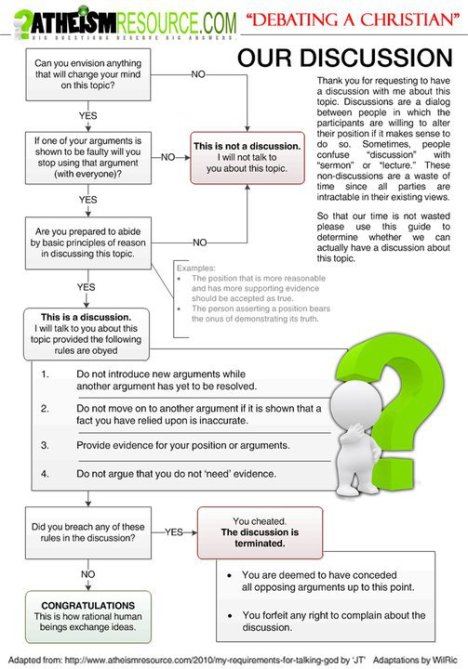
I plan on making a separate post about abortion, so I will address their dogma arguments there. Of course, that would be the appropriate thing to do, right? Not according to Roxeanne. She insisted that I tell her my personal views in response to the questions I was posing. That is logically inappropriate. The issue at hand needs to be resolved; it is only a red herring to go after my views as a means of defending her views. To help clarify:

And she isn’t even a Christian.

She violated number 1 in the list over and over again. That apparently makes me dishonest. Oh, and a “jerk” and “stupid” and somehow sexist. Okay, okay. The sexist part doesn’t come from that, I admit it. I actually accused her of grabbing the mantle of science. We all know how sexist that is, amirite? (Oh, and for the record, she said I called her anti-scientific; her point in claiming that was to brag about her undergraduate degree in engineering (because that constitutes authority in biology?), but she was wrong. She may very well be as anti-scientific as a creationist theist (just like the blog owner), but I was calling her position an attempt to misuse science. I said very little of her.)

Then there comes the Comments tab. The blog owner goes on and on about some random Internet guy and his supposedly bad arguments, but he only quotes one supposed comment. Who knows what the real context was. But since the author had some obvious flaws in what he said, I quickly pointed them out: 1) In addressing the charge of being censorious, he cited that awful creationist movie Expelled; 2) he said Darwinists insist that evolution explains the origins of the Universe; 3) he said reason and logic are “clearly” immaterial. The issues are obvious: 1) the false charge that anyone from Expelled was censored doesn’t even begin to address whether or not he was right to censor others; 2) it is creationists who often conflate evolution with the Big Bang – I have never once witnessed a Darwinist (he means atheist) do that; 3) reason and logic are products of the electrical impulses in our brains. So are our thoughts, our feelings, our perception of reality.

Of course, he hardly responded to any of that. Of what he did say, he had two revealing replies. First, I pointed out that when he says “morality”, he really means objective morality. This is a common error of assumption theists make. It’s annoying. If we’re going to compare objective and subjective morality, we need to use our qualifiers. Aside from creating a lack of clarity in discourse, it’s begging the question: if we’re trying to determine what is moral and one side is asserting that objectivity is the key factor, then they don’t get to assume “objective” in front of morality. It would be like saying, “What makes objective morality objective is objectivity.” This shows an unwillingness to approach the topic in a way resembling any sort of fairness (or logic). Second, he claimed that he embraces science. Let’s take a peek.

I don’t reject science, I embrace it as discovering how God put his universe together.

That sure doesn’t sound like an “embrace” of science to me. It sounds like he will only accept science which reaches the conclusion he already has. Need more proof? No problem.

My evidence comes before science. I see the evidence for God and the supernatural and I see evidence in the natural and how science sometimes gets it right.

That is an outright rejection of what science is, of what it stands for. By only accepting what reaches his pre-held conclusion, he shows an unwillingness to look at any evidence objectively; every idea he will ever have on science must be distrusted. He’s a walking stereotype.

The primary reason for this post was that I was apparently banned (despite being the only respectful person there – and you all know how dirty that makes me feel). I have no idea where the administrator said I would no longer be allowed to post, but I thank Dan Trabue for letting me know before I made some big reply. As it turns out, my comments are ‘only’ being held in moderation. As a result, I won’t be making any further posts over there; someone who feels the need to moderate perfectly rational discourse for no more reason than because he disagrees with it is not someone I can trust.

Gay marriage updates

Here are just a few of the recent news stories concerning gay marriage:

  • Dubya’s daughter, Barbara, has come out in support of gay marriage. She is helping the fight for basic equality in New York. Currently, thousands of families with gay heads of the house are being forced into unnecessary financial difficulties while they face bigoted social stigma. It ought to stop.
  • Illinois has taken a step in the right direction by legalizing civil unions. Gay couples will still face unnecessary hardships, but they now have some relief. Oh, and the negatives? Nothing. Absolutely nothing negative will come from this law.
  • New Hampshire lawmakers are trying to turn the state back. They’ve attached the banning of incest to a law that would ban gay marriage. I find this repulsive for two reasons. First, the most obvious reason is that it associates two separate ideas, as if it’s okay to say homosexuality and incest go hand in hand. Second, this is simply logically offensive. It’s a classic “When are you going to stop beating your wife?” fallacy. That is, it’s asking two questions but seeking one answer. (Remember that famous Watergate inquiry, “What did Nixon know and when did he know it?”) On the plus side, it is destined to fail.

Why I don’t eat at Chick-fil-A

This would be one good reason.

Chicken sandwich giant Chick-fil-A has come under fire over the past week for sponsoring anti-gay marriage seminars. The New York Times reports a local restaurant in Pennsylvania donated some lunch baskets to a program called “The Art of Marriage” in Harrisburg, Pa. The seminar is sponsored by the Pennsylvania Family Institute, a conservative Christian group which sponsors programs and promotes policies regarding Christian values such as right to life and anti-gay marriage.

Yeah, one good reason is the blatant promotion of irrational hatred. Or just the fact that I generally avoid fast food because it’s unhealthy. Or it could simply be that the chain isn’t common to my area. But I think there’s one reason that stands heads and shoulders above all this – above the endorsement of bigotry, above the unhealthy nature of fast food, above the sheer distance:

Chick-fil-A just tastes like shit.

The cost of tough-on-crime horseshit

It’s steep.

When Harry Coates campaigned for the Oklahoma state Senate in 2002, he had one approach to crime: “Lock ’em up and throw away the key.”

Now, Coates is looking for that key. He and other tough-on-crime lawmakers across the country, faced with steep budget shortfalls, are searching anxiously for ways to let inmates out of prison faster and keep more offenders on the street.

Oklahoma’s preferred answer for crime has collided head-on with a budget deficit estimated at $600 million, and prison costs that have increased more than 30 percent in the last decade.

And this is common all across the country. As a result, prisoners are being released early, others are only being put on probation, and still others are receiving treatment for drug addiction. This is helping the problem somewhat. No, no. Not the money. I mean, yes, that is being helped, but the real problem – the one where non-violent offenders go to prison to lose years of their lives, where they lose any real chance at becoming better, where they go to learn how to be better criminals – that is being helped.

It’s just for all the wrong reasons.

When raising taxes works

There are a few times when I think raising taxes is a good thing. If the unemployment rate is down? You might want to raise them. If it’s on an industry that is making more than it could ever need (i.e., the oil industry)? You might want to raise them. If the tax rate is extremely low already and you need funds, a la Illinois? Raise them. That doesn’t mean we always want high taxes. We don’t. But this no-taxes-ever mentality needs to stop. It’s just plain bad economics/greed.

Recently the mayor of Omaha raised taxes and some fees. He was heavily criticized, and in fact, he was almost recalled. But it’s a good thing that city has Jim Suttle.

[Recall] Organizers accused Suttle of supporting excessive taxes, breaking his promises and pushing for changes that threaten the city’s economic future.

But the tax increases helped the city generate a $3.3 million surplus by the end of 2010 and restore its AAA bond rating, meaning it can borrow money on more favorable terms.

It seems to me that the primary motivation for low taxes in all scenarios, aside from the usual greed and dismissal of poor people, is that people think the sooner they get money, the better off they will be. But that is not always the case. In fact, when it comes to investing in infrastructure, something the U.S. has largely been ignoring for the past couple of decades, it is absolutely the long term view that wins. In Omaha’s case, the investment was in gaining a better bond rating. (That isn’t to dismiss the short term win here as well; the massive increase in revenue has helped with the city’s current fiscal crisis.)

So are there times when it is best to raise taxes? Absolutely. In Omaha’s case, it has very low unemployment (4.7%; 4.4% for Nebraska). That doesn’t mean it would always be good to raise taxes. If the city had no shortfall, then why do it? But in tough times, people have to learn to sacrifice. I know that’s an unpopular notion in the 21st century, but it’s the only way a healthy economy can be sustained sometimes.

Greed and libertarianism

Charles and David Koch are two of the wealthiest men in the world. They’ve funded a vast number of projects, especially in New York, and it would be hard to say boo to a lot of what they’ve done: they’ve restored theaters, supported museums, and even funded cancer centers. This has all been at whopping costs, ranging into the hundreds of millions of dollars. But this is just the stuff that’s going to be mentioned in their eulogies.

The Koch brothers have also channeled millions and millions of dollars into efforts to deny reality. They’ve fought many Democratic policies tooth and nail, giving sly support (i.e., funding) to the Tea Party movement, and it’s all been done in the guise of libertarianism. The reality is much different.

In a study released this spring, the University of Massachusetts at Amherst’s Political Economy Research Institute named Koch Industries one of the top ten air polluters in the United States. And Greenpeace issued a report identifying the company as a “kingpin of climate science denial.” The report showed that, from 2005 to 2008, the Kochs vastly outdid ExxonMobil in giving money to organizations fighting legislation related to climate change, underwriting a huge network of foundations, think tanks, and political front groups. Indeed, the brothers have funded opposition campaigns against so many Obama Administration policies—from health-care reform to the economic-stimulus program—that, in political circles, their ideological network is known as the Kochtopus.

They have even gone so far as to fund an exhibit on evolution (good) in an effort to deny the significance of global warming (bad).

Underlying the libertarian ideology of the Koch brothers is greed. Given the massive revenues of Koch Industries ($100 billion annually), it ought to be surprising, but it really isn’t. Libertarianism has its root in the positive ideals of liberty and freedom, but it almost always is taken too far, taken to a point where it causes obvious harm. In this case, the Koch brothers are using their ideology to motivate a sizable portion of the country to do their biding, including: reducing government help for the needy, polluting the planet, and harming our infrastructure. No one wants these things. No one wants people to be needy, no one wants pollution, no one wants bad roads and bridges. The pragmatic (i.e., reasonable) position is to find a middle ground which allows us to afford all these good things while making sure we aren’t harming jobs and other necessities. Given the $100 billion in annual revenue, I would say Koch Industries doesn’t particularly need any more “liberty”; it has been thriving just fine within our current system. (And I suspect it would continue to thrive even if it didn’t skirt laws and undermine reality.) Pragmatism, in this case, tells us there is no need to further enrich the Koch brothers; if anything, they ought to be taxed more.

Of course, this all is somewhat a misrepresentation of libertarianism. The reality is that very few people actually adhere to such an abhorrent ideology because, like with all ideologies, it quickly reaches a point of ridiculousness and harm. Who can name an actual libertarian politician in America, after all? Rand Paul is the closest, but when he maintained his ideology and said people ought to be able to deny black people service, there was an uproar – even among Teabaggers. Unfortunately for all the so-called libertarians, Paul was perfectly in line with the ideology. It wasn’t that he said black people ought to be denied service. In fact, it’s unfathomable that he believes that. What he said was that people ought to have the right to deny others service. That is libertarianism. Sorry if facts rub you the wrong way, Teabaggers.

Besides that, most so-called libertarian Teabaggers are really just far right-wing conservatives who only favor economic libertarianism. Don’t believe me? Go to the nearest rally on April 15th and start asking how many Teabaggers think gay marriage ought to be legal. Or go far enough south and see how many still favor anti-sodomy laws. I doubt the spirit of libertarianism will be so buoyant at that point. And the reason is simple: libertarianism is a convenient excuse for greed. That is why it is so selectively applied to economic issues. People aren’t adhering to a bad ideology because they think it’s good. They’re adhering to a bad ideology because they think it’s good for their wallets.

There isn’t anything inherently bad about wanting personal wealth and success. You want it? You can get it? Go nuts. But if it’s done at the expense of the poor, of the middle class, even of other wealthy people (that last one is a stretch), then tough. Too bad. Back off. There is something inherently bad about wanting personal wealth and success when it makes the poor poorer, when it increases the income gap, when it makes workers weaker, when it harms the overall economy, when it’s done in an unfair way. We all want to see poor people rise up, we all want to see the middle class increase, we all want to see workers have control over their well being, we all want to see a strong economy, we all want to see a fundamental fairness in our system. Following a sloppy, or even worse, a stringent, libertarian ideology gets us further and further away from all that.

Michele Bachmann hates history

I thought it was pretty terrible when I heard about this historical rewriting.

Archivist of the United States David S. Ferriero announced today that Thomas Lowry, a long-time Lincoln researcher from Woodbridge, VA, confessed on January 12, 2011, to altering an Abraham Lincoln Presidential pardon that is part of the permanent records of the U.S. National Archives. The pardon was for Patrick Murphy, a Civil War soldier in the Union Army who was court-martialed for desertion.

Lowry admitted to changing the date of Murphy’s pardon, written in Lincoln’s hand, from April 14, 1864, to April 14, 1865, the day John Wilkes Booth assassinated Lincoln at Ford’s Theatre in Washington, DC. Having changed the year from 1864 to 1865, Lowry was then able to claim that this pardon was of significant historical relevance because it could be considered one of, if not the final official act by President Lincoln before his assassination.

This is unfortunate. All that makes this any less lamentable is the fact that at least we know the true history of the document and it can no longer have an effect on us.

Too bad that isn’t the case with Michele Bachmann. (Embedding is disabled and WordPress hates embedding CNN videos directly.) She apparently thinks the founding fathers worked tirelessly to end slavery.

The Tea Party fave said that “the very founders that wrote those documents worked tirelessly until slavery was no more in the United States….Men like John Quincy Adams, who would not rest until slavery was extinguished in the country.”

First, John Quincy Adams was not a founding father. Second, no founding father worked tirelessly to end slavery. The one who did the most was Jefferson when he ended the slave trade, but he certainly did not work without tire in order to end the practice all together. Third, virtually all the founding fathers owned black people. Fourth, in case Bachmann or a Bachmann supporter is reading this, let me spell it out: those black people? They were slaves.

Bachmann is said to be looking at a presidential run. As awful as it would be to have such a goof as president, I can’t deny I have a little morbid curiosity. Throw in Sarah Palin and, well, wouldn’t it at least be interesting?

“I didn’t choose to be gay.”

Take a look at this video where a high school senior by the name Kayla K (“Kearney” appears in the tags of the video) takes the stage at a Martin Luther King, Jr. assembly earlier this month to come out as gay. Or rather, to bravely come out as gay.

It’s people like this that ought to give us real hope.