Life is beautiful

Thanks to the wonder that is LASIK, I can now see very well. I had the surgery done about 18 months ago when I had horrific vision. It brought me to 20/25 vision, which was a decrease from my contacts. Over time, my vision deteriorated a bit, which is normal, especially for someone as young as I am, and it got to 20/40. I decided to have it redone (at a reduced cost) recently. I am now at 20/15 vision. The difference is unbelievable. Everything I see is far more beautiful. The road as I drive is aesthetically pleasing right now. The details of trees are better than ever. Hell, retail stores looks great to me. I hate big box stores. They hate their employees; people are not their concern, just an expense. It’s no wonder so many support Republican causes. But if they’re going to be there, I’d rather be able to see them than not.

But what I’ve missed most of all, lightyears beyond everything else (quite literally), is the night sky. I arrived home last night. No one left the outside light on. The moon was hidden behind Earth’s shadow. I’m not in the middle of a city. The sky was intense. I stared deep into the Milky Way. Just a week ago I shied from doing this because I was so actively disappointed in the blurry edges of the stars. I could hardly identify planets anymore. Everything was dull. Now life feels fundamentally different. It’s been a long time since I’ve been able to capture that deep feeling of physical spirituality. The night sky is where it’s at for me, but it’s been missing for some time now. Science has finally recaptured it for me. It turns out all that namby-bamby empirical evidence actually means something. Who knew.

Looking at the sky last night was stunning. There was pinpoint accuracy in the stars. Everything popped. I cannot wait to go back out.
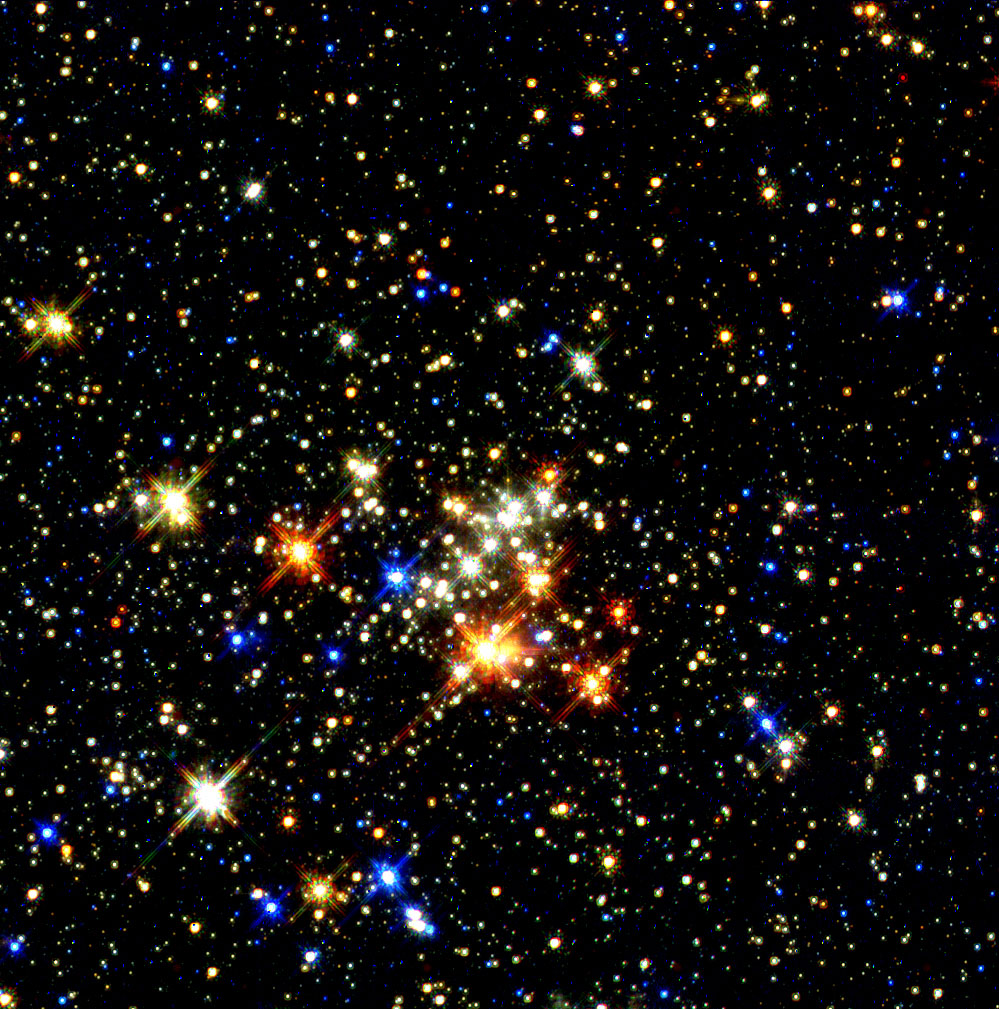
Quintuplet Cluster

Quintuplet Cluster

That link

I posted a link earlier. Here it is again.

However, though researchers have been able to show how RNA’s component molecules, called ribonucleotides, could assemble into RNA, their many attempts to synthesize these ribonucleotides have failed. No matter how they combined the ingredients — a sugar, a phosphate, and one of four different nitrogenous molecules, or nucleobases — ribonucleotides just wouldn’t form.

Sutherland’s team took a different approach in what Harvard molecular biologist Jack Szostak called a “synthetic tour de force” in an accompanying commentary in Nature.

“By changing the way we mix the ingredients together, we managed to make ribonucleotides,” said Sutherland. “The chemistry works very effectively from simple precursors, and the conditions required are not distinct from what one might imagine took place on the early Earth.”

Like other would-be nucleotide synthesizers, Sutherland’s team included phosphate in their mix, but rather than adding it to sugars and nucleobases, they started with an array of even simpler molecules that were probably also in Earth’s primordial ooze.

They mixed the molecules in water, heated the solution, then allowed it to evaporate, leaving behind a residue of hybrid, half-sugar, half-nucleobase molecules. To this residue they again added water, heated it, allowed it evaporate, and then irradiated it.

At each stage of the cycle, the resulting molecules were more complex. At the final stage, Sutherland’s team added phosphate. “Remarkably, it transformed into the ribonucleotide!” said Sutherland.

According to Sutherland, these laboratory conditions resembled those of the life-originating “warm little pond” hypothesized by Charles Darwin if the pond “evaporated, got heated, and then it rained and the sun shone.”

I figured I’d have more to add to this, but I don’t. At best I suppose I should point out that this experiment shows that general principles can result in RNA: do such-and-such in a certain order and you’re on your way. That’s an oversimplification, but it makes comprehending the origins of life a bit easier.

Five minutes with Dawkins

WordPress hates embedding some things correctly, so here’s a link to an interview with Richard Dawkins.

When faced with evidence

I’ve noticed that when creationists are faced with direct evidence, they fold. They give up the specific argument for generalities and rhetoric. I am thinking of a couple of specific instances.

Back when I accepted an invitation to see a screening of Expelled, I presented a few specific arguments. The first one was in response to that entirely dumb creationist conflation: ‘Evolution says the world came from nothing, from some Big Bang’. Well, clearly, that is not true. Evolution is about how organisms change over time. It is not a theory within physics. Upon pointing this out, the creationist response was to move on to how people just want to reject God. They so badly want to have no responsibility that they’ll latch on to any old theory. (Remember, these are creationists, so “theory” here doesn’t mean the same as “scientific theory“.) They ignored the argument. They made a false claim. I countered it with a true statement. They surely continued believing in the falsehood, but rather than to present a counter-argument to support their continued belief, they folded.

This is yet another coy creationist tactic. These people have no real meat to their beliefs, so they just move from poorly fashioned concept to poorly fashioned concept, hoping to dazzle us with their ability to believe in spite of all the empirical evidence. It’s astounding.

There are over 700 comments on this blog. A little more than 120 are my own. Most of the remaining are from creationists. They’re more than willing to discuss the color of the bike shed, but when it comes to some real meat, they’re nowhere to be seen. There are two detailed posts sitting below this one which have no responses. None. Maybe my writing just isn’t popular enough to fill my blog space, I can buy that. But c’mon. No one wants to counter any points I’ve raised (via Jerry Coyne)? methinks no one can.