Those hateful atheists

The Obama administration invited the Secular Coalition for America to the White House for a meeting on national policy.

President Barack Obama was not scheduled to make an appearance at the meeting, nor were any policy changes to be announced, McClatchy news service reported.

But that didn’t stop a number of religious conservative groups from attacking the meeting as a sign the president has an anti-religious agenda.

Really? This holds as much water as claiming Obama was born in Kenya or that he’s a Muslim. The U.S. presidency will be held by pro-religious administrations for a long, long time to come, despite this encouraging meeting.

The title of the article I found is Right wing slams White House for meeting with atheist ‘hate groups’. Here are some quotes.

“It is one thing for Administration to meet with groups of varying viewpoints, but it is quite another for a senior official to sit down with activists representing some of the most hate-filled, anti-religious groups in the nation,” said Council Nedd, chairman of the religious advocacy group In God We Trust.

“People of faith, especially Christians, have good reason to wonder exactly where their interests lie with the Obama administration,” Donohue said in a statement. “Now we have the definitive answer. In an unprecedented move, leaders of a presidential administration are hosting some of the biggest anti-religious zealots in the nation.

And from this article,

The fact that this meeting is happening at all is an affront to the vast majority of people of all faiths who believe in God.”

You hear that? Secular, largely atheist organizations are filled with hateful zealots and it’s offensive that they would even get a voice in public policy. Why don’t those damned atheists just shut up?

This is one of the biggest problems facing atheists; the religious feel they have a right to use offensive, derogatory language at will, whether justified or not, and they aren’t afraid to apply it towards atheists – without fear of political fallout. And the truth is, they do have that right. The problem, however, is that they believe only they have that right. Anyone who says religion is bad should just sit down and shut up because their very existence is offensive.

Oh, and all those hate-filled comments from the atheist group?

“We are committed to the separation of church and state and to equality for non-believers in the political arena. Religious speakers must not continue to be given special privileges.”

Equality? HATEFUL!

“I have witnessed firsthand how [military] service members who are openly non-theist have been harassed by their commanders, leaders, and peers, and have been disrespected by their subordinates for failing to hold certain religious beliefs,” said American Atheists vice president Kathleen Johnson.

SHUT UP SHUT UP SHUT UP! ZEALOT!

Johnson called on the Obama administration to make non-theists “a protected class throughout the Armed Services on par with the protections afforded to women, minorities, and those belonging to minority faith groups.”

What? They want equality for themselves and for faith groups? THAT’S SO ANTI-RELIGIOUS!*

*No special privileges for Christians = anti-religious.

Circumcision

Any time male circumcision is discussed, people can usually be described in one of three ways: 1) those who have had it done and thus favor it. 2) those who have not had it done and thus do not favor it. 3) Women. This third category doesn’t have any significant, inherent bias that can be easily detected (at least by me). That notion is true for Christiane Northrup and her anti-circumcision article.

Believe it or not, circumcision was introduced in English-speaking countries in the late 1800s to control or prevent masturbation, similar to the way that female circumcision–the removal of the clitoris and labia–was promoted and continues to be advocated in some Muslim and African countries to control women’s sexuality. [1]

Routine female circumcision, which has been practiced in some cultures, is completely unacceptable. Few people would argue otherwise. In fact, the United Nations has issued a decree against it. Circumcision is a form of sexual abuse whether it’s done to girls or boys.

I never like this tactic. Northrup first mentions female circumcision and does so relevantly – circumcision has been used as a tool to control sexuality. But then she goes on about it in the next paragraph, quickly trying to draw a connection between it and male circumcision. These are two entirely different things. One is violent, messy, often comes with complications, and is emotionally scarring in most instances. Who can guess which one I just described?

We justify male infant circumcision by pretending that the babies don’t feel it because they’re too young and it will have no consequences when they are older. This is not true. Women who experience memories of abuse in childhood know how deeply and painfully early experiences leave their marks in the body. Why wouldn’t the same thing apply to boys?

What does “abuse” mean in this context? While the article is generally well written, this paragraph is a bit of a mish-mash. Northrup tries equating female and male circumcision, goes on about pain, and throws in abuse, undefined. If female circumcision is meant here, it’s quite odd since Northrup talks about childhood trauma. If female circumcision isn’t meant here, then abuse first needs to be defined, then Northrup needs to explain why she is equating what happens to an infant to what happens to older children; one will remember the event – a key aspect in what defines “traumatic”.

In medical school, I was taught that babies couldn’t feel when they were born and therefore wouldn’t feel their circumcision. Why was it, then, that when I strapped their little arms and legs down on the board (called a “circumstraint”), they were often perfectly calm; then when I started cutting their foreskin, they screamed loudly, with cries that broke my heart? For years, in some hospitals, surgery on infants has been carried out without anesthesia because of this misconception!

The “pain argument” is often used by anti-circumcision advocates. That’s seemingly fair enough, especially coming from someone qualified like Northrup (who is an M.D.), but she quickly undermines the argument by pointing out the use of anesthetic. If hospitals are now using them, then there is virtually no pain, right? So…argument defeated?

But these are justifications that science has been unable to support. Nor is there any scientific proof that circumcision prevents sexually transmitted diseases.

This includes the recent studies done in Kenya, South Africa, and Uganda by Ronald H. Gray, a professor at Johns Hopkins University. He recently reported that men who were circumcised were less likely by half to contract HIV virus and less likely by one-third to become infected with HPV and herpes. [2]

While this sounds promising, I agree with my colleague George Denniston, M.D., who said, “The United States has high rates of HIV and the highest rate of circumcision in the West. The “experiment” of using circumcision to stem HIV infection has been running here for decades. It has failed miserably. Why do countries such as New Zealand, where they abandoned infant circumcision 50 years ago, or European countries, where circumcision is rare, have such low rates of HIV?”

When I first read this article, I had no knowledge of the author or anything of that nature. Upon reading the above excerpt, I assumed the person was a journalist or a passionate advocate, but not a doctor.

The evidence continues to mount that HIV transmission is reduced with circumcised penises during penile-vaginal intercourse. A number of studies have supported this. It’s surprising enough that Northrup disagrees on the point, but what really raises an eyebrow is her quote of George Denniston. Yes, the U.S. has a relatively high rate of HIV and yes, many in the U.S. are circumcised. So what? Where’s the evidence? Right now I see a broad correlation: the U.S. has a lot of two things. Okay, that’s great, but are there studies showing that HIV transmission is no different in circumcised versus uncircumcised men? Could other factors be at play? Given that the HIV prevention studies are based upon vaginal sex, could the higher acceptance of homosexuality be a contributing factor in the U.S. versus poorly developed, less accepting nations? What about number of partners? Do Americans tend to have more partners than others? There just needs to be more than a simple correlation.

Similarly, one of the main reasons people choose to have their child circumcised is they believe that it’s nearly impossible to keep an uncircumcised penis clean. This also isn’t true.

The best I have for the U.S. is a simple anecdote of a friend who got a circumcision at age 22 due to recurrent infections, and this was despite reportedly vigilant cleaning. Of course, on the whole, Northrup is right; it isn’t that hard to clean basically any part of the body, including the foreskin area. But one important caveat: for the West. Developed nations have constant access to showers and baths. Poorer nations where HIV is rampant are not always so high on hygiene. While cleaning is possible, the reality is that it may not always happen. That can be remedied, but I personally have to favor circumcision over a long and constant hygiene education program.

The next part of Northrup’s argument is titled “Religious Reasons”, but instead of really giving any or arguing against them, she describes how one religion does it and then concludes,

This allows the parents to practice their faith and adhere to tradition while protecting their child from a painful, medically-unnecessary procedure. This is far superior to what baby boys are subjected to in most hospitals. I know. I’ve done hundreds of circumcisions personally.

Again, the “pain argument” seems to be undermined.

Circumcision also has profound implications for male sexuality.

No. The evidence is weak, subjective, inconclusive, and extremely difficult to compare.

It would seem that a far better argument for the anti-circumcision crowd would be to just put the onus on the pro-circumcision crowd. Why do it at all? Here are basically the only real arguments.

1) Religion. This one sucks because all religions hold many falsehoods, tend to be based upon falsehoods, and do not offer actual arguments, only decrees and dogmas.

2) Tradition. So what? Circumcision is a non-moment in a baby’s life; he won’t remember it. The only way out of this is to say it’s a moment for a family. That might be true for Jews and some other religious groups (which aren’t merely doing it out of tradition, but religion, obviously), but it hardly seems to be the secular norm. And do families ever celebrate circumcisions later in life? What good comes out of this? There seems to be no point, no benefit from this reason.

3) Aesthetics. This is highly subjective, but more than a few accounts enthusiastically describe uncircumcised penises in negative terms. This is likely also true of circumcised penises, but would seem to be less so. This argument holds more water in countries where circumcision has become the norm.

The first two arguments are weak and dismissible. The third offers the most strength, I think. There seems to be no harm and it looks better by many standards. At the very least, this is a good argument against the level of vociferous opposition.

Yet another Symphony of Science

This one includes some familiar and some new ‘singers’ (including someone without a penis for the first time in the series): Michael Shermer, Jacob Bronowski, Carl Sagan, Neil deGrasse Tyson, Richard Dawkins, Jill Tarter, Lawrence Krauss, Richard Feynman, Brian Greene, Stephen Hawking, Carolyn Porco, and PZ Myers.

(Whoops. As a commenter pointed out, Jane Goodall was in the last one. But this one has two women, so, uh, there.)

Thought of the day

A characteristic of the Republican party is a hostility towards science.

Just like a fanatic

Jesus and Mo.

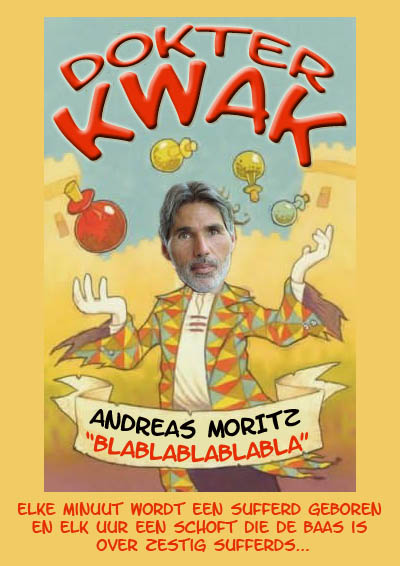
Dokter Kwak

I’m not sure what the subtitle says, but I think the rest of this image breaks the language barrier.

(I lied. The subtitle, through the limitations of Google translator, says something about there being a sucker born every minute. It also says “bastard” for some reason.)

Update: I got the clear translation (and astoundingly quickly).

Doctor Quack
Andreas Moritz
blablablabla
There’s a sucker born every minute
And a crook every hour to take care of 60 suckers

Francis Collins

Francis Collins has a new book due out soon. Jerry Coyne has already covered it more interestingly than I can here, but this quote from Collins really got me.

The conclusion is astounding: if any of these [physical constants] were to vary by even the tiniest degree, a universe capable of sustaining any imaginable form of life would be impossible.

Having just read Victor Stenger’s New Atheism, I find Collins all the more annoying for bringing up this point. The fine-tuning argument is terrible enough just for the fact that it often takes the form of “But how is everything so well adapted to life?!”, but all of its creationist forms are awful. In Collins’ version, he’s assuming that the variance would be done to only one physical constant. In reality, physical constants are almost always dependent upon each other; the changing of one would mean the changing of them all. Collins’ argument is, then, incoherent.

Hubble

While my traffic has been way up since the Andreas Moritz incident, I know it isn’t going to stay that way. That’s why it’s especially disappointing that my Hubble contest post no longer shows up on Google images on the first page. It had been there for quite a long time, artificially boosting my stats, which in turn did raise the profile of FTSOS, if even only slightly. But since WordPress took me down for a couple days, that image has vanished from Google images. I suppose the best I can do is link back to it from time to time. More importantly, I suppose I can start making a few more posts about Hubble and Hubble news now.

But other than one of those slow news day stories, there doesn’t seem to be much out there. So in lieu of a real post, here is some eye candy.

1987 Supernova

Good news for gay atheists

Your numbers and the numbers of those who accept you are on the rise.

According to a new report by the Pew Forum on Religion & Public Life, the gap on some issues has widened into a chasm, notably on issues related to gay rights and tolerance.

“Young people are more accepting of homosexuality and evolution than are older people. They are also more comfortable with having a bigger government, and they are less concerned about Hollywood threatening their values,” said the report, which was released on Wednesday.

The report also found “Millennials” (aged 18-29) were far more likely than their elders from “Generation X” and the “Baby Boom” to be unaffiliated with a specific faith. Generation X was born between 1965 and 1980, Baby Boomers from 1946 to 1964.

While I fully plan on lamenting later generations as I grow older, I like to take advantage of earlier generations still being around to do the same thing to them*. Because really, Baby Boomers and Gen X really fucked a lot of stuff up, the least of which might be their slow come-around on social morality.

The number of those 18-29 who accept homosexuality (and presumably same-sex marriage, by and large) nearly double up the rickety old fogies who reject it (63 to 35 percent).

Those without any particular faith go from 13% for Baby Boomers to 25% for the 18-29 group. Unfortunately, this doesn’t fully translate into better acceptance of the fact of evolution. Only 55% of my generation accepts it while 47% of all other older groups accept it. (Incidentally, these numbers seem to be higher overall than what commonly gets touted.) One reason may be that while religion is obviously the primary root for ruining the thinking parts of people, the poor focus on science education is also to blame here. Of course, with the older generations making most of the policy decisions and passing most of the terrible laws, it’s not surprise the younger generations have been harmed.

And while this still seems like a generally positive trend, that may not be the case.

But in other ways American Millennials are not so radically different in their religious beliefs.

“Though young adults pray less often than their elders do today, the number of young adults who say they pray every day rivals the portion of young people who said the same in prior decades,” the report said.

“This suggests that some of the religious differences between younger and older Americans today are not entirely generational but result in part from people’s tendency to place greater emphasis on religion as they age,” it noted.

Credulity is as much a trait of the very old as it is the very young, it would seem.

*Of course, I don’t restrict myself from yet again doing the same when it comes to my own generation. Maybe it’s just humanity.

Guess who’s number 2 again?

And number 3 (until Google does its thing).

Correction: I misunderstood what I was seeing. I do have the third result, which is this post.