The importance of thought experiments

Thought experiments are crucial to the field of philosophy. They seek to reveal the principle(s) underlying the reasoning for a position so that such a principle(s) can either be applied ubiquitously in one’s life or thrown out all together. Or, if the thought experiment is really good and/or really precise, so that such principle(s) can be augmented for a given context. This process is so important I have a hard time imagining too many philosophers disagreeing with the usefulness of thought experiments (though many will reject the validity of various ones on varying grounds).

The reason I bring this up is because of Michael Hartwell’s post about utilitarianism from a couple of months ago. I have already responded to the bulk of what he had to say, so that can stand for itself where it is. However, I only briefly touched on one aspect of what he said and I want to address that now. Here is the relevant portion:

Of course, it’s never that simple in real life. These fables (thought experiments) assume godlike knowledge of the situation. What if the cave was only going to flood knee-deep levels and there were small holes to breath from? What if the five people on the train tracks weren’t oblivious to the train or were planting a bomb?

They also assume a dichotomy of actions. Do nothing, or kill. There’s no option to swim out of the cave, wait for rescuers or warn the people on the tracks.

There are two major issues with this. First, Michael is attempting to apply the idea of thought experiments specifically to utilitarianism. I have little doubt that he knows that there are plenty of other thought experiments which are used for other ethical theories, but none-the-less, he is applying certain ones solely to utilitarianism. That is, in his post he references the Trolley Problem as if it is a utilitarianism center-piece, a bit of logical exploration which is unique or primary to that ethical framework. He is wholly wrong to do this.

The Trolley Example is used by a number of ethical theories in order to arrive at particular moral answers. Libertarian Judith Jarvis Thomson famously extended the problem and concluded, as she often does, that there is a right to not be unjustly harmed. That had little to nothing to do with utilitarianism. There are dozens of other uber-famous thought experiments people of all ethical persuasions use. People may design their scenarios with a particular framework in mind, but nothing stops any other philosopher from applying entirely different ideas to them.

Second, the whole point of a thought experiment is to present a scenario with controlled parameters. The goal is to unveil a principle behind the reasoning for a position. (This is especially important when a given position is intuitive but has no good underlying principle from the viewpoint of the thinker.) It may be of interest to ask something like, Is it moral to take a risk when the negative consequence is significant? Does the positive consequence need to be equal? Bigger? But that is still searching for underlying principles – and it is still doing so with controlled parameters. That is, even if there is a factor of randomness thrown into a scenario in an effort to better mimic real life – “There is a 5% chance everything will be fine if you do X instead of Y” – it is still controlled.

A good thought experiment gives enough information to illicit a certain type of response. In the traditional trolley example, it’s you, a lever, and a few people scattered across a couple of tracks whilst unable to communicate with you and certain to die or live given your choices. That gets at particular principles of right and wrong. If we were to change the experiment to say that there was a small chance that the people on one track turn around in time and survive whereas there was no chance the person on the other track would turn around in time, we would shift the focus from principles to risk/reward analysis, getting into a much more subjective area of human psychology. That could help us in real life, but only insofar as we find ourselves in similar enough situations – which is unlikely. That’s fine if that’s the type of response one wants, but it doesn’t do much to illustrate principles – at least not in the way the original Trolley Problem does.

I’ve written a few times about thought experiments in philosophy. I’ve never been that extensive on their importance because I just sort of assumed people recognized how useful they are. But I guess I know what happens when I assume:

Finals

One more test, one more paper, one more class…

Keep the government out of my wallet and in my pants, inconsistent Republicans say

The past year and a half has really been entertaining. The far right-wing of the Republican party, the Teabaggers, got everyone all up in a tizzy and found themselves influencing the 2010 elections, as if they knew anything about any issue. They ousted a lot of Democrats by campaigning on no more than austerity – which has worked out just so well for Europe – but once they got in office, they switched gears and started passing laws that told women they were too stupid to know what abortion entailed, which I presume was also their basis for repealing laws which said women deserve equal pay for equal work as compared to men. Apparently the government has no place in the wallets of Teabaggers – unless we’re talking about Medicare and Social Security – but it should have everything to do with the uterus of a woman. But worry not! The GOP is turning over a new leaf. That’s right. Now they’re going after the genitals of boys and girls – particularly before they even get stimulated:

[Tennessee] legislation banning teachers from promoting or condoning “gateway sexual activity” is headed to the governor’s desk after approval by the state House of Representatives on Friday.

The bill, which passed the full Senate earlier this month, would require all state sexual education classes to “exclusively and emphatically” promote abstinence while banning teachers from promoting any form of “gateway sexual activity.” The latter term, which has garnered national media attention and been lampooned by comedian Stephen Colbert, is not specifically defined in the bill.

The vote was 68-23, with all but one Republican for it.

In other news, Republicans in 14 states have passed bills which mandate books be carried by boys at all times and that the temperature in school building is to never dip below 72. GOP leaders said boys need to carry the books, especially around the age of 11, because time has proven that to be one of the most effective ways of covering up a poorly-timed erection. As for the temperature, one house member said, “We don’t want girls getting cold and pointing their thingies at the boys. Those books are there for emergencies, not leisure.”

Dan Savage discusses Bible, children walk out

It’s still finals week, so short posts will have to do:

Thought of the day

I hate finals week. Hate it.

On the plus side, my degrees are done bar a single course (which is ever-so-conveniently offered two semesters from now).

Fun fact of the day

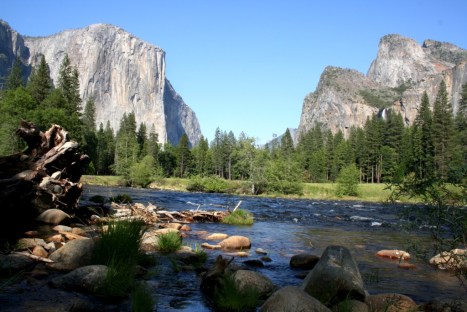
I think most people know where this is:

For those who don’t know where it is, I bet most have still at least seen this image. It’s of Yosemite Valley in Yosemite National Park in California. Notice the square shape of the valley. This is unusual because valleys tend to be formed by two things: rivers and/or glaciers. Rivers result in a V-shape due to their cutting action and glaciers result in a U-shape due to weight and grinding. So why is Yosemite Valley square?

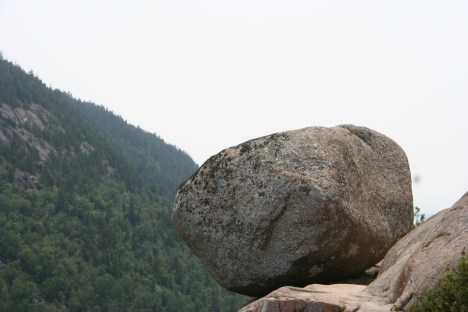
The answer actually does lie in the geological activity of glaciers. When a glacier moves, it has a lot of mass and power behind it. That means it can easily bring tons and tons of rocks and debris along for the ride. Go on a hike anywhere reasonably far from the equator and glacial erratics will not be uncommon.

In the case of Yosemite Valley, a glacier moving through it brought more than a few erratics. In fact, it was more than just one glacier. Over millions of years many glaciers have run through the park, creating a massive lake where we see sheer cliffs in the first picture. On one end of this lake was a moraine, a collection of rocks pushed forward by the weight of all that ice. They built up on each other and formed what was essentially a damn. This allowed the lake to also form, filling in what was then a U-shape. Of course, that shape was still underneath all that water.

So the question that may be popping up from all this is, What is it that lakes do that is important here? The answer is that they create sediment. And with enough time, all that sediment adds up. In the case of Yosemite Valley, it added up to the point where it filled in that U-shape, creating the square we know today.

Nationalism and stupidity

Here is the epitome of nationalism:

Here is what I just read on Facebook:

Why don’t you go tell every veteran that they are racist then.

Agreeing to die for you nation is pretty nationalistic. But then again, you apparently wouldn’t understand that. Nationalism can also be inclusive; not inherently divisive and racist. But then again, maybe you don’t understand that either

Go ask a soldier and get back to me. If you don’t like our nation then move out.

These were all responses to another person’s posts contending and explaining why nationalism is categorically racist. (He was using “racist” with some liberty, but that was never really even the issue.) It may be the least fruitful discussion I have ever seen on Facebook. It’s like the person conflating patriotism with nationalism has never even considered these arguments. I…I’m speechless. I have to let George Orwell take over:

A nationalist is one who thinks solely, or mainly, in terms of competitive prestige. He may be a positive or a negative nationalist — that is, he may use his mental energy either in boosting or in denigrating — but at any rate his thoughts always turn on victories, defeats, triumphs and humiliations. He sees history, especially contemporary history, as the endless rise and decline of great power units, and every event that happens seems to him a demonstration that his own side is on the upgrade and some hated rival is on the downgrade. But finally, it is important not to confuse nationalism with mere worship of success. The nationalist does not go on the principle of simply ganging up with the strongest side. On the contrary, having picked his side, he persuades himself that it is the strongest, and is able to stick to his belief even when the facts are overwhelmingly against him.

Update: I usually make it a point to not publish names that come from non-public discussions, but whereas this person defriended the status maker over my comments, I don’t feel bad to say that I think Allyson McCreery is a twit who deserves zero respect.

Welcome to the Anthropocene

Globaia.org has put together a great video of the impact humanity has had on the world over the past several hundred years. I think the worst part has to be the fact that CO2 levels in the atmosphere today are higher than they’ve been in the past million years or so. But hey. Maybe it’s just coincidence, amirite?

Thought of the day

I just saw an article about a new employee cafeteria Apple is building. A “news” article.

Someone needs to tell all the Apple fanboys out there where their obsession ends and real news begins.