An elaborate fraud

Andrew Wakefield is the disgraced research who claimed to have found a link between vaccines and autism in a 1998 study. This resulted in many deaths, increased illness, and his removal from the medical register in the U.K. Now a little investigative journalism has found that Wakefield outright made up a lot of his data.

A new examination found, by comparing the reported diagnoses in the paper to hospital records, that Wakefield and colleagues altered facts about patients in their study.

The analysis, by British journalist Brian Deer, found that despite the claim in Wakefield’s paper that the 12 children studied were normal until they had the MMR shot, five had previously documented developmental problems. Deer also found that all the cases were somehow misrepresented when he compared data from medical records and the children’s parents.

And then children died because of Andrew Wakefield. I wonder when the public will get an apology from the media for promoting this pure horseshit? I’m not holding my breath.

In an accompanying editorial, BMJ editor Fiona Godlee and colleagues called Wakefield’s study “an elaborate fraud.” They said Wakefield’s work in other journals should be examined to see if it should be retracted.

I only include this because I had a different original source, so I hadn’t read this part of the article when I made the title to this post. I guess it’s just the most accurate way of describing the work of Andrew Wakefield.

Update: via PZ, watch Anderson Cooper engage in some responsible journalism by not letting Wakefield off the hook.

One of Baldacci’s last acts: Morally outstanding

One of now former Maine Governor John Baldacci’s final acts was one I cannot help but admire so much.

In one of his final acts as governor, John Baldacci signed an order Wednesday pardoning a Portland man [Touch Rin Svay] who faced deportation to Cambodia because of a drunken-driving crash that killed his sister [Sary Svay] 10 years ago.

Although he had lived in the United States since he was 4, he faced likely deportation because he was born to Cambodian parents in a refugee camp on the Thai border. He does not speak Cambodian and has no ties to that country.

The sentencing judge said deporting Svay would be “a horrible and unjust resolution.” Svay’s immigration attorney, Beth Stickney, said Svay’s only way to stay in the country was a pardon, a rarely used power the governor has to forgive crimes.

Baldacci said in a prepared statement that he issued the pardon largely because of Sary Svay’s two children and Touch Rin Svay’s role in supporting them.

“He has complied with the terms of his sentence, and has turned his life around,” Baldacci said. “But, in my mind, he continues to have an obligation to his sister’s two children — his niece and nephew — to be involved in their lives and to explain to them his actions. He is actively involved in their lives, and his debt cannot be fully repaid unless he maintains that supporting role.”

The article continues that Svay was due a pardon in 2004, but he admitted to minor transgressions of his parole and that caused a delay (as well as another 5 months in prison). Other than that, however, Svay has been a model citizen since completing his original sentence and subsequent probation violation, holding a steady job and helping to care for his niece and nephew. I greatly admire Gov. Baldacci for his decision. Svay has no connection to Cambodia; deporting him would be nothing short of inhumane. The right call was made today.

(Gov. Baldacci also pardoned a second man who had served a morally trivial but legally significant conviction from 18 years ago. That man, who was not named in the article, faced a similar situation, with all his family ties existing in Maine.)

“A judicial slap…”

A federal court has found that a cross in San Diego marking a war memorial is unconstitutional.

The three-judge panel concluded in its 47-page opinion that the U.S. “district court erred in declaring the memorial to be primarily nonsectarian and granting summary judgment in favor of the government and the memorial’s supporters.”

A group that filed a brief on behalf of 25 members of Congress supporting the Mount Soledad Veterans Memorial, the American Center for Law and Justice, condemned the appeals court ruling as “a judicial slap in the face to our military veterans.”

And they’re right. This ruling is a total slap in the face of military veterans…

unless they’re Jewish.

or Muslim.

or atheist.

or agnostic.

or Buddhist.

or any non-Christian religion.

or supporters of the First Amendment.

But for everyone else? Total slappage.

Hartlaub’s Turaco

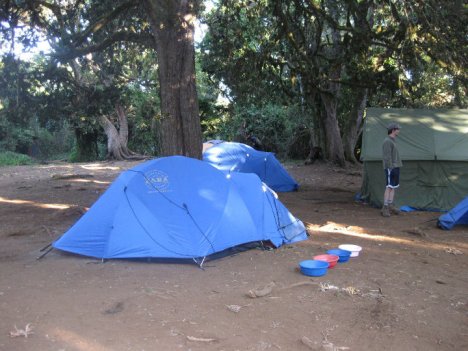
Look at these manly legs.

This comes from Shira Camp 1, the first and least creatively named camp site on my trek up Kilimanjaro (or perhaps Shira Camp 2 wins that title). Since it was practically dark by the time we rolled in that first day, I’m going to hazard this comes from the morning of Day 2. (Actually, the warm water for washing – say it with a Swahili accent – tells me it definitely was morning.) So that means you’re seeing me as I wonder just what all the sounds were from the prior night.

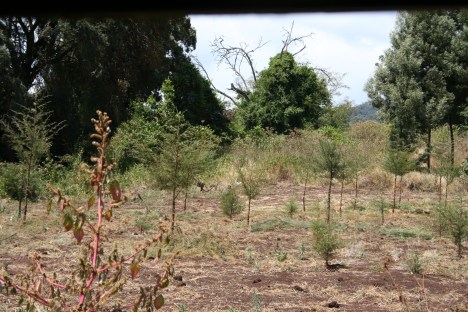
My initial thought was baboon. In fact, several baboons. We had seen some on the way to the head of the Lemosho route.

They aren’t easy to make out, but they are there. And as far as I know, they may have stayed there because they actually weren’t surrounding the camp site that night. Or if they were, they were tucked in their beds snug as could be. What was actually making all the racket was the Hartlaub’s Turaco.

It’s a pretty awesome bird that is native to Kenya, Tanzania, and Uganda. From what I’ve been reading, it appears to be most numerous in Kenya, at least in small part because of excessive hunting in Tanzania. Fortunately, however, it faces no significant danger to its overall health as a species at this point. (In fact, its conservation status is “LC” or Least Concern, the lowest, and thus best, it can be.)

But I know as great as pretty pictures are, what everyone really wants is some sound. (It will link you out, but do click anyway.)

ARKive video - Hartlaub's turaco - overview

I think the deep throatiness of the baboon is discernible through the Hartlaub’s Turaco’s call. But perhaps it was the quiet of the encompassing night that made it seem all the more phenomenal to me; I couldn’t help but be convinced I was hearing baboons. Without a deeper knowledge, I can only speculate why the bird makes such a sound: perhaps it is imitation, but that doesn’t strike me as the most plausible explanation off-hand.

Thanks to Mike for providing the necessary information, the first photograph, and even the link to the video. I appreciate it.

A plea for beer

It is the most noble of pleas, is it not?

I’m looking for this:

I had the pleasure of drinking a few of these while in Moshi, but for the life of me I cannot seem to find them for personal order over here. I did manage to find them for large-scale purchase, but I really don’t plan on opening my own beer shack where I live. Does anyone have any information on how I might get hold of some Kilimanjaro Lager? There is also Serengeti Lager, and I would be pleased with that as well.

Thought of the day

Jeopardy! is great.

Fine, I’ll post it

WordPress users have been posting all their stats today. I’ll give into peer pressure.

The stats helper monkeys at WordPress.com mulled over how this blog did in 2010, and here’s a high level summary of its overall blog health:

Healthy blog!

The Blog-Health-o-Meter™ reads Wow.

Crunchy numbers

Featured image

The Louvre Museum has 8.5 million visitors per year. This blog was viewed about 130,000 times in 2010. If it were an exhibit at The Louvre Museum, it would take 6 days for that many people to see it.

In 2010, there were 879 new posts, growing the total archive of this blog to 1423 posts. There were 226 pictures uploaded, taking up a total of 139mb. That’s about 4 pictures per week.

The busiest day of the year was February 23rd with 8,799 views. The most popular post that day was Andreas Moritz is a stupid, dangerous man.

Where did they come from?

The top referring sites in 2010 were scienceblogs.com, Google Reader, facebook.com, en.wordpress.com, and community.livejournal.com.

Some visitors came searching, mostly for hubble, hubble images, andreas moritz, hubble pictures, and golden lion tamarin.

Attractions in 2010

These are the posts and pages that got the most views in 2010.

1

Andreas Moritz is a stupid, dangerous man May 2009
330 comments

2

Hubble Contest March 2009
12 comments

3

Topless march in Farmington April 2010
3 comments

4

Why? March 2009
1 comment

5

Everest: Beyond the Limit December 2009
3 comments

Atheists never…

There are a lot of terrible things atheists have never done. And there are a lot of great things atheists have never done. And then there are plenty of terrible things and plenty of great things they have done. But at no point can we say any action by an atheist has been done because of atheism. The whole worldview is descriptive, not normative.

That said, there is a site that lists out the things atheists have never done, providing links to each item. It’s worth a look.

Okay, I have to steal this one

via PZ

Are humans “more advanced” than other organisms?

I recently had a discussion with a friend where he asserted that he was more advanced than, say, a plant. By the common connotations that come from the word “advanced”, we would have to agree that his statement was true. But it asks an interesting question: What do we really mean when we say we’re advanced?

To put the discussion in a proper framework, think in evolutionary terms. That means we can’t compare Albert Einstein to Sarah Palin and say, “Why, yes, he was more intellectually advanced than she is.” Of course that is true, but if we’re going to discuss evolution and what it means to be advanced, we’re necessarily comparing species, not individuals. That is what makes my friend’s initial comparison to plants a reasonable starting point.

But it is only a starting point. Because what are we comparing exactly? In terms of brain development, yes, he beats that plant handily. But what about in terms of ability to photosynthesize? Well, the plant just got a knockout in that round. Clearly there is a difficulty in making useful (and, in my view for this discussion, any) comparisons between species. Maybe we need to find a species that is closer in relation to humans. (It certainly would help for it to have a brain in the first place.) The animal I chose for the discussion and the one I am choosing for this discussion is the skunk. Jerry Coyne is the inspiration.

It does not always [evolutionarily] pay to be smarter, either. For some years I had a pet skunk, who was lovable but dim. I mentioned this to my vet, who put me in my place: “Stupid? Hell, he’s perfectly adapted for being a skunk!” Intelligence comes with a cost: you need to produce and to carry that extra brain matter, and to crank up your metabolism to support it. And sometimes this cost exceeds the genetic payoff. A smarter skunk might not be a fitter skunk.

A skunk is vastly more well adapted to life as a skunk than any human ever could be. All the things it takes to be a skunk? A skunk has them nailed down pretty well. The counter to this point was to say that if humans decided to destroy all skunks, we could. True enough. But does that make us more advanced? Of course our intelligence allows us to wipe out many other species, but the whole point of bringing up a skunk and its adaptation is to say that a comparison of intelligence is not valid for purposes of this discussion in the first place! (As always, you know I mean it when I use the lazy-man’s exclamation point.)

When we choose to compare intelligence in order to define what it means to be advanced, we have two massive assumptions going on. First, we’re assuming that intelligence is better than toothiness or having sharp claws or any other characteristic we see in nature. This assumption is untenable because some environments might call for all or any of those characteristics over intelligence. To put things in perspective, try thinking on an evolutionary timescale. So far I have only been comparing humans to other extant organisms (plants and skunks). But what if we go back 100 million years? 200 million? 500? 600? Any human put into an ancient enough environment would die. We know this because the right foods would not be available or because there would be no proper shelter or because the atmosphere would be poisonous or because our immune systems would not be evolved to cope with the bacteria and viruses present at the time or because…and so on. The assumption that intelligence is better than anything else is clearly wrong once we recognize that evolution and the ability of a species to survive depends largely upon environment.

The second assumption in this whole discussion is that we can even say something in evolution is “advanced”. We can say more complex or better suited to a particular environment, but “advanced”? That implies evolution is on the march towards some goal, to some end. That is not true. Science has demonstrated this again and again by showing what a contingent process evolution is. Take the Lenski experiments, for example. (I’m rather disappointed I never wrote about them here.) Richard Lenski and his researchers followed several lineages of E. coli for 20 years (in fact, they’re still following them). They would freeze samples every 500 generations so they could go back and re-run the tape of evolution should some fundamental change occur. And, eventually, such change did occur. Some E. coli were able to consume a natural by-product of their environment after nearly 30,000 generations. Lenski et al. unfroze the old generations to see just what enabled the bacteria to obtain their new found skill. As it turned out, they had to go back many thousands of generations; it wasn’t just one mutation, but at least three. The first two were effectively random. But they were necessary in order to get to the third mutation – the one that opened up a new food product for the colonies. But in the re-running of the tape, not all lineages re-evolved the new mutations. The chance involved in the process was too great to be inevitable; evolution is contingent.

So my answer to the question, Are humans “more advanced” than other organisms?, is to say it is an inappropriate question in the first place. There are several things we should not be assuming:

  • Intelligence is the best trait (whether to this point or in terms of possibility)
  • Evolution is goal oriented
  • The ability to destroy other species and still survive is a mark of advancement

I mentioned the argument for point three, but I have yet to address it. This one is pretty straight-forward, I think: We may be able to destroy many species, but that really only applies for large organisms. The vast majority of life is microbial. Since we would never be able to destroy it all (or even a minute fraction of it), does that mean it is more advanced than we are? What about all the bacteria we need to keep us alive? We certainly could not destroy all the mitochondria of the world and still survive.

Evolution is a contingent process that has no march towards any end. It is about the ability to survive. Our genes are interested in propagating themselves and that is why we are here. Life may mostly (though not entirely) be more complex since it first sprung forth nearly 4 billion years ago, but it always depends upon its environment – and that makes some characteristics more valuable than others. Sometimes.