I want this in video game form. Now.

What have we had our fellow primates do in video games so far? Throw barrels? Run around on an island so boring that only the most devoted video game fans will understand this reference? Come on. Let’s give them some real fire power.

The only problem is that if we let them snipe, then every asshole is going to grab that weapon and ruin everyone else’s good time.

Thought of the day

It isn’t merely that theists have no evidence for their particular, cultural god(s). It’s that most of them don’t even seem to understand what evidence is.

Things we’ve learned from Republicans

…over the past couple of years:

I just wanted to remind myself why I would never vote for such a moronic party.

Food Revolution

I just watched an episode of Jamie Oliver’s Food Revolution on ABC. It’s basically about this health food chef who goes around to schools in America to try and make a difference in what kids are eating. He started out in Huntington, West Virginia in the first season and apparently made a positive difference there – despite the resistance.

I didn’t see that first season due to my general boycott of shitty network television, but I did catch Oliver in an interview with Jon Stewart recently and I really liked what I saw. Since then I’ve added the show to my DVR recordings and watched the first episode of season 2 just tonight. The editing and format is a little bit all over the place, but the episode had some important information. Of course there were the staggering statistics of what kids eat every day/week/year in sugar/fat/pure feces, but there was also the fact that the L.A. school system will not allow the show to film in a single school. They claim they’re doing well and have nothing to hide, but a 2006 study says otherwise:

To determine the prevalence and identify demographic and socioeconomic correlates of childhood overweight, we assessed height and weight data on 281,630 Los Angeles County, CA, public school students collected during school-based physical fitness testing in 2001. Overweight prevalence was 20.6% overall and varied by race/ethnicity: 25.2% among Latinos, 20.0% among Pacific Islanders, 19.4% among blacks, 17.6% among American Indians, 13.0% among whites, and 11.9% among Asians. By using multilevel analysis, we found that school-level percentage of students enrolled in free or reduced-price meal programs was independently associated with overweight, after controlling for school-level median household income and student-level demographic characteristics.

I suspect there is a combination of stubbornness and special interests involved here. Companies make a lot of money off selling shitty food to kids, so it isn’t going to be easy to fix the epidemic. But it’s all the more distressing when the 2nd largest school district in the nation won’t even bother to acknowledge the problem.

Didn’t we already know this?

A new study says older brains are less nimble than younger brains:

The elderly have a harder time multi-tasking than young adults because older people are far less nimble at switching neurological connections in their brains between activities, according to research released on Monday.

The findings of neuroscientists from the University of California at San Francisco add new insights to a growing body of studies showing that one’s ability to move from one task to another in quick succession becomes more difficult with age.

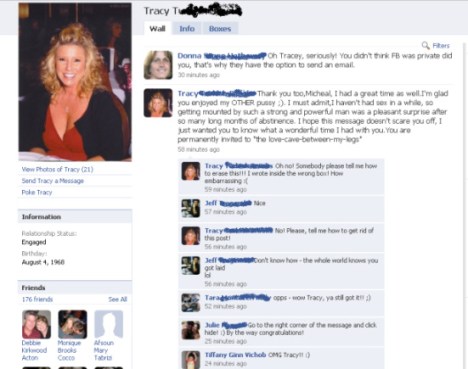
I thought this was already pretty clear. I don’t mean from the stand point of common sense – it is clear from the position, but evidence is important in actually knowing what is true. What I mean is that for the past several years Facebook has been open to everyone. Once the company did away with requiring school email addresses to sign up, the number of technologically inept people skyrocketed, primarily with old people. (As I’ve said before, “old” does not necessarily refer to age here.) It wasn’t too long until it became obvious that quite a few old people were unable to deal with Facebook like adults. From responding to other posts by making wholly new status updates to trying to keep their conversations straight between posts, links, and statuses, anyone who has been paying attention knows that Facebook is not the place for old people.

(Click to enlarge. If old, retrieve your reading glasses.)

Thought of the day

Kids deserve respect.

Harvard twins cannot undue FB settlement

Good:

A federal appeals court ruled Monday that former Harvard University schoolmates of Facebook founder Mark Zuckerberg can’t undo their settlement over creation of the social networking site.

The 9th U.S. Circuit Court of Appeals said Monday that Tyler and Cameron Winklevoss were savvy enough to understand what they were agreeing to when they signed the agreement in 2008. The deal called for a $20 million cash payment and a partial ownership of Facebook. A third classmate, Divya Narendra, was part of the settlement with the twins but did not pursue the second lawsuit seeking to undo the agreement.

Monday’s ruling upholds a lower court decision enforcing the settlement during the six years of litigation that grew so contentious that the dispute was dramatized in the Oscar-nominated film, “The Social Network.”

The settlement is now worth more than $160 million because of Facebook’s increased valuation.

As much as I have a love-hate relation with Facebook, this is good news. It’s nothing but manipulative greed and bitterness to go after more money here.

Thought of the day

Dear new version of Firefox,

When you open up a new window, usually against my wishes, and I go to close it, I would appreciate it if only that window would close. You see, what actually happens is I get a pop-up that warns me of all the tabs I will be closing. In fact, I am only closing one – the single tab in the single new window. But you don’t seem to know this. What you seem to think is that the “X” on that new window also counts as the “X” on my main window – the one with a bunch of tabs open. And to make the problem all the worse, when I click “Cancel”, meaning “No, do not close all my tabs”, you go ahead and close everything anyway. Please knock it the hell off.

Sincerely,
Everyone

Scientists ahead of their time

“[I]f we could intervene in the antagonism observed between some bacteria, it would offer perhaps the greatest hopes for therapeutics.”

~Louis Pasteur

It’s all subjective

I find it frustrating when theists repeat over and over that atheists have no basis for morality. It’s an immature view that misunderstands both atheism and morality. The argument goes something like this:

Morality must be grounded. The only way it can be grounded is if it comes from somewhere outside humanity (at a minimum). Only a higher power can provide for such objectivity. Thus, atheism provides for no objective morality.

There are several problems here. First, I worded the summary specifically, so take note: It starts out talking about morality but then makes a switch to objective morality. This characterizes the number one mistake theists make, and it isn’t goal post moving. What they’re doing is assuming morality must be objective when talking about it in the first place. It’s classic Question Begging. (Goal post moving entails knowing where the goal posts are in the first place.) Second, so what if they’re right? If we follow the argument, it’s going to end in God. But did God tell them what argument to follow? How do they know their argument is right? Even if they can be highly certain, apply scientific standards to their process, and not a single person can find a flaw in their steps, they are still making an argument that necessarily lacks 100% certainty (just like every argument ever made). In other words, they have come to their conclusion via their own perspectives, via their own values, via their own reasoning, via their own abilities. At every point they have been arguing subjectively. Even if they are right, no one can objectively confirm as much.

So where does this leave us? Well, on a pretty level playing field. Once my argument is understood, a theist can no longer say he has an objective grounding for morality. He doesn’t. No one does. The best we can do is argue from our common needs and values. Fortunately, thanks to evolution, we have a lot of overlap there. That gives us a basis for talking about morality; indeed, it has been the basis of morality since the beginning of humanity and before.