Hitchens-Blair debate

There is a YouTube channel devoted specifically to the recent debate between Christopher Hitchens and Tony Blair. I’ve yet to watch it, but I find both men to be quite intelligent. (Update: I have watched it.) Hitchens’ intelligence is crashingly obvious; I’ve never seen him lose a debate point. And I absolutely love how he will routinely bend over backwards to grant as much as possible to his opponent just so he can point out that he still has the point won. Anyone who saw that awful creationist movie with Ben Stein should be familiar with this tactic: In the Richard Dawkins interview, Dawkins granted that it’s possible that we could have been designed by aliens, but even if that were so, we would still need to appeal to evolution in order to explain their existence. Stein, unsurprisingly, takes the dishonest route of claiming that Richard Dawkins is only against intelligent design when it involves a god. This was rather expected since the creators of the movie lied to every biologist involved, not to mention the fundamental dishonesty behind creationism intelligent design. But I digress. Blair’s intelligence is clear enough, but I think perhaps some of my perception of it comes from the contrast of it with Dubya’s lack of smarts.

Anyway. Watch the debate. (Skip the first video if you just want to get to the meat of the debate.)

I refuse to believe it

I just came across an article about Mount Kilimanjaro. It says something I find difficult to believe.

There’s no clear number of how many people attempt to climb Kilimanjaro each year, although it’s at least 20,000. Steinhilber said probably less than half that number make it to the true summit.

When they reach Stella Point — about 800 to 1,000 feet below the actual peak, Uhuru Peak — many figure “good enough,” she said.

Upon reaching Stella Point, I actually thought I was practically there. But then I saw how far the trail continued. It was no longer so steep – it’s a very significant incline to that point – but it was still another 1-2 hours from the summit. And perhaps that was the most excruciating part. It felt like I should be seeing that idyllically simple African sign indicating the summit of the mountain at any moment, but it seemed like it was perpetually ‘just around the next corner’.

But could I have ever just stopped? Could I ever have just called it good because the rest of the way was mentally frustrating?

No.

Summit day is roughly 4,000 feet of elevation gain. Stella Point is a mere 700 or so feet lower than the summit – and that’s over the course of a good distance. It constitutes an insignificant portion of the entire hike, even if it is in some ways the most difficult. Unless the person is physically struggling with the elevation (I was told after the fact that someone in another group died near Stella Point on the same day I was there), I find it impossible to believe anyone could just say ‘good enough’.

(Please excuse Buga for the crooked horizon.)

Update: I am reminded by a member of my hiking group that the peak is actually visible from Stella Point.

Thought of the day

We can hardly talk about morality without speaking in subjective terms.

An average conversation with a red herring theist

This is an extension of a previous post. Both that post and this post are influenced by common arguments I’ve heard from theists who just have no clue about how to stay on topic or, perhaps, just don’t want to stay on topic. It’s easier to engage this same point (which I will post in a moment) over and over – and then ignore the given answers – than to engage more difficult points. William Dembski is guilty of that recently, providing me the final impetus for this post. So here it is:

A = Atheist

T = Theist

Atheist: So yeah, I guess to summarize, I disagree with your position on how we should approach North Korea over the next year.

Theist: Yeah, well, why does your opinion matter?

A: Huh? Well, I suppose I’ve become fairly informed on the issues and I think…

T: No, no. You’re an atheist. You have no basis for morality. So why is your opinion good?

A: That’s really a red herring. We’re discussing North Korea (our allies according to Sarah Palin).

T: Stop dodging my question.

A: So you want to change the subject?

T: You aren’t answering me!

A: Okay, I’ll just pretend like you acknowledged that you want to change the topic rather than continue to discuss North Korea. So why is my opinion good? It depends on how we want to define “good” and then it depends on how my opinion comports with that definition.

T: So how do we define good?

A: We are a social animal that has evolved a general concern for ourselves and for other members of our population, “population” initially being defined as the small group in which we lived. As with every other social animal, we developed rules for interactions. This served and serves to better the health of the group. It’s important to note that this group betterment is ultimately being done for the sake of the individual gene, but I digress.

T: So then we should all individually just do whatever it takes to survive? Then why shouldn’t I just kill you if you’re standing in my way to a better job or position in life?

A: …uh, no. No. What I’ve given you is a description of reality based upon scientific observation. Do you know the difference between a descriptive position and a normative one?

T: No.

A: Right, then. You ought to know that since you aren’t 14, but briefly: A descriptive position describes something and is not a claim of value. A normative position is a value position that says how something should or should not be.

T: I still don’t get it.

A: You should. But let’s move on.

T: Okay, so why shouldn’t I kill you if you’re in the way of that sweet new job?

A: That we evolved to best survive in a particular environment does not dictate how we ought to act now. Besides that, even if our past evolution did say how we should presently act, it would not follow that we should kill each other. We’re a social animal. Killing each other probably wouldn’t help us out individually (or as a group) in the long run.

T: So if we shouldn’t act based upon our previous evolution, then what should our basis for what is good and bad be?

A: I probably can’t give you a satisfactory answer. In fact, most of your fellow Christians will disagree with you on some points concerning what is good and what is bad, but I digress. My basis is rationality. I cannot rationally justify hurting someone in any way unless I say they can do the same to me under the same circumstances. Often I don’t want to face pain – nor do I want that for the ones I care about and love.

T: So what stops you from acting irrationally?

A: Love, empathy, self-interest, sympathy, culture, social pressures, norms, dominant values that surround me, my upbringing, assumptions, passion for science, etc. Irrationality conflicts with my personal identity. Fortunately, it also conflicts with the personal identity of many of my fellow humans.

T: Then there is no ultimate right or wrong.

A: You’re right. We have to define these terms with practical and operational considerations. If we want to say anything and everything is right (or wrong), then we’re likely to undermine our own interests (interests which may directly be our own or which may be reflections of the interests of those we care about and love).

T: So my opinion on North Korea has a basis for ultimately being right and yours does not.

A: In theory, yes. Unfortunately for you, the important question here is, ‘Is it true?’ Is it true that we have accurate information from your basis? Is it true that your basis isn’t arbitrary and capricious? Is it true that your basis even exists? In reality, you have a claim to an ultimate basis, but credible evidence has yet to be given for that ultimate basis. All you’ve done is based your opinions off the same sort of things I previously listed as my own basis, perhaps minus the rationality. Furthermore, without any valid, self-correcting method for determining what is true in religion, you only have personal, often anecdotal, and usually subjective interpretations of any given evidence. This makes your conclusions just as ultimately subjective as anyone else’s but with the key difference that many other conclusions – namely scientific ones – have a superior empirical basis. We can say those conclusions are objective within a given framework of reality, a framework most everyone except the most pedantic amateur philosopher accepts. We cannot say the same of yours.

Thought of the day

The Teabagger portion of the Republican Party claims to hate when government tells them what to do, but when it comes to civil rights for gays they love to use government to say what others can’t do.

A Quantum of Knowledge

Just a quick blogroll update: After reading A Quantum of Knowledge, I’ve decided to add it to the blogroll links on the right side of the site here.

Take a look.

Oh, and don’t forget to take a look at the blog of Jim Hodgson, bike and font enthusiast.

FOX Noise

Thought of the day

One of the most common theist tricks to avoiding actual discussion on whether something is right or wrong – sometimes even when the topic isn’t even religious in nature – is just to appeal to the notion that they have an objective basis for morality whereas an atheist does not. There are a couple of problems with this. First, it’s a red herring. Learn some basic fucking logic. Second, just because the theist claims to have an objective basis does not mean he does have one. In fact, he’s just assuming his position is correct. If we’re going to let the theist get away with arguing fallacies, then we may as well point out that he has never shown his view to be right. What he needs is evidence, not only for a deity, but for his specific, cultural choice of a deity. No one has provided that to date. Third, the important issue in this red herring isn’t whether or not someone believes in an objective basis for morality, but rather, Is it true? Is it true that there is an objective basis to be had? The answer, of course, is no. The basis we always use is operational; we are a social animal (and it’s important to remember that we are not somehow magically separate from other animals) and we have a basis for acting which is being applied in a modern world but that was evolved for the African jungles and plains, places with animals far more toothier than we were or are.

A Universe From Nothing

I doubt anyone is likely to watch this video from Lawrence Krauss, but it is worth the time.

Following the evidence

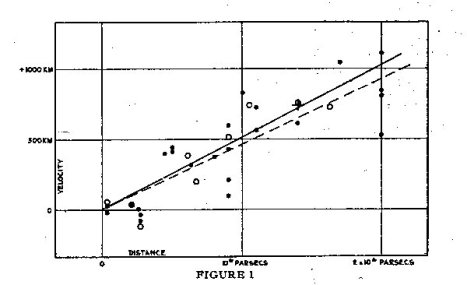
When Edwin Hubble first discovered that the Universe was expanding and all the galaxies (except those in our local cluster) were moving away from us, he found that distance was proportional to velocity. That is, those galaxies moving two times as fast from us as closer galaxies were twice as far away. If they were moving three times as fast, they were three times as far. This was all great – and correct – but there came a problem from this. And that problem can be seen in Hubble’s data.

Extrapolating from this data, the age of the Universe was about 1.7 or 1.8 billion years old. Whoops, right? Yes, but for an interesting reason. Hubble didn’t have a reliable light source to measure distance. He relied on the Doppler Effect to determine the speed at which the galaxies were moving, but he didn’t know how far they were in the first place. He had chosen a particular type of star for his measurements, but there were complications in knowing consistent luminosity due to the fact that the stars could be of different sizes. This video explains it all.

The point I want to make is that when Hubble’s calculations gave a wildly inaccurate age for the Universe – around the same time, we were coming to a conclusion as to the age of Earth at 4.6 billion years – it wasn’t based upon bad science. In fact, the scientific method worked wonderfully. The issue was with figuring out just what was needed to obtain more accurate observations. That is, the science was never weak – and, in fact, science never is weak – instead the problem was merely one of needing better evidence. Once we were able to find standard candles, we were able to better utilize Hubble’s observations. In essence, that is what science does. It relies upon interpreting observations according to a methodology; the reason why it changes is due to better observations, not a change in general methodology. Can religion say anything remotely similar?