PZ is wrong again

It was advertised earlier this week that South Park was going to feature an image of Mohammed. They, of course, never did because they prefer to entice their audience with lies, but I don’t think anyone familiar with the show really thought it was going to happen anyway. But it seems that PZ Myers might only be somewhat familiar with the series and so thought it would happen.

Are you ready for civilization to end? I guess the television show South Park is going to show a cartoon rendition of Mohammed tonight. I think the show has been steadily declining in quality, but I’ll tune it in one more time just to support the public desecration of the sacred.

Have they ever done a show where they lampoon juvenile libertarianism? I’d also tune in for that, but that probably hits a little too close to home for the creators.

Does anyone else see the glaring problem here? Does anyone recognize just how little sense this makes?! PZ called the vague ideology of the South Park creators “juvenile libertarianism”. That is completely inaccurate. Come on. Everyone knows libertarianism is infantile at best.

And even then, that’s being redundant.

PZ and Ebert are wrong

It’s fairly rare that I disagree with PZ Myers. He’s pretty spot on about a lot of things. Of course, that doesn’t mean I think everything he says is gold. But regardless, most anything he writes or says matches most anything I have said, will say, or at least think. Roger Ebert, on the other hand, likes a lot of crappy movies. For instance, Last Days was just an awful, awful, awful piece of garbage. But Ebert gave it a very high rating. Or take the horror-porn movie Saw:

That said, “Saw” is well made and acted, and does what it does about as well as it could be expected to.

The one point of Saw that really stood out to me – aside from the boredom it induced – was how poorly acted some of the scenes were. The scene where the doctor sawed through his foot? That was perhaps the worst individual acting moment for any major release that entire year.

But despite some errors of taste, I usually like Ebert. He hates creationism and all its science-hating silliness, and he recognizes the simple mindedness of the Republican party, so it’s tough to go against him sometimes. However, he has recently written a piece which is totally unacceptable. On this I am against Ebert.

Let me just say that no video gamer now living will survive long enough to experience the medium as an art form.

What stirs me to return to the subject? I was urged by a reader, Mark Johns, to consider a video of a TED talk given at USC by Kellee Santiago, a designer and producer of video games. I did so. I warmed to Santiago immediately. She is bright, confident, persuasive. But she is mistaken.

I generally stopped playing video games many years ago. It isn’t that I decided to go down that pretentious I’m-too-mature-for-this-stuff route. I actually played too much at times, getting far too worked up over unimportant issues (e.g., Halo 2 – not to mention the fact that the people running the game, Bungie, loved to let players boot each other for “betrayals” even when no such thing had occurred; it got too annoying sometimes). It was just time for me to take a break. I still play when the opportunity presents itself because I still find video games fun, and I might one day relatively soon invest in some system, but right now I have other interests.

That said, I never especially considered the art work of video games; it played no role in my decision to play and then subsequent decision not to play. However, it certainly isn’t hard for any experienced gamer to look back on his gaming history and recognize all the works of art he played. Ebert, of course, does not play video games. He has little idea what is in them, even in his article indicating the common belief that shooting games are all mindless. I think the most obvious counter to that is Fatal Frame. In that game the player didn’t shoot with a gun, but rather a camera. All the principles of shooting, improving accessories, upgrading equipment, etc were present; the difference was superficial – it was still a shooter. But it was more than that. The player had to figure out a number of puzzles, actually read (a ton of) clues, and really pay attention to the story. And unlike Saw, it was actually scary. (In fact, when has any horror movie ever been scary?)

But more to the point, it relied on some actual history to a small extent, it created its own intense world, and it offered designs which were absolutely beautiful, especially for its time period. It certainly was art.

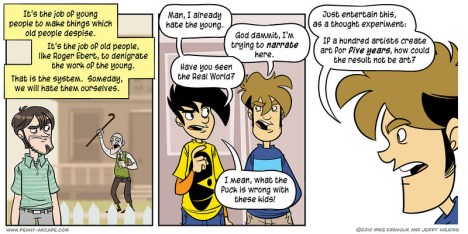
But Ebert isn’t the only one showing his age. PZ does the same with this quip.

Video games will become art when replaying the performance becomes something we find interesting, when the execution of those tools generates something splendid and lasting. It just doesn’t now, though.

These two guys clearly don’t know much about video games. Role playing games, or RPGs, are often defined by how much they can be replayed. I’ve played through Star Ocean: The Second Story more times than I can remember, logging several hundred hours. I’m sure Final Fantasy fans have done the same with their preferred series. Now with American-style, open-battle RPGs becoming more popular, more people are playing them, and they’re playing them again and again.

If you want to see something really boring, watch someone else playing a video game. Then imagine recording that game, and wanting to go back and watch the replay again sometime.

My grandmother used to love watching me play Super Mario Brothers at her house. And no, it was not a matter of her telling me something I wanted to hear. She would often encourage me to play even when I was already successfully occupying my time (e.g., not bugging anyone). And recording? Has PZ searched YouTube? People love to watch videos of what others have done. But more importantly than any of that is that the game itself is the art, not the act of playing the game. Think of going to an art gallery featuring, say, oil paintings. Just about everyone will agree that the place is filled with art, but no one is going to agree that watching people view all that art is itself art.

The problem in which PZ and Ebert find themselves is in defining art. Ebert, for example, cites Plato and his concerns over mimesis.

But is Plato’s any better? Does art grow better the more it imitates nature? My notion is that it grows better the more it improves or alters nature through an (sic) passage through what we might call the artist’s soul, or vision.

Plato’s definition of art sucks. He basically says mimesis, or the representation of some part of Nature as conveyed onto a canvas or likewise medium through the use of paints*, is bad because there is an ideal and then there are mere imitations. That is, there is an ideal concept of a table (or chair or TV or whatever). There can only be one ideal, but there can be many imitations. The first imitation is a table itself. This is once removed from the ideal (which, incidentally, comes from God for Plato). Then there is a painting of that imitation. Because this is twice removed from the ideal, it is of a lesser beauty – beauty is derived from ideals. All he’s saying is that nature is more beautiful than human imitations of it. Not such a grand point. And perhaps more importantly, he’s presuming the existence of God in his definition. Should there be no God – as Ebert believes – then there is no ideal concept. Without God, concepts can only be scaled subjectively.

I think a better definition of art comes from Morris Weitz. He points out that we cannot define art, but we can define aspects of it; we can see common themes. He cites Ludwig Wittgenstein who used the same point about games. There is no one thing which defines what a game is. A board? Dice? A goal? A winner? A loser? All these things are common and if one were to list out as many properties of games as possible there would be a lot of overlap. It is that overlap which helps us to recognize and define games. Weitz argues the same for art. Of course, this eventually runs into an infinite regress, but what doesn’t? And does that really matter if the definition is ultimately subjective anyway?

Using Weitz’s definition, I think video games share a number of properties with other forms of art, the already accepted forms. From here it becomes almost required that video games be defined as art because they have just too much overlap. Story lines overlap with what authors do all the time. Drawings overlap with painters. Cut scenes not only overlap with movie scenes, they virtually are movies.

In all these attempts to define art, however, the most important has been overlooked: the eye of the beholder. Art really does come down to the individual. A distinction should be made between a “work of art” and “artwork” so as to appreciate the difference between the artist and the observer, but when the normal connotations from “What is art?” are in use, the beholder is what matters. That is, a “work of art” should be viewed from the perspective of an artist; the effort, the labor, the love, the passion, the skills, etc, they all help to define something as art. But “artwork” is the product, the final presentation. This, given the very fact that there is presentation at all, places importance on the observer. This necessarily makes the definition of art subjective.

It’s difficult to see how someone can even begin to claim video games are not art – unless there is just a genuine disinterest in playing them in the first place, of course.

*This is verbatim from a past Philosophy of Aesthetics exam of mine, incidentally.

Update: But to be more concise, let us turn to Penny Arcade.
Jesus cheated

Another problem: Jesus cheats. We’re supposed to believe that he’s saving us from an imaginary ancestral sin, and that he’s doing so by dying…but he doesn’t! He comes back three days (OK, actually a day and a half) later, perfectly healthy except for a few holes which don’t seem to perturb him much, and he gets to magically zoom up into the sky and live forever in his dad’s palace. This is no sacrifice at all.

Now, if our hypothetical soldier who threw himself on a grenade turned out to survive the experience hale and healthy because, for instance, the bomb was dud, he’d still be a hero — he didn’t know it would fizzle, and the intent was there. This doesn’t help Jesus, though. He’s omnipotent and omniscient and knew his own nature, and knew that you don’t kill a god by hanging him from a tree and poking him with sticks. Jesus faked his heroism. He’s no hero at all.

Via PZ

The religion prize

PZ Myers complained last week over the London Times calling the Templeton Prize a prize for “scientific thought”.

Say what? There’s no amount of science you can do that will win you a Templeton prize. It’s a prize for religious apologetics, nothing more.

That’s pretty accurate, so maybe this Yahoo! article can do some soothing…

A one-time priest who later became an evolutionary geneticist and molecular biologist and helped scientifically refute creationism with his research was honored Thursday with one of the world’s top religion prizes.

Of course, it would be better if all that money was just given out as research grants.

Where are these boundaries anyway?

Believers are often railing that atheism, and especially Richard Dawkins, goes beyond the bounds of science in its claims. What is never actually articulated is how. How does atheism go beyond these bounds?

But that other comment about going “beyond the boundaries of science” is a curious one. Where? I think that when you invoke an invisible, undetectable ghost in the sky who diddles quanta or turns into a man who raises the dead, then you are going beyond the boundaries of science. When someone points out that there is no evidence of such activities, that the claims of supernaturalists are contradictory and unreasonable, or explains that the material claims of priests are fair game for critical examination, they are actually operating entirely within the domain of science.

Atheism is not science, but as I’ve said in the past, it reflects the essence of science.

Acceptance without proof is the fundamental characteristic of Western religion. Rejection without proof is the fundamental characteristic of Western science. ~Gary Zukav

While Zukav is otherwise uninteresting, his quote is concise and spot on. The onus is on the positive claimant to show his evidence. This is why the common comparison of God and gods to gnomes and unicorns is so apt; atheism is a rejection of certain claims which have no proof.

Of course, an absence of evidence is not evidence of absence. But an absence of what should be present is evidence of absence. This is just common sense we use all the time; if a prosecutor claims John shot his friend but there is no bullet hole in the friend and there hasn’t been time for anything to heal, then that is evidence that John never did shoot his friend. Faith, the basis for all religious belief, is not good enough here. It’s laughable.

To put it another way,

If Susie tells us she stopped a train in its tracks a la Superman, we would rightfully demand some real evidence of this (assuming we didn’t outright reject her claim as obviously false). We would even call Susie’s claim impossible. But that isn’t to actually say it is impossible. In theory, at least, it could have happened. All the atoms which made up the train could have spontaneously disassembled in a manner consistent with how they would have been altered had Superman actually been standing in front of the train. Of course, there is a huge difference between something being possible and something being plausible. This scenario fits the former while falling far short of the latter.

Atheism is much the same.

Atheism does not violate any boundaries of science (though it is not required to fall within a scientific purview to be true); instead it is a reflection of science. It is not built upon superstition or faith or unevidenced claims. Atheism is a rational view of reality which does not overstep anything. In fact, it embraces particular bounds – the bounds of human knowledge. “There probably is no God” perfectly reflects current human knowledge because, to date, there is no evidence for any gods. None. Let that sink in. It isn’t that the evidence is disparate, poorly argued or presented, poorly collected or organized…no. No, it’s that there is no evidence for any supernatural being. It cannot, with any respect for reason, be asserted that atheism is the boundary-stomping culprit here. Atheism is a standing demand for evidence as a result of a standing lack of reason, rationality, knowledge, and, well, evidence.

Quote of the day

From PZ’s Andreas Moritz is a cancer quack post.

Lol …..

@ PZ Myers!

Who really the quack after all.

Im or you.

Sorry, Mr. Jefferson

Sorry, Mr. Jefferson, it is now a terrible idea to go to school in Virginia.

Attorney General Ken Cuccinelli says Virginia’s colleges and universities cannot prohibit discrimination against gays because the General Assembly has not authorized them to do so.

In a letter Thursday to the presidents, rectors and boards of visitors of Virginia public colleges, Cuccinelli said: the law and public policy of Virginia “prohibit a college or university from including ‘sexual orientation’, ‘gender identity’, ‘gender expression’ or like classification, as a protected class within its non-discrimination policy, absent specific authorization from the General Assembly.“

Most places of higher education have the reasonable policy of not allowing discrimination on the basis of sexual orientation. It just isn’t relevant to the quality of work one can produce. And fortunately for much of the country, places of higher education do not include many in the general population who tend to be bigoted towards gays (i.e., old people who never needed to go to school to get decent jobs, the religious who are hostile toward secular education [such as facts], dumb people, etc). And some states even have laws banning discrimination based upon sexual orientation. In fact, despite my home state recently voting in favor of bigotry – and for no reason other than “ewwww!!!!” – there is a law on the books (after many tries) which bans sexual orientation discrimination in Maine. But this is New England, the place where fewer people tend to think their sexual orientation is superior to that of others.

Jon Blair, chief executive officer of Equality Virginia, criticized Cuccinelli’s opinion.

“Attorney General Cuccinelli clearly doesn’t understand that his radical actions are putting Virginia at risk of losing both top students and faculty, and discouraging prospective ones from coming here,“ he said.

That’s unfortunate for education in Virginia, but I hope it happens. Cuccinelli is another conservative out to ruin the liberty and rights of individuals for no good reason. Anyone considering school in Virginia should only do so once this issue is resolved in favor of equality.

Oh, and this.

In his first weeks as the state’s top lawyer, Cuccinelli has not tried to hide his conservative political philosophy.

He filed petitions seeking to block a decision by the Environmental Protection Agency that global warming poses a threat to people.

There’s some underlying horror that seems to cause certain people to go off the deep end, embrace crazy ideas, and reject all that is real.

The lies of Maloney

Christopher Maloney has been going around the Internet trying to defend himself, often at hostile sites (i.e., places where science is discussed and woo is not tolerated). He is generally getting thrashed wherever his ugly little head of woo pops up. While that’s been entertaining, there are still places where he isn’t always challenged, often due to low traffic or people just being tired of his antics. One of the points I’ve only seen challenged once (and I forget where) is this one:

Please check the PZ Myer website for complete information. For those who haven’t caught up, PZ Myers has already rescinded his previous posting about me.

Of course, this isn’t really true, and what part of it is true isn’t true in the way Maloney wants people to think. Specifically, he’s referring to this post. PZ points out Maloney’s claim that he never contacted WordPress directly. That’s probably true. But what isn’t true is that Maloney is innocent in the whole affair. As PZ says,

Note the comment from Mark at WordPress, “We were sent”. Someone targeted Hawkins, and sent a demand to WordPress to shut him down. This is someone in communication with Maloney, because Maloney just sent me this email:

The email in question can be seen at the above link. It shows that Maloney was in contact with Andreas Moritz and knew what was going on. His responsibility is not lifted simply because he doesn’t show the same quacking initiative as Moritz to actually send an email.

But more important here is the fact that Maloney is going around saying PZ simply rescinded his post. In this instance he said it in response to a YouTube video of him quacking. (Did Moritz send YouTube a letter threatening a lawsuit for him?) It’s obvious he wants people to think PZ does not believe him to be a quack or that PZ’s opinion of him is somehow not horribly negative; he wants to give the impression that he made an intelligent person run off, tail between his legs. Of course, that isn’t the case. Everyone, especially PZ, knows Maloney is still a quack. What’s more, everyone is able to see that Maloney has always been involved. His hands are not clean, he is a quack, and best of all, he has made things far worse for himself because any Internet search of his name will inevitably turn up results for his quackery.

A HUGE thank you to PZ

I thought the big story of the day for me was the fact that my main blog, For the Sake of Science, was inappropriately shut down. As it turns out, there’s even bigger (and far better) news.

There’s another way you can tell [Christopher Maloney’s] a quack. When a student, Michael Hawkins, dared to criticize him, pointing out that “Naturopathic medicine is pure bull” and stating that naturopaths are underqualified and do not deserve the title of “doctor,” Maloney took action to silence him. After all, we can’t have people questioning quacks — that just makes them look even more ridiculous, which could lead to a loss of business.

So Maloney complained to WordPress, where Hawkins blog was located, and got them to shut it down. This does not speak well of craven WordPress; if you’re using WordPress hosting, you might want to reconsider it and move elsewhere. You know, to someplace that respects reality.

Now, given what has transpired so far with WordPress, I’m unfortunately timid. Believe me, once this blog moves to a more suitable location, words of loathing will fly. But until then, I feel horribly restricted. Therefore, it is probably necessary to point out that I am quoting someone. I did not just say those things about Christopher Maloney.

But really. This pinch on my free speech cannot stand for much longer.

Is Scienceblogs going to shutdown PZ?

Will Scienceblogs.com follow in the brilliant footsteps of WordPress.com? When non-doctor doctor Christopher Maloney whined when I called him not a doctor on FTSOS, WordPress shut me down for two days without an explanation (shoot first, ask questions later!). So I wonder if Scienceblogs will do the same thing to PZ Myers?

A doctor in Texas was peddling herbal crap on the side, got reported, and retaliated by charging the whistleblowers with a crime. Oh, well…at least we can console ourselves with the idea that he wasn’t really a doctor, but just a fraud with an M.D.

Whoa, whoa, whoa! He can’t say that a doctor isn’t really a doctor! That’s libel!

Wait.

Wait.

That’s right. It would be moronic to think it was libel. More importantly, PZ noted the guy had a degree and was credentialed under state law, but that that’s irrelevant to a good definition of what a doctor is. It’s almost like I can read basic English! So,

Dear WordPress and non-doctor doctor Christopher Maloney,

If you would like a detailed explanation of how to analyze PZ’s post, please leave a comment below. If you would like a bonus explanation of how this relates to what I said, I will be glad to help you out.

Also, Chris, please stop “treating” patients.

~Yours,
English departments and scientists everywhere