Jack Hudson is a moron, part 2

After rambling on with a number of lies and a little incoherency, one might imagine Jack Hudson couldn’t get worse. Don’t worry. There’s always art.

(Not only is Religion not Dangerous) But it appears to have given us art.

Please excuse the randomly capitalized words. Inside the parentheses is the title of the post (despite “only” being written inappropriately).

Jack is attempting to make a correlation and call it a causation here, nothing more. But let’s continue.

But we already knew that didn’t? After all, the vast majority of art, music, writing, and much architecture in human history appear to be motivated by some sort of spiritual beliefs.

Lol? Yes, lol.

1) “Spiritual beliefs” do not equal religious beliefs.
2) That something can be motivated by a type of belief is not evidence that that something originated in a type of belief. In other words, just because there is religious art, music, writing, and architecture does not mean that religion is somehow the creator of these things. Indeed, all of these things are actually what help to create religion. They are means of communication and expression which promote ideas that then morph and evolve into more and more complex things. Jack’s analysis is fairly immature.

The article on Science Daily discusses how the origin of art and religious beliefs are linked though – and how we had to overcome wrongheaded ideas about evolution to realize it.

The article in question actually says nothing about evolution. The original paper (to which Jack does not link), however, mentions ideas about social evolution. It quotes the beliefs surrounding early man – from 1865; it also quotes socially-based racist beliefs surrounding man from the same time. In fact, the paper then goes on to note that many of the beliefs that early man had no religion came largely from political considerations, not any actual evidence. None of the ideas expressed were ever really part of evolutionary theory, and they certainly are not part of it today.

The reality is that humans are spiritual creatures – we are in fact the only organisms which exhibit spirituality. Divest us of this spiritual reality, and we lose all that that it produces, and which makes us unique as humans – art, music, philosophy, systems of morality and law.

Jack has no idea what makes human unique.

1) Evidence exists which shows that Neanderthals also had art. Were they also spiritual? Does that put them on an even playing field with humans?
2) There is no evidence that spirituality – a nebulous term Jack has not bothered to define – gives us art or anything else.
3) No evidence has been offered which actually shows causation. Major fail. Move along.

Jack Hudson is a moron, part 1

In all likelihood, Jack Hudson still reads this blog. As regular readers will know, he left in a huff when I exposed the ‘anonymous’ phone calls he or one of his friends had been making to a family member of mine. Of course, I went out of my way to point out that the best evidence was track phone numbers which originated from his home state, but he’s likely one of the most deluded, arrogant individuals I’ve encountered so that fell on deaf ears since he didn’t want to hear it. My relative then berated him for the sake of causing anger, pulling out a number of insults which any rational person would have seen as zingers that should have little consequence beyond a small blog in the corner of the Internet. Then after all that, Jack blamed me for what someone else said (sharing 1/4 of my genes with someone makes me guilty, I guess?), defriended me on Facebook a la John Lott style, and stormed off the set.

But he still probably reads this blog.

He has this post about a case of bigotry in Sonoma County in California, likely having taken the news from FTSOS; the main ways of finding the story were via a short post from PZ or by being someone who specifically searches gay and lesbian sites for news. And since most of Jack’s posts relating to PZ only pop up after I post about them, it’s hard to believe he doesn’t still peruse FTSOS. And that’s fine. I glance at some of his posts. I’ve even tried leaving a couple comments, but alas, he has already gone out of his way to block my IP. Some people just can’t take it. (Even those who can beat people up real bad!)

But enough qualification, let’s get to the post in question (which is about two elderly gay men who were forcefully separated by Sonoma County).

So the story came out, was gobbled up (though not digested) – and of course no follow-up will happen, because these folks aren’t interested in facts which might muddle up their epistemic closure on all things homosexual.

Of course there will be follow-up. If the result is in favor of the elderly gay man who is still living (despite having all his property stolen), then that’s good news for gay rights. If the result is against the elderly gay man, it’s an unfortunate blow which serves roughly the same political purpose as the initial story.

At the outset its important to note the events themselves take place in Sonoma County, California. This is important because we aren’t talking about some back-woods, redneck, right-wing enclave that systematically oppresses anyone who isn’t a white heterosexual – this is perhaps one of the most gay-friendly places on earth. It is also one of the most ‘progressive’ parts of the country; so there is little indication that politics ordered the set of events detailed in this story.

Here Jack wants a strawman. No one said there was some deep political current. Those in charge separated the two because the couple could not get married. Nothing beyond that matters.

It also went without note the reasoning the county gave for acting as it did with the two men…In this case of course, the left-wingers weren’t interested in the whole story, because another set of facts might threaten the usefulness of the story they had concocted

(The ellipsis is for some meaningless, irrelevant excerpt from the Bible.)

One of the first sites to break the story actually linked to the .pdf of the lawsuit which included that claim.

No one is saying supposed accounts of abuse are unimportant, but the county did not charge anyone. No convictions were made. The county had no right to dissolve all the legal arrangements the two had set up. They did it with no authority, and in fact, they repeatedly claimed both men were suffering from dementia. Isn’t it just convenient that both men were suffering from severe mental impairment, yet the county was still able to selectively believe certain claims? And how can anyone believe these people? The man who is still living, Clay, is not actually suffering from anything (other than the torment of having not seen the final days of his partner’s life). He is actually free from the abuse he actually suffered at his prison nursing home.

And what is even more ironic is what is really bothersome in this case is the wanton disregard the county showed for property rights. The fact that they felt they could imprison an individual and then confiscate his property to pay for his incarceration, even if they felt it was for his own health, is outrageous – but it is outrageous for conservative reasons, not progressive reasons. In this situation the bureaucrats were acting exactly as progressives want the state to act; to be indifferent to our property, to act in what they deem is our best interest, and to intrude into what should be personal and individual financial issues.

Going off the looney deep-end with a non-sequitur much? If the couple was married, the county would not have been able to steal property. End of story.

Hey, I’m from Maine

And I’m awesome.

PZ is wrong again

It was advertised earlier this week that South Park was going to feature an image of Mohammed. They, of course, never did because they prefer to entice their audience with lies, but I don’t think anyone familiar with the show really thought it was going to happen anyway. But it seems that PZ Myers might only be somewhat familiar with the series and so thought it would happen.

Are you ready for civilization to end? I guess the television show South Park is going to show a cartoon rendition of Mohammed tonight. I think the show has been steadily declining in quality, but I’ll tune it in one more time just to support the public desecration of the sacred.

Have they ever done a show where they lampoon juvenile libertarianism? I’d also tune in for that, but that probably hits a little too close to home for the creators.

Does anyone else see the glaring problem here? Does anyone recognize just how little sense this makes?! PZ called the vague ideology of the South Park creators “juvenile libertarianism”. That is completely inaccurate. Come on. Everyone knows libertarianism is infantile at best.

And even then, that’s being redundant.

20 year Hubble anniversary

My favorite thing about showing up 3rd for searches of “Hubble” in Google image is that whenever Hubble is in the news, I know it pretty quickly thanks to the sharp increase in hits. (Right now the third result is some website that has swiped my Hubble image, but it still links back to FTSOS.) For instance, tomorrow is the 20th anniversary of the launch of Hubble.

The universe was a different-looking place 20 years ago. The most powerful optical telescopes on Earth could see only halfway across the cosmos. Estimates for the age of the universe disagreed by a big margin. Supermassive black holes were only suspected to be the powerhouses behind a rare zoo of energetic phenomena seen at great distances. Einstein’s cosmological constant, a hypothesized repulsive property of space, was merely a skeleton in the astrophysics closet.

But astronomy was kicked-started into fast-forward on April 24th, 1990 when NASA’s Hubble Space Telescope left the blurry skies of Earth for the stars. Tucked away inside the space shuttle Discovery’s cargo bay, the telescope was set free into low earth orbit on April 25th.

Of course, this naturally means eye candy on FTSOS.

Hear ye, hear ye!

The April-May edition of Without Apology is out. This is likely the last edition I do for quite some time as I will be busy this summer (not to mention the cost, plus the reduced audience given the end of the spring semester).

The articles in this edition of Without Apology are more varied than usual. From issues in the NFL to a revisiting of T’s Golf to gene therapy for mouse vision, the range is wider.

Perhaps the best article, however, is the one by Gabriel Levesque. Also known as Mr. Jay Gatsby, Gabe has written about bastardizing history.

History is too often called upon to support presentist ideological and political themes. Politicians and radio personalities use historical figures to suggest their ideas are correct and in accordance with some great historical figure. Polarizing images and comparisons with Lincoln, for example, dominated Obama’s campaign and the first year of his presidency. Obama’s political adversaries countered by comparing his policies with Soviet Russia and Joseph Stalin. This is a practice that is unfair and all too common…

Thanks to Gabe for his contribution. Physical copies of the paper were placed around UMA, but it looks like they went quickly. A second batch will show up around campus sometime soon.

PZ and Ebert are wrong

It’s fairly rare that I disagree with PZ Myers. He’s pretty spot on about a lot of things. Of course, that doesn’t mean I think everything he says is gold. But regardless, most anything he writes or says matches most anything I have said, will say, or at least think. Roger Ebert, on the other hand, likes a lot of crappy movies. For instance, Last Days was just an awful, awful, awful piece of garbage. But Ebert gave it a very high rating. Or take the horror-porn movie Saw:

That said, “Saw” is well made and acted, and does what it does about as well as it could be expected to.

The one point of Saw that really stood out to me – aside from the boredom it induced – was how poorly acted some of the scenes were. The scene where the doctor sawed through his foot? That was perhaps the worst individual acting moment for any major release that entire year.

But despite some errors of taste, I usually like Ebert. He hates creationism and all its science-hating silliness, and he recognizes the simple mindedness of the Republican party, so it’s tough to go against him sometimes. However, he has recently written a piece which is totally unacceptable. On this I am against Ebert.

Let me just say that no video gamer now living will survive long enough to experience the medium as an art form.

What stirs me to return to the subject? I was urged by a reader, Mark Johns, to consider a video of a TED talk given at USC by Kellee Santiago, a designer and producer of video games. I did so. I warmed to Santiago immediately. She is bright, confident, persuasive. But she is mistaken.

I generally stopped playing video games many years ago. It isn’t that I decided to go down that pretentious I’m-too-mature-for-this-stuff route. I actually played too much at times, getting far too worked up over unimportant issues (e.g., Halo 2 – not to mention the fact that the people running the game, Bungie, loved to let players boot each other for “betrayals” even when no such thing had occurred; it got too annoying sometimes). It was just time for me to take a break. I still play when the opportunity presents itself because I still find video games fun, and I might one day relatively soon invest in some system, but right now I have other interests.

That said, I never especially considered the art work of video games; it played no role in my decision to play and then subsequent decision not to play. However, it certainly isn’t hard for any experienced gamer to look back on his gaming history and recognize all the works of art he played. Ebert, of course, does not play video games. He has little idea what is in them, even in his article indicating the common belief that shooting games are all mindless. I think the most obvious counter to that is Fatal Frame. In that game the player didn’t shoot with a gun, but rather a camera. All the principles of shooting, improving accessories, upgrading equipment, etc were present; the difference was superficial – it was still a shooter. But it was more than that. The player had to figure out a number of puzzles, actually read (a ton of) clues, and really pay attention to the story. And unlike Saw, it was actually scary. (In fact, when has any horror movie ever been scary?)

But more to the point, it relied on some actual history to a small extent, it created its own intense world, and it offered designs which were absolutely beautiful, especially for its time period. It certainly was art.

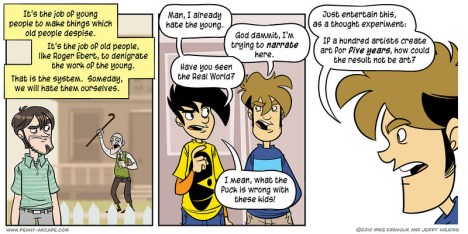
But Ebert isn’t the only one showing his age. PZ does the same with this quip.

Video games will become art when replaying the performance becomes something we find interesting, when the execution of those tools generates something splendid and lasting. It just doesn’t now, though.

These two guys clearly don’t know much about video games. Role playing games, or RPGs, are often defined by how much they can be replayed. I’ve played through Star Ocean: The Second Story more times than I can remember, logging several hundred hours. I’m sure Final Fantasy fans have done the same with their preferred series. Now with American-style, open-battle RPGs becoming more popular, more people are playing them, and they’re playing them again and again.

If you want to see something really boring, watch someone else playing a video game. Then imagine recording that game, and wanting to go back and watch the replay again sometime.

My grandmother used to love watching me play Super Mario Brothers at her house. And no, it was not a matter of her telling me something I wanted to hear. She would often encourage me to play even when I was already successfully occupying my time (e.g., not bugging anyone). And recording? Has PZ searched YouTube? People love to watch videos of what others have done. But more importantly than any of that is that the game itself is the art, not the act of playing the game. Think of going to an art gallery featuring, say, oil paintings. Just about everyone will agree that the place is filled with art, but no one is going to agree that watching people view all that art is itself art.

The problem in which PZ and Ebert find themselves is in defining art. Ebert, for example, cites Plato and his concerns over mimesis.

But is Plato’s any better? Does art grow better the more it imitates nature? My notion is that it grows better the more it improves or alters nature through an (sic) passage through what we might call the artist’s soul, or vision.

Plato’s definition of art sucks. He basically says mimesis, or the representation of some part of Nature as conveyed onto a canvas or likewise medium through the use of paints*, is bad because there is an ideal and then there are mere imitations. That is, there is an ideal concept of a table (or chair or TV or whatever). There can only be one ideal, but there can be many imitations. The first imitation is a table itself. This is once removed from the ideal (which, incidentally, comes from God for Plato). Then there is a painting of that imitation. Because this is twice removed from the ideal, it is of a lesser beauty – beauty is derived from ideals. All he’s saying is that nature is more beautiful than human imitations of it. Not such a grand point. And perhaps more importantly, he’s presuming the existence of God in his definition. Should there be no God – as Ebert believes – then there is no ideal concept. Without God, concepts can only be scaled subjectively.

I think a better definition of art comes from Morris Weitz. He points out that we cannot define art, but we can define aspects of it; we can see common themes. He cites Ludwig Wittgenstein who used the same point about games. There is no one thing which defines what a game is. A board? Dice? A goal? A winner? A loser? All these things are common and if one were to list out as many properties of games as possible there would be a lot of overlap. It is that overlap which helps us to recognize and define games. Weitz argues the same for art. Of course, this eventually runs into an infinite regress, but what doesn’t? And does that really matter if the definition is ultimately subjective anyway?

Using Weitz’s definition, I think video games share a number of properties with other forms of art, the already accepted forms. From here it becomes almost required that video games be defined as art because they have just too much overlap. Story lines overlap with what authors do all the time. Drawings overlap with painters. Cut scenes not only overlap with movie scenes, they virtually are movies.

In all these attempts to define art, however, the most important has been overlooked: the eye of the beholder. Art really does come down to the individual. A distinction should be made between a “work of art” and “artwork” so as to appreciate the difference between the artist and the observer, but when the normal connotations from “What is art?” are in use, the beholder is what matters. That is, a “work of art” should be viewed from the perspective of an artist; the effort, the labor, the love, the passion, the skills, etc, they all help to define something as art. But “artwork” is the product, the final presentation. This, given the very fact that there is presentation at all, places importance on the observer. This necessarily makes the definition of art subjective.

It’s difficult to see how someone can even begin to claim video games are not art – unless there is just a genuine disinterest in playing them in the first place, of course.

*This is verbatim from a past Philosophy of Aesthetics exam of mine, incidentally.

Update: But to be more concise, let us turn to Penny Arcade.
First ever evidence of a god discovered

Thought of the day

If you are against same-sex marriage, you are a bigot. Fuck you.

Lawrence Stowe is a horrible human being

I hate snake oil salesman. I hate them with an ever growing passion. They take advantage of innocent, sick people for nothing more than money. They make the world a worse place and ought to be jailed. Lawrence Stowe is one of the worst.

Con men used to travel town to town hawking medical remedies said to be made of Chinese snakes. Snake oil was useless and dangerous. So the FDA was created to put a stop to it and other food and drug scams.

But, today, quack medicine has never been bigger. In the 21st century, snake oil has been replaced by bogus therapies using stem cells. Stem cells may offer cures one day, but medical charlatans on the Internet are making outrageous claims that they can reverse the incurable, from autism to multiple sclerosis to every kind of cancer.

Desperate people are being bilked out of their life’s savings.

We’ve been looking into this surging crime and we found there is no better window on how it works than the practice of a man who calls himself “doctor,” a man named Lawrence Stowe.

Stowe has been unaware that, lately, some of his patients have been working with 60 Minutes.

I wish 60 Minutes could look into every quack out there, but there are just so many.

Stowe told our MS patient that he can reverse her disease with his program of herbs and vitamins to boost the immune system, custom vaccines and stem cell injections. Medical experts say it’s nonsense but it’s the same pitch that we secretly recorded again and again as Stowe claimed to reverse cancer, ALS, MS, Parkinson’s disease and more.

Honestly. I cannot understand how these people live with themselves. Stowe charges exorbitant sums of money so he can insert IVs into people in some dank, run-down building in Mexico. One family sold their home to pay for Stowe’s bogus treatments. Others have paid tens of thousands of dollars of their savings with no results. This guy is a piece of work.

Everyone who reads FTSOS knows I rag on Andreas Moritz over and over. A very small part of the reason is that he’s just too dumb to stop showing up on my radar, but far, far, far more important than that is the fact that I view him as legitimately dangerous. I’ve managed to divert a few specific individuals from his potential harm (and I will not mention any specifics because I do not want Moritz contacting and conning them), but I suppose I can at least give him credit for not charging massive sums of money for his ‘services’; his style is to play small ball and take small amounts of money from desperate people. And even though that’s just one of a depressing number of horrible traits that man holds, he’s nothing compared to Lawrence Stowe; there is no comparing the two. Stowe is in a league all his own: if Moritz is Mario Mendoza, Stowe is Babe Ruth. (I would say Ted Williams but it would pain me a little too much as a Red Sox fan.)

Watch these two videos. Every person needs to be aware of the scams that are out there.

Lawrence Stowe is a scumbag part 1.

Lawrence Stowe is a scumbag part 2.